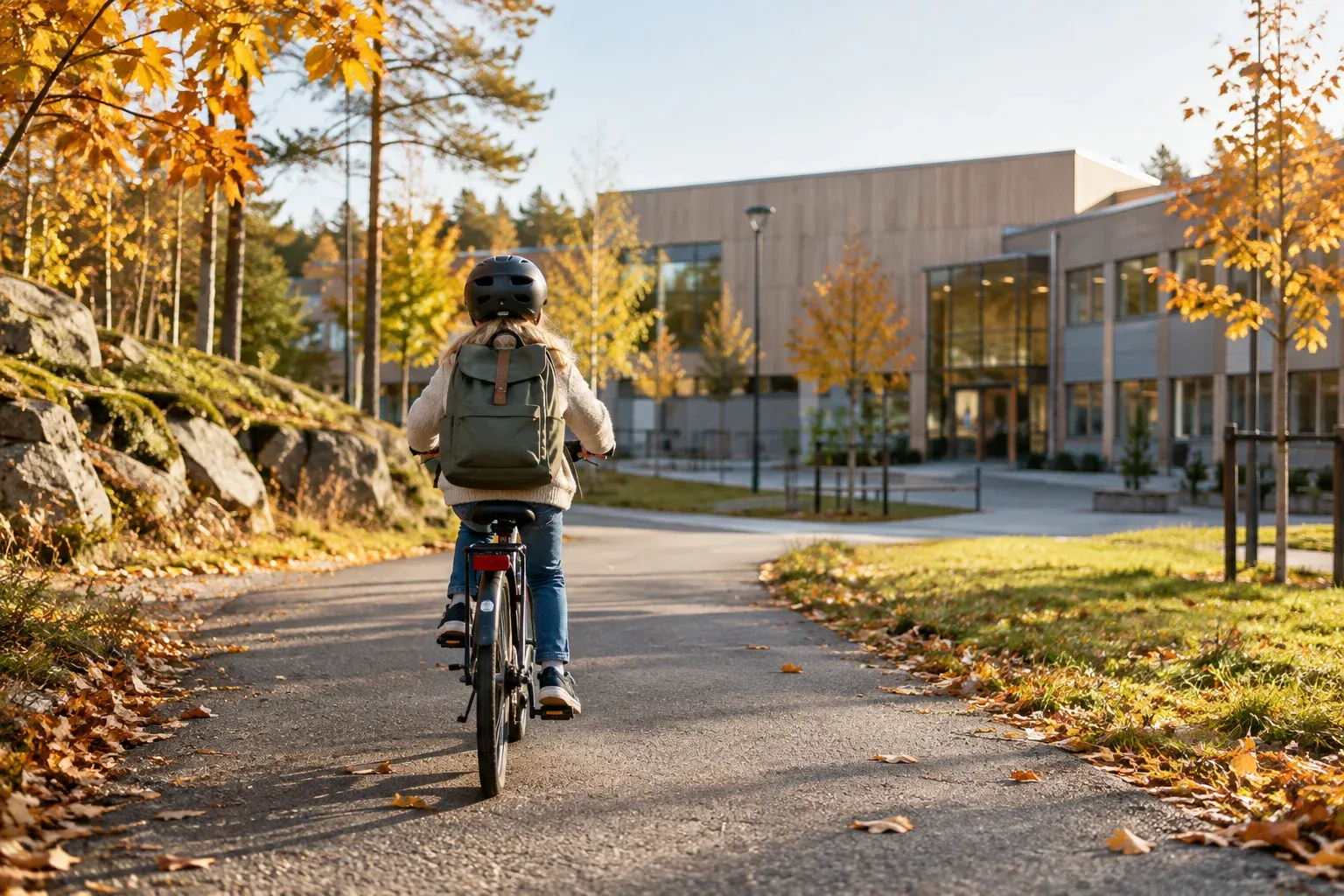
An eight-year-old alone on the Stockholm metro is not a sign of neglect. Here is why Swedish children get around on their own, which age rules actually exist, what has changed in 2026, and how to judge whether your own child is ready.
When you need this
You saw a small child alone on a bus, a train or a bike and wondered whether that is even legal. You are moving to Sweden and your child’s new classmates walk or cycle to school without an adult. Your child wants to try the metro alone while you are on holiday. Or a Swedish school or after-school club asks how your child will get home, and you are not sure what answer is expected.
What visitors notice
The scenes are ordinary in Sweden: eight-year-olds on the metro with a school bag, ten-year-olds cycling to football practice, groups of children walking home in the afternoon dark. Swedish parents are not careless. The country is built so that children can manage short trips on their own, and the law leaves the judgement to the parent rather than setting a number.
What the law says, and what it doesn’t
Swedish law deliberately avoids fixed ages. The Children and Parents Code (föräldrabalken) makes the guardian responsible for giving the child the supervision (tillsyn) it needs with regard to its age, development and other circumstances. The same section says the guardian must see that the child is supervised, or that other suitable measures are taken, to stop the child harming others.
Nothing in that code or in the traffic ordinance sets an age for being home alone, walking, cycling or riding public transport alone. That cuts both ways. There is no age limit you can break by letting a confident nine-year-old take the bus. But there is also no age that makes it automatically fine. A child left alone too young or too long can become a matter for social services, because teachers, health staff and other professionals must report concern that a child is being harmed. The full picture of that system is in children’s rights in Sweden.
The age rules that do exist
A handful of hard numbers apply, and visitors often get them wrong:
| Age | Rule | What kind of rule |
|---|---|---|
| Under 6 | May not travel alone on SL (Stockholm) or Västtrafik (Gothenburg) | Operator rule |
| Under 7 | Free on SL and Västtrafik, but only with a paying passenger | Operator rule |
| Up to the year they turn 8 | May cycle on the pavement where there is no cycle path | Law |
| From 6 | May travel alone on Västtrafik with their own youth ticket | Operator rule |
| Under 15 | Must wear a helmet on a two-wheeled bicycle, including a rental e-scooter | Law |
| Under 18 | Not allowed on rental e-scooters by the big apps, although Sweden has no legal age limit | Company terms |
Beyond these, the ages you hear quoted are rules of thumb. The national road-safety organization NTF suggests that children can walk to school alone in moderate traffic at around 9 to 10, and cycle in traffic at around 11 to 12. It also says younger children can cycle to school alone on safe, connected cycle paths. These are expert guidance, not law. For the full cycling rulebook, see cycling in Sweden; for e-scooters, see e-scooters and city bikes.
Why children’s traffic skills have limits
NTF is blunt about why age matters. Most children under 12 lack the skills for complex traffic. They cannot judge the speed and distance of cars the way adults can, and full side vision only develops around 15 to 16. That is why Swedish families build up gradually: walking a familiar route first, cycling on separate paths before mixed traffic. The pedestrian rules guide covers what children need to know at crossings.
The systems behind the norm
Independence in Sweden is not only a parenting style. Three school rules make it practical:
- Schools near home. Pupils go to the school their guardians choose, unless that would override another pupil’s justified claim to a school near home. The result is that most children have a school within reach.
- Free school transport (skolskjuts). Pupils in municipal compulsory school have the right to free transport where distance, traffic conditions, disability or another special circumstance make it necessary. It does not apply if the family chose a different school than the one the municipality would have placed the child in. Many pupils get a school travel card (skolkort) for ordinary buses.
- After-school care ends early. After-school care (fritidshem, usually fritids) must be offered until the spring term of the year the child turns 13, and from the autumn of the year the child turns 10, the municipality may offer open drop-in activities instead. So many children from about ten make their own way home.
Families moving to Sweden will find placement, school transport and fritids explained in Swedish schools for newcomers and fritids: after-school care.
Public transport built for children
Stockholm’s transport operator SL counts everyone under 18 as a child and writes it into its staff handbook. Its guidance to staff says starting to travel alone on SL is a big step for a child, that children prefer to ask staff rather than other passengers, and that staff should answer them plainly. Most importantly, no child should be left in an exposed situation, such as a deserted bus stop or the metro, without money or a way to call a parent. Children without a valid ticket may be allowed to travel free for that reason.
That is a safety net, not a fare policy. A child traveling alone needs their own ticket: SL and Västtrafik both bar children under 6 from traveling alone, free travel for under-7s applies only with a paying passenger, and on Västtrafik a child from 6 travels alone with a youth ticket. Ticket types and how to buy them are in Stockholm public transport. Operators in other regions set their own rules, so check the local one before relying on these.
How Sweden compares, and the decline
Sweden is high on independence, but not at the top. In a survey of 18,303 children aged 7 to 15 in 16 countries, run in 2010–2012 by the Policy Studies Institute, Sweden ranked fourth for children’s independent mobility:
| Rank | Country |
|---|---|
| 1 | Finland |
| 2 | Germany |
| 3 | Norway |
| 4 | Sweden |
Sweden was one of only four countries, with Finland, Japan and Denmark, where most children were allowed out alone after dark. That matters in a country where it is dark before school ends in December.
The trend is downward. Trafikverket, the Swedish Transport Administration, says children’s school trips by bike have fallen by 48% since the 1980s and 1990s. It now backs a proposed national recommendation that children walk or cycle to school all year, all or part of the way, from the preschool class. The idea that every Swedish child walks to school alone is therefore partly a memory. The norm is real, but the country is working to keep it.
What changed in 2026
Good to know: older guides may still describe the previous rules. Since 1 August 2026, pupils’ phones are collected at the start of the school day and handed back at the end, in compulsory school, after-school care and open after-school activities.
A head teacher or teacher can make exceptions for teaching use or for an individual pupil with special reasons. For parents, the practical effect is that a child cannot text you during the school day. Pick-up arrangements have to be agreed in the morning, or go through the school office.
If your child wants to try
Local children have usually practiced the same route with a parent for months. Copy the method, not just the result:
- Practice the route together first, then walk behind, then let the child go alone.
- Start with walking, then cycling. Use separate cycle paths before mixed traffic.
- Load a ticket on the child’s own card or phone, so they never depend on the staff safety net.
- Write your phone number down, not only in the phone.
- Teach your child to ask staff, not strangers.
- Add reflectors and a bike light for the winter dark.
A child who is new to Swedish, the route or the ticket system is not in the same position as a local classmate. “Swedish kids do it” is not a reason on its own.
Practical information
| Item | What to know | Checked |
|---|---|---|
| Legal age to travel or be home alone | None; the supervision duty applies | 2026-10-14 |
| Children traveling alone on SL and Västtrafik | From 6, with their own reduced (youth) ticket; check the operator’s current price | 2026-10-14 |
| Children under 7 on SL and Västtrafik | Free with a paying passenger | 2026-10-14 |
| Bike helmet | Required under 15 | 2026-10-14 |
| School transport (when the right applies) | Free by statute | 2026-10-14 |
| After-school care (fritidshem) | Fees set by each municipality | 2026-10-14 |
| Phones at school | Collected during the school day since 1 August 2026 | 2026-10-14 |
FAQ
At what age can a child travel alone in Sweden?
Swedish law sets no age. Parents must give the supervision a child needs given age and development, and decide from there. Transport operators add their own rules: SL in Stockholm and Västtrafik in Gothenburg do not let children under 6 travel alone. In practice many Swedish children start using buses or the metro alone around 9 to 12.
Why do Swedish children walk or cycle to school alone?
Schools are usually near home, because municipalities must respect other pupils’ claims to a nearby school, and free school transport covers long or dangerous routes. After-school care can end from age 10, and parents tend to train children step by step. Trafikverket backs walking and cycling to school from the preschool class, at least part of the way.
Is it legal to leave a child home alone in Sweden?
Yes, there is no legal age for it. The Children and Parents Code says guardians must give the supervision the child needs given age, development and other circumstances, so it depends on the child, how long and the time of day. Leaving a young child alone repeatedly or for long periods can lead to a report to social services.
At what age can kids cycle alone in Sweden?
No law sets one. The road-safety organization NTF says most children under 12 lack the skills for complex traffic, and suggests cycling in traffic at around 11 to 12, though younger children can manage safe, separate cycle paths. Under-15s must wear a helmet, and children up to the year they turn eight may cycle on the pavement.
Can tourist children ride public transport alone in Sweden?
Yes, under the same rules as Swedish children: SL and Västtrafik do not let children under 6 travel alone, and from 6 a child needs their own youth ticket. Free travel for under-7s applies only with a paying passenger. Make sure the child has a working ticket and a phone or a written number to call you.
Are Swedish kids more independent than other children?
Mostly, but not the most. In a survey of over 18,000 children in 16 countries in 2010–2012, Sweden ranked fourth, behind Finland, Germany and Norway. It was one of four countries where most children were allowed out after dark. Trips to school by bike have fallen sharply since the 1980s/90s.
Related guides
- Children’s rights in Sweden — the supervision duty, the smacking ban and how reports of concern work
- Sweden with kids — fares, helmets and the practical overview for a family trip
- Swedish schools for newcomers — school placement, school transport and fritids, step by step
- Cycling in Sweden — the full rulebook before your child rides
- Stockholm public transport — buying a ticket for a child traveling alone
Facts verified 2026-10-14. Sources: Sveriges riksdag (Föräldrabalk 1949:381, Skollag 2010:800, Trafikförordning 1998:1276, Socialtjänstlag 2025:400), Trafikverket, NTF, SL, Västtrafik, Nordregio and the Policy Studies Institute — full register in this topic’s source file. Found something outdated? Tell us and we’ll fix it.