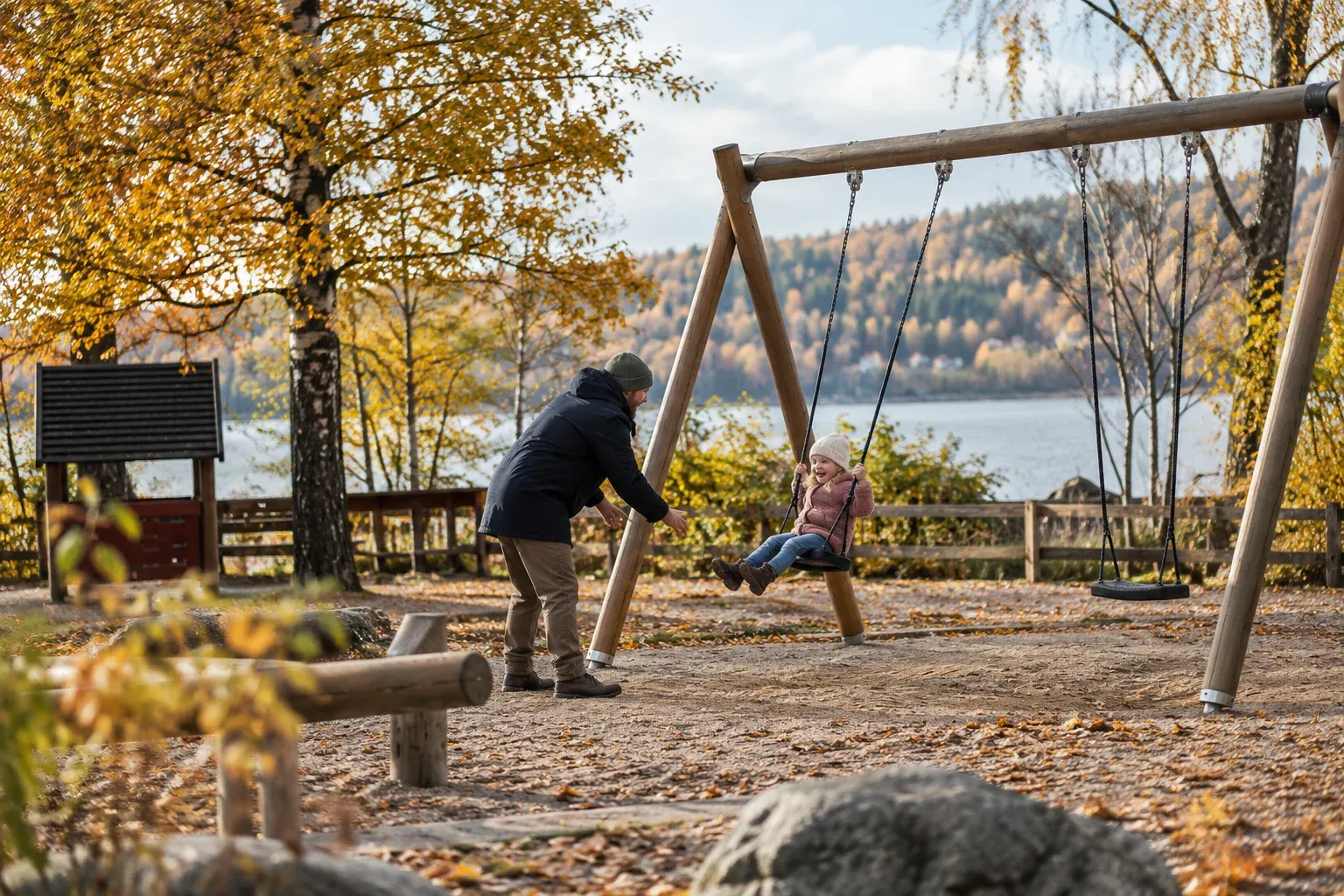
Sweden was the first country to ban smacking, in 1979. What most guides leave out is how the ban is enforced, why it applies to tourists, and what a “report of concern” really sets in motion. Here is the law as written, with the 2025 and 2026 changes.
When you need this
You’re visiting with children and come from a country where a smack on the bottom is normal. Or you’ve just watched an adult slap a child in a supermarket and wonder whether to do something. Or your child’s new teacher has mentioned an orosanmälan, a report of concern, and you want to know what it means.
The smacking ban: what the law says
The ban is one sentence in the Children and Parents Code (föräldrabalken), chapter 6, section 1. Children are entitled to care, security and a good upbringing, must be treated with respect for their person and individuality, and may not be subjected to corporal punishment or other humiliating treatment. Sweden added it in 1979, the first country in the world to do so.
That sentence carries no penalty of its own. The teeth come from the Criminal Code (brottsbalken), which defines assault (misshandel) as causing someone bodily injury, illness or pain, with no exception for parents.
| What happens | Legal label | Maximum penalty |
|---|---|---|
| A slap or smack that hurts | Minor assault (ringa misshandel) | Fines or six months in prison |
| Hitting that causes injury | Assault (misshandel) | Two years in prison |
| Insults, threats, public humiliation as discipline | Humiliating treatment, banned by föräldrabalken | No penalty in itself; can trigger a report of concern |
Physically stopping a child who runs toward a road isn’t punishment, and nobody treats it as such. The ban targets punishment and humiliation.
Yes, it applies to visitors
Swedish courts can try any crime committed in Sweden, whoever commits it. A visiting parent who hits a child can be reported to the police and prosecuted for assault, just like a resident.
Social services can get involved too. The municipality where you’re temporarily staying must help in acute situations, and in an emergency social services can take a child into immediate care even when the family lives abroad and foreign courts have the final say. Those cases are rare, but the rule exists.
Swedish attitudes are firm, though violence hasn’t disappeared. In a 2022 national survey of 5,820 ninth-graders, one in five said an adult had used physical violence against them while growing up, and 13% thought violence in upbringing can be acceptable in some circumstances.
Violence children witness, and psychological violence
Two newer crimes matter for families:
- Child-peace violation (barnfridsbrott), since 1 July 2021: letting a child who is related to both people witness assault, threats or certain other crimes between close relatives is a separate crime against the child.
- Psychological violence (psykiskt våld), since 1 July 2026: repeated insults, humiliation, threats or controlling surveillance that seriously harm someone’s self-esteem, punishable by up to four years in prison. It applies to victims of any age. The same change raised the penalty for aggravated child-peace violation.
In practice: a row with your partner in front of the children that includes threats or violence is also an offence against the children.
Reports of concern: who reports and what happens
Sweden replaced its Social Services Act on 1 July 2025. The duty to report is now in chapter 19 of the new Act (2025:400). Older pages that cite “chapter 14” are referring to the repealed law.
Who must report, immediately: staff in health and dental care, schools and preschools, social services, the police, Migrationsverket, Försäkringskassan and other listed agencies. Since 15 January 2026 the duty also covers Skatteverket, Tullverket and security guards (ordningsvakter).
Who should report: everyone else. It’s a recommendation, not a duty, and as a private person you can stay anonymous by not giving your name.
What happens next is set by law:
| Step | Deadline |
|---|---|
| Immediate protection assessment: does the child need protection right now? | At once |
| Decision on whether to open an investigation | Within 14 days |
| Investigation, if opened | Normally within four months |
| Support | Offered with the family’s consent first |
| Care without consent | Decided by the administrative court (förvaltningsrätten); in urgent cases social services decide first and the court reviews |
A report can end without any investigation. The fear that a report means “they’ll take your child” doesn’t match how the system works: consent-based support comes first. The rules for compulsory care also change on 1 January 2027, when the LVU law of 1990 is replaced by a new Act on compulsory care of children and young people (2026:1600). Consent-based help stays the first choice under both.
If a child is in danger right now, call 112. If you see a child being hit in public, speak up if it feels safe, call 112 if the child is at risk, or contact the local social services afterwards.
The Convention on the Rights of the Child is Swedish law
Since 1 January 2020, articles 1–42 of the UN Convention on the Rights of the Child have applied as Swedish law. For families, this shows up mainly as a requirement that authorities put the child’s best interests first and listen to the child’s views. The new Social Services Act writes both in directly.
Everyday rules: home alone, car seats, helmets, sun
| Situation | Rule | Type |
|---|---|---|
| Leaving a child home alone | No fixed age: parents must give the supervision the child needs given its age and development | law |
| Car travel | Under 135 cm: child seat, booster seat or cushion; the driver answers for passengers under 15 | law |
| Cycling | Under 15 on a two-wheeled bike: helmet; a rider carrying a child passenger must make sure the child wears one | law |
| Babies and sun | No direct sun under age one; don’t cover the pram with a blanket | guidance |
| Hot cars | Never leave a child in a parked car on a warm day | guidance |
Home alone is judged case by case. Consider the child’s maturity, how long you’ll be away, the time of day, and whether the child knows how to reach you and call 112. A child left alone too young or too long can become a matter for social services.
Car seats have two short-trip exceptions; see our child car seat rules. Helmets are needed only by riders under 15, and only the adult carrying a child passenger can be fined; see cycling rules in Sweden.
Mistakes to avoid
- “A light smack leaves no mark, so it’s fine.” Pain alone meets the definition of assault.
- “We’re tourists, so Swedish family law doesn’t apply.” The criminal law and social services’ acute duty apply to anyone here.
- “A report means they’ll take the child.” A report starts an assessment; support with consent comes first.
- “There’s a legal age for staying home alone.” There isn’t.
- Citing chapter 14 of the old Social Services Act. It was replaced on 1 July 2025.
- Renting family bikes without helmets for the under-15s.
Practical information
| What | Detail |
|---|---|
| Emergency (child in danger now) | 112 |
| Police, non-urgent | 114 14 (+46 77 114 14 00 from a foreign mobile) |
| Report of concern | Social services in the municipality where the child is; many have a web form; out of hours, the socialjour duty service |
| Bris (anyone under 18) | 116 111, free and anonymous, phone always open, English spoken |
| Cost of reporting | Free |
| Minor assault | Fines or up to six months in prison |
| Aggravated child-peace violation | One to six years in prison (since 1 July 2026) |
| Laws | Föräldrabalken 6:1–2; brottsbalken 3:5, 4:3, 4:7 b; socialtjänstlagen (2025:400) ch. 19–20 |
FAQ
Is it illegal to smack your child in Sweden?
Yes. Föräldrabalken has banned all corporal punishment and other humiliating treatment of children since 1979, and a smack that causes pain meets the Criminal Code’s definition of assault. There is no exception for a light smack or for parents. Minor assault is punished by fines or up to six months in prison, and social services may also look into the family.
Does the smacking ban apply to tourists in Sweden?
Yes. Swedish courts can try any crime committed in Sweden, whatever the nationality of the person who commits it, so a visiting parent who hits a child can be reported and prosecuted for assault. The municipality where you are staying must also act in an acute situation, which means social services can get involved with a visiting family too.
What happens after an orosanmälan in Sweden?
Social services must immediately assess whether the child needs protection right away, then decide within 14 days whether to open an investigation, which must normally finish within four months. A report can end without any investigation. Support is offered with the family’s consent first; care without consent needs a court decision, except in emergencies.
Who has to report concern for a child in Sweden?
Staff in health and dental care, schools, social services, the police and many other agencies must report immediately to social services if they know of or suspect that a child is being harmed. Since 15 January 2026 the duty also covers Skatteverket, Tullverket and security guards. Everyone else should report, and private persons may stay anonymous.
At what age can a child stay home alone in Sweden?
Swedish law sets no age. Föräldrabalken says parents must give a child the supervision it needs given its age, development and other circumstances, so the answer depends on the child, how long, and the time of day. A child who is regularly left alone too young or too long can become a matter for social services.
Do children have to wear bike helmets in Sweden?
Yes, anyone under 15 riding a two-wheeled bicycle must wear a helmet or other suitable head protection, and a rider carrying a passenger under 15 must make sure the child wears one. Only that adult rider can be fined. Adults have no legal duty to wear a helmet. Rent child helmets along with the bikes.
Related guides
- Traveling in Sweden with kids — the practical family overview: transport, museums, playgrounds.
- Sweden with a baby or toddler — prams on buses, changing tables, sun and sleep.
- Child car seat rules — the seat types, rental cars, taxis and the driver’s fine.
- Crisis helplines in Sweden — Bris, Kvinnofridslinjen and who answers at night.
- Parental leave in Sweden — why Swedish parenting looks the way it does.
Facts verified 2026-10-06. Sources: Sveriges riksdag (föräldrabalken, brottsbalken, socialtjänstlagen, LVU and its successor, trafikförordningen), Svensk författningssamling, Socialstyrelsen, 1177 Vårdguiden, Strålsäkerhetsmyndigheten, Trafikverket, Polismyndigheten, Bris, Stiftelsen Allmänna Barnhuset — full register in this topic’s source file. Found something outdated? Tell us and we’ll fix it.