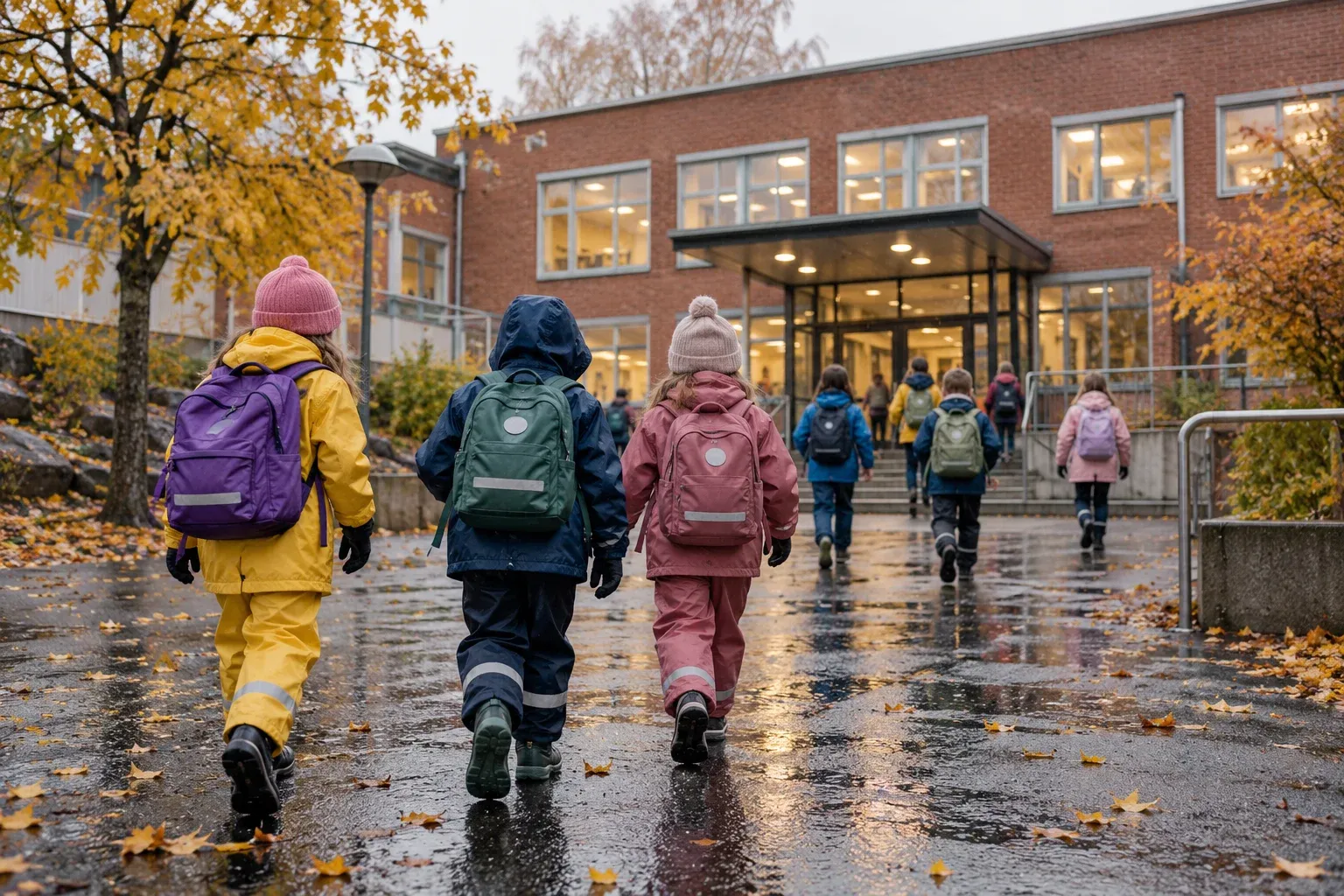
Swedish schooling is free, run by your municipality or by tax-funded independent schools, and built to take children who arrive mid-year. Here’s how each stage works, which rights newcomers have, and what changes in 2026 and 2028.
When you need this
You’re moving to Sweden with children, or you’ve just arrived and your child needs a place now. Maybe a letter from the municipality offers your three-year-old a preschool place you never asked for. You’re weighing a municipal school against an independent, bilingual or international one. Your teenager is 17 and you wonder whether upper secondary is still open. Or you’ve heard Swedish school years are being renumbered.
The stages at a glance
Everything sits under one national law, the Education Act (skollagen). Your kommun (municipality) is responsible for making sure every child gets a place.
| Stage | Swedish | Ages | Compulsory? | Cost |
|---|---|---|---|---|
| Preschool | förskola | 1–5 | No | Capped fee; 525 hours a year free from age 3 |
| Reception year | förskoleklass | 6 | Yes (until 2028) | Free |
| Compulsory school | grundskola | 7–16 | Yes | Free, including books and lunch |
| Upper secondary | gymnasieskola | 16–19 | No | Free tuition; lunch set by municipality |
Rights follow residence. In practice that means registering at your address with Skatteverket; see our personnummer guide and moving to Sweden for work.
Preschool: from age 1
Every child living in Sweden must be offered förskola from age 1, as needed for the parents’ work or studies. If a parent is unemployed or on parental leave with a sibling, the child still gets at least 3 hours a day or 15 a week. From the autumn term of the year your child turns 3, at least 525 hours a year are free; fees may only cover hours above that.
- Timing: once you apply, the municipality must offer a place within four months, as close to home as possible. Apply early.
- Fees: most municipalities use the national cap, maxtaxa, a percentage of household income. It was cut on 1 July 2026 (amounts under Practical information).
- The newcomer offer: from age 3, a child born abroad who has lived in Sweden at most five years, or whose resident parents were born abroad and arrived within five years, is offered a place without applying. That’s the letter you didn’t ask for. It’s an offer, not an order.
Preschool is voluntary. The government launched an inquiry in September 2026 into making language preschool mandatory for children who don’t hear Swedish at home, due in September 2027. Nothing has been enacted.
Compulsory school: ten years from age 6
Skolplikt (school duty) begins in the autumn term of the calendar year your child turns 6 and lasts ten years, normally until the spring they turn 16. Today the first of those years is förskoleklass, a reception year. A child can start a year early if the school judges them ready, or a year late for special reasons.
Children who count as resident only through another route have the same right to school but no duty. That covers asylum seekers, EU citizens not yet registered and children without permits.
What “free” means is written into the law:
- No fees, and no fee for applying
- Free textbooks and learning tools
- A free, nutritious school lunch every day
- Only voluntary, at-cost contributions for the occasional school trip, which must be open to every pupil
Grades are given every term from year 6 today, on an A–F scale (F is a fail). Before that, teachers give written assessments. Teacher, pupil and parents meet for a utvecklingssamtal (development talk) at least once a term. After-school care (fritidshem) must be offered until the spring the child turns 13. Since 1 August 2026, pupils’ phones are collected at the start of the school day and handed back at the end.
Choosing a school
Sweden lets parents choose. For municipal schools, your child is placed where you want unless that would push out another child’s justified claim to a school near home, cause major organisational or financial difficulty, or threaten other pupils’ safety.
Independent schools (friskolor) are funded per pupil by your home municipality, so they’re free too. They must be open to all pupils and may not use entrance tests. When full, they select by rules the Schools Inspectorate has approved, so a popular school may have no place for a newcomer. All teaching must be non-confessional.
Watch the bus. Free school transport covers the school the municipality would have placed your child in. Choose a school further away and you may lose it.
Support for newly arrived pupils
A child counts as nyanländ (newly arrived) after living abroad and starting school here after the normal starting age. The status lasts four years of schooling, and it comes with specific rights:
| Right | Time limit or rule |
|---|---|
| Assessment of previous schooling and knowledge | Done quickly, before placement |
| Placement in the right year and teaching group | Within two months of arrival at the school |
| Förberedelseklass (preparatory class) | Part-time, subject by subject, two years at most; not every school has one |
| Study guidance in the mother tongue | Can be in the child’s strongest school language instead |
| Individual study plan (upper grades) | Within two months |
| Adapted timetable (upper grades) | Only with the family’s consent, to reach upper-secondary eligibility |
Ask about Swedish as a second language (svenska som andraspråk), a separate subject with its own grades. Bring previous school reports, translated if you can.
Mother-tongue tuition (modersmålsundervisning) is a right if a parent has another mother tongue, the child speaks it daily at home and has basic knowledge of it. The school provider only has to arrange it if at least five pupils want the language and a suitable teacher exists. That limit doesn’t apply to Sweden’s national minority languages.
English-language and international schools
There are three routes. Bilingual Swedish-English schools, both municipal and independent, follow the Swedish curriculum and are free. International schools follow another country’s or an international curriculum. They’re mainly for families staying temporarily, and they may charge fees to cover reasonable extra costs. Finally, some upper-secondary schools offer the IB Diploma; the home municipality pays the provider, so pupils normally pay no tuition.
Choice is widest in Stockholm, Gothenburg, Malmö and Uppsala. A small town may have one municipal school.
Upper secondary: the age limit matters
Gymnasieskola is voluntary, free and normally three years. National programmes, vocational or university-preparatory, require passing grades in Swedish or Swedish as a second language, English, mathematics and further subjects. Newcomers who couldn’t study English for much of their schooling can have it waived if they’re judged able to cope.
Teens who don’t yet qualify usually start on språkintroduktion, the language introduction programme.
Don’t miss the deadline. A programme must be started by the first half of the year the young person turns 20. Asylum seekers and some others must start before 18. After that, the route is adult education.
The 2026–2028 changes
| When | What changes | Rule |
|---|---|---|
| 1 July 2026 | Lower preschool fees | Maxtaxa revision |
| 1 August 2026 | Phones collected all school day | Skollag 5 kap. 4 § |
| Autumn 2028 | Förskoleklass ends; grundskola runs years 1–10 | Lag 2025:729 |
| Autumn 2028 | Years 1–8 and first-year upper secondary graded 1–10 instead of A–F | Lag 2026:1243 |
| From 2031 | Upper-secondary admission by merit value | Lag 2026:1243 |
A child in förskoleklass in 2027/28 goes straight to year 2 in autumn 2028. Everyone else moves up one number at the same stage, so a year 3 pupil in 2027/28 starts year 5. Guides that talk about “year 9” or A–F grades describe the old system.
Mistakes to avoid
- Assuming English schooling costs money. Bilingual schools in the normal system are free; only international schools may charge fees.
- Waiting for a new term. Schools take newcomers all year and must place them within two months.
- Reading the preschool offer as compulsory. It’s voluntary.
- Assuming a 17-year-old is too old. Language introduction is usually still open; check the age rule for your status.
Practical information
| Item | Detail |
|---|---|
| Compulsory school, books, lunch | Free by law |
| Upper secondary | Free tuition and books; lunch decided by the municipality |
| Preschool, age 3 and up | 525 hours a year free |
| Preschool fee cap from 1 July 2026 | 3% / 2% / 1% of household income; max 1,547 / 1,031 / 516 kr a month for child 1 / 2 / 3; no fee from child 4 |
| Fee income rules | Income counted up to 51,560 kr a month; first 10,000 kr deducted |
| International schools | May charge fees for reasonable extra costs |
| Where to apply | Your municipality’s website or reception unit for newly arrived pupils |
FAQ
At what age do children start school in Sweden?
School duty begins in the autumn of the year a child turns 6 and lasts ten years, normally until the spring they turn 16. Today the first year is förskoleklass, a reception year inside the school system. From autumn 2028 that year becomes year 1 of a ten-year grundskola. A child can start a year early if the school judges them ready.
Is school free in Sweden for foreign children?
Yes, if the child lives in Sweden. Compulsory school is free by law, including textbooks and a nutritious lunch every day, and independent schools may not charge fees either. Upper secondary is also free, though lunch there depends on the municipality. Only international schools that follow another country’s curriculum may charge fees to cover extra costs.
How fast does a newcomer child get a school place?
Quickly. The head teacher must assess the child’s knowledge and decide the year and teaching group within two months of the child being received at the school. Schools take pupils all year round. Many municipalities have a reception unit for newly arrived pupils; contact the municipality as soon as you have an address.
What is förberedelseklass?
A preparatory class for newly arrived pupils who do not yet know enough Swedish to follow normal lessons. It is part-time and subject by subject: the child leaves it in each subject as soon as their Swedish is good enough, and never stays longer than two years. Not every school offers one; others integrate newcomers directly with support.
Can my child go to an English-speaking school in Sweden?
Often, yes. Some municipal and independent schools teach partly in English while following the Swedish curriculum, and they are free. International schools follow a foreign or international curriculum, mainly for families staying temporarily, and may charge fees. Some upper-secondary schools offer the IB Diploma, paid for by the home municipality. Choice is widest in the big cities.
Does my child have a right to mother-tongue lessons?
Usually. A pupil is entitled if a guardian has another mother tongue, the child speaks it daily at home and has basic knowledge of it. The school provider only has to arrange it if at least five pupils want the language and a suitable teacher exists, a limit that does not apply to Sweden’s national minority languages.
Is preschool compulsory in Sweden?
No. Preschool is voluntary, but every child living in Sweden must be offered a place from age 1 as needed, and 525 hours a year free from the autumn they turn 3. Newcomer children get a place offered without applying. The government launched an inquiry in September 2026 into mandatory language preschool, due September 2027; nothing is law yet.
What changes in Swedish schools in 2028?
From autumn 2028 förskoleklass ends and grundskola has ten numbered years, so pupils already in school move up one year number. Pupils in years 1–8 or their first upper-secondary year in autumn 2028 are graded 1–10 instead of A–F; older pupils finish on A–F. A child in förskoleklass in 2027/28 goes straight to year 2. Upper-secondary admission switches to a merit value from 2031.
Related guides
- Moving to Sweden for work — the registration that gives your children school rights.
- Personnummer explained — the number most school forms ask for.
- Learning Swedish as a newcomer — SFI for the parents while the children start school.
- Swedish school holidays — term dates are set by each municipality.
- Children’s rights and the smacking ban — what school staff must report.
Facts verified 6 October 2026. Sources: Sveriges riksdag (Education Act, School Ordinance), Skolverket, Regeringskansliet, Uppsala kommun — full register in this topic’s source file. Found something outdated? Tell us and we’ll fix it.