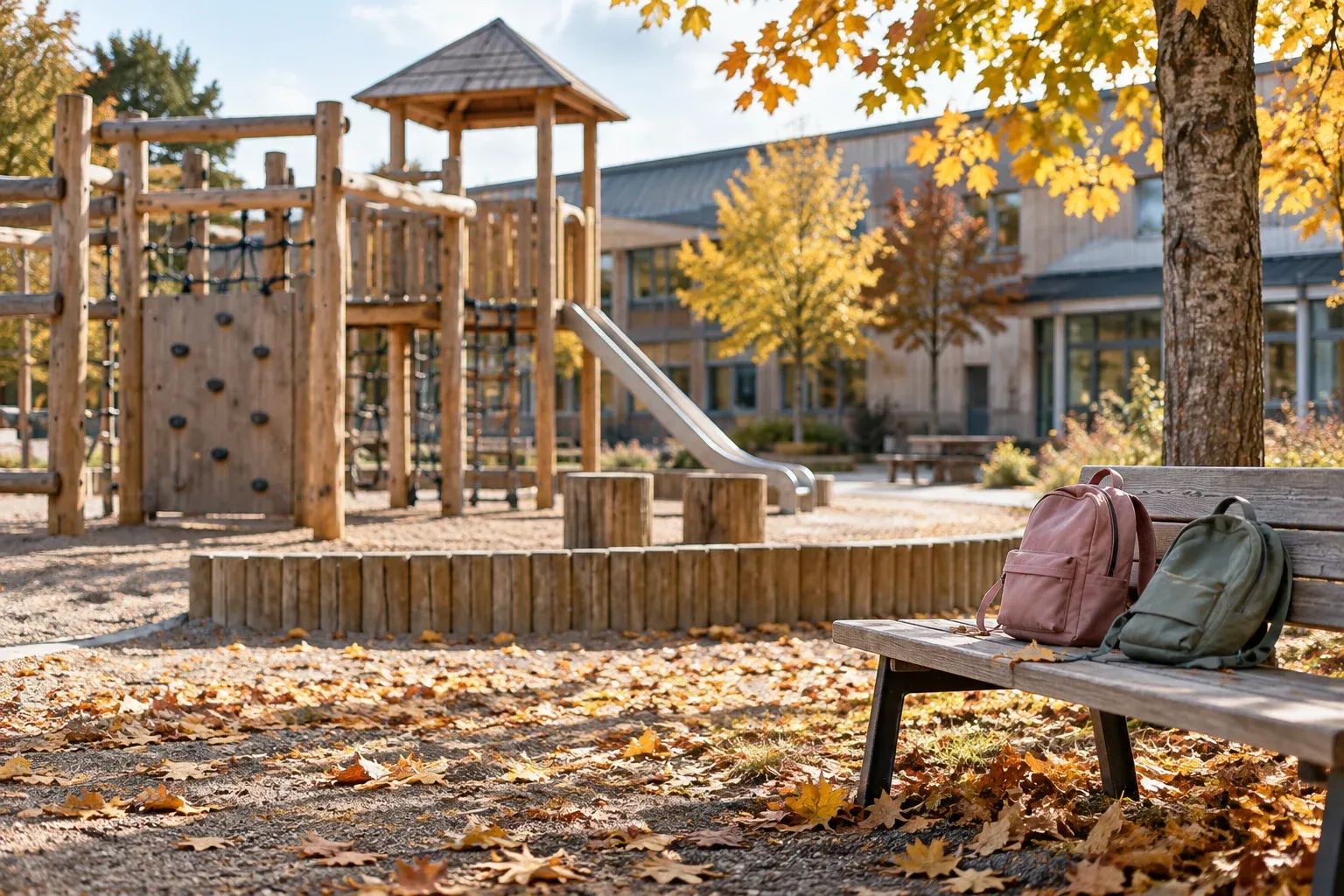
If your child goes to school in Sweden and you work, fritids is how the afternoon and the school holidays get covered. Here’s who gets a place, what it costs since the July 2026 fee cut, and what changes if you lose your job.
When you need this
You’ve moved to Sweden with a child aged 6 to 12 and both of you will work or study. The school asks whether you want a fritids place, and you’re not sure what it is or what it costs. Maybe you’ve just lost a job or gone on parental leave and wonder whether your child keeps the place. Or the summer break is coming, you have no regular place, and you need care for a few weeks. Or your 10-year-old has been moved to a fritidsklubb and you want to know why.
What fritids is
Fritidshem (after-school center), almost always shortened to fritids, is part of the Swedish school system, not a private club added on. It is governed by chapter 14 of the Education Act (skollagen) and by its own section of the national curriculum. Its legal job is to complement school, stimulate children’s development and learning, and give them a meaningful free time with rest and recreation.
In practice your child stays at or near the school building after lessons, often with adults they already know from the school day, and fritids shares rooms with the school. The day mixes free play, outdoor time, creative activities and an afternoon snack (mellanmål, or mellis). Meals are part of the care, so no extra charge may be added for them above the fee cap.
Every municipality must offer fritids to pupils in its compulsory schools. If your child goes to an independent school (friskola) that does not run its own fritids, the home municipality must offer one instead.
Who gets a place
The right is tied to need. That surprises many newcomers who know that Swedish school itself is free and universal. The Education Act says a pupil must be offered fritids:
| Situation | Right to a place? | Classification |
|---|---|---|
| Parents work or study | Yes, to the extent needed for those hours | Law |
| The child has a need of its own because of the family’s situation | Yes | Law |
| The child needs special support for physical, mental or other reasons | Yes, whatever the parents do | Law |
| Family speaks another mother tongue, or lives in a sparsely populated area | Can count as a family-situation need | Skolverket guidance |
| A parent is unemployed or on parental leave | Not guaranteed; set by each municipality | Local practice |
A place must be offered as soon as the need is known, at or as close as possible to the child’s school. The age range runs from förskoleklass, the reception year at 6, up to and including the spring term of the year the child turns 13. When förskoleklass becomes year 1 of a ten-year compulsory school in autumn 2028, the age range stays the same.
Residence matters. The right belongs to children who count as resident under the Education Act. That means children registered in Sweden (folkbokförda), and also asylum-seeking children, children with certain temporary permits and EU citizens’ children with a right of residence. Children of foreign diplomatic staff and children without any permit are entitled only to school itself, not to fritids. Holidaymakers are not covered at all.
Unemployed or on parental leave
This is where municipal rules part ways. The statute does not oblige the municipality to keep a full place when a parent loses a job or goes on parental leave, and an opposition motion in the Riksdag in 2025/26 to create a universal right has not been adopted. Two examples show the range:
- Falkenberg gives children of jobseekers and parents on leave Fritids Plus, a reduced place until 15:00 on school days, but not on holidays or planning days. A regular place must be ended and Fritids Plus applied for.
- Köping states plainly that children of jobseekers or parents on parental leave have no right to a place.
Check your own municipality’s rules before your status changes, because the notice period and its fee keep running.
One change may be coming. Since 1 July 2026, people receiving social assistance face a full-time activity requirement. In September 2026 a government inquiry proposed that their children should get more time in preschool, fritids or pedagogical care, as a main rule 30 or 40 hours a week. Nothing has been decided yet.
Fritidsklubb from age 10
From the autumn term of the year a child turns 10, the provider may offer open leisure activities (öppen fritidsverksamhet) instead of fritids. Most people call it fritidsklubb. Children come and go more freely and have less supervision, which suits pupils in years 4 to 6. A child who needs the special support that only fritids can give keeps a fritids place.
The Education Act sets no fee rules for a fritidsklubb run by a municipality, and some, such as Köping, run it free. An independent provider may charge a fee, as long as it is not unreasonably high. So if your 10-year-old is moved to a club, nobody has thrown them out: it is a common, legal step.
Hours and holidays
Fritids covers the part of the day your child is not in school, both before and after lessons, plus school holidays. It does not have to open in the evening, at night, at weekends or around major public holidays. Within the day, the municipality sets the frame. Falkenberg, for example, can open from 06:30 to 18:30.
Holidays need planning. The care is there for children whose parents work or study, so if you are off work, your child is often expected to be off too. Before summer and Christmas, schools ask parents to report their needs in advance, sometimes on a certified form, and many merge fritids into a few holiday units. Some municipalities sell holiday-only care, paid per term, to families without a regular place.
Fritids may also close for a few planning days (studiedagar) a year, but must still arrange care for parents who work. Falkenberg allows six such days and must warn parents two months ahead.
For shift workers, municipalities must only strive to offer care in the evening, at night and at weekends (nattis). It is not a right, but ask whether yours offers it.
Fees: the cap and the July 2026 cut
All municipalities use the maxtaxa, a national fee cap set by a government ordinance. The fee is a percentage of your household’s monthly income, with a ceiling:
- 2% for the youngest child in fritids
- 1% for the next child
- 1% for the third child
- nothing from the fourth child
Younger siblings in preschool count in the same order, with preschool’s own percentages. “Household” means a single parent, or a couple living together who are married, have a child together or are registered at the same address.
The cut you may not have heard about: since 1 July 2026, the first 10,000 kr of every household’s monthly income is no longer counted. Households earning under 10,001 kr a month pay nothing, and every paying household’s fee fell. Municipal fee pages lag behind: as of August 2026, Köping’s page still showed the older, higher ceiling. Check your invoice against Skolverket’s figures in the table below.
Two practical points catch new families. Municipalities such as Falkenberg charge the maximum fee until you register a lower income, and they compare your figure with Skatteverket’s tax data afterwards and invoice the difference. And they charge regardless of attendance, so holidays, sick days and long trips do not reduce the bill.
Applying, schedules and notice
- Register your address with Skatteverket; the right follows residence.
- Apply in the municipality’s e-service for a municipal school, or ask an independent school directly. Falkenberg, for example, wants 14 days’ notice.
- Have your working or study hours ready; you can be asked to prove them. Shift workers may be entitled to time for sleep.
- Register household income when the place starts.
- Enter drop-off and pick-up times in the school’s app, where absence is reported too.
- Report changes straight away: new income, job loss, parental leave, a move.
- End the place in writing or in the e-service. Oral notice to staff usually does not count, and notice periods are set locally. Falkenberg’s is 60 days.
Since 1 August 2026, phones are collected at the start of the child’s day and handed back at the end, in fritids and fritidsklubb as well as in school. Staff can make exceptions.
Mistakes to avoid
- Assuming fritids is free like school. School and lunch are free; fritids carries a capped, income-based fee.
- Assuming the place is safe whatever happens. It follows need, and job loss or parental leave can end it.
- Telling a staff member instead of giving written notice. You keep paying until a valid notice period runs out.
- Skipping the income report. No report means the maximum fee.
- Not booking holiday care. An unbooked July week may have no place.
Practical information
| Item | Detail (as of October 2026) |
|---|---|
| Ages | From förskoleklass (6) to the spring term of the year the child turns 13 |
| Fee, first child | 2% of fee-basis income, max 1,031 kr a month from 1 July 2026 (checked 2026-10-14) |
| Fee, second and third child | 1% each, max 516 kr a month each from 1 July 2026 (checked 2026-10-14) |
| Fourth child onwards | No fee |
| Income ceiling | Counted up to 51,560 kr a month, after the 10,000 kr deduction (checked 2026-10-14) |
| Households under 10,001 kr a month | No fee |
| Fritidsklubb (municipal) | No national fee rule; free in some municipalities |
| Holiday-only care | Flat fee per term, set by each municipality |
| Closed | Evenings, nights, weekends, major public holidays |
| Where to apply | Your municipality’s e-service, or the independent school |
| English information | Skolverket’s Utbildningsguiden, “About school-age educare” |
FAQ
What is fritids in Sweden?
Fritids, short for fritidshem, is after-school care that is part of the Swedish school system. Children aged 6 to 12 go there before and after lessons and during school holidays, usually in the same building as their school. It mixes play, outdoor time, creative activities and an afternoon snack, following its own section of the national curriculum.
How much does fritids cost?
The fee depends on household income and is capped nationally. As of October 2026, under rules in force since 1 July, the first child pays at most 2% of household income above 10,000 kr a month, up to 1,031 kr a month; the second and third child pay at most 1%, up to 516 kr each. The fourth child is free. Snacks are included.
Who has the right to a fritids place?
Children living in Sweden, from förskoleklass until the spring they turn 13, when their parents work or study, or when the family’s situation or the child’s own need for support calls for it. Asylum-seeking children and EU citizens’ children are included. A place must be offered as soon as the need is known, at or near the child’s school.
Can my child keep fritids if I am unemployed or on parental leave?
It depends on your municipality. The Education Act guarantees a place for work, studies, the family’s situation or special support, but not for unemployment as such. Some municipalities offer a shorter day, for example until 15:00 on school days; others end the place after a notice period. Check your municipality’s rules before you change status.
Is fritids open during school holidays?
Yes. Fritids covers school holidays as well as the hours around the school day, but only for children whose parents need it, so you usually have to book holiday care in advance. Many municipalities merge fritids into fewer units during summer and Christmas. It does not have to open evenings, weekends or around major public holidays.
What is fritidsklubb?
Fritidsklubb is the everyday name for open leisure activities (öppen fritidsverksamhet), which a provider may offer instead of fritids from the autumn a child turns 10. Children come and go more freely, with less supervision, so it suits older pupils. A child who needs the special support only fritids gives keeps a fritids place.
Can tourists or short-term visitors use fritids?
Generally no. The right belongs to children who count as resident under the Education Act: those registered in Sweden, asylum seekers, children with certain temporary permits and EU citizens with a right of residence. Holidaymakers are not covered, and children of foreign diplomats are only entitled to school itself. Families on longer stays should ask their municipality.
Related guides
- Swedish schools for newcomer families — the school system fritids complements, from preschool to upper secondary.
- Swedish school holidays — the breaks you’ll need holiday care for.
- VAB: staying home with a sick child — what happens when your child is ill instead of at fritids.
- Folkbokföring: registering your address — the registration that gives the right to a place.
- Parental leave in Sweden — and why it can affect a fritids place.
Facts verified 14 October 2026. Sources: Sveriges riksdag (Education Act, maxtaxa ordinance), Skolverket, Regeringskansliet, Falkenbergs kommun, Köpings kommun — full register in this topic’s source file. Found something outdated? Tell us and we’ll fix it.