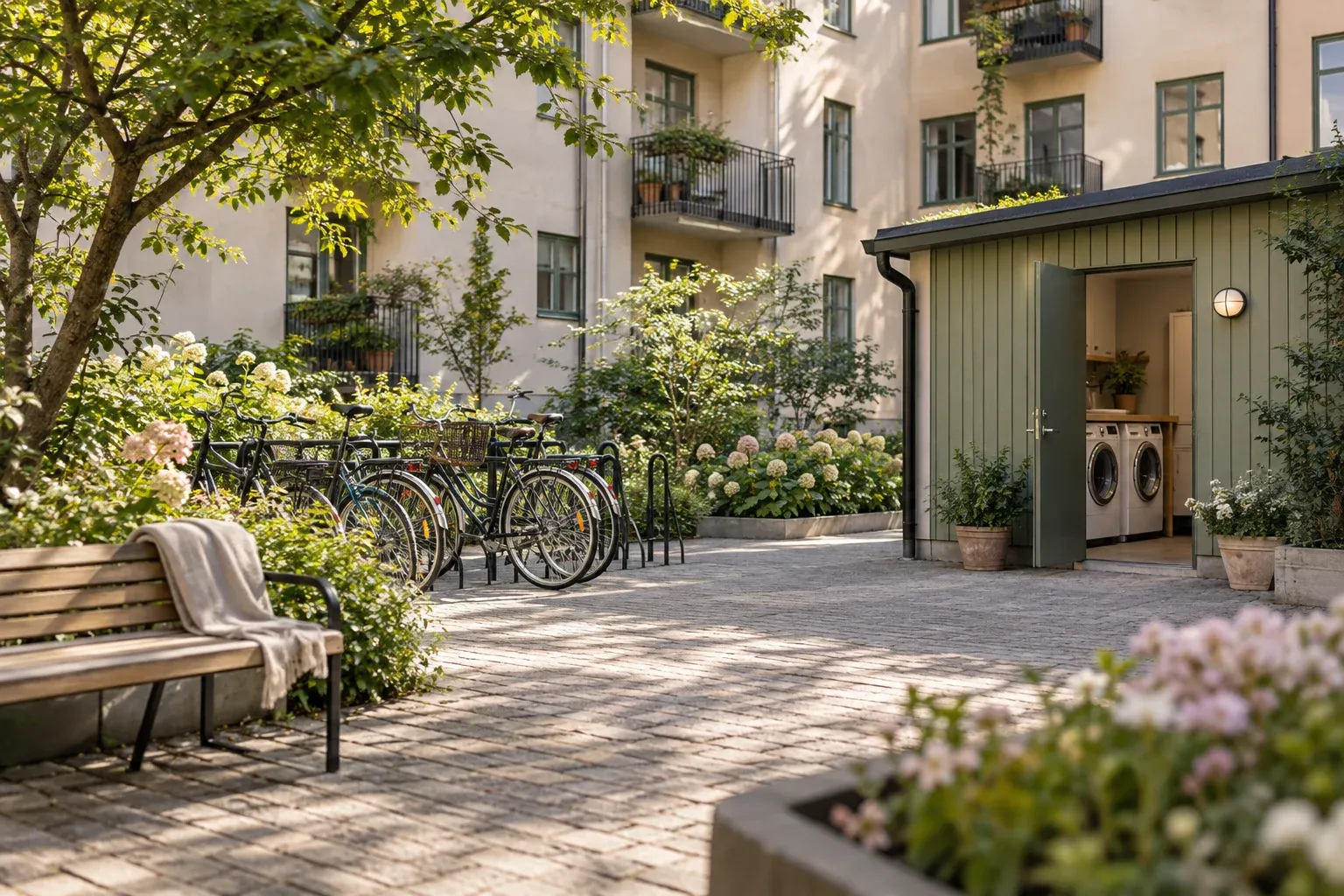
In most Swedish cities, the person who “owns” a flat doesn’t own any walls. They hold a permanent right to use it, and the building belongs to a co-op run by the neighbours. Here’s how that works and what it means if you buy, rent or live in one.
When you need this
You’ll meet the association the moment a listing says bostadsrätt and brf, or a board asks for a membership application. It also matters when you rent a flat from a private owner and wonder whether the board knows, or when a notice about the annual meeting or a fee rise lands in your mailbox. And if you own a flat and want to let it while you work abroad, the board decides first.
What a brf is and what you actually own
A bostadsrättsförening is an economic association that owns an apartment building and grants its members a bostadsrätt: the right to use one flat, for payment and with no end date. When Swedes say they bought a flat, they bought that right plus membership. The building and the land stay with the association.
Every association must be registered and have at least three members, its own statutes (stadgar), a board and at least one auditor. It is a big part of how Sweden lives: at the end of 2025, about 21% of households lived in a cooperative flat in an apartment block. In Stockholm County it was the most common form, at 38%.
| You are… | What the brf means for you |
|---|---|
| Buying a flat | The board must accept you as a member, or the purchase is void |
| Renting from an owner | The board must have consented to the sublet; its house rules bind you |
| Living there as a member | You pay the monthly fee, vote at the annual meeting and maintain your flat |
If you’re still working out which kind of flat you’re looking at, start with bostadsrätt vs hyresrätt.
Who runs it: the board and the annual meeting
The members run the association together. The annual meeting (föreningsstämma) is the top body: each member has one vote, and joint holders of one flat share a single vote. It must be held within six months of the end of the financial year. There, members adopt the accounts, decide whether to discharge the board from liability, elect the board and vote on motions.
The board (styrelse) handles everything in between. It admits new members, sets the fees unless the statutes say otherwise, and decides on sublets and on renovations that touch the structure. Most boards are unpaid neighbours, and many hire a property manager (förvaltare) for accounts and repairs.
Your rights as a member at the meeting:
- Notice: four to six weeks before an ordinary meeting, or two weeks if the statutes allow.
- Documents: the annual and audit reports must be available to you for at least two weeks beforehand.
- Motions: you may have any matter dealt with if you ask the board in writing in time for the notice.
- Proxies: only a spouse, cohabitant or another member may vote for you, unless the statutes allow more. Postal voting does not apply.
- Extra meeting: one tenth of voting members can demand one in writing.
Statute changes need either a unanimous vote or two meetings in a row with two-thirds at the second. Changing how annual fees are calculated needs three-quarters.
Buying: getting approved as a member
Nationality is not a hurdle. The law voids any statute condition based on citizenship, income or wealth. A buyer may not be refused if the statute conditions are met and the association “should reasonably accept” them as a holder. In practice, boards commonly ask for proof that you can pay, such as a credit check or a loan approval.
The stakes are real, because a transfer is invalid if the buyer is refused membership. Three more rules shape a purchase:
- The contract must be in writing, signed by both parties, naming the flat and a price. A side deal on a different price is void.
- Joint buyers can be refused unless they are spouses or cohabitants.
- Companies can be refused membership when buying an ordinary home.
Refused? You can take the board’s decision to the rent tribunal (hyresnämnden) within one month of learning of it. Don’t pay the full price before membership is approved: if the refusal stands, you must recover the money from the seller.
Renting a co-op flat: the sublet rules
Most newcomers meet a brf as a tenant, because so many second-hand lets are cooperative flats (see renting a flat in Stockholm). The owner may let the flat for independent use only with the board’s consent. If the board refuses, the rent tribunal shall grant permission when the owner has a reason and the association has no justified reason to refuse. Permission is always time-limited and may carry conditions.
The tribunal’s accepted reasons include work or studies elsewhere, trying out living with a partner, letting to a relative, and a flat that is hard to sell (usually for up to a year). A subtenant who does not behave can be a justified reason to refuse.
Changed on 1 July 2026. Earlier sublets now count against a new one only if they took place “to a significant extent”. And letting all or part of a flat the owner does not use as a permanent home always counts as independent use, so even renting out a room in an empty flat needs consent. Guides written before mid-2026 describe the old text.
For you as a tenant, the risk sits with the owner but lands on you. Letting without consent or tribunal permission is a ground for terminating the owner’s right, and your sublet ends with it. Ask to see the board’s written consent before you sign. The full renting process is in long stays in Sweden: renting for a season.
Two narrow exceptions exist: municipalities and regions holding a flat for permanent housing, and a lender who bought at a forced sale, may sublet without consent but must tell the board.
The monthly fee
Members pay an entry contribution (insats) when a flat is first granted, then an annual fee (årsavgift), usually billed monthly and called the avgift. It covers the association’s running costs, such as loan interest and upkeep of the building; what else is included varies. Transfer, pledge and sublet fees may be charged only if the statutes allow them.
The board sets the fee unless the statutes say otherwise, so it rises when interest rates or repairs go up. Changing the insats always needs the general meeting. After a significant fee rise, a member may give notice and leave within three months, unless that would be unreasonable towards the association.
Pay on time. An annual fee more than one week overdue on a home is a ground for forfeiture of the flat.
Reading the annual report
A cheap flat can hide an expensive association. The annual report (årsredovisning) is the best guide to where your fee is heading, and the law now fixes what it must show:
| Key ratio | What it tells you |
|---|---|
| Annual fee per m² | What members already pay for the space |
| Debt per m² | How much the association owes for each square metre |
| Savings per m² | How much it puts aside for future upkeep |
| Interest-rate sensitivity | How much fees must rise if rates go up |
| Energy cost per m² | Exposure to heating and electricity prices |
The report must also include a cash-flow statement and, if the association made a loss, explain what that means for its ability to finance future commitments. For financial years beginning after 31 December 2024, every association files its annual and audit reports with Bolagsverket within one month of the meeting adopting them.
Ask the estate agent for the last three reports and the maintenance plan, and look for planned pipe replacement (stambyte) or roof work in board notices. Compare debt and interest sensitivity across the buildings you’re considering. A newly formed association must instead have a registered economic plan with a 50-year maintenance plan and a sensitivity analysis.
Living there: rules and repairs
The member keeps the inside of the flat in good condition at their own cost, unless the statutes say otherwise. Shared pipes and ventilation ducts are the association’s. Representatives of the association may enter the flat for inspection or for work it is responsible for.
Some changes need the board’s permission first:
- work on load-bearing walls
- water, drain, heating or gas pipes, and ventilation
- fireplaces, chimneys or anything else affecting fire safety
- any other major change to the flat
The board may refuse only if the work clearly harms the association, and the tribunal can review a refusal. Unapproved work that endangers safety or others’ property can be fixed at the member’s cost. If your flat includes a parking space, you may ask the association to install an EV charger at your own cost; it needs a justified reason to say no.
Members must keep the peace too: neighbours should not face disturbance they cannot reasonably be expected to tolerate, including from guests and tenants, and the association’s house rules apply. The everyday side of that, from laundry-room bookings to door codes, is in staying in a Swedish apartment.
What’s changing
Swedish housing law moved fast in 2026. Besides the sublet change, a national register of all cooperative flats is being built by Lantmäteriet, the land survey agency. Associations must report every flat, holder, pledge and note by 31 December 2027, and Lantmäteriet can order them to under a fine. The government decides when the register itself takes effect; transfers and pledges will then be registered there instead of in each association’s own list.
Practical information
| Item | Detail |
|---|---|
| Monthly fee (avgift) | Set by each association; depends on size, debt and what is included (checked 2026-10-14) |
| Sublet fee cap | 10% of the price base amount per year: 5,920 kr in 2026 (price base amount 59,200 kr, checked 2026-10-14) |
| Transfer and pledge fees | Only if the statutes allow; amounts set in each association’s statutes |
| Membership application | No fee in the act |
| Refused membership | Appeal to the rent tribunal within one month |
| Sublet refused | Apply to the rent tribunal (form HN1c); check any fee with the tribunal |
| Annual meeting | Within six months of the financial year’s end; notice four to six weeks ahead |
| Annual reports | Filed with Bolagsverket for financial years from 2025 |
| Register deadline | Associations report to Lantmäteriet by 31 December 2027 |
FAQ
What is a bostadsrättsförening?
It is a member-owned housing cooperative that owns an apartment building and grants each member a permanent right to use one flat. When Swedes say they “own” a flat, they own that right plus membership. The members elect a board at the annual meeting, the board runs daily affairs and sets fees, and every association must publish an annual report.
Can a foreigner buy a bostadsrätt and become a member?
Yes. The law voids any statute condition based on citizenship, income or wealth, and a buyer may not be refused if the statute conditions are met and the association should reasonably accept them. Boards commonly check ability to pay. If you are refused, you can take the decision to the rent tribunal within one month; otherwise the purchase is void.
Can the owner of a cooperative flat rent it out to me?
Only with the board’s consent or, if the board refuses, the rent tribunal’s permission, which is always time-limited. Since 1 July 2026 earlier sublets count against a new one only if they were extensive. If the owner lets without permission, the association can terminate their right, and your sublet ends with it. Ask to see the written consent.
What does the monthly avgift pay for, and can it go up?
The fee covers the association’s running costs, such as loan interest and upkeep of the building; what else is included varies. The board sets it unless the statutes say otherwise, so it can rise when interest rates or repairs go up. After a significant rise a member may give notice and leave within three months, unless that would be unreasonable towards the association.
How do I check whether a housing association is healthy?
Read its annual report. By law it must show the annual fee, debt, savings and energy cost per square metre, plus interest-rate sensitivity, a cash-flow statement and what any loss means for future financing. Reports for financial years from 2025 are filed with Bolagsverket. Also ask for the maintenance plan and planned major works.
What happens at the annual meeting, the föreningsstämma?
It must be held within six months of the financial year’s end. Members adopt the accounts, discharge the board and elect a new one, and vote on motions. Each member has one vote, joint holders share one. Notice comes four to six weeks ahead, and any member may raise a matter by writing to the board in time.
Is anything changing for housing cooperatives?
Yes. Sublet rules loosened on 1 July 2026. A national register of cooperative flats is being built by Lantmäteriet: associations must report every flat, holder and pledge by 31 December 2027. The government decides when the register takes effect; transfers and pledges will then be registered there instead of in each association’s own list.
Related guides
- Bostadsrätt vs hyresrätt — which of Sweden’s two kinds of flat you’re dealing with
- Long stays in Sweden: renting for a season — renting a co-op flat second-hand, step by step
- Why it is so hard to rent in Stockholm — why most newcomers rent from owners
- Staying in a Swedish apartment — house rules, laundry rooms and door codes in practice
- Home insurance for long stays — covering your things and your liability in someone else’s flat
Facts verified 2026-10-14. Sources: Sveriges riksdag (Bostadsrättslag 1991:614, Lag 2018:672 om ekonomiska föreningar, Årsredovisningslag 1995:1554, Civilutskottet), Svensk författningssamling (SFS 2026:776, 2024:1115, 2026:485), Sveriges Domstolar, SCB — full register in this topic’s source file. We deliberately publish no typical monthly fees or “safe” key-ratio thresholds. Found something outdated? Tell us and we’ll fix it.