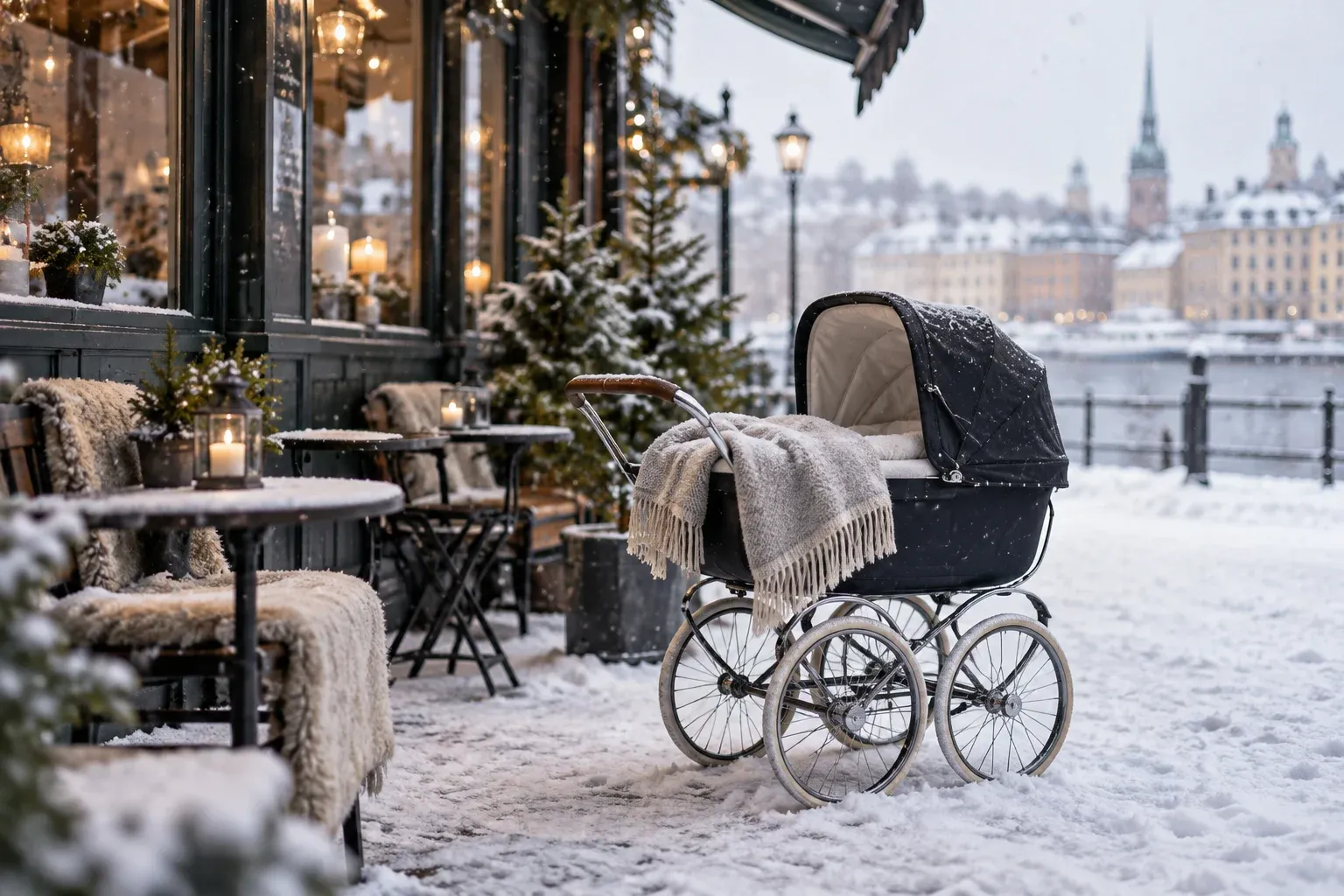
A row of prams in the snow outside a café, each with a sleeping baby inside, is one of the first things that puzzles winter visitors. Here is why Swedes do it, what the health service actually advises, and what the research found.
When you need this
You walked past a café on a January weekday and saw sleeping babies lined up outside the window. A Swedish host offers your baby a nap on the balcony or in the garden. You are spending a winter in Sweden with a baby, or you have moved here and your neighbours, your BVC nurse or your child’s preschool talk about outdoor naps as if they were obvious. Or you are home again and someone asks whether Scandinavian babies really sleep in the snow.
A Nordic habit, not a rule
Daytime naps outdoors in a pram (barnvagn) are an ordinary part of Swedish baby care. Parents do it all year, including when the temperature is below zero, and many grew up napping outside themselves; a 2013 BBC report from Stockholm followed one family where three generations had done it. The baby sleeps in a footmuff (åkpåse) with a hat on, the pram parked on a balcony, in a garden or outside a café while the parent stays close.
The habit is shared across the Nordic countries and is best studied in Finland. In a survey of 116 families with children under two in the city of Oulu, outdoor winter naps were “taken for granted”. They usually started when the baby was about two weeks old and happened once a day, in outdoor temperatures that ranged from −27 °C to +5 °C.
No Swedish law requires the outdoor nap or regulates how it is done. The only binding rule is the general one in the Parental Code (Föräldrabalken, chapter 6, section 2): a guardian must make sure the child gets the supervision its age, development and circumstances call for. Everything else is custom plus health advice.
What 1177 actually says
The official advice comes from 1177, Sweden’s national health information service, on its page about dressing children for outdoors. It does not tell parents to nap babies outside or not to. It tells them how to do it safely, starting from one fact: the youngest children have the hardest time controlling their body temperature, so be careful outdoors in both strong heat and strong cold.
For a baby lying still in a pram in winter, 1177 lists:
| Item | 1177’s advice |
|---|---|
| Footmuff (åkpåse) | Yes, perhaps with a blanket too |
| Feet | Socks, with thicker socks on top |
| Hands | Mittens if it is very cold; hands are often tucked inside the footmuff |
| Head | A hat; babies under one need their head covered all year |
| Neck | A neck warmer (halskrage), not a scarf or a hood, which can get caught |
| Layers | Dress airily in layers, then feel after a while |
| Material | Wool keeps the skin dry; cotton gets damp and cools |
The checking routine is simple. Put your hand on the back of the neck and the forehead: if they feel cold, the baby is too cold. If the chest, neck or back feels very warm, the baby is too warm. Hands and feet are often colder than the rest of the body, but they should not be ice cold.
Wind matters as much as temperature. 1177 points out that a windy day below zero feels much colder than the thermometer shows, and that more wind means more risk of frostbite, whose first sign is white patches on the skin. Its one explicit “stay indoors” instruction is for newborns when it is windy and very cold. It also advises against washing a baby’s face or rubbing in cream just before going out in the cold, unless the cream is completely water-free.
No official temperature limit
Many English-language articles say Swedish babies “can sleep outside down to −10 °C”, as if that were official advice. It is not. Neither 1177’s page on dressing children for outdoors nor its page on preventing sudden infant death gives any temperature limit, and a BVC leaflet from Region Östergötland says only that a baby in a pram should wear clothes that are moderately warm.
The −10 °C figure is a Nordic rule of thumb. In the BBC report, a grandmother described bringing her baby in at around −10 °C in the 1950s, and a preschool head teacher near Stockholm said they cover the prams more heavily at −15 °C and judge by how cold it feels, not only by the reading. Treat any number as folk wisdom: what decides is the wind, the baby’s age, the clothing and what your hand tells you at the neck.
Overheating, the quieter risk
Swedish health advice worries at least as much about babies being too warm as too cold. 1177 notes that it is more common to dress a child too warmly than too lightly. Its safe-sleep advice says a sleeping baby should lie on its back, with the face free, moderately warm and able to move, and that the risk of sudden infant death rises if the baby gets too warm.
So more blankets is not the answer to a colder day. Dress in layers, check the neck, and when you bring the pram onto a bus or into a shop, open the footmuff and take off the hat and mittens. For how Swedes handle safe sleep at night, see how Swedes sleep: two duvets and continental beds.
What the research found
The best evidence comes from Finnish nursing researchers in Oulu:
- Longer naps. In a 2010 study of three-month-olds, outdoor naps lasted 92 minutes longer than indoor naps. The authors suggested that clothing restricting movement, and a cold environment that allows swaddling without overheating, probably explain it.
- Cooling is real. In the same study the babies’ skin cooled faster the colder it was outside, despite extra clothing, and naps were shorter when cooling was fast. The clothing compensated only partly.
- Cold fingers and sweaty necks. In the 2008 survey, parents reported cold fingers in 3 % of babies sleeping at 0 °C and in 25 % at −15 °C, while almost half had sweaty necks at 0 °C.
- Health claims are unproven. The studies did not measure illness. A Swedish paediatrician quoted by the BBC described the studies on whether outdoor time means fewer sick days as conflicting.
The 2008 authors themselves concluded that more objective research was needed before guidelines on outdoor sleep could be updated.
Prams outside cafés
The scene that surprises visitors most is the café: prams parked outside the window while parents drink coffee inside. Many of those parents are on parental leave, which is why weekday cafés are full of prams and fathers; see parental leave and latte dads. The pram outside is usually being watched from the window.
That is a local norm, not a universal one. In 2011 a Swedish mother left her one-year-old son in a stroller outside a taco restaurant in Amherst, Massachusetts, watching through the window. Police found the boy healthy but still reported the case to social services; a Swedish police officer said it would not have caused a stir at home. If you are a Swedish resident travelling abroad, or a visitor going home, do not assume the habit travels.
Summer naps
Outdoor naps continue in summer, and the rules flip from cold to heat:
| Summer rule | Source |
|---|---|
| Park the pram in shelter, never in direct sunlight | 1177 |
| Do not cover the pram with a blanket; it gets very hot under the hood | 1177 |
| Babies under one should not be in direct sun at all; use a parasol, sun tent or pram shade | Strålsäkerhetsmyndigheten |
| Stay in the shade especially between 11:00 and 15:00 | 1177 |
| Use a mosquito net over the pram for small children | 1177 |
Mosquito season is covered in mosquitoes in Sweden.
Should you try it?
As a visiting parent you are not expected to. If your baby is used to napping outdoors and you have proper gear, Swedish practice is a reasonable model: a warm, sheltered pram, wool layers, a footmuff, a parent within sight and regular neck checks. If your baby is a newborn, it is windy and very cold, or you are unsure, keep the nap indoors.
Registered residents can ask their BVC nurse; BVC child health care explains the service. Visitors can call 1177 for health advice. If your child starts at a Swedish preschool, expect outdoor naps there too; outdoor play at Swedish preschools covers how they work. For frostbite and hypothermia basics, see cold risks in Sweden.
Practical information
| Item | What to expect |
|---|---|
| Is it legal? | Yes; no rule bans or requires it. Guardians must provide supervision suited to the child’s age (Föräldrabalken 6:2) |
| Official temperature limit | None in 1177’s advice; −10 °C is a folk rule of thumb |
| When 1177 says stay indoors | Newborns when it is windy and very cold |
| Winter pram kit (1177) | Footmuff, wool layers, socks plus thick socks, hat, mittens if very cold, neck warmer |
| How to check | Cold neck and forehead = too cold; very warm chest, neck or back = too warm |
| Summer | Shade, never direct sun for under-ones, no blanket over the pram, mosquito net |
| Where to ask | BVC (registered residents); 1177 by phone or web (everyone) |
| Cost | The nap is free; gear prices not published here, they vary by retailer and season |
FAQ
Why do Swedish babies nap outside in the cold?
Because it is an old, ordinary Nordic habit: parents believe fresh air helps babies sleep longer and stay healthy. Research from Finland found outdoor naps were taken for granted and lasted longer than indoor ones, but the health benefits are not proven. No law requires it; it is simply what many Swedish parents do, all year round.
How cold is too cold for a baby to nap outside?
Swedish health guidance gives no fixed number. 1177 says to stay indoors with a newborn when it is windy and very cold, to dress a pram baby in a footmuff, layers and a hat, and to feel the neck and forehead. The often-quoted −10 °C is a rule of thumb; wind can make a milder day colder for the baby.
Is it legal to leave a baby in a pram outside a café in Sweden?
No Swedish rule bans it, and it is a common sight. The law simply says a guardian must make sure the child gets the supervision its age and circumstances require, so parents usually sit by the window and watch. Abroad the same habit has led to police and social-services reports, including for a Swedish mother in the US in 2011.
How do I dress a baby for a pram nap in winter?
1177 lists a footmuff, possibly a blanket, socks with thicker socks on top, mittens if very cold and a hat, dressed airily in layers. Wool next to the skin keeps it dry; cotton gets damp. Use a neck warmer instead of a scarf or hood. After a while, feel the neck: cold means too cold, very warm means too warm.
Do babies really sleep better outside?
They sleep longer, according to Finnish research: three-month-olds napped 92 minutes longer outdoors than indoors. The same study found their skin cooled faster the colder it was, despite extra clothing, and naps shortened when cooling was fast. Whether outdoor napping prevents colds is unproven; a Swedish paediatrician described the studies on sick days as conflicting.
Can babies nap outside in summer?
Yes, but shade matters more than warmth. 1177 says to park the pram in shelter and never in direct sunlight, because it gets very hot under the hood, and not to cover the pram with a blanket. Strålsäkerhetsmyndigheten says babies under one should not be in direct sun at all. A mosquito net over the pram keeps insects off.
Should I try it as a visiting parent?
Only if your baby is used to it and you can keep watch. Swedish parents rely on proper gear: a warm pram, wool layers, a footmuff and regular checks. If you are unsure, ask a Swedish host how they do it or call 1177 for advice, and never leave the pram somewhere you cannot see it.
Related guides
- Sweden with a baby or toddler — prams on buses, car seats, nappies, sun and sleep on the road.
- Parental leave and latte dads — why weekday cafés are full of prams in the first place.
- Outdoor play at Swedish preschools — outdoor naps and play in all weather once children start preschool.
- BVC child health care — the service registered residents can ask about sleep and clothing.
- Cold risks: hypothermia and frostbite — the warning signs behind 1177’s cold-weather advice.
Facts verified 14 October 2026. Sources: 1177, Strålsäkerhetsmyndigheten, Riksdagen (Föräldrabalken), Region Östergötland, University of Oulu research (PubMed), BBC and Sveriges Radio — full register in this topic’s source file. Found something outdated? Tell us and we’ll fix it.