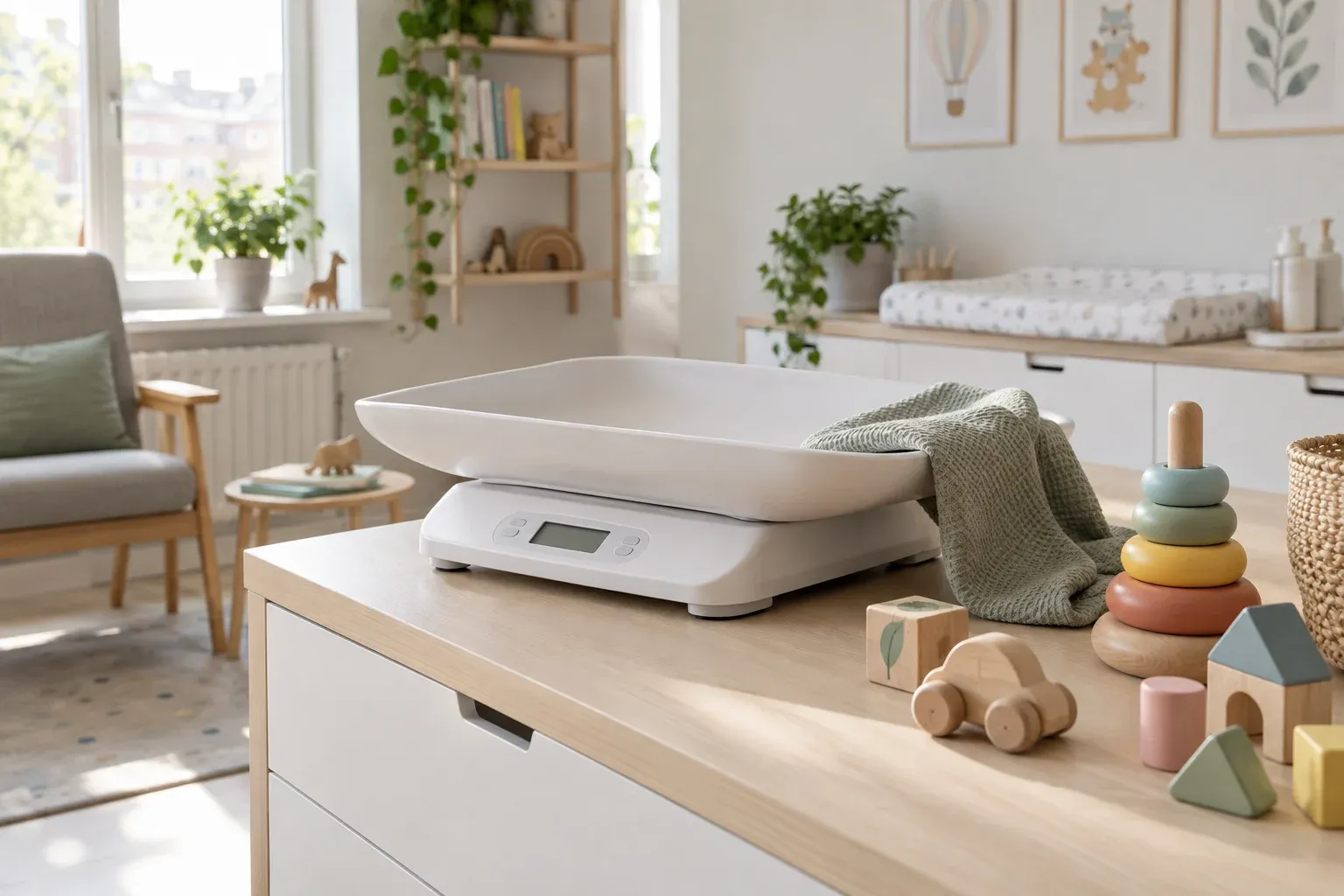
Every Swedish parent knows three letters: BVC. Here is what the child health centre does, how often you will go, which vaccines your child gets and when, what changes in 2027, and who is entitled to it.
When you need this
You are moving to Sweden with a baby or a child under six, or your child was just born here and a nurse wants to visit your home. Perhaps you were handed a vaccination schedule in Swedish, or your child was vaccinated abroad and you need to know what is missing. Or you are visiting with a baby and wonder whether you can drop in at a BVC.
What a BVC is, and what it is not
Barnhälsovård (child health care) is the preventive half of Swedish care for small children. The 21 regions run it, and it is delivered at a barnavårdscentral, BVC, which is usually located inside a vårdcentral (primary-care health centre). Your main contact is the BVC-sjuksköterska, a nurse specialized in child health, with a doctor joining at some visits.
The BVC follows growth and development, supports parents and gives the vaccinations. It does not treat sick children. If your child has an infection, stay away from the BVC so the newborns in the waiting room are not exposed, and contact the vårdcentral or call 1177 instead (see 1177, Sweden’s medical advice line). For a child who seems seriously ill, call 112.
| Situation | Where to go |
|---|---|
| Check-ups, growth, development | BVC |
| Routine vaccinations before school | BVC |
| Parent support and parent groups | BVC |
| A child with an infection | Vårdcentral, or call 1177 |
| A child who seems seriously ill | Call 112 |
Visits are free and voluntary, and 1177 says you can get an interpreter if you do not speak Swedish. Ask for one when you book.
The visit programme from birth to five
The content of BVC is set nationally. Rikshandboken för barnhälsovård, the regions’ shared national handbook, lays down a three-tier programme: a basic programme offered to every child at fixed ages, with extra visits for families with greater needs, adoptive families and foster placements. The overview approved on 13 May 2026 lists about 18 contacts:
| Age | Where | What stands out |
|---|---|---|
| 1 week | Home visit | First contact after you come home |
| 2, 3 weeks | BVC | Weight, feeding, how the family is doing |
| 4 weeks | BVC, nurse and doctor | Physical examination |
| 6, 8 weeks | BVC | Postnatal-depression screening of the birth parent; first rotavirus dose |
| 3, 4, 5 months | BVC | Vaccinations; individual talk with the non-birthing parent |
| 6 months | BVC, nurse and doctor | Examination and development check |
| 8 months | Home visit | Child safety in your home |
| 10, 12 months | BVC (doctor at 12) | Vaccinations at 12 months |
| 18 months | BVC | Development; measles-mumps-rubella |
| 2½, 3 years | BVC (doctor at 3) | Language screening |
| 4 years | BVC | Hearing and vision |
| 5 years | BVC | Booster vaccination; summary before school |
During the first year every parent is also offered group support, the föräldragrupp (parent group). At each visit the nurse asks about the family situation, measures growth and talks about health.
If you have a newborn in Sweden, the maternity ward notifies the BVC, and in many regions the first visit takes place in your home.
The vaccination schedule
The vaccines rest on law. The Communicable Diseases Act obliges regions to offer the national vaccination programmes and makes those vaccinations free for the patient. The government decides which diseases are included: eleven today. Vaccination in Sweden is voluntary, and parents decide.
| Age | Vaccine | Given by |
|---|---|---|
| 6 weeks | Rotavirus (drops), dose 1 | BVC |
| 3 months | Diphtheria, tetanus, pertussis, polio, Hib and hepatitis B in one injection; pneumococcal injection; rotavirus dose 2 | BVC |
| 5 months | Same injections; rotavirus dose 3 | BVC |
| 12 months | Same two injections | BVC |
| 18 months | Measles, mumps, rubella | BVC |
| 5 years | Diphtheria, tetanus, pertussis, polio booster | BVC |
| School years 1–2 | Measles, mumps, rubella, dose 2 | Elevhälsan (school health services) |
| School year 5 | HPV, two doses | School health services |
| School years 8–9 | Diphtheria, tetanus, pertussis | School health services |
Two details many English-language pages get wrong:
- Rotavirus is three doses, and the window is strict. The first dose must be given before 12 weeks, the second before 16 and the third before 32. Preterm babies get the first dose in hospital.
- Hepatitis B is a regional programme, not a national one. It is not on the government’s list, but Folkhälsomyndigheten recommends it for all infants and every region gives it free, in the same injection. For you as a parent nothing differs.
Tuberculosis (BCG) vaccine is a separate risk-group programme, offered only to children with a higher risk of exposure.
New in 2027: chickenpox
From 1 January 2027, chickenpox (vattkoppor) joins the national childhood programme. It covers children born on or after 1 July 2025, with dose 1 at the 18-month BVC visit and dose 2 in school years 1–2. From 1 March 2027 a free catch-up campaign, running to 2033, offers the vaccine to older children up to age 17 who have not had chickenpox.
Changed in 2026: most English-language schedules still list eleven diseases with no chickenpox. The change comes from a government ordinance amendment (SFS 2026:1527) and Folkhälsomyndigheten’s October 2026 guidance.
Who is entitled
Entitlement follows residence, not citizenship. Regions must offer care to people living in the region, and the duty to offer vaccinations points to the same group.
| Your situation | BVC and programme vaccines |
|---|---|
| Registered as living in Sweden (folkbokförd) | Yes, free |
| Asylum-seeking child or child with temporary protection | Yes, same extent as residents |
| Undocumented child, not on a temporary stay | Yes, same extent as residents |
| Residence permit, not yet registered | Care is charged at full cost until registration |
| Tourist or short visit | Immediate care only, not the preventive programme |
For a visiting family, the practical answer is simple: take routine vaccinations at home, and if your baby seems unwell, call 1177 on +46 771-11 77 00 for advice (see Sweden with a baby or toddler). For a child who seems seriously ill, call 112.
Moving to Sweden with a young child
- Get registered first. BVC and vårdcentral listing follow residence, normally population registration with Skatteverket; see the personnummer. A permit holder who needs care before being registered pays the full cost, so keep insurance for that gap (see healthcare as a new resident).
- Choose a vårdcentral for your child. In many regions that also chooses the BVC; if you choose none, the region assigns one near your home.
- Call the BVC. Phoning or visiting is the usual first contact. Ask for an interpreter when you book.
- Bring the vaccination records. The nurse compares them with the Swedish schedule. Doses given abroad count; you do not start again.
- Expect catch-up doses. Missing vaccines are offered free up to age 18, by the BVC before school and by school health services after. Hib and pneumococcal catch-up only runs to age six, and rotavirus only in early infancy.
Working parents can take vab (temporary parental benefit) for BVC visits; see vab for sick children. When your child starts school, school health services take over (see Swedish schools for newcomer families).
Practical information
| Item | What to know | Checked |
|---|---|---|
| BVC visits, including home visits | Free | 2026-10-14 |
| National-programme vaccinations | Free by law for those covered | 2026-10-14 |
| Hepatitis B for infants | Free through regional programmes | 2026-10-14 |
| Chickenpox vaccination from 2027, incl. catch-up | Free | 2026-10-14 |
| Care before population registration (non-EU permit holder) | Full cost, set by the region | 2026-10-14 |
| 1177 from a foreign phone | +46 771-11 77 00 | 2026-10-14 |
FAQ
What is a BVC in Sweden?
A BVC, barnavårdscentral, is a child health centre. It follows your child’s growth and development from birth until school start, supports parents and gives the childhood vaccinations. It is usually inside a vårdcentral, run by the region, free and voluntary. A sick child goes to the vårdcentral or calls 1177 instead, because the BVC is for check-ups.
How many BVC visits are there?
Rikshandboken’s national programme, approved in May 2026, lists about 18 contacts for every child: weekly early on, monthly around the vaccinations, then at 18 months, two and a half, three, four and five years. Two are home visits, in the first week and at eight months. Families with greater needs get extra visits.
What vaccines does a BVC give?
Rotavirus drops at six weeks, three and five months; a combined injection against diphtheria, tetanus, pertussis, polio, Hib and hepatitis B plus a pneumococcal injection at three, five and twelve months; measles-mumps-rubella at 18 months; and a booster at five. From 1 January 2027 chickenpox is added at 18 months for children born from 1 July 2025.
Is BVC free?
Yes. Visits are free, and vaccinations in the national programme are free by law. Hepatitis B, which is a regional programme, is also free. The catch is entitlement: the programme is for children living in Sweden. A family with a residence permit that needs care before population registration pays the full cost.
Can tourists use BVC?
Not for routine check-ups. Regions must give non-residents immediate care, but the preventive programme is for residents, asylum-seeking children and undocumented children. A visiting family with a baby who seems unwell should call 1177 on +46 771-11 77 00 for advice, or 112 in an emergency. Plan routine vaccinations at home.
My child was vaccinated abroad. What happens?
Bring the vaccination records to the first BVC visit. The nurse compares them with the Swedish schedule and offers the missing doses free; school health services do the same for older children. Catch-up runs up to 18, but Hib and pneumococcal only to six, and rotavirus only in early infancy. Doses already given count.
Do I have to vaccinate my child in Sweden?
No. 1177 states that all vaccination in Sweden is voluntary, and parents decide. The BVC nurse offers each dose at the age in the schedule and can explain what it protects against. If you wait or change your mind, catch-up doses stay free up to 18, though Hib, pneumococcal and rotavirus have earlier limits.
Related guides
- Healthcare as a new resident — vårdcentral listing, fees and the registration gap
- VAB: staying home with a sick child — paid leave that also covers BVC visits
- Sweden with a baby or toddler — what visiting families do instead of BVC
- Swedish schools for newcomer families — where school health services take over
- The personnummer — the registration that opens BVC and the vårdcentral
Facts verified 2026-10-14. Sources: Sveriges riksdag (Smittskyddslag 2004:168, Smittskyddsförordning 2004:255, Hälso- och sjukvårdslag 2017:30, Lag 2008:344, Lag 2013:407), Folkhälsomyndigheten, Regeringskansliet, Rikshandboken för barnhälsovård and 1177 — full register in this topic’s source file. This is general information, not medical advice. Found something outdated? Tell us and we’ll fix it.