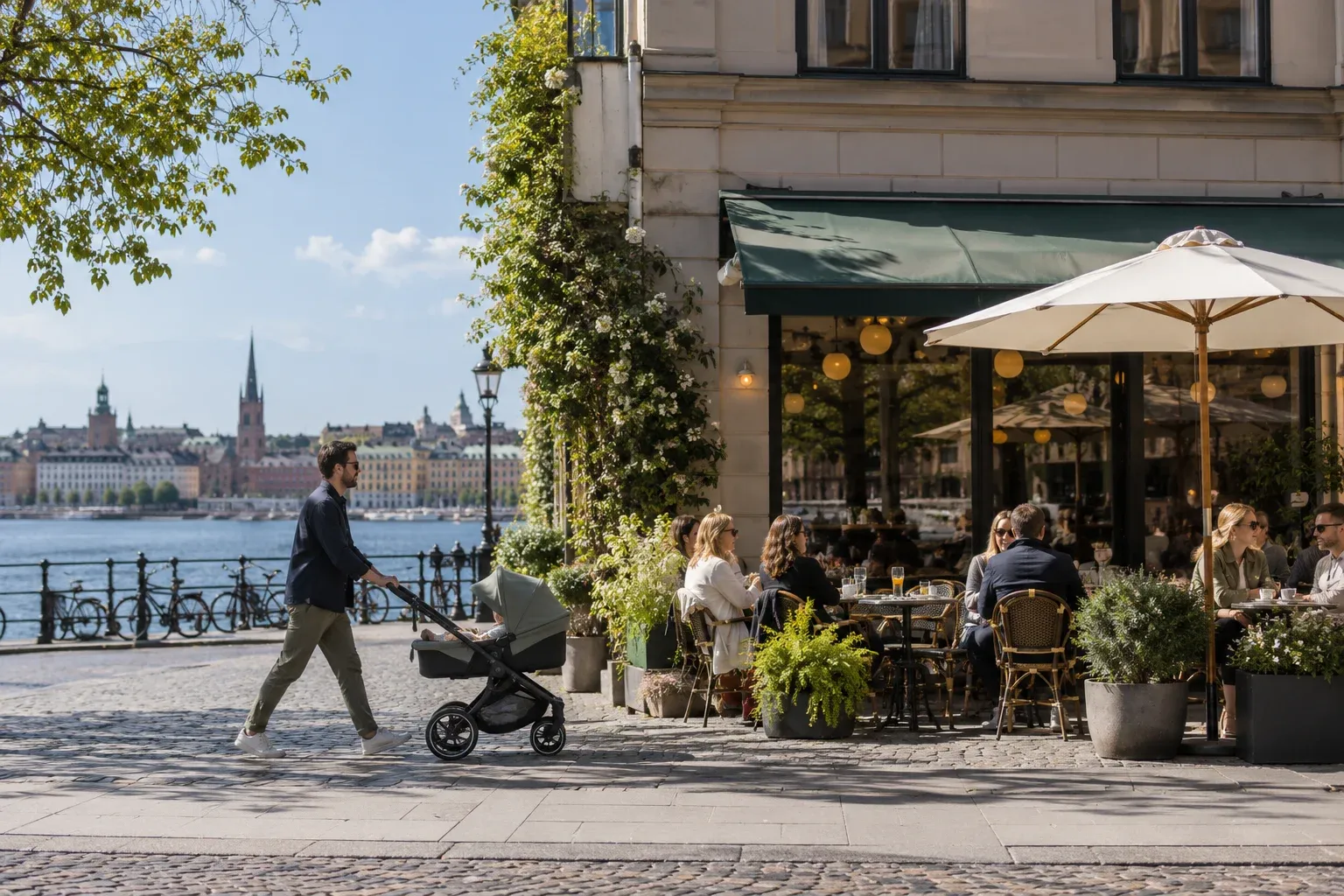
Walk through any Swedish city on a Tuesday morning and you’ll see prams in cafés, on buses and in museums, many of them pushed by men. That isn’t a cultural quirk. It’s a benefit system designed to get both parents home, and it shapes what you meet as a visitor.
When you need this
Maybe you’ve noticed how many fathers push prams on weekdays and want to know why. Or you’re traveling with a baby and wonder how family-friendly cafés, buses and toilets really are. You might be moving to Sweden, or working here, and want to know whether you’ll get parental benefit. Or a Swedish colleague is “on föräldraledighet” (parental leave) for months, or out on vab at short notice, and you’d like to understand what that means.
How Swedish parental leave works
Sweden introduced föräldraförsäkringen (parental insurance) in 1974, replacing maternity benefit. Försäkringskassan, the Swedish Social Insurance Agency, describes it as the first general parental benefit in the world open to both mothers and fathers. Today the system rests on one shared pot of days per child:
| Part of the system | What parents get |
|---|---|
| Total föräldrapenning (parental benefit) | 480 days per child, about 16 months |
| Income-related days | 390 days at roughly 80% of salary, up to a ceiling |
| Minimum-level days | 90 days at a flat rate, regardless of income |
| Each parent’s share | 240 days, of which 90 income-related days are reserved |
| Double days | Up to 60 days with both parents home, in the first 15 months |
| Transfer to another carer | Up to 45 days per parent, for example to a grandparent |
| 10 days at birth | For the non-pregnant parent, within 60 days of homecoming |
The first 180 days taken for a child must be at the income-related level. Days can be taken in fractions, as three-quarter, half, quarter or one-eighth days, which is how many Swedes work shorter weeks for years. Benefit can be saved until the child turns 12 or finishes year 5 of school, but only 96 days may remain after the fourth birthday.
The money is only half of it. Föräldraledighetslagen, the Parental Leave Act, gives every parent the right to full leave from work until the child is 18 months old, with or without benefit. It also gives the right to cut normal hours by up to a quarter until the child turns 8 or finishes the first school year. From 1 July 2028 that end point moves to the second school year, when Sweden switches to a ten-year compulsory school.
Why so many dads: the reserved days
Of each parent’s 240 days, 90 income-related days are reserved and cannot be transferred to the other parent. Nobody is forced to take leave, but a father who doesn’t take his days simply loses them. A sole custodian gets all 480.
The reservation came in three steps. In 1995 Sweden reserved 30 days, nicknamed pappamånaden (“the daddy month”). A second month followed in 2002 and a third in 2016. In July 2024 double days rose from 30 to 60 and the transfer to grandparents arrived. So if a guide quotes “60 reserved days” or “30 double days”, it is out of date.
The result is real but not equal. In 2025 men took 31% of all parental-benefit days and women 69%, according to Försäkringskassan. Fathers on leave are common enough to have a nickname: lattepappor, “latte dads”, after the coffee they drink while the baby sleeps. It’s affectionate and a little teasing.
VAB, preschool and the rest of the system
Two more pillars explain the rhythm of Swedish family life.
VAB (vård av barn, care of a sick child) pays a parent to stay home with a sick child, normally from 8 months until the day before the child turns 12. It covers up to 120 days per child per year. From the 8th day of illness you need a certificate from a doctor or nurse, and since 1 April 2026 you must apply within 30 days. “Vabba” is an everyday verb, and women take just over 60% of these days. Since 1 January 2026, parents of children with an illness or disability can also take VAB to brief preschool staff on care needs or to attend related meetings.
Preschool (förskola) must be offered to children resident in Sweden from age one, to the extent their parents work or study. From the autumn term of the year a child turns three, 525 hours a year are free.
What it means for visitors
You can’t claim any of this as a tourist, and you don’t need to. What you’ll notice are the side effects:
- Prams everywhere. Cafés, museums and playgrounds fill with parents on leave on weekdays. A café with prams parked outside is a good sign for families.
- Buses built around strollers. Board through the middle doors, where the stroller area is. The stroller itself rides free, but the adult usually pays. In Stockholm, SL lets one adult with a child in a stroller ride free only on buses whose ticket readers are at the front doors alone. Our guide to strollers on Swedish public transport covers every operator.
- Changing tables in men’s toilets. Skötbord are common in men’s toilets as well as women’s, in shopping centres, stations and museums.
- Babies napping outdoors. A pram parked outside a café window, even in winter, is usually being watched from inside. It’s a Swedish habit, not neglect.
- Öppen förskola. Open preschools are municipal drop-ins for children 0–6 with their parent. In Malmö they’re free, need no registration, and the adult stays responsible for the child. Ask locally whether visitors are welcome, because Malmö’s page doesn’t say.
Watch out: “Parents with prams ride free” is a Stockholm bus rule, not a Swedish one, and in Stockholm it applies only on buses with ticket readers at the front. On Västtrafik in Gothenburg the child and stroller ride free and the adult pays. Getting it wrong means an inspector’s surcharge.
If you do business in Sweden, plan around two seasons. In July many parents combine summer holiday with parental leave, and offices go quiet. In winter, especially February, colds and stomach bugs send parents home on VAB. Swedes call it vabruari, so build slack into deadlines.
Moving to Sweden with a child
Parental benefit depends on being insured in Sweden, which usually means living or working here. The child must also live in Sweden, another EU/EEA country or Switzerland. If you settle in Sweden from 1 January 2027, you must also qualify through five years’ residence or an income fast track before getting the basic and minimum levels; the income-related level is not affected.
The surprise for many newcomers is the day count. A child who becomes resident in Sweden after the first birthday gives 200 days in total, and 100 after the second birthday, instead of 480. Children born in 2015 or earlier had 60 reserved days per parent rather than 90.
Preschool works the same way: it’s for resident children, and the municipality must offer a place within four months of your application. A short stay won’t get your child into the local förskola. For insurance and tax on longer stays, see our guide to working remotely from Sweden.
Mistakes to avoid
- Calling a Swedish father “babysitting” his own child. The leave is shared by design, so the remark lands badly. Say “on parental leave”.
- Thinking the reserved days can be transferred. They can’t. Unused, they’re gone.
- Quoting old numbers. It’s 90 reserved days (since 2016) and 60 double days (since July 2024).
- Believing paternity leave is compulsory. Nothing forces a father to take leave. He just loses his reserved days.
- Tapping for free on any bus with a pram. Check the operator’s rule first.
Practical information
| Item | Detail (checked 2026-10-05) |
|---|---|
| Who pays benefit | Försäkringskassan, the Swedish Social Insurance Agency |
| Days per child | 480 (twins 660, triplets 840) |
| Reserved per parent | 90 income-related days |
| Income-related level | About 80% of salary up to a ceiling; Försäkringskassan publishes the current daily maximum |
| Minimum level | SEK 180 per day |
| VAB | Up to 120 days per child per year, child aged 8 months to 11 |
| Child moving to Sweden after age 1 | 200 days; after age 2, 100 days |
| Leave from work | Full leave until 18 months; up to 25% shorter hours until age 8 |
| Preschool | From age 1 for residents; 525 free hours a year from the autumn the child turns 3 |
| Öppen förskola | Free in Malmö, no registration; other municipalities set their own terms |
| Stroller on local buses | Stroller free; the adult usually pays, rules by operator |
FAQ
How long is parental leave in Sweden?
Parents share 480 days of paid parental benefit per child, about 16 months. Of these, 390 days pay roughly 80% of salary up to a ceiling and 90 days pay a flat SEK 180. Each parent has 90 income-related days that cannot be transferred. Separately, the law gives every parent the right to full leave from work until the child is 18 months old.
Do fathers in Sweden have to take parental leave?
No one is forced to take leave, but 90 income-related days are reserved for each parent and cannot be handed to the other. If a father does not use his, they are lost. The reserved months came in 1995, 2002 and 2016, and in 2025 men took 31% of all parental-benefit days, up from almost none in the 1970s.
What is a latte dad?
A lattepappa is the Swedish nickname for a father on parental leave who spends weekdays pushing a pram, often with a coffee in a café. The phrase is affectionate and a little teasing. It became a symbol of Sweden’s shared parental leave, where each parent has 90 days reserved, so fathers with babies on weekday mornings are an ordinary sight.
Can tourists or foreigners get Swedish parental benefit?
Tourists cannot: you must be insured in Sweden, which usually means living or working here, and the child must live in Sweden, the EU/EEA or Switzerland. Newcomers who move with a child should know that a child who becomes resident after the first birthday gives only 200 days, or 100 after the second birthday, instead of 480.
What is VAB in Sweden?
Vab (vård av barn) is paid leave to care for a sick child, usually from 8 months until the day before the child turns 12. Parents can claim up to 120 days per child per year. “Vabba” is an everyday verb, and colleagues vanishing at short notice in winter, jokingly called vabruari, is normal. Women take just over 60% of these days.
Do parents with strollers ride free on Swedish buses?
Only partly. The stroller itself rides free, but the adult usually pays. In Stockholm, SL lets one adult with a child in a stroller ride free on buses whose ticket readers are only at the front doors; on lines with readers at every door the adult pays. Västtrafik and Skånetrafiken state no free-adult rule, so check the operator before you board.
Can visiting families use Swedish preschools?
Not as a drop-off service. Swedish law offers förskola to children resident in Sweden, from age one, and a place comes within four months of applying. Visiting families can instead try an öppen förskola, a municipal drop-in for children 0–6 where the parent stays. Malmö’s are free with no registration; ask the local municipality whether visitors are welcome.
Related guides
- Strollers on Swedish public transport: who pays, operator by operator
- Traveling in Sweden with a baby: changing tables, breastfeeding and car seats
- Sweden with kids: free transport for small children, museums and playgrounds
- Gender equality in everyday Sweden: the bigger picture behind the latte dads
- Swedish work culture: why the office empties in July
Facts verified 2026-10-05. Sources: Försäkringskassan, Sveriges Riksdag (Socialförsäkringsbalken, Föräldraledighetslagen, Skollagen), SL, Västtrafik, Skånetrafiken and Malmö stad. The full register is in this topic’s source file. This page explains the system and is not legal or benefits advice. Found something outdated? Tell us and we’ll fix it.