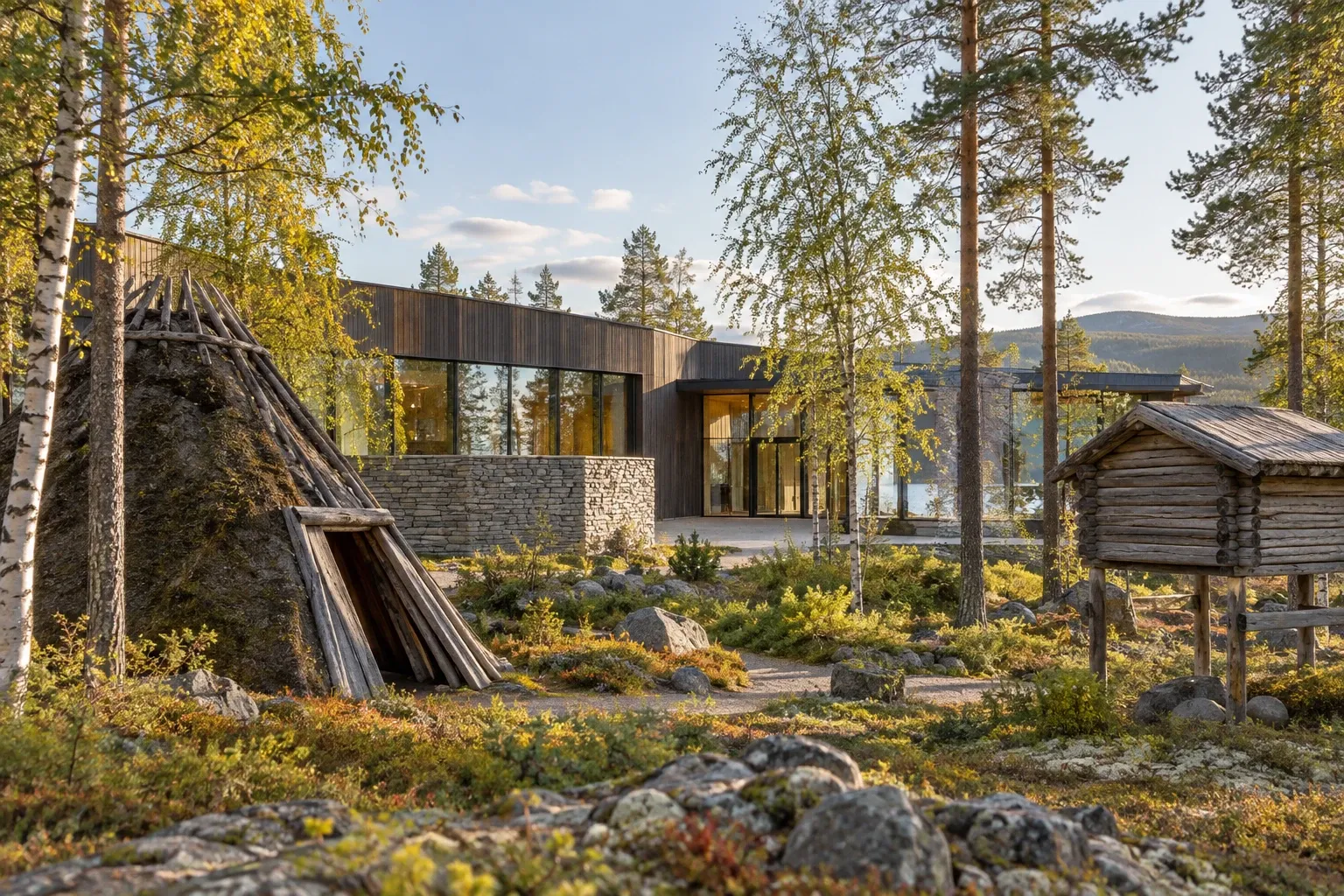
Ájtte is where Sweden’s main Sámi museum explains Sámi life before you meet it, and its calendar catches out visitors more often than its exhibits do. Here is what is inside, who it suits, and how to arrive on a day it is open.
When you need this
You are driving the E45 or riding the Inlandsbanan through Lapland and wondering whether Ájtte is worth a stop. Maybe you are coming for the February market, traveling with children or a wheelchair user, or you want Sámi history told by a Sámi institution before you stay with a Sámi host. For the village itself and how to get there, read our guide to Jokkmokk.
What Ájtte is
Ájtte is the Sámi word for a storage hut, and the museum says it means to work exactly like one: a storehouse where things are kept for the future and brought out when they are needed. Its full name is Ájtte, Svenskt Fjäll- och Samemuseum, the Swedish Mountain and Sámi Museum, and it describes itself as the main museum of Sámi culture in Sweden and a specialist museum for the nature and culture of the mountains.
It is not a state agency. A foundation formed in 1983 runs it, set up by the Swedish state, Norrbotten County Council, Jokkmokk municipality and two Sámi organizations, Svenska Samernas Riksförbund and Same Ätnam. Jokkmokk had a smaller museum from 1965; it was merged into the new building, which opened in June 1989 with eight times the floor area. The museum’s field stretches across the traditional Sámi settlement area, from the mountains in the west through the forest land, about 1,000 km from north to south.
Ájtte is also the Jokkmokk entrance to the Laponia World Heritage site, where a virtual flight takes you over the area. The other entrances are in Gällivare, Kvikkjokk and Porjus, and the main visitor center is naturum Laponia at Stora Sjöfallet.
Inside the permanent exhibition
The permanent exhibition, Här i Sápmi (“Here in Sápmi”), is about living and surviving on the bog, in the forest and on the mountain, from the melting of the ice sheet to today. It is laid out like a reindeer separation corral. You begin in the Gamla hallen (old hall), where a låvdagoahte, a Sámi tent kåta, shows the kind of dwelling families lived in all year until the 1950s. A long passage, Tidens gång (the passage of time), leads to the Round Room at the center, and openings lead from there into each section.
| Section | What you find |
|---|---|
| Trumtid (the time of the drums) | Pre-Christian Sámi religion: drums, sacred places, the noajdde (religious leader) and the bear rites |
| Samisk dräkt och silver | Sámi dress from nine areas in Sweden, and the silver worn with it |
| Att reda sig (making do) | How birch and reindeer gave food, clothing and tools, in a room shaped like a kåta |
| På väg (on the move) | Paths, waterways, snow, skis and reindeer caravans |
| Nybyggarliv (settler life) | A settler family’s year about a century ago; the mother and grandmother were Sámi |
| Laponia – mitt och världens arv | The World Heritage site as a Sámi cultural landscape |
| Isande vandring (an icy walk) | The Jokkmokk winter market and the village through the centuries |
| Duodje | Sámi handicraft |
| Laponiakollen, LaponiaMania, Sarredievvá | Interactive and children’s rooms |
Three things are worth slowing down for. In Trumtid, the museum’s teachers’ guide says only 71 Sámi drums survive, spread across Europe, and that eight of them can be seen here, beside a bear grave about 1,000 years old from an island in Lake Karats, the oldest one found. In the dress section, the museum explains that a person’s dress (gapta, kolt) follows where their family comes from, not where they live. And the silver is a myth-buster: Sámi did not make it. They ordered it from town silversmiths, often as a silver copy of an object in horn or wood.
Guide booklets come in Swedish, English, German, Dutch and French, and the audio guide in Swedish and English; the price page also lists German.
Visiting with children
Ájtte works well for families. In the children’s exhibition Sarredievvá (Blueberry Slope), kids fish in a stream, throw a lasso, bake, barter on a market street and work in a carpentry shed. In LaponiaMania they complete nine missions about the World Heritage site, keep score with calf-ear notches, as herders do at summer calf marking, and can collect a prize at reception.
Children up to 16 go free with a parent or guardian, a rule stated on the 2026 price page; the 2027 sheet does not list child prices, so ask at the desk if it matters.
Accessibility, photos and practical rules
- Wheelchairs: all exhibitions can be reached by wheelchair, with accessible parking by the main entrance and accessible toilets.
- Hearing: the auditorium has a hearing loop.
- Allergies: reindeer skins and furs are part of the exhibitions, and the shop may smell of perfumed soaps.
- Photography: unless a sign says otherwise, you may photograph and film for private use or your own school work. Avoid flash, because many objects are sensitive to strong light. Commercial photography needs the museum’s agreement first.
- Guided tours: 150 kr per person including entry, minimum 900 kr per group, and must be prebooked.
- Food and shopping: the museum restaurant reopened under a new operator on 1 June 2026, serving local and Sámi-inspired food during museum hours. The shop sells books on the Sámi, silver jewelry and handicraft; for genuine duodji, look for the Sámi Duodji mark explained in our Jokkmokk winter market guide.
The mountain garden and Hamberg’s hut
A few hundred meters from the museum, by the Kvarnbäcken stream where it leaves Lake Talvatis, Ájtte Fjällträdgård (the mountain garden) is free. About a dozen themed areas recreate mountain environments, from snowbeds and south-facing slopes to meadow birch forest, and a small building shows photographs of mountain flowers. In 2026 it was open daily 10–17 from 8 June to 30 August; it is closed in winter. You can park beside it, and the north entrance has a path adapted for visitors with limited mobility. Garden tours cost 50 kr per adult, with a minimum of five people, and are booked and paid at the museum reception.
The garden also holds a research hut built by Axel Hamberg (1863–1933), the Uppsala geographer who mapped Sarek. He built five huts there between 1911 and 1914. The one from Tjågnoris was moved for a 1967 exhibition, later taken down, and rebuilt in the garden in 1995.
Ájtte in market week
Market week 2027 brings two changes worth knowing. The hours are Tuesday to Saturday, 2–6 February, 10–17 and Sunday 7 February 12–16, not the daily 09–18 of 2026 that older pages still repeat. And for the first time, every programme item is included in the 120 kr ticket: films and talks in the auditorium, joik in the old hall and guided tours. The market exhibitions open on the Wednesday of market week.
Outside in the museum park, coffee with kaffeost (cheese dunked in coffee) by the fire, a reindeer visit on Friday and Saturday afternoons and a drop-in portrait studio are free. Monday 1 February is an ordinary closed Monday. For the market itself, see the Jokkmokk winter market guide; for the national day that falls around it, see Sámi National Day.
Archive, library and the return of Sámi collections
Behind the exhibitions, Ájtte keeps an archive with a large collection of sound recordings, a picture archive of about 100,000 photographs, and natural-history collections. It is one of five museums in Sweden permitted to care for state-owned wildlife. The archive and library sit in the Ája wing, entered from Lärargatan, sharing the space with Sametinget’s library. They open on Tuesdays 14–18, and in even-numbered weeks also Wednesday and Thursday 13–15. Contact them ahead if you want archive material. From home, more than 10,000 object photographs are free to browse in the museum’s online collection.
Ájtte is also central to returning Sámi objects to Sápmi. In 2024 the government let Uppsala University hand over ownership of 84 Sámi objects that had been on deposit at Ájtte since the 1990s. In 2026 it funded Nordiska museet in Stockholm, which holds about 10,000 Sámi objects, to prepare the return of its Sámi collections in close collaboration with Ájtte.
Practical information
| Item | Detail (checked 2026-10-15) |
|---|---|
| Address | Kyrkogatan 3, Jokkmokk |
| Adult entry | 120 kr (2026 and 2027); annual card 180 kr |
| Children 0–16 | Free with a parent or guardian (2026 price page) |
| Guided tour | 150 kr per person incl. entry, minimum 900 kr; prebook |
| School groups | Entry 60 kr per pupil; guided 85 kr per pupil, minimum 600 kr |
| Rest of 2026 | Tue–Fri 10–16, Sat 12–16; closed 31 Oct, 24–26 Dec, 31 Dec |
| 2027, most of the year | Tue–Fri 10–16, Sat 12–16 (1 Jan–1 Feb, 8 Feb–9 May, 13 Sept–31 Dec) |
| 2027, late spring and late summer | Tue–Fri 10–16, Sat–Sun 12–16 (10 May–13 June, 17 Aug–12 Sept) |
| 2027, summer | Daily 10–17, 14 June–16 August |
| 2027, market week | Tue–Sat 2–6 Feb 10–17; Sun 7 Feb 12–16; programme included in entry |
| 2027 closing days | 1 and 6 Jan, 26–27 Mar, 1 May, 6 May, 15–16 May, 6 June, 6 Nov, 24–25 Dec, 31 Dec |
| Mountain garden | Free; 2026 season 8 June–30 Aug, daily 10–17; tours 50 kr per adult (min 5) |
| Archive and library | Tue 14–18; even weeks also Wed and Thu 13–15 |
The museum publishes its yearly sheet “with reservation for changes”, so check its hours page before a long drive.
FAQ
How much does Ájtte cost?
Adult entry is 120 kr in both 2026 and 2027, and an annual card costs 180 kr. Children up to 16 go free with a parent or guardian. A prebooked guided tour costs 150 kr per person including entry, with a 900 kr minimum per group. The mountain garden a few hundred metres away is free. In market week 2027, the museum’s programme is included in the ticket.
When is Ájtte open?
In 2027 the museum opens every day 10–17 from 14 June to 16 August. Most of the rest of the year it opens Tuesday to Friday 10–16 and Saturday 12–16, adding Sundays 12–16 in late spring and late summer. It is closed on Mondays outside high summer and on listed holidays, so check the yearly sheet before you travel.
What does Ájtte mean?
Ájtte is the Sámi word for a storage hut. The museum chose it on purpose: it sees itself as a big storehouse where objects, knowledge, stories and joik are kept for the future and brought out when they are needed. The full name is Ájtte, Svenskt Fjäll- och Samemuseum, the Swedish Mountain and Sámi Museum.
Is Ájtte good for children?
Yes. The children’s exhibition Sarredievvá, Blueberry Slope, lets them fish in a stream, throw a lasso, bake, barter and hammer in a carpentry shed. In LaponiaMania they complete nine missions about the World Heritage site and can earn a prize at reception. Children up to 16 enter free with a parent or guardian.
Can you take photos inside Ájtte?
Yes, for private use. Unless a sign says otherwise, you may photograph and film in the exhibitions for yourself or for school work, but avoid flash, because many objects are sensitive to strong light. Commercial photography or filming needs the museum’s agreement first. More than 10,000 object photographs are free to view in the museum’s online collection.
Is Ájtte wheelchair accessible?
Yes. All exhibitions can be reached by wheelchair, there is accessible parking beside the main entrance, accessible toilets and a hearing loop in the auditorium. Reindeer skins and furs are part of the exhibitions, and the shop may smell of perfumed soaps. At the mountain garden, the north entrance has a path adapted for visitors with limited mobility.
What is on at Ájtte during the Jokkmokk winter market?
In market week 2027 the museum opens Tuesday to Saturday 10–17 and Sunday 7 February 12–16. New for 2027, all programme items, including films and talks in the auditorium, joik and guided tours, are included in the 120 kr ticket. Outdoors in the museum park, coffee by the fire and a reindeer visit are free.
Related guides
- Jokkmokk — getting there by bus or car, and what else to see
- The Jokkmokk winter market — dates, beds and cold for the February week
- Sámi culture: a respectful visitor’s guide — the etiquette that the museum’s stories explain
- Staying with a Sámi host — the natural next step once you have the context
- Reindeer in Sweden — who owns them and how to behave around a herd
Facts verified 2026-10-15. Sources: Ájtte, Svenskt Fjäll- och Samemuseum; Länsstyrelsen Norrbotten; Regeringen (Government Offices of Sweden) — full register in this topic’s source file. Found something outdated? Tell us and we’ll fix it.