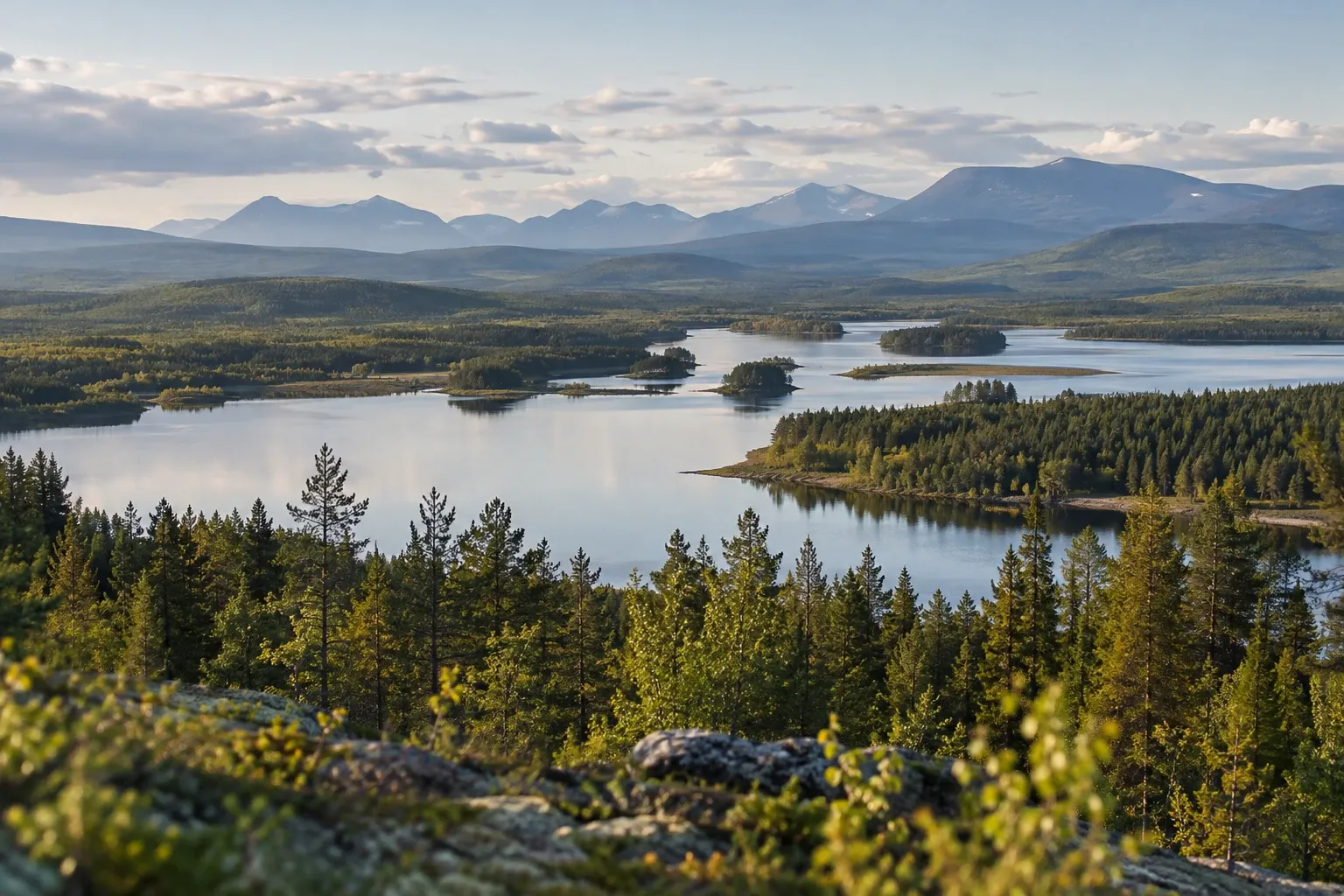
Jokkmokk is small, cold in winter and light all night in June, and it repays a stop at any time of year. This guide explains what the “Sámi capital” label really means, what to see in and around the village, and how to get there without a car.
When you need this
You’re planning a trip through Swedish Lapland and Jokkmokk keeps appearing on the map, on the Inlandsbanan or the E45, or as the gateway to Sarek and Padjelanta. Maybe you want to know whether it’s worth a night outside the famous February market. Maybe you’re arriving at Murjek or Luleå without a car, or you want Sámi culture through a museum and its makers rather than a show. This page covers the village itself; the market has its own guide to the Jokkmokk winter market.
Why “Sámi capital”?
Jokkmokk (Jåhkåmåhkke in Lule Sámi) is the centre of a huge, empty municipality: at 19,474 km² it is Sweden’s second largest, yet SCB counted only 4,701 residents at the end of 2024. The village itself has about 2,700. Around 12,000 people lived in the municipality in the 1950s and 1960s, when forestry and the building of the Lule River power stations brought work.
No institution gives Jokkmokk the title “Sámi capital”. Sametinget, the Sámi Parliament, has its headquarters in Kiruna (see how Sametinget works). The label is a description, and here is what it rests on:
| What | Why it counts |
|---|---|
| A meeting place | Swedish Lapland’s visitors board calls the village a natural meeting place for Sámi from all over Sápmi |
| Ájtte | The Swedish Mountain and Sámi Museum, the main museum of Sámi culture in Sweden |
| Sámij åhpadusguovdásj | A Sámi adult-education centre teaching duodji (Sámi handicraft) and the Sámi languages |
| Laponia | Ájtte is the Jokkmokk entrance to the Laponia World Heritage site |
| The winter market | Held since the early 1600s, now up to about 50,000 visitors in three days |
| The law | Jokkmokk is in the Sámi administrative area under the minority-languages act |
Ájtte and the mountain garden
Start at Ájtte, Svenskt Fjäll- och Samemuseum (the Swedish Mountain and Sámi Museum) on Kyrkogatan, which describes itself as the main museum of Sámi culture in Sweden and is also a specialist museum for the mountains. Its exhibitions cover Sámi life and mountain nature. The museum doubles as the village’s Laponia entrance, where a virtual flight takes you over the World Heritage site.
Adult entry is 120 kr, and children up to 16 go free with a parent or guardian. The opening calendar is the thing to check. Outside high summer Ájtte is closed on Mondays, and from mid-September to early May it is also closed on Sundays. In 2027 it opens every day only from 14 June to 16 August, a day earlier at both ends than in 2026, so plans built on last year’s sheet will be off.
A few hundred meters away, beside the Kvarnbäcken stream, the mountain garden (fjällträdgården) shows arctic plants as a living exhibition. It also has a reconstruction of the research hut that Axel Hamberg, a pioneer of mountain research, built in Sarek. Entry is free. In 2025 it was open daily from 9 June to 24 August, and parts of it are wheelchair accessible.
Walking the village
Everything in the centre is walkable, and most of it costs nothing.
- The old church is an octagonal timber church first consecrated in 1753. It burned down in 1972 and was rebuilt in 1976, with interior colors taken from Sámi dress. Jokkmokk’s first church went up in 1607, which the municipality ties to King Karl IX’s colonisation of Sápmi.
- The Sámi Sculpture Park follows the east shore of Lake Talvatis: six works by Sámi artists made for a 2005 sculpture symposium.
- Uvssat Davás (“the westward doors”) are monumental paintings by Lars Pirak, Bengt Lindström and Lars J:son Nutti at Akkats power station, 3 km out on the E45 towards Gällivare.
- Talvatis trails: the 2.3 km lakeside path works for pushchairs, walking frames and wheelchairs. Kvarnbäcksleden runs 7.7 km through the village with 20 information boards, and Getberget has trails from 1.6 to about 10 km.
- Storknabben is the viewpoint above the village, a place for the midnight sun in summer and the northern lights in winter. The road up is not lit.
Churches are as a rule open in the daytime in summer. At other times, call the parish office. The tourist office, Jokkmokks Infocenter, sits in the municipal building on Västra Torggatan and has trail maps, but it keeps weekday office hours only.
Laponia and the national parks
All four national parks in the municipality — Sarek, Padjelanta, Stora Sjöfallet and Muddus — belong to Laponia, a 9,400 km² World Heritage site inscribed in 1996 for both its nature and its living Sámi reindeer-herding culture.
| Place | Distance and access | What it is |
|---|---|---|
| Muddus/Muttos National Park | Skájdde is the easiest of three entrances, with parking, boardwalks and a toilet | Sweden’s largest forest national park, 49,340 hectares, with a 42-meter waterfall |
| Harsprånget | About 34 km north on the E45 towards Porjus, boardwalk to a viewpoint | Once one of Sweden’s mightiest rapids: a 75 m drop over 4.2 km before the dam |
| Porjus | On the E45 north | The Laponiaporten building, a Laponia entrance with an exhibition on winter herding |
| Kvikkjokk | Bus 47 from Jokkmokk; in summer bus 94 direct from Murjek | Gateway to Sarek National Park and Padjelantaleden |
| Stora Sjöfallet | See the park guide for access | naturum Laponia, the World Heritage visitor center (see Stora Sjöfallet) |
In Muddus you may camp under allemansrätten, the right of public access, for a night or two in one place. Dogs are not allowed in the park except from 1 January to 30 April, and then always on a lead. Most other waters need a fishing licence; the county board’s Jokkmokkskortet covers many lakes and rivers in the mountains, and our fly-fishing guide to Lapland explains the system.
Getting there and around
Jokkmokk is a bus town. The nearest station on the main line is Murjek, and the bus from there takes about an hour. Trunk bus lines also run from Gällivare and Luleå, and on to Östersund. For the train north, see night trains to Lapland and check connections to Murjek on sj.se.
By air, Luleå Airport is 180 km away: take the airport bus to Luleå bus station and change to Länstrafiken, or ride the demand-responsive airport car, line 712, which you must book by phone by 17:00 on the last weekday before you travel. Gällivare airport is 100 km north and Arvidsjaur 155 km south. In summer the Inlandsbanan tourist train stops in Jokkmokk. By car, the village sits on the E45, with road 97 from Luleå and road 374 from Piteå joining from the coast.
Jokkmokk by season
| Season | What you get |
|---|---|
| Midsummer | Midnight sun from about 8 June to early July: STF says to 4 July, the municipality to 6 July |
| Summer | Ájtte open daily, the mountain garden open, the Inlandsbanan running |
| Autumn and winter | Northern lights on clear dark nights; Ájtte on its short-week hours |
| Early February | The winter market, 4–6 February 2027, always starting on the first Thursday of February |
| Deep winter | Four groomed ski tracks at Talvatis (3.5–10.2 km, two lit) and a ploughed ice track with free kicksleds |
Winter here is serious. The market organizer recorded −40 °C in 2012, so read cold safety in Sweden before a long walk on the lake. For the summer light, see the midnight sun in Sweden; for the winter sky, northern lights in Sweden.
Visiting with respect
Reindeer here are working animals. It is prohibited to scare, disturb or drive away reindeer, and if the herd moves off, you are too close. That applies on roads as much as on trails, and our reindeer guide explains why.
If you buy Sámi handicraft, look for the Sámi Duodji mark, for genuine duodji made by a Sámi maker, or Sámi Made, for any product from a Sámi person or company. The foundation behind the Sámi Duodji mark has an exhibition and sales room in Jokkmokk. For etiquette beyond shopping, read Sámi culture: a respectful visitor’s guide.
Practical information
| Item | Detail (checked 2026-10-15) |
|---|---|
| Ájtte, adult entry | 120 kr (2026 and 2027); children 0–16 free with a guardian; annual card 180 kr |
| Ájtte guided tour | 150 kr per person incl. entry, minimum 900 kr per group; prebook |
| Ájtte hours 2027 | Tue–Fri 10–16, Sat 12–16 most of the year; Sat–Sun 12–16 also 10 May–13 June and 17 Aug–12 Sept; daily 10–17 14 June–16 Aug; market week 2–6 Feb Tue–Sat 10–17, 7 Feb 12–16 |
| Ájtte closed 2027 | 1 and 6 Jan, 26–27 Mar, 1 May, 6 May, 15–16 May, 6 June, 6 Nov, 24–25 Dec, 31 Dec |
| Mountain garden | Free; 2025 season 9 June–24 Aug, daily 10–17 |
| Jokkmokks Infocenter | Västra Torggatan 11; Mon–Thu 08–12 and 13–16, Fri 08–12 and 13–15; 0971-222 50 |
| Airport car, line 712 | Book on 0771-100 110 by 17:00 the last weekday before; at most two weeks ahead; fare on Länstrafiken’s site |
| Bus lines | 43 Murjek–Jokkmokk; 44 Gällivare–Jokkmokk–Luleå; 45 Gällivare–Jokkmokk–Östersund; 47 Jokkmokk–Kvikkjokk; summer 94 Murjek–Kvikkjokk |
| Inlandsbanan | Summer only: 16 June–12 August in 2026 |
| Muddus with a dog | Only 1 January–30 April, on a lead |
FAQ
Is Jokkmokk worth visiting outside the winter market?
Yes, especially in summer. Ájtte, the main museum of Sámi culture in Sweden, is open every day from 14 June to 16 August 2027, and the free mountain garden sits a short walk away. Add the old church, the lake trails, Muddus National Park and the midnight sun, and Jokkmokk easily fills two days without the February crowds.
How do I get to Jokkmokk without a car?
Take a main-line train to Murjek, then the bus, which takes about an hour. Trunk bus lines also run from Gällivare and Luleå. From Luleå Airport, 180 km away, take the airport bus to Luleå bus station and change to Länstrafiken, or book the airport car by 17:00 on the last weekday before. In summer the Inlandsbanan stops here.
Why is Jokkmokk called the Sámi capital?
It is an informal label, not an official status; the Sámi Parliament is based in Kiruna. Jokkmokk earns it as a meeting place for Sámi from across Sápmi. The village has Ájtte, the main Sámi museum in Sweden, a Sámi adult-education centre teaching duodji and language, a Laponia World Heritage entrance and the centuries-old winter market.
Is Jokkmokk above the Arctic Circle?
Yes. The village lies on the E45 about 7 km north of the Arctic Circle, so you cross it driving up from the south, and the summer Inlandsbanan crosses it too. That puts Jokkmokk inside the midnight-sun zone: STF lists 8 June to 4 July, and the municipality 7 June to 6 July, so plan for early June to early July.
How much does Ájtte cost and when is it open?
Adult entry is 120 kr in both 2026 and 2027, and children up to 16 enter free with a parent or guardian. In 2027 the museum opens Tuesday to Friday 10–16 and Saturday 12–16 most of the year, daily 10–17 from 14 June to 16 August, with special hours in market week. It is closed on Mondays outside summer.
Can you see the northern lights in Jokkmokk?
Yes, on clear, dark nights in the autumn and winter months; the municipality points to the Storknabben viewpoint above the village. The road up is not lit, so bring a headlamp and dress for deep cold, since temperatures as low as −40 °C have been recorded at market time. For forecasts and timing, see our northern lights guide.
Related guides
- The Jokkmokk winter market — dates, beds, cold and cash for the February week
- Sámi culture: a respectful visitor’s guide — the etiquette behind everything in Jokkmokk
- Swedish Lapland — how Jokkmokk fits the wider region
- Sarek National Park — the wilderness beyond Kvikkjokk
- Reaching the mountains by public transport — the bus chains from Murjek and Jokkmokk
Facts verified 2026-10-15. Sources: Ájtte, Jokkmokks kommun, Länsstyrelsen Norrbotten, Riksantikvarieämbetet, Svenska kyrkan, Sveriges riksdag, SCB, Länstrafiken Norrbotten, Naturvårdsverket — full register in this topic’s source file. Found something outdated? Tell us and we’ll fix it.