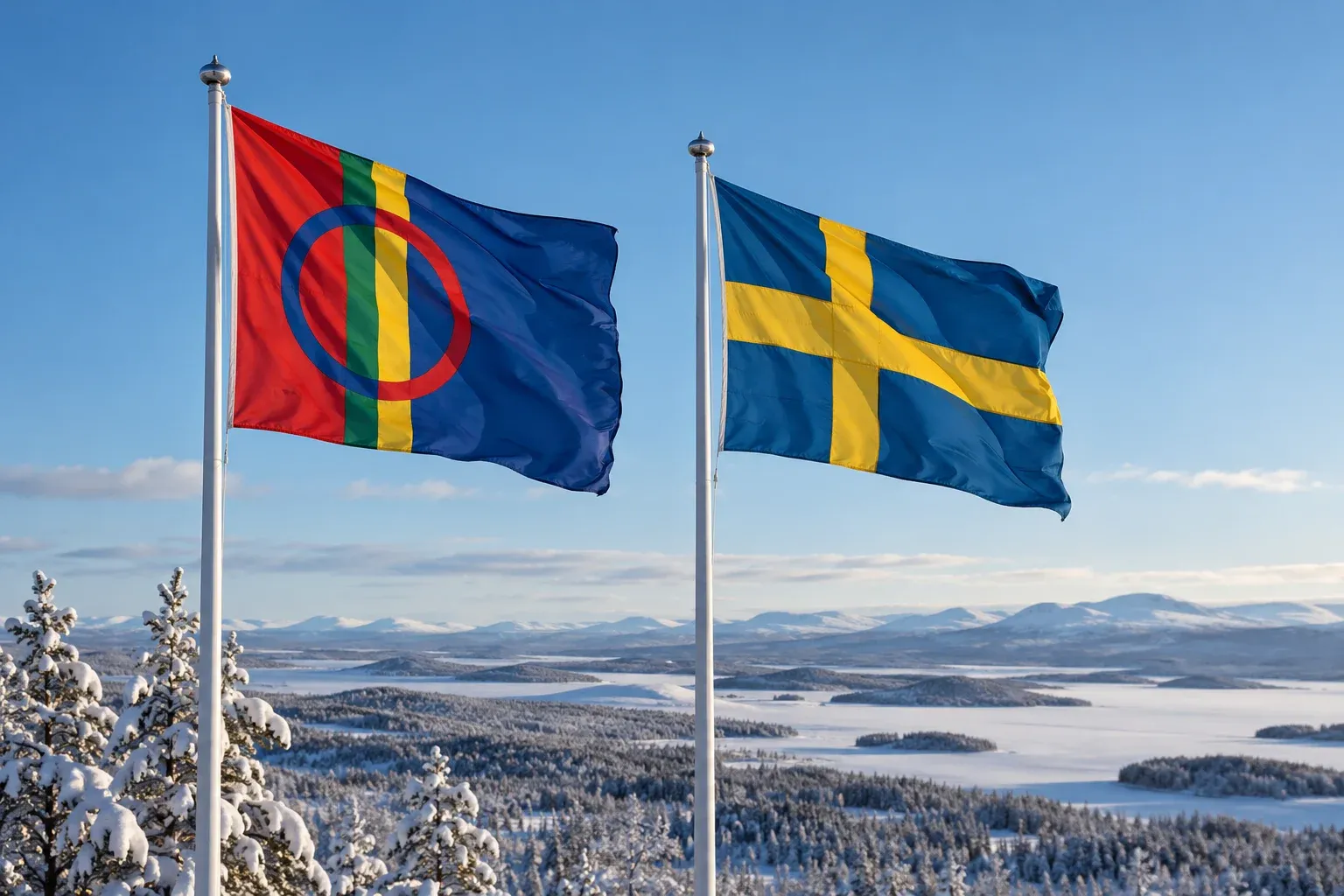
If you’re in northern Sweden in early February, you’ll see a red, blue, green and yellow flag beside the Swedish one. Here’s what the day marks, what its legal status really is, and how to join a celebration as a welcome guest.
When you need this
- You’re in the north in early February and spot the Sámi flag on municipal flagpoles
- You’re planning around the Jokkmokk winter market and wonder what 6 February adds
- You want to know whether offices, schools and shops close
- You’d like to attend a public celebration without getting the etiquette wrong
- Someone tells you Sweden has made 6 February an official flag day
What 6 February marks
Sámi National Day (samernas nationaldag) commemorates the first Sámi national meeting, held in Trondheim, Norway, on 6 February 1917. The South Sámi pioneer Elsa Laula Renberg was one of the people behind that meeting. Today the day is celebrated across the whole of Sápmi, the Sámi homeland that stretches over Sweden, Norway, Finland and Russia.
The national day itself is younger than many people think. The dates are easy to mix up, so here they are side by side:
| Year | What happened |
|---|---|
| 1917 | First Sámi national meeting, Trondheim, 6 February |
| 1986 | Sámi Conference in Åre approves the Sámi flag and anthem (15 August) |
| 1992 | 15th Sámi Conference in Helsinki chooses 6 February as the national day |
| 1993 | First celebration, in Jokkmokk, at the start of the UN International Year of the World’s Indigenous People |
| 2025 | Swedish Parliament rejects making it an official flag day (16 January) |
| 2026 | Parliament rejects it again (25 February, 284 votes to 19) |
Holiday or flag day?
Neither, legally. This is where many English pages go wrong.
Not a public holiday. Sweden’s public holidays (allmänna helgdagar) are listed in the holidays act, and 6 February isn’t on it. It’s a normal working and school day, so shops, offices and public transport run as usual. Celebrations are fitted around the working day.
Not an official flag day. It isn’t among the official flag days (allmänna flaggdagar) in the flag-day ordinance. Parliament has rejected motions to add it twice: on 16 January 2025, and again on 25 February 2026, when the vote was 284 to 19. Both times the Constitution Committee said the flag days had been reviewed in 2022 and it didn’t want to add new ones.
But widely flagged in practice. Many municipalities in the Sámi areas fly the Sámi flag beside the Swedish flag on 6 February, and agencies elsewhere do too. In 2026 the County Administrative Board of Värmland raised it at its Karlstad office, far south of Sápmi. These are local decisions, so one town may fly it and the next may not. The accurate phrase is “customary flag day”. For the full official list, see Swedish flag days.
The Sámi flag and anthem
The Sámi flag dates from 1986. It was designed by Astrid Båhl from Skibotn in Norway and approved by the Saami Council’s Sámi Conference in Åre. Its red, blue, green and yellow come from the Sámi dress, and the circle stands for both the sun (the red half) and the moon (the blue half).
The anthem is Sámi soga lávlla, often rendered as the song of the Sámi people. Isak Saba wrote the text in 1906, Arne Sørlie composed the melody, and the same 1986 conference adopted it as the anthem common to all Sámi. You’ll hear it at most celebrations.
6 February isn’t the only Sámi flag day. Sametinget lists others too:
| Date | Sámi flag day |
|---|---|
| 6 February | Sámi National Day |
| 9 August | UN International Day of the World’s Indigenous Peoples |
| 15 August | The Sámi flag adopted, 1986 |
| 26 August | Opening of Sweden’s Sámi Parliament, late August 1993 |
| 15 November | Isak Saba’s birthday, author of the anthem |
| 29 November | Elsa Laula Renberg’s birthday |
How to join in respectfully
Public flag-raisings, speeches and concerts are open to anyone. Past programmes have combined the flag, speeches, joik (traditional Sámi song), music and fika (coffee and something sweet), sometimes with a film or a lunch. Treat it like being invited to someone else’s national day, because that’s exactly what it is.
- Stand quietly for the flag-raising and the anthem, as the people around you do.
- Ask before photographing people. Sámi guidance says a person in a Sámi dress who isn’t working in tourism must not be photographed without consent. Don’t photograph children without asking a parent.
- Expect to see gákti (the Sámi dress). It’s now worn mainly on special occasions and is a personal marker of who the wearer is and where they come from. Admire it; don’t touch it or ask to try it on.
- Never wear an imitation Sámi costume. Sámi guidance calls imitation dress cultural appropriation, and on this day of all days it gives offence.
- Remember whose day it is. Sámi guidance asks visitors not to treat anyone as an attraction or a prop. You’re a welcome guest, not the audience.
For the wider etiquette, from photos to genuine handicraft, read the Sámi culture guide.
Where to celebrate
There’s no national programme. Municipalities, universities, museums and Sámi associations publish their own events, usually in January, so check locally.
- Jokkmokk is where the day was first celebrated in 1993. The winter market always starts on the first Thursday of February and lasts three days; in 2027 it runs Thursday 4 to Saturday 6 February, so the national day falls on its final day. Ájtte, the Sámi museum, extends its hours that week.
- Kiruna, Luleå, Umeå and Östersund have had speeches, music and flag-raisings by municipalities and universities in past years. See our guides to Kiruna and Umeå.
- Stockholm has hosted a flag ceremony at the City Hall with speeches and joik in past years.
- Elsewhere, agencies and cultural venues raise the Sámi flag too, as Länsstyrelsen Värmland did in Karlstad in 2026.
Dress for real cold. Jokkmokk has seen −40 °C at market time, and only a few years later the thermometer showed temperatures above zero. Outdoor ceremonies are short, but you’ll be standing still.
Mistakes to avoid
- “It’s an official flag day in Sweden.” It’s customary; Parliament said no in 2025 and again in 2026.
- “It’s a day off.” It’s a normal working day under Swedish law.
- “It celebrates the Sámi Parliament.” It marks the 1917 Trondheim meeting; Sweden’s Sámi Parliament opened in late August 1993.
- “The national day dates from 1917.” The meeting does; the day was chosen in 1992 and first celebrated in 1993.
- Turning up without a bed in Jokkmokk. In market years, accommodation sells out months ahead.
Practical information
| What | Details |
|---|---|
| Date | 6 February every year; Saturday in 2027 |
| Legal status in Sweden | Not a public holiday; not an official flag day |
| Public celebrations | Usually free; programmes published locally, often in January |
| Jokkmokk winter market 2027 | Thursday 4 – Saturday 6 February, market area 10:00–18:00, free entry; some side events charge |
| Ájtte (Jokkmokk), market week 2027 | 2–6 February Tue–Sat 10–17, 7 February 12–16; adult SEK 120, children 0–16 with a guardian free |
| Swedish name | samernas nationaldag; also samefolkets dag on some municipal flag calendars |
FAQ
What is Sámi National Day and why is it on 6 February?
Sámi National Day commemorates the first Sámi national meeting, held in Trondheim, Norway, on 6 February 1917; South Sámi pioneer Elsa Laula Renberg was among its initiators. The Sámi Conference chose the date in 1992, and the day was first celebrated in 1993 in Jokkmokk. It is celebrated across Sápmi, the Sámi homeland in Sweden, Norway, Finland and Russia.
Is 6 February a public holiday in Sweden?
No. Sweden’s public holidays are set by law, and 6 February is not on the list. It is a normal working and school day, so offices, shops and public transport run as usual. Celebrations are fitted around the working day, for example at lunchtime, so check the local programme for times before you plan the day.
Is Sámi National Day an official flag day in Sweden?
No. It is not in the flag-day ordinance, and Parliament has rejected motions to add it twice: on 16 January 2025 and again on 25 February 2026, by 284 votes to 19, saying flag days had recently been reviewed. In practice many municipalities, especially in Sápmi, still fly the Sámi flag beside the Swedish one that day.
Can visitors join a Sámi National Day celebration?
Yes. Public flag-raisings, speeches and concerts are open to anyone. Stand quietly for the flag and the anthem, ask before photographing people, especially children and anyone in a Sámi dress who is not performing, and never wear an imitation Sámi costume. Remember it is the Sámi’s own day: you are a welcome guest, not the audience it was made for.
What is the Sámi national anthem?
It is Sámi soga lávlla, often translated as the song of the Sámi people. Isak Saba wrote the text in 1906 and Arne Sørlie composed the melody. The Saami Council’s Sámi Conference in Åre adopted it as the anthem common to all Sámi in 1986, at the same conference that approved the Sámi flag. You will hear it at most celebrations.
What does the Sámi flag mean?
The Sámi flag was designed by Astrid Båhl from Skibotn in Norway and approved at the Sámi Conference in Åre in 1986. Its red, blue, green and yellow come from the Sámi dress. The circle stands for both the sun, the red half, and the moon, the blue half. Sámi flag days include 6 February, 9 August and 15 August.
Where can I celebrate Sámi National Day in Sweden?
Look at municipalities and universities in Sápmi, such as Jokkmokk, Kiruna, Luleå, Umeå and Östersund, and in Stockholm, where past years have included a City Hall flag ceremony. There is no national programme; events are published locally in January. In 2027 the day falls on the last day of the Jokkmokk winter market, the year’s biggest Sámi gathering.
Related guides
- Sámi culture: a respectful visitor’s guide — hosts, photos and genuine handicraft all year round
- The Jokkmokk winter market — the big Sámi gathering in the same week
- Swedish flag days — the official list, and how flagging works
- Sweden’s minority languages — the Sámi languages and the signs you’ll see
- Swedish public holidays — the days that really are off
Facts verified 2026-10-06. Sources: Sametinget (minoritet.se, samer.se), Sveriges riksdag (holidays act, flag-day ordinance, bet. 2024/25:KU8 and 2025/26:KU25), Länsstyrelsen Värmland, Jokkmokks marknad, Ájtte, the Sámi Parliament of Finland and SVT — full register in this topic’s source file. Found something outdated? Tell us and we’ll fix it.