Sweden has been in the EU since 1995 and still prices everything in kronor. Here’s the legal reason, the political one, what changed in 2026, and what it means for the money in your wallet.
When you need this
You’ve arrived from Helsinki, Berlin or Tallinn with euros in your wallet. You assumed an EU country would use the euro. You read somewhere that Sweden “has to” adopt it and wonder whether the currency is about to change. Or you’re moving here and want to know whether your salary and savings will stay in kronor. This page answers all four.
An EU country with its own currency
Sweden’s currency is the krona (plural kronor, written kr or SEK). Sweden joined the EU in 1995, and the European Commission puts its position plainly: Sweden has not yet adopted the euro, but under the Treaty it will do so once it meets the necessary conditions. It has no target date.
That makes Sweden a “Member State with a derogation” — committed in principle, outside in practice. Unlike Denmark, Sweden never negotiated an opt-out. Since 1 June 1998 it has been formally obliged to adapt its laws for joining the Eurosystem, the euro area’s central bank network.
| Fact | Status in 2026 |
|---|---|
| EU member since | 1995 |
| Treaty duty to adopt the euro | Yes, no opt-out |
| Target date | None |
| Krona in ERM II | No — never has been |
| Euro area size | 21 of 27 EU countries (Bulgaria joined 1 January 2026) |
The 2003 referendum
On 14 September 2003, Swedes were asked a single question: should Sweden introduce the euro as its currency? The answer was a clear no.
| Result | Share |
|---|---|
| No | 55.9% |
| Yes | 42.0% |
| Blank | 2.1% |
| Turnout | 82.6% of 7.08 million eligible voters |
The vote was rådgivande — advisory. All six national referendums Sweden has held have been advisory, and the Riksdag decides what to do with the result. Legally, parliament could have ignored it. Politically, every government since has treated the no as settled, and it remains the most recent national referendum in Sweden.
The path there began in 1997, when the government proposed that Sweden should not join the euro at its launch on 1 January 1999 and that any later decision to join should be put to the people.
ERM II: the real lock
Here’s the part most explanations miss. To qualify for the euro, a country must keep its currency in ERM II, the EU’s exchange-rate mechanism, for two years. The Swedish krona has never been in it.
Under Swedish law, joining is not the central bank’s call. The Lag om valutapolitik (1998:1404) says the government decides the exchange-rate regime, after the Riksbank has had the chance to comment. The Riksbank Act then requires the central bank to apply whatever regime the government chooses. No government has chosen ERM II, so the krona floats freely — with what the ECB’s June 2026 Convergence Report calls “a high degree of volatility” against the euro.
The same report flags a second gap. In the ECB’s view, Swedish law still doesn’t fully meet the Treaty’s requirements on central bank independence, the ban on monetary financing, and legal integration into the Eurosystem, and no major changes were made since its 2024 report. On the economic tests, Sweden scores well — low inflation, low debt — but without ERM II it cannot pass the exchange-rate criterion.
Denmark and Finland compared
A Nordic trip can take you through three different currency arrangements in a week.
| Country | Currency | Arrangement |
|---|---|---|
| Sweden | Krona (SEK) | Floats freely; Treaty duty to adopt the euro, no opt-out |
| Denmark | Krone (DKK) | Treaty opt-out; pegged in ERM II since 1999 at 7.46038 per euro, ±2.25% |
| Finland | Euro | Adopted 1 January 1999; notes and coins since 2002 |
Denmark’s opt-out lets it stay outside even if it meets every criterion. Sweden has no such clause — it stays out simply by not joining ERM II. Finland, including the Åland Islands, went the other way, which is why a ferry from Stockholm takes you straight into the euro area.
The 2026 debate
The euro question came back this year. In January 2026, Finance Minister Elisabeth Svantesson (Moderates) said she would quickly appoint a new euro inquiry if she was still in office after the election, citing the changed security situation. The Centre Party and Christian Democrats backed an inquiry; the Sweden Democrats, Left Party and Greens opposed the euro.
In March 2026, the Liberals and Sweden Democrats agreed on 15 points to pursue in government negotiations — one of them a euro referendum on election day 2030.
Then two things happened:
- The governing bloc lost. In the 13 September 2026 election, the four Tidö parties won 173 of 349 seats; the Social Democrats, Left, Centre and Greens won 176.
- Support fell. Statistics Sweden’s May 2026 survey found 28.7% would vote yes and 52.1% no, with 19.2% unsure — down from 32% yes a year earlier.
As of 6 October 2026, a new government is being formed, no euro inquiry has been appointed and no referendum is scheduled. Even if one were, the process — law changes, two years in ERM II, a convergence assessment and an EU decision — would take years.
What it means for your trip
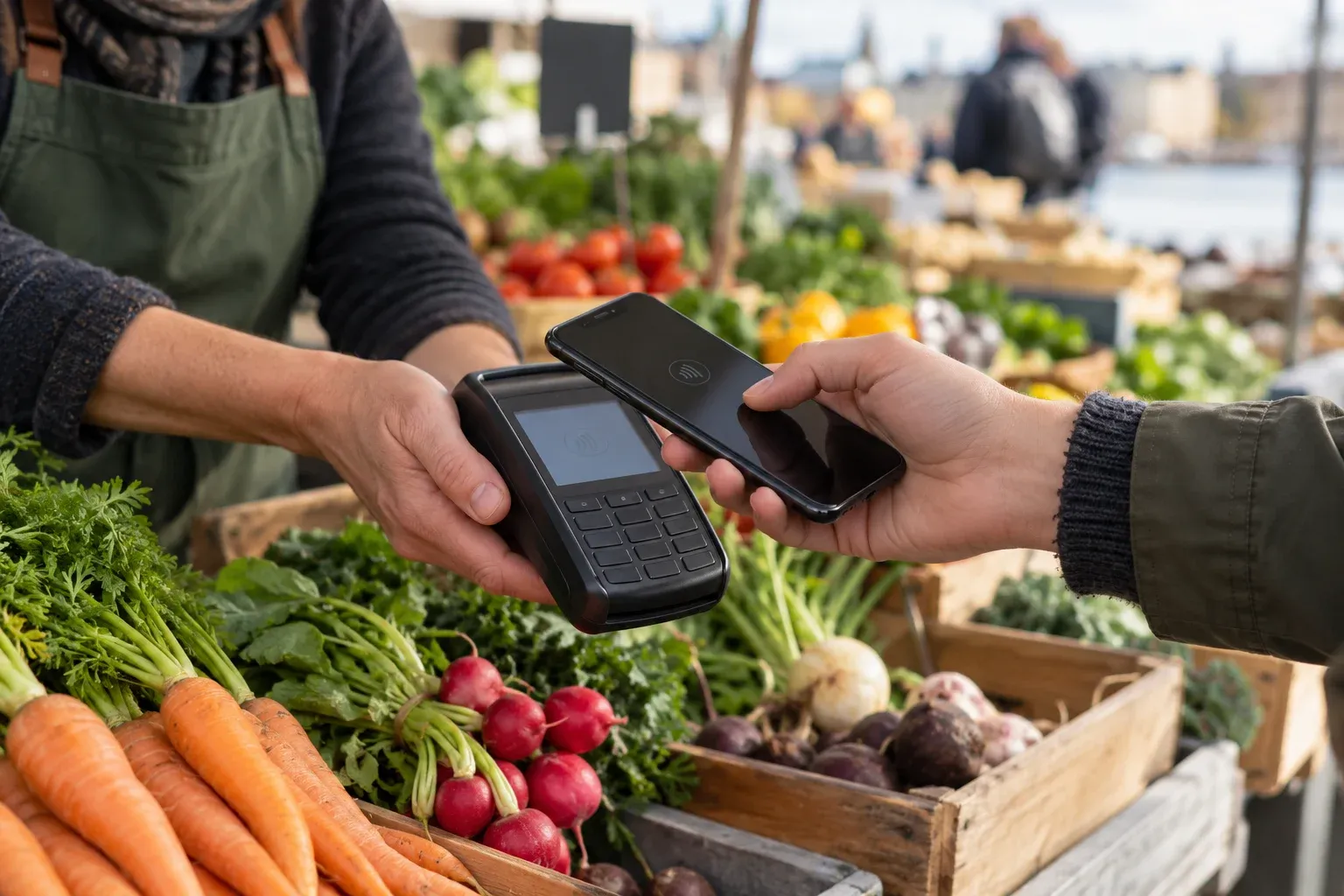
The practical upshot fits in a sentence: Sweden runs on kronor and cards. Under the Riksbank Act, only Riksbank notes and coins are legal tender, so a shop that takes euros does so by choice, at its own rate, and usually gives change in kronor.
Mistakes to avoid:
- Bringing euros to spend. Ordinary shops, cafés and public transport don’t take them. Pay by card in SEK instead — see cards in Sweden.
- Choosing “EUR” at a card terminal. That triggers dynamic currency conversion with a markup; always pay in SEK.
- Exchanging leftover euros in Sweden. Keep them for your next euro-area trip — see exchanging currency.
- Planning around a coming euro. There is no decision, and entry would take several years after one.
A few places do show euro prices — mainly ferries to Finland, Åland, Germany and the Baltics, and some shops near the Finnish border at Haparanda–Tornio. Heading on to Finland? Some Bankomat ATMs dispense euros, charged in SEK; the Hitta Bankomat app shows which.
Practical information
| Item | Details |
|---|---|
| Swedish currency | Krona (SEK, kr); euro not legal tender |
| 2003 referendum | 55.9% no, 42.0% yes, 2.1% blank; turnout 82.6% |
| Public opinion, May 2026 | 28.7% yes, 52.1% no, 19.2% don’t know (SCB) |
| Euro area | 21 of 27 EU countries since Bulgaria joined on 1 January 2026 |
| Exchange rate | Floats daily — check the ECB’s euro reference rates |
| Denmark’s peg | 7.46038 DKK per euro, ±2.25% (ERM II) |
| Next Riksdag election | September 2030 |
FAQ
Why doesn’t Sweden use the euro?
Because Swedish voters rejected it in a 2003 referendum, 55.9% to 42.0%, and no government since has taken the first formal step: putting the krona into ERM II, the exchange-rate mechanism in which a currency must spend two years before qualifying. The referendum was advisory, but every government has treated it as politically decisive, and polls still show a clear majority against.
Is Sweden required to adopt the euro?
In principle yes. Sweden joined the EU in 1995 without an opt-out, so under the Treaty it is committed to adopt the euro once it meets the conditions. In practice no date exists, because entry requires two years in ERM II and joining ERM II is a decision of the Swedish government, which no government has made. Denmark, by contrast, has a formal opt-out.
Can I pay with euros in Sweden?
Generally no. Only Swedish kronor are legal tender, and ordinary shops, cafés and public transport do not take euro cash. Some ferries and a few border or tourist shops accept euros at their own rate, usually giving change in kronor. Pay by card and choose to be charged in SEK; if you need cash, withdraw kronor from an ATM.
Will Sweden adopt the euro soon?
Not in the next few years. In 2026 the finance minister promised a new euro inquiry and two parties backed a 2030 referendum, but both assumed the governing bloc would win the September 2026 election, which it lost. SCB’s May 2026 survey found 52.1% would vote no. Even after a decision, ERM II alone takes two years.
How is Denmark different from Sweden on the euro?
Denmark has a Treaty opt-out that lets it stay outside the euro even if it meets every criterion, and its krone has been pegged to the euro in ERM II since 1999 at 7.46038 kroner per euro. Sweden has no opt-out and no peg: the krona floats freely, and Sweden stays out simply by not joining ERM II.
What was the result of Sweden’s 2003 euro referendum?
On 14 September 2003, Swedes were asked whether Sweden should introduce the euro as its currency. The answer was no: 55.9% voted no, 42.0% yes and 2.1% blank, with a turnout of 82.6% of 7.08 million eligible voters. It was an advisory referendum and remains the most recent national referendum Sweden has held.
Related guides
- Money in Sweden — the full payment picture in one page.
- Pay in SEK, not your home currency — the one terminal choice that saves you money.
- Exchanging currency in Sweden — what to do with the euros you brought.
- Cash in Sweden — where notes still work and where they’re refused.
- Ferries between Finland and Sweden — the crossing where the euro begins.
Facts verified 2026-10-06. Sources: Valmyndigheten, Sveriges riksdag, European Central Bank, European Commission, Statistics Sweden (SCB), Sveriges Riksbank — full register in this topic’s source file. Found something outdated? Tell us and we’ll fix it.