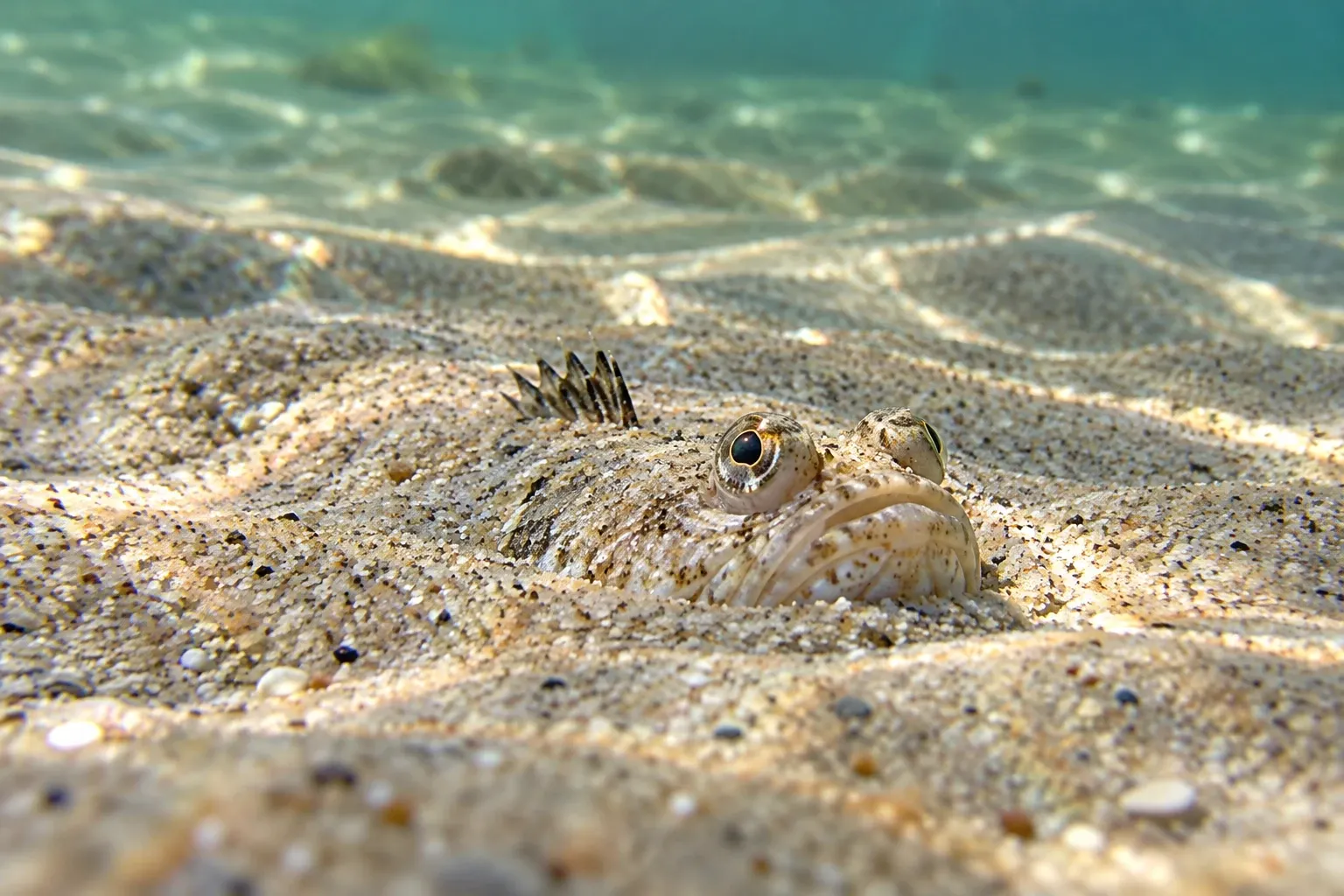
Sweden has one fish with a venom that matters, and it hides under the sand where children paddle. Here is what to do in the first hour, when to see a doctor, and how bathers, anglers and cooks avoid the sting.
When you need this
Someone has stepped on something sharp in shallow, sandy water on the west coast and is suddenly in severe pain. Or you have a weever on your hook or in your net, or a weever from the fishmonger on the chopping board. It also applies when a sting from yesterday is still swollen, red or oozing, and when you are packing for a family beach week in Halland or Bohuslän.
If you’ve just been stung
Sweden’s health authorities agree on one treatment: heat. 1177, the national health information service, and Giftinformationscentralen (GIC), the Swedish Poisons Information Centre, give the same steps, and the Swedish Red Cross teaches them too.
- Get out of the water without touching the fish again.
- Put the stung foot or hand in hot water, as hot as the person can bear without scalding: 40–45 °C. Test it first with a finger of the other hand.
- Keep it there 30 to 60 minutes, or until the pain goes. Top up with fresh hot water so it stays hot.
- Pick out any visible remains of the spine.
- Keep the stung part as still as possible, leave it alone otherwise, and keep the wound clean.
Don’t stop after five minutes because the first edge of pain has dulled. The clinical reference Swedish doctors use, revised in February 2026, goes further than the public advice: at least 30 minutes, up to 90 if needed, with 60 recommended. Without a thermometer, it suggests water just below your pain threshold.
Out on a boat with no hot tap? The Red Cross’s advice is direct: if you have a thermos of coffee, use it. Test it on unhurt skin first, as with any hot water. On a guarded beach, go to the lifeguards; at Tylösand in Halland they helped four stung bathers in the summer of 2018.
When to get care
A weever sting is very painful but normally not life-threatening. The pain is immediate and intense, with swelling and discoloured skin. Untreated, it can last a day according to GIC and several days according to 1177. The swelling can last weeks, and in single cases months.
1177 gives two levels of urgency:
| Situation | What to do |
|---|---|
| Headache, dizziness, chills, sweating or nausea | Contact a health centre (vårdcentral) or out-of-hours clinic (jouröppen mottagning) at once; if closed, go to an emergency department (akutmottagning) |
| Hot water hasn’t eased the pain within 30–60 minutes, or pain or swelling is growing | Contact a health centre |
| You can’t get the spine remains out | Contact a health centre |
| After a few days the wound is red, swollen and pus-filled | Contact a health centre |
| The situation is life-threatening | Call 112 |
Phone 1177 for advice on where to go; from a foreign phone, use +46 771-11 77 00. For non-urgent poison questions, GIC answers day and night. Sometimes damaged tissue has to be removed surgically, and a wound infection is the complication to watch for in the days after. See 1177, Sweden’s medical advice line for how the service works and emergency rooms in Sweden for when the health centre is shut.
Why heat works, and why it’s not the rule for every sting
1177 explains that the venom becomes less active with heat, which reduces the damage. The clinical reference adds the mechanism: the venom is a protein, heat breaks it down, and the pain relief comes fast.
That makes the weever the odd one out among Swedish bites and stings. For an adder bite, 1177 says the opposite: never cool it, never heat it. Mixing the two up is an easy mistake on a summer holiday where both are possible.
| Sting or bite | Hot water? |
|---|---|
| Weever fish | Yes, it is the treatment: 40–45 °C, 30–60 minutes |
| Adder (huggorm) | No: 1177 says do not cool or heat the bite; call 112 at once (see adders in Sweden) |
Don’t reach for ice or a cold rinse either. The advice for a weever sting is heat, full stop.
What a weever looks like and where it hides
The greater weever (Trachinus draco) is a slim, compressed fish, usually 20–25 cm long and up to 40–45 cm. It is shimmering green, yellow and black on a yellow-green base, with an upturned mouth. It has two dorsal fins; the front one carries venomous spines, and so do the gill covers.
You almost never see it. In summer it lies buried in sand, with only its eyes and the tip of its front fin, or its mouth, showing. Touching a spine injects venom automatically, as a defence. GIC adds a detail most pages miss: the spine refills with venom immediately, so a second touch stings again.
Stepping on one can leave several broken spine tips in the foot, which is one reason a sting that will not settle needs a clinic.
Where and when
The weever is a west-coast fish. 1177 and GIC call it common along the west coast; the clinical reference says it occurs from the Skagerrak down to the Sound and is commonest in Bohuslän. HELCOM, the Baltic Sea intergovernmental body, records it as common and breeding in the Kattegat and the Sound, but only occasional, and not breeding, in the southern Baltic.
- Spring: it moves in towards the coast.
- Summer: it lives in shallow water near beaches, spawning on sand or gravel. This is when most stings happen.
- Night: it leaves its burrow to feed.
- Winter: it moves deeper, down to about 150 m.
Sources differ a little on how often bathers meet it. 1177 and GIC place it in shallow water in summer; Krisinformation, the government’s emergency information service, says it usually swims deeper than where people bathe but can be in shallow water. Take both seriously: the fish is often out of the way, but when stings happen, it is in shallow sandy water.
Warm summers can bring more. In 2018 lifeguards at Tylösand in Halland had helped four bathers who stepped on weever, more than usual, and the county fisheries adviser linked it to water above 17 °C for a long time. None of the sources consulted describes weever around Stockholm, in the northern Baltic or in lakes.
If you are heading for Sweden’s beaches, treat the shallow sandy water of Halland and Bohuslän, where the clinical reference says the weever is commonest, as weever country.
Anglers and cooks: dead fish still sting
Most weever stings don’t happen to swimmers at all. GIC and the clinical reference say they usually happen when fishers pick the fish out of nets, and unhooking one is risky. If you are fishing in Sweden from the west-coast rocks or a boat, a weever on the hook is a real possibility.
Three facts change how you handle one:
- Dead weever still sting. 1177 and GIC both say the venom stays in the spines after the fish dies.
- The gill covers are armed too, not just the front dorsal fin.
- It is good to eat. The weever is an edible fish sold at fishmongers, so the risk follows it into the kitchen.
Krisinformation’s advice for anglers is a landing net (håv) and protective gloves. Cleaning a bought weever deserves the same gloves. See west-coast seafood for what else ends up on the fishmonger’s slab.
Avoiding stings
| Who | What helps | Source |
|---|---|---|
| Bathers | Bathing shoes (badskor) on sandy bottoms; they also protect against oysters, stones and glass | Krisinformation |
| Bathers | A solid sole: the related lesser weever’s spines can pierce a flip-flop or a wetsuit | Clinical reference |
| Anglers | Landing net and protective gloves; never unhook by hand | Krisinformation, clinical reference |
| Cooks | Gloves; keep fingers off the gill covers and front fin | 1177, clinical reference |
| Boaters and beach days | A thermos of hot liquid, in case | Red Cross |
A note on English-language advice: much of it comes from British beaches, where the lesser weever lives. That species is found off Denmark’s North Sea coast, in the English Channel and further south. The Swedish sources describe only the greater weever, but the first aid is the same heat.
Practical information
| Item | Detail |
|---|---|
| First aid | Hot water 40–45 °C, 30–60 minutes or until pain goes; test on unhurt skin first |
| Clinical maximum | Up to 90 minutes; 60 recommended |
| Season | Mostly summer, in shallow sandy water |
| Where | West coast, Skagerrak to the Sound; occasional in the southern Baltic |
| Medical advice | 1177; +46 771-11 77 00 from a foreign phone |
| Poison advice, non-urgent | 010-456 6700, day and night |
| Emergency | 112 |
| Bathing shoes | Widely sold; price varies |
| Clinic visit as a visitor | Depends on residence and insurance; see healthcare as a tourist |
FAQ
Are there venomous fish in Sweden?
One that matters: the greater weever, or fjärsing. 1177 and the Swedish Red Cross call it the only fish species in Sweden with a dangerous venom. It is common on the west coast and occasional in the southern Baltic. Krisinformation also mentions the rabbit fish, which has a venomous spine but lives so deep that bathers never meet it.
What should I do if I step on a weever fish?
Get out of the water and put the foot in water as hot as you can bear without scalding, 40–45 °C, for 30 to 60 minutes or until the pain goes. Test the temperature with a finger first and keep topping up with hot water. Pick out any spine remains, keep the foot still, and keep the wound clean.
Why does hot water help a weever sting?
1177 says the venom becomes less active with heat, so the damage is reduced. The clinical reference explains that the venom is a protein that heat breaks down, which is also why it brings fast pain relief. That makes weever the opposite of an adder bite, where Swedish advice says never to heat or cool the bite.
Is a weever sting dangerous?
It is very painful but normally not life-threatening. Some people get headache, dizziness, chills, sweating or nausea, and 1177 says to contact a health centre or out-of-hours clinic at once if so. Swelling can last weeks, occasionally months, and the wound can become infected after a few days. Call 112 if the situation is ever life-threatening.
Where and when are weever fish found in Sweden?
On the west coast, from the Skagerrak down to the Sound, in shallow sandy water during summer. They come towards the coast in spring and move deeper, down to about 150 m, for winter. They are only occasional in the southern Baltic, and none of the sources consulted describes them around Stockholm or in lakes.
Do water shoes protect against weever fish?
They help. Krisinformation’s advice is to wear bathing shoes so you need not worry about stepping on a weever, and they also guard against oysters, stones and glass. Choose a solid sole: the clinical reference notes that the spines of the related lesser weever can go through a flip-flop or a wetsuit.
Can a dead weever fish still sting?
Yes. 1177 and the Poisons Information Centre both say dead weever fish still have venom in their spines, and the clinical reference adds that the venom stays active after the fish is caught. Anglers, people clearing nets and anyone cleaning a weever bought at a fishmonger should handle it with gloves and keep fingers away from the gill covers and front fin.
Related guides
- Jellyfish in Swedish waters — the other west-coast sting, with different first aid.
- Swimming safety and lifeguard flags — what the flags mean on a guarded beach.
- 112 and Sweden’s emergency numbers — what to say and how to call without a Swedish SIM.
- Adders in Sweden — the bite where heat is forbidden.
- Healthcare as a tourist — what a clinic visit costs you.
Facts verified 2026-10-15. Sources: 1177, Giftinformationscentralen, Krisinformation, HELCOM, Swedish Red Cross, Internetmedicin, SVT — full register in this topic’s source file. Found something outdated? Tell us and we’ll fix it.