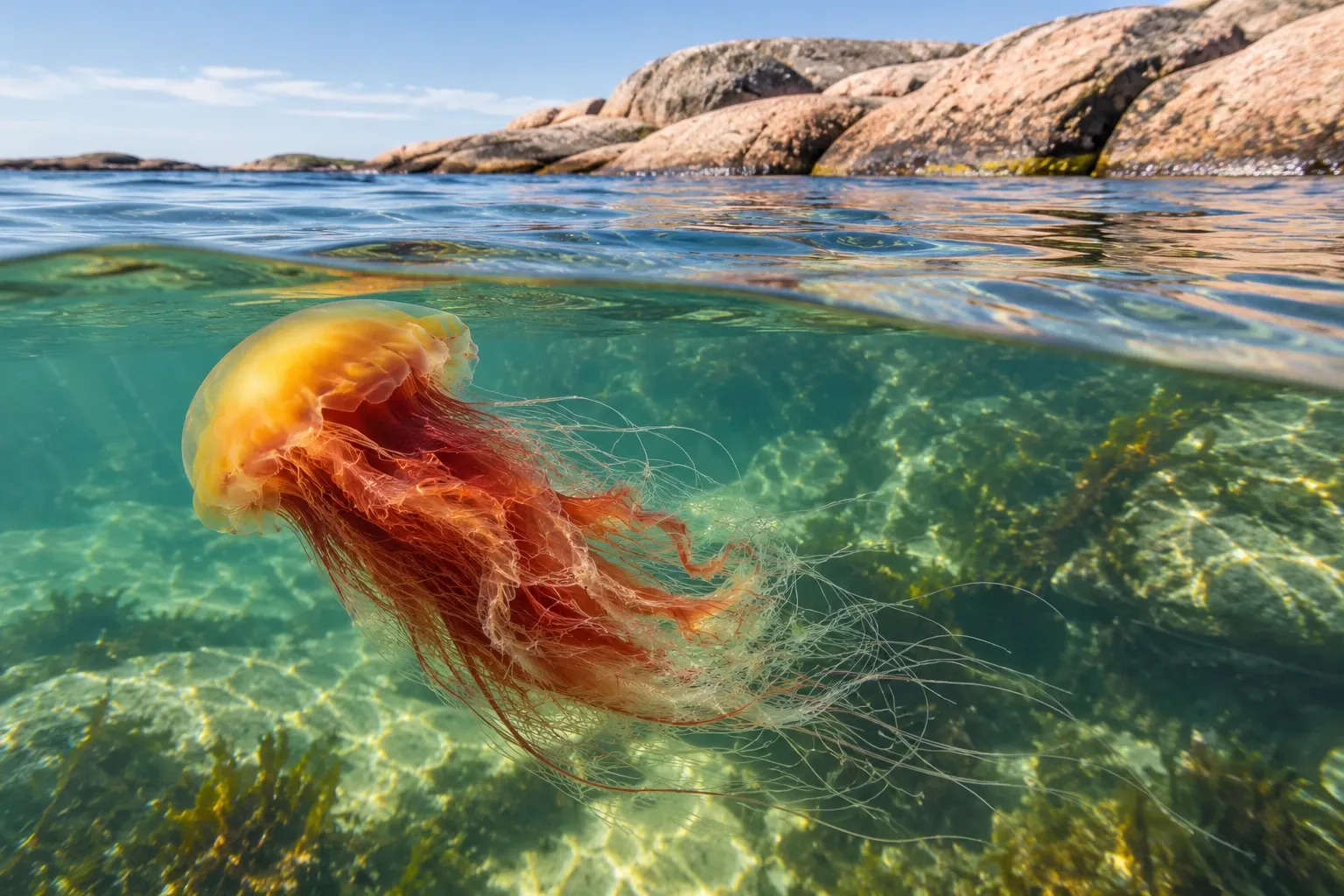
A jellyfish sting in Sweden is painful, not dangerous, in almost every case. Here’s what to do in the first minutes, which jellyfish to avoid, where they are, and the few signs that mean you should see a doctor.
When you need this
Someone has just come out of the sea at a west-coast beach or jetty with a red, burning welt. Or a big orange jellyfish is drifting where you want to swim, a guarded beach is flying a purple flag, or your child waded through a bay full of jellyfish and is now crying. It also applies when a sting is still burning hours later, when it was near the eyes, or when you find jellyfish washed up on the sand.
If you’ve just been stung
Sweden’s two health authorities give almost the same first aid. 1177, the national health information service, and Giftinformationscentralen (GIC), the Swedish Poisons Information Centre, both say: get the threads off without rubbing, then treat the pain.
- Get out of the water calmly, without brushing against more threads.
- Rinse the threads off with seawater. 1177 says seawater first of all, because tap water can make more venom release.
- Scrape off what sticks with a stiff card, such as a payment card, or lift it with wide tape. Shaving foam and a razor also work; GIC calls shaving very effective.
- Don’t rub, not with a towel and not with sand. Rubbing bursts more stinging cells.
- Treat the pain with paracetamol or ibuprofen. A lidocaine ointment numbs the skin.
- Try hot water if it still hurts. GIC suggests holding the stung part in water as hot as you can bear, 40–45 °C. Test the temperature on unhurt skin first.
- For itching afterwards, rinse and gently dry the skin, then apply hydrocortisone cream.
Two age limits apply. 1177 says not to use lidocaine ointment on children under 18 months, or hydrocortisone cream on children under two, unless a doctor has said so. All of these medicines are sold without prescription at Swedish pharmacies (apotek).
On a guarded beach, go straight to the lifeguards. In Ängelholm, for example, they are on duty from late June to early August, and a purple flag there warns of dangerous marine life such as many stinging jellyfish.
What not to put on it
| Remedy | Use it? | Why |
|---|---|---|
| Seawater | Yes, first | Both Swedish authorities accept it; 1177 prefers it |
| Tap water or the beach shower | Not first | 1177 says it can release more venom; GIC says plenty of any water is acceptable |
| Vinegar | No | Neither Swedish authority mentions it; Irish council advice for the same lion’s mane species says don’t |
| Urine or alcohol | No | The same Irish advice lists both as things not to do |
| Rubbing with a towel or sand | No | It fires more stinging cells |
Vinegar is the standard advice for some tropical jellyfish, which is why it turns up in so many first-aid lists. It isn’t part of the Swedish advice for Swedish species.
The authorities’ one disagreement is about tap water, and it matters less than it sounds. Both agree seawater works, and it’s what you have on the beach anyway.
When to get care
Most stings settle with self-care. GIC says stings from Swedish species almost always cause only local symptoms; a few people get a general stinging itch after about half an hour. The pain itself can become severe, though, and can bring nausea and vomiting.
Seek care at once if:
- A jellyfish or thread touched the eye. Rinse the eye with water straight away for at least five minutes, then contact a doctor. An eye sting can cause redness, swelling and sometimes damage to the surface of the eye.
- The skin reaction is strong, with widespread redness, swelling and marked tenderness.
- You get a fever and feel unwell.
In Sweden that means a health centre (vårdcentral) or an out-of-hours clinic (jouröppen mottagning). Phone 1177 for medical advice on where to go; from a foreign phone, 1177 gives +46 771-11 77 00. Call 112 if the situation is life-threatening. For non-urgent poison questions, GIC answers on 010-456 6700 day and night. See 1177, Sweden’s medical advice line for how the service works and healthcare as a tourist for what a clinic visit costs you.
Which jellyfish sting
1177 lists three species to avoid along Swedish coasts: the red lion’s mane, the blue lion’s mane and the compass jellyfish. HaV, the Swedish Agency for Marine and Water Management, adds two rarer stingers.
| Jellyfish | Swedish name | How to recognize it | Sting |
|---|---|---|---|
| Moon jellyfish | öronmanet | Clear, faintly blue or pink, four pale rings; the commonest | None a person feels, except perhaps on thin skin |
| Red lion’s mane | röd brännmanet | Yellow, orange or reddish, a mass of long threads; usually up to 50–60 cm | Hard |
| Blue lion’s mane | blå brännmanet | Bluish, at most about 20 cm, shorter threads | Weaker than the red |
| Compass jellyfish | kompassmanet | Yellowish-white with brown V-shapes on top, up to 30 cm | Fairly strong |
| Clinging jellyfish | klängmedusa | Transparent, 2–3 cm, reddish-brown cross | Can be very painful |
| Mauve stinger | lysmanet | Small, spotted, often reddish to violet, up to 12 cm | Fairly strong, bell included |
| Barrel jellyfish | lungmanet | Huge and solid, up to 90 cm, dark-blue rim | Very weak |
Two look-alikes are harmless. Comb jellies (amerikansk kammanet), which can fill west-coast bays in late summer, have no stinging cells. The tiny Chinese freshwater jellyfish found in about 20 Swedish lakes doesn’t sting either.
A red lion’s mane’s threads are long, so you can be stung by one that seems a few metres away. The top of its bell doesn’t sting; the threads and mouth-arms underneath do.
Where and when
The stinging species need salty water, so this is mostly a west-coast story. The Baltic and the Stockholm archipelago are far calmer.
- West coast, from Bohuslän down to Skåne: moon jellyfish and red and blue lion’s mane in summer. Compass and barrel jellyfish drift in later in the summer and in autumn.
- Öresund: about 100 swimmers in Helsingborg were stung over Midsummer weekend 2022 and went to the sea lifeguards for help.
- Baltic and Stockholm archipelago: moon jellyfish near the surface in the south. The red lion’s mane is there too, but deep down where the water is saltier.
- Lakes: only the non-stinging freshwater jellyfish.
Stinging jellyfish occur mostly in summer and autumn. Numbers swing strongly from one year to the next, so a bay that was clear last summer can be full this year. Blue lion’s mane in particular turns up more sporadically than the red. If you’re heading for the Bohuslän coast, assume jellyfish are part of the swim.
The tiny one in the eelgrass
Most pages stop at lion’s mane, but HaV’s 2026 species page adds a newer problem. The clinging jellyfish is only 2–3 cm across and transparent, so it’s hard to spot among eelgrass. It occurs sparsely along almost the whole west coast. In July and August 2018 and 2025 it was locally numerous in eelgrass bays on the inner sides of Orust and Tjörn, probably because those summers were warm. Its sting can be very painful.
The sheltered, shallow bays that look perfect for children are exactly where it lives. If you get a sharp sting in such a bay without seeing any jellyfish, this is a likely suspect. The first aid is the same.
The mauve stinger is rarer still: HaV records it in Swedish water in autumn 1969 and November 2024. Unlike the others it stings on its bell too, so there is no safe way to handle one.
Avoiding stings
1177’s prevention advice is short and practical:
- Never swim close to jellyfish you can see.
- Avoid swimming in poor light or darkness, when you can’t see them.
- Be careful when the tide is coming in, which can bring more jellyfish.
- Wear a wetsuit for diving or snorkelling where there are jellyfish; it gives fairly good protection.
- Ask locals or dive and snorkel rental staff whether jellyfish are around.
Two more habits help. Look into the water before you jump off a jetty or rocks, which is what a Gothenburg marine biologist advises, and keep an eye on each other. And keep children and dogs away from jellyfish washed up on the sand: Irish council advice for the same lion’s mane species says the venom stays in the tentacles for a few days after stranding, and broken-off fragments in the water sting too.
If you spot a clinging jellyfish or compass jellyfish, HaV asks you to report it on rappen.nu; mauve stingers go to Artportalen or the county board.
Practical information
| Item | Detail |
|---|---|
| Rinse | Seawater first |
| Scraping kit | Stiff card, wide tape; shaving foam and razor also work |
| Painkillers and creams | Paracetamol, ibuprofen, lidocaine ointment, hydrocortisone cream; no prescription needed; price varies by pharmacy |
| Hot-water relief | 40–45 °C, tested on unhurt skin first |
| Eye contact | Rinse with water at least 5 minutes, then a doctor |
| Medical advice | 1177; +46 771-11 77 00 from a foreign phone |
| Poison advice, non-urgent | 010-456 6700, day and night |
| Emergency | 112 |
| Season | Mostly summer and autumn |
FAQ
Are there dangerous jellyfish in Sweden?
None that kill, but some sting hard. 1177 says to avoid red and blue lion’s mane and compass jellyfish, and HaV adds the tiny clinging jellyfish and the rare mauve stinger. The Poisons Information Centre says stings almost always stay local. The common clear moon jellyfish, with four pale rings, does not sting a person.
What should I do if a jellyfish stings me in Sweden?
Get out of the water and rinse the threads off with seawater. Scrape what remains off with a stiff card or lift it with wide tape, and do not rub. Take paracetamol or ibuprofen for pain; hot water you can bear, around 40–45 °C, may also help. Hydrocortisone cream eases itching afterwards.
Should I use vinegar or tap water on a jellyfish sting?
Use seawater. 1177 says tap water can release more venom, though the Poisons Information Centre accepts plenty of any water. Neither Swedish authority mentions vinegar, and Irish council advice for the same lion’s mane species says not to use vinegar, alcohol or urine. Vinegar is advice for some tropical jellyfish, not for Swedish ones.
When should I see a doctor for a jellyfish sting?
At once if the jellyfish touched the eye, after rinsing it with water for at least five minutes. Also seek care quickly for a strong reaction with spreading redness, swelling and tenderness, or a fever with feeling unwell. Phone 1177 for advice, or +46 771-11 77 00 from a foreign phone; call 112 in a life-threatening situation.
Where and when are jellyfish worst in Sweden?
On the salty west coast, from Bohuslän down to Skåne, mostly in summer and autumn. Compass and barrel jellyfish drift in from the Atlantic late in the season. In the Baltic and around Stockholm the red lion’s mane stays deep, so swimmers mostly meet harmless moon jellyfish. Lakes have only a tiny non-stinging species.
Can a dead jellyfish on the beach still sting?
Yes. The threads keep their stinging cells after a jellyfish washes up; Irish council advice for the same lion’s mane species says the venom stays in the tentacles for a few days, and broken-off fragments in the water sting too. Keep children and dogs away from stranded jellyfish and do not pick them up.
Related guides
- Swedish beaches — which coast has sand, how warm the sea gets, and local dog rules.
- Swimming safety and life jackets — what each lifeguard flag means, purple included.
- Weever fish on the west coast — the other west-coast sting, hidden in the sand.
- 112 and Sweden’s emergency numbers — what to say and how to call without a Swedish SIM.
- Pharmacies in Sweden — where to buy painkillers and hydrocortisone cream.
Facts verified 2026-10-14. Sources: 1177, Giftinformationscentralen, Havs- och vattenmyndigheten, Ängelholms kommun, Fingal County Council (Ireland), TV4 — full register in this topic’s source file. Found something outdated? Tell us and we’ll fix it.