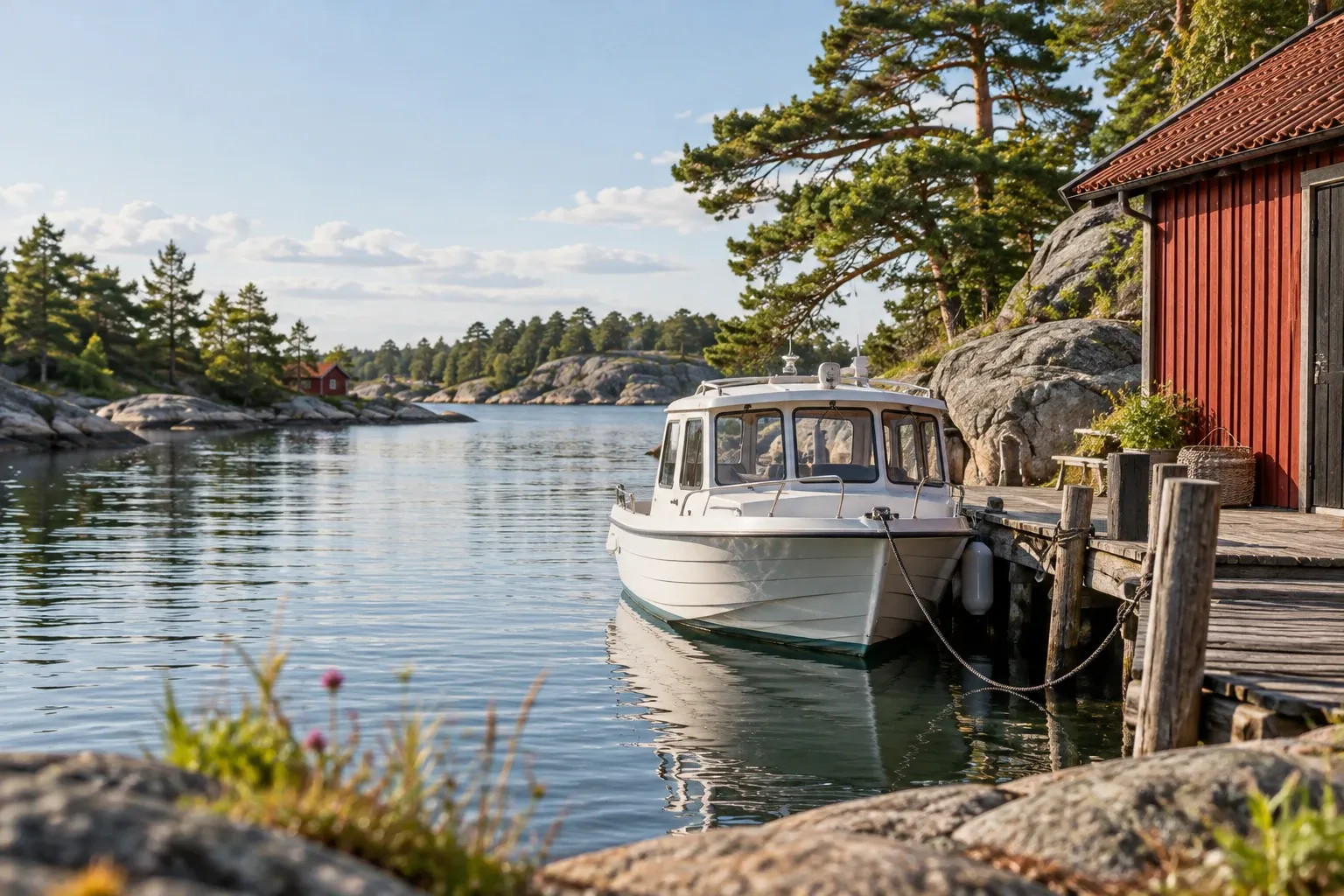
A water taxi gets you to islands the public boats skip, and home after the last departure. It is priced like a hired boat, not a bus seat, and Swedish law treats it differently from a road taxi. Here is how to book one without a surprise bill.
When you need this
- The last public boat has left and you are still on the island.
- Your island has no scheduled boat, or the boat doesn’t stop at your jetty.
- A group of 4 to 12 wants one boat instead of a dozen tickets and two connections.
- You are heading for a rented cottage with heavy luggage, or for the outer skerries.
- Someone in your party can’t manage a long chain of timetable connections.
Water taxi or public boat?
Start with the public boat. Waxholmsbolaget, Region Stockholm’s archipelago company, runs fixed timetables with per-person fares, all searchable in the SL app (our Stockholm archipelago ferries guide covers tickets in detail). Some islands and jetties are served only when someone books the stop in advance, through the same app. That booked stop costs an ordinary fare. It is not a water taxi, and it is often what you actually need.
A water taxi is a small boat with a skipper that you hire for your own trip. Visit Sweden describes taxi boats as the option for short hops between islands, for travel outside the regular routes, and for groups. For some places it is the only way in without your own boat. Skärgårdsstiftelsen (the Archipelago Foundation, which owns about 12% of the archipelago’s land) says islands without scheduled boats need your own boat or a taxi boat. It says the same of the outer archipelago (ytterskärgården).
| Public boat (Waxholmsbolaget) | Water taxi | |
|---|---|---|
| You pay for | A seat, by distance band | The whole boat, usually by time |
| Timetable | Fixed timetables | Whenever you book |
| Destinations | Listed jetties; some only on booking | Almost any jetty or landing |
| Group limit | The ship’s capacity | Usually 12 per boat |
| Price rules | Published fares | Set by each operator; agree in advance |
How the price is built
There is no standard water-taxi fare. Each operator prices the whole boat, and the usual model is time. One central-Stockholm operator published its rates in October 2026: an hourly rate for driving time, a lower hourly rate for waiting, and a minimum charge per job. The figures are in the practical information table below.
The detail that surprises visitors is what “driving time” covers. That operator bills the boat’s run from its base in the city, out to you, on to your destination, and back to base. A one-way drop can therefore cost as much as a round trip, because you pay for the empty return. Waiting while you finish lunch is charged too.
The second surprise is VAT. Passenger transport carries 6% VAT in Sweden, and quotes aimed at companies are often given excluding it. Swedish price-information law defines a consumer price as the final price including VAT. So when a quote says “excl. VAT”, ask for the full figure or add 6% yourself.
Three ways to keep the bill down:
- Book a boat based near your island. A taxi from a mainland harbour like Stavsnäs has a far shorter billed run to the central and outer archipelago than one sent out from the city.
- Fill it. The price is per boat, so with 6 to 12 people the cost per head falls sharply. Compare it with the ferry fare multiplied by your group, and count the hours of connections saved.
- Ask for a fixed price for the whole trip rather than an hourly estimate. Then a slow crossing is the operator’s problem, not yours.
Not a taxi in Swedish law
This is the point most English pages get wrong. Sweden’s road taxis are tightly regulated for price transparency: every car shows a jämförpris (comparison price), and above a threshold the driver must give a binding maximum price (see taxis in Sweden). None of that applies on the water.
The Taxi Traffic Act (taxitrafiklagen) defines taxi traffic as commercial passenger transport by car or light truck. Boats are not mentioned. A water taxi needs no price sticker, no taxi driver ID and no binding quote. What still applies is general consumer law: a price given to a consumer must include VAT, and if the price can’t be stated in advance, the trader must explain how it will be calculated. In practice, the only real protection is a price agreed in writing before you board.
Two other protections you might expect are also missing:
- No cooling-off period. The Swedish distance-selling act excludes passenger transport from the 14-day right of withdrawal. Book by phone or online, and the operator’s own cancellation terms decide what you pay if your plans change.
- No EU ferry passenger rights. The EU regulation on sea passengers’ rights to assistance and compensation for delays and cancellations does not apply to ships certified for up to 12 passengers, or crewed by three people or fewer. That covers almost every water taxi.
The 12-passenger line
Most water taxis carry 12 passengers or fewer, and the number is a legal line, not a sales choice. Transportstyrelsen (the Swedish Transport Agency) exempts a vessel under 15 metres that carries at most 12 passengers from certification and inspection. Instead the owner runs a self-inspection regime and answers for the boat’s seaworthiness and safe operation. Commercial crew still need a seafarer’s medical certificate whatever the boat’s size, and must meet competence requirements.
Carry a 13th passenger and the boat becomes a passagerarfartyg (passenger ship), leisure boats included. A passenger ship needs a passenger-ship certificate and must be registered as one. So a group of 13 or more needs two water taxis or a certified passenger vessel, and a skipper who refuses the 13th person is following the rules. Capacity can also shrink with the weather: one Sandhamn taxi boat takes up to 7 guests, or 12 in fair weather.
Booking step by step
- Check the public boat first. Search the trip in the SL app; a booked Waxholmsbolaget stop may be all you need.
- Name both jetties (brygga) and the islands, and find out whether there is a jetty at all.
- Pick an operator near your route. A mainland-harbour base usually means a shorter billed run.
- Request a quote with passengers, luggage, date and time. Operators take bookings and price requests by phone, email or web form.
- Get the price in writing and ask what it includes: the run to and from base, waiting, the minimum charge, night or holiday supplements, and VAT.
- Read the cancellation and weather terms, including what happens if the skipper cancels.
- Confirm the headcount is 12 or fewer per boat.
- Be on the jetty on time, luggage ready, since waiting is billed.
- Save the operator’s number for delays or a changed pick-up.
Book the return when you book the outward trip. Boats may run late, but booking lines may keep office hours. One operator staffs its phones from 06:00 to 19:00 and takes later calls only for existing trips or urgent bookings.
Where they leave from
| Base | Good for | Note |
|---|---|---|
| Central Stockholm quays (Strandvägen, Nybrokajen, Slussen) | Inner archipelago, groups starting in the city | You pay the run out and back |
| Stavsnäs Winter Harbour (Stavsnäs vinterhamn), Värmdö | Sandhamn area, Nämdöskärgården, central and outer islands | Year-round public-boat hub, buses 433 or 434 from Slussen |
| Sandhamn | The island and surrounding outer archipelago | Local taxi boats |
Stavsnäs is worth knowing about. Naturvårdsverket’s national park guide says all boat routes into Nämdöskärgården, Sweden’s archipelago national park, leave from Stavsnäs Winter Harbour, which is also where the boat taxis depart. Some water-taxi operators there also run scheduled lines with per-person tickets, for example to Sandhamn, Nämdö, Runmarö and Bullerö. Bullerö’s line runs from May to early October. A seat on one of those lines costs far less than a whole boat.
Jetties, rocks and seasons
Don’t count on a pier. In Nämdöskärgården, the park guide says, the boat lands directly on the rocks in most cases. That means stepping over a bow onto sloping granite, which matters for small children, heavy bags and anyone with limited mobility. Ask the operator how landing works at your destination, and see accessible travel in Sweden for planning help. Before you step ashore on a small island, also check the landing rules for islands and bird sanctuaries.
Ask in advance for child-size life jackets if you are bringing small children. Our water safety guide explains life jackets more generally.
Seasons change the picture:
- Summer: public boats run most often, so a water taxi is mainly for evening returns, groups and islands without stops. Book ahead.
- Low season: some operators run all year; the Stavsnäs operator advertises service every day of the year, in almost all weather.
- Ice: when the archipelago freezes, even Waxholmsbolaget switches to fewer, slower departures, some bookable only in advance. Ask a water-taxi operator directly whether it can run.
Practical information
| Item | Amount or rule (checked 2026-10-15 unless stated) |
|---|---|
| Water-taxi fare | Set by each operator, per boat; not regulated |
| Example published rate, central Stockholm | 4,000 kr/hour driving (base → destination → base) + 1,000 kr/hour waiting; minimum 6,000 kr per job; excl. VAT |
| VAT on passenger transport | 6% |
| Waxholmsbolaget single, per person, for comparison | 61–186 kr adult by fare band (checked 2026-09-25) |
| Passengers per standard water taxi | 12 or fewer (boats under 15 m) |
| Right of withdrawal for online or phone booking | None for passenger transport |
| EU sea passenger rights | Do not apply to boats certified for up to 12 |
FAQ
How much does a water taxi cost in the Stockholm archipelago?
There is no standard fare. Each operator sets its own price for the whole boat, usually by time, and often including the run back to base, waiting time and a minimum charge. One central-Stockholm operator published 4,000 kronor an hour plus VAT in October 2026, with a 6,000 kronor minimum. Always get a written quote that states what it includes.
Is a water taxi cheaper than the ferry?
For one or two people, almost never: a Waxholmsbolaget single costs 61 to 186 kronor per person, while a water taxi is priced per boat. For a group of eight to twelve, the gap narrows, and the taxi saves connections and waiting. Divide the boat price by your group before you decide.
Do Swedish taxi price rules apply to water taxis?
No. The Taxi Traffic Act covers passenger transport by car and light truck only, so the window comparison price and the binding maximum-price rule do not apply on a boat. General Swedish price law still requires a consumer price to include VAT, or an explanation of how it will be calculated. Agree the price before you board.
How many people fit in a water taxi?
Usually up to 12. A vessel under 15 metres carrying no more than 12 passengers is exempt from certification; anything carrying more than 12 counts as a passenger ship and must be certified. Some small boats take fewer in rough weather, for example 7 instead of 12. Larger groups need two boats or a certified vessel.
Can I cancel a water taxi I booked online?
Only on the operator’s own terms. Swedish distance-selling law gives no 14-day right of withdrawal for passenger transport, and EU sea passenger rights do not cover boats certified for 12 or fewer. Read the cancellation and weather terms before you confirm, and ask what happens if the skipper cancels.
Where do water taxis leave from?
Anywhere you agree with the operator, but most are based either at central Stockholm quays such as Strandvägen, Nybrokajen and Slussen, or at mainland harbours such as Stavsnäs Winter Harbour on Värmdö. A boat based near your island usually costs less, because you pay for its run to you and back.
Can a water taxi take me to an island without a ferry?
Yes, that is one of its main uses. Skärgårdsstiftelsen says islands without scheduled boats need your own boat or a taxi boat, and the outer archipelago needs one too. In Nämdöskärgården National Park the boat often lands directly on the rocks, so pack light and wear good shoes.
Related guides
- Stockholm archipelago ferries — check the public boat and booked stops before hiring a whole boat.
- The Stockholm archipelago — which islands to aim for and what you’ll find there.
- Taxis in Sweden — the price rules that protect you on land, and why they stop at the shore.
- Islands and skerries: landing rules — where you may step ashore, and when bird sanctuaries close.
- Renting a boat in Sweden — the do-it-yourself alternative, with the licence rules.
Facts verified 2026-10-15. Sources: Sveriges Riksdag (Taxitrafiklag 2012:211, Prisinformationslag 2004:347, Lag 2005:59), Transportstyrelsen, EUR-Lex (Regulation 1177/2010), Skatteverket, Naturvårdsverket (Sveriges nationalparker), Waxholmsbolaget, Skärgårdsstiftelsen, Visit Sweden — full register in this topic’s source file. Found something outdated? Tell us and we’ll fix it.