Sweden’s preparedness is a civic habit, not a warning sign. Here is what each visible piece means, the one law that does touch visitors, and the small things worth doing on a longer or more remote trip.
When you need this
You’ve spotted an orange-and-blue SKYDDSRUM sign on an apartment block. A Swedish friend has mentioned keeping a week of water at home. The siren has sounded at 15:00 on a Monday. Or military convoys and warships are more visible than you expected, and you’re wondering whether any of it concerns you.
What total defense means
Totalförsvar (“total defense”) is the Swedish name for everything the country does to prepare for war. By law it has two halves: military defense and civil defense. Civil defense is the part you notice as a visitor. Agencies, municipalities, regions, businesses, voluntary groups and ordinary households all have a role in keeping power, water, food and vital services running and in protecting people.
Behind it sits totalförsvarsplikt (total defense duty). It covers every Swedish citizen and every foreigner who lives in Sweden, from the year they turn 16 to the year they turn 70. It takes three forms:
| Form | What it is | Who it touches |
|---|---|---|
| Värnplikt | Military service, 9–15 months | Selected young Swedish citizens; not everyone is called to assessment |
| Civilplikt | Civil service in vital functions | Residents, when the government activates it; since 2026 it includes assessment and basic training, first in rescue services |
| Allmän tjänsteplikt | General duty to support society during heightened alert | All residents aged 16–70 |
A tourist is neither a citizen nor a resident, so none of this applies to you. Plikt- och prövningsverket, the agency that runs the duty, describes it as covering everyone who lives in Sweden.
The agency for the civilian side used to be called MSB. Since 1 January 2026 it has been Myndigheten för civilt försvar (Swedish Civil Defence and Resilience Agency), at mcf.se. Many pages still use the old name, but it’s the same agency.
Shelters and the orange sign
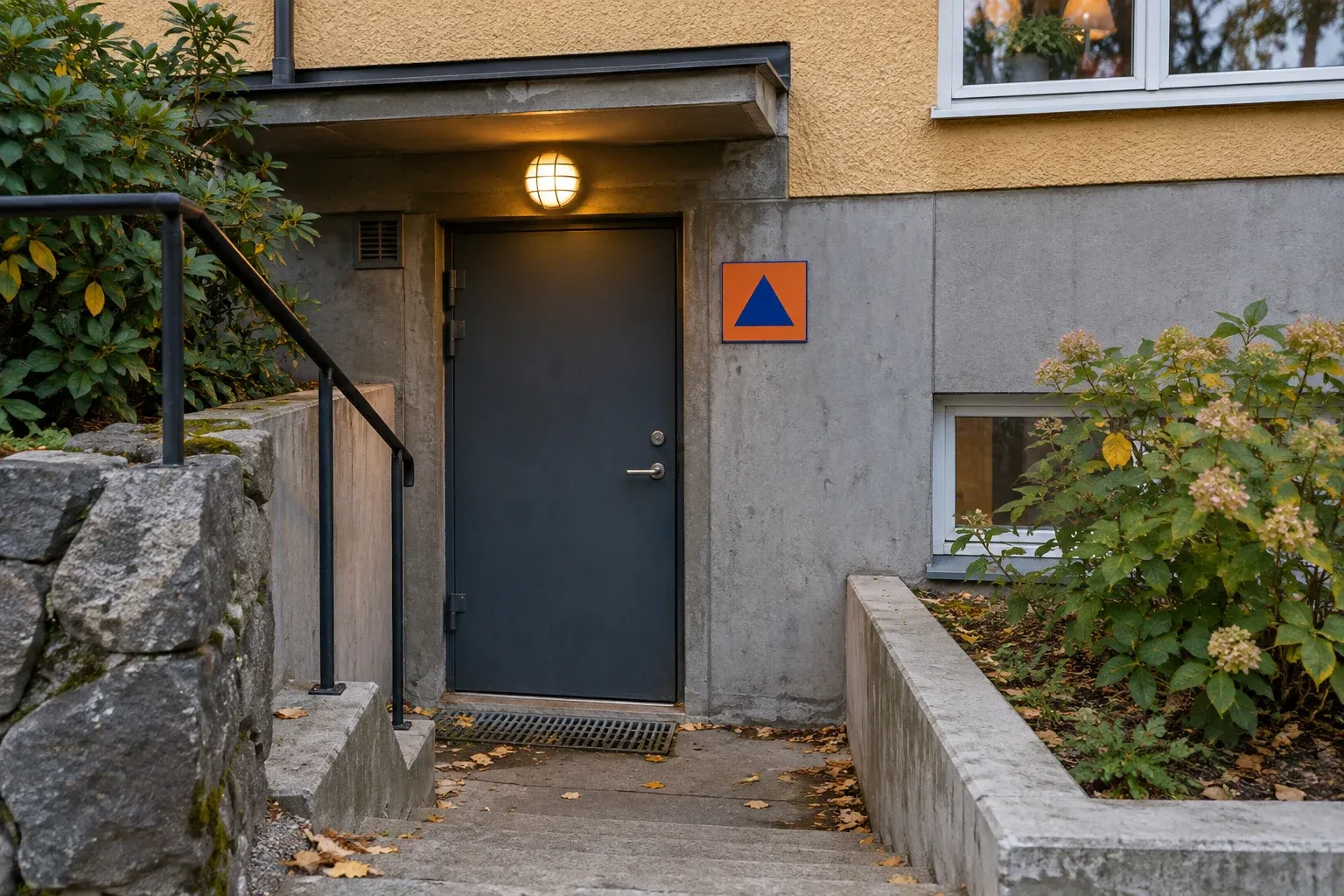
The most visible piece of total defense is the shelter sign: a blue triangle on an orange background with the word SKYDDSRUM. Sweden has about 64,000 civil defense shelters, with room for around seven million people. They’re built into apartment blocks, schools and public buildings, so you’ll see the signs far more in towns than in the countryside. Munkfors, a small municipality in Värmland, lists 20.
A shelter isn’t a bunker to visit. In peacetime it’s an ordinary room used for other purposes. If the government raises the alert level, the property owner must have it ready within 48 hours. Shelters are only opened at heightened alert or in war.
Two things worth knowing:
- Nobody is assigned a shelter. You go to the nearest one, wherever you are.
- There is an official shelter map. The agency publishes a skyddsrumskarta on mcf.se. It’s free, takes a minute, and is a calm way to learn where the nearest one is to your hotel or rental.
The siren pattern that sends people to shelters is the air-raid alarm (flyglarm): short blasts for one minute. It means go to the nearest shelter, basement or protected space, not just indoors. The other signals, and how warnings reach your phone, are explained in Sweden’s emergency alerts. The scheduled siren test at 15:00 on the first non-holiday Monday of March, June, September and December needs no action at all.
The brochure and “at least a week”
If you’ve read about Sweden’s “war brochure”, this is it: Om krisen eller kriget kommer (In case of crisis or war). The current version is the fifth, after 1943, 1952, 1961 and 2018. It was sent to Swedish households between 18 and 29 November 2024. That edition added sections on total defense duty, psychological defense, digital security and protection against air attack. An English version is free to download from mcf.se.
The brochure’s central request is simple: the Riksdag and government want everyone to cope with their basic needs for at least a week without help from society.
That’s the freshness point most guides miss. Plenty of English content still says Swedes should prepare for 72 hours. The agency’s own explanation is that the government’s 2020 defense policy decision recommended one week, and since 2024 the wording has been “at least one week”. It adds that 72 hours is better than nothing.
What the agency suggests households plan for:
| Need | What the advice says |
|---|---|
| Water | Three to five liters per adult per day for drinking, cooking and basic hygiene |
| Food | Food that needs no fridge or freezer |
| Heat | Sleeping bags, blankets, warm clothes; indoor temperature drops fast in a winter power cut |
| Communication | A radio powered by batteries, solar or a crank |
| Medicines | A month’s supply if you take them regularly |
| Payments | Cash, in case cards stop working |
A tourist in a hotel needs none of this. On a cabin stay, a winter road trip or a long stretch in the countryside, though, a little of it is sensible: some water, a torch, a power bank, warm layers and some cash. On cash, since 1 July 2026 grocery stores and pharmacies with a staffed checkout must accept it for small payments. The details are in cash in Sweden.
NATO, conscription and military traffic
Sweden joined NATO on 7 March 2024. The agency says plainly that membership puts no new requirements on individuals. The visible difference is that Sweden takes part in larger joint exercises, so you may see allied vehicles, ships and aircraft as well as Swedish ones.
Military activity varies by region. Garrison towns, naval bases and Gotland see more of it, and some exercise areas are protected only during stated periods. Every year in week 39, in late September, Sweden also holds Beredskapsveckan (Preparedness Week), with posters, events and media coverage. The 2026 theme was “You are part of Sweden’s total defense”.
None of this is a travel warning. It’s how Sweden has organized preparedness for generations, made more visible since 2024.
The rule that applies to visitors
There’s one place where total defense really does touch tourists: protected sites and objects (skyddsobjekt). Many military facilities can be declared protected, and so can some military ships, aircraft and vehicles. A protected object can carry an access ban and a ban on making images of it.
| If you… | Possible consequence |
|---|---|
| Photograph or film a signed site, or a protected ship or vehicle | Fine or up to one year in prison; equipment can be seized |
| Enter a protected site without permission, including by drone | Up to two years in prison |
The practical rule: keep cameras and drones away from military sites, convoys, warships and military aircraft. Filming a convoy “because it’s on a public road” is a common mistake, because the vehicles themselves can be protected objects. The full regime is in photography rules in Sweden, and drone limits are in drone rules in Sweden.
What a visitor should do
- Learn the air-raid signal: short blasts for one minute means shelter or basement.
- Note the test rule: 15:00, first non-holiday Monday of March, June, September and December.
- Look up the shelter nearest your accommodation on the mcf.se map if you’d like to know.
- Keep cameras and drones away from military sites, convoys, ships and aircraft.
- On rural or winter trips, carry some cash and a power bank, and keep water, a torch and warm clothing at a cabin.
- Skip the stockpile if you’re in a city hotel for a few days. You don’t need one.
Practical information
| Item | Detail |
|---|---|
| Total defense | Military defense + civil defense |
| Total defense duty | Swedish citizens and residents, aged 16–70; not tourists |
| Conscription | Selective; 9–15 months |
| Shelters | About 64,000, room for about 7 million people |
| Shelter sign | Blue triangle on orange, text SKYDDSRUM |
| Shelter readiness | Within 48 hours of heightened alert; go to the nearest |
| Shelter map | mcf.se, free |
| Home-preparedness advice | At least a week (not 72 hours) |
| Water | 3–5 liters per adult per day |
| Brochure | In case of crisis or war, fifth edition, November 2024; English PDF free on mcf.se |
| NATO | Member since 7 March 2024; no new requirements on individuals |
| Preparedness Week | Every year in week 39 (late September) |
| Siren test | 15:00, first non-holiday Monday of March, June, September, December |
| Agency | Myndigheten för civilt försvar (formerly MSB), mcf.se |
FAQ
What does the orange sign with a blue triangle mean in Sweden?
It marks a civil defense shelter, a skyddsrum. Sweden has about 64,000 of them, with room for about seven million people, built into apartment blocks, schools and public buildings. In peacetime they are used for other purposes; if the government raises the alert level, owners must have them ready within 48 hours. You use the nearest one.
Do tourists have to do anything for Sweden’s total defense?
No. Total defense duty applies to Swedish citizens and to non-citizens resident in Sweden, aged 16 to 70. A tourist is neither, so there is no duty to serve, register or stock supplies. What does apply to everyone is the law on protected sites: do not photograph or enter signed military areas.
How do I find the nearest shelter in Sweden?
Use the civil defense shelter map published by Myndigheten för civilt försvar, the agency formerly called MSB, on mcf.se. It shows shelters by location; nobody is assigned a specific one, so you go to the closest. Shelters are only opened when the government raises the alert level, so in peacetime none is open as a shelter.
What is the Swedish brochure “In case of crisis or war”?
A booklet on preparing for emergencies and war, Om krisen eller kriget kommer. The fifth edition, after 1943, 1952, 1961 and 2018, was sent to Swedish households in November 2024 and added sections on total defense duty, psychological defense, digital security and air-raid protection. An English version is free to download from mcf.se.
Should visitors prepare for 72 hours or a week?
Sweden’s official advice for residents is to manage on your own for at least a week; the agency has used that wording since 2024, while saying 72 hours is better than nothing. A short-stay tourist in a hotel needs no stockpile, but a cabin stay or long road trip justifies water, a torch, a power bank and some cash.
Does NATO membership change anything for travelers in Sweden?
Not directly. Sweden joined NATO on 7 March 2024, and the agency says membership places no new requirements on individuals. The visible difference is that larger joint military exercises take place in Sweden, so you may see more allied vehicles, ships and aircraft. Do not photograph them where signs or circumstances suggest a protected object.
Related guides
- Sweden’s emergency alerts — what each siren signal means and how warnings reach your phone
- Emergency numbers in Sweden — when you need help rather than information
- Photography rules in Sweden — protected sites and photo bans in full
- Drone rules in Sweden — where you may not fly, including military areas
- Is Sweden safe? — the everyday safety picture for visitors
Facts verified 2026-10-05. Sources: Myndigheten för civilt försvar (formerly MSB), Krisinformation.se, Plikt- och prövningsverket, Sveriges Riksdag, Försvarsmakten, Regeringen, NATO and Länsstyrelsen — full register in this topic’s source file. We publish no threat assessment or current alert level. Found something outdated? Tell us and we’ll fix it.