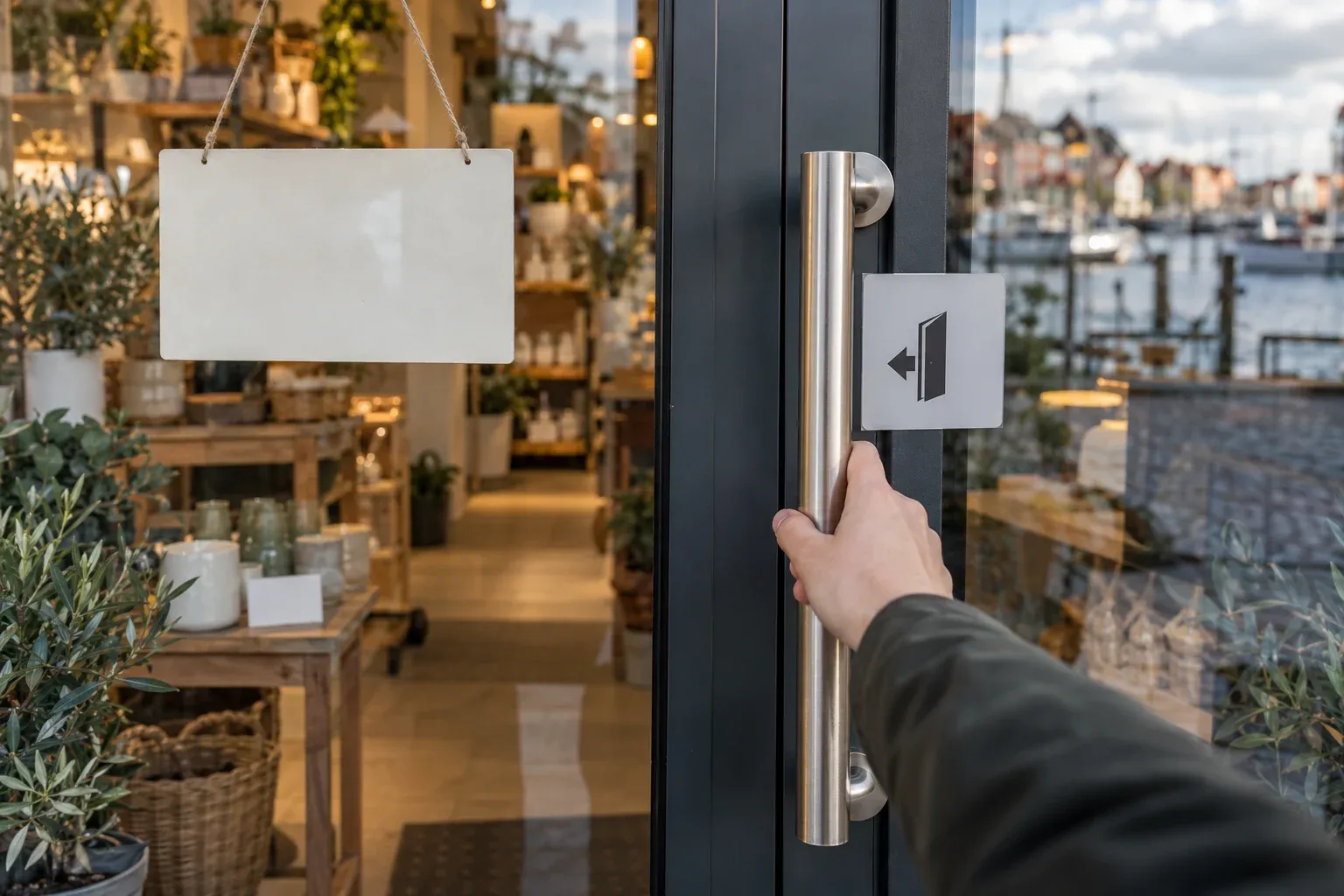
Swedish signs use a small, repetitive vocabulary. Learn about 60 words, grouped by where you stand, and you can read doors, shops, stations and parking panels. A few of them also carry legal consequences.
When you need this
You are at a glass door with one word on it and a queue behind you. You need the toilet, the exit or the till. A departure board says försenad next to your train, a gate says utfart, or a forest road has a jakt pågår sign. Each of these takes one word to decode.
Why signs are in Swedish
Under the Language Act, Swedish is Sweden’s principal language, and courts, agencies and other public bodies work in Swedish. The Act says nothing about English, so English on a sign is a courtesy, not a requirement. You will find it almost everywhere at Arlanda and on intercity trains, but often not on a village shop door or a parking panel.
In the far north you may also see Sámi, Finnish or Meänkieli next to the Swedish. These are national minority languages with their own legal status, and the Swedish word is still on the sign.
One trap first: signs use the formal negation ej (“not”) instead of everyday inte. That one short word reverses the sentence, so parkering ej tillåten means parking is not allowed.
Doors and buildings
| Swedish | English |
|---|---|
| drag / tryck | pull / push |
| ingång / utgång | entrance / exit |
| nödutgång | emergency exit |
| öppet / stängt | open / closed |
| uppgång | exit stairs (metro) |
| privat / privat område | private / private area |
| ur funktion / ej i drift | out of order |
Drag is the traditional sign form of “pull” (in speech Swedes say dra), so it has nothing to do with dragging. On metro platforms, uppgång signs show the exit stairs, often with a street name, so you come up on the right side of the street.
Opening hours on shop doors list vardagar or mån–fre (weekdays), lör (Saturday) and sön (Sunday). Helgdagar or röda dagar means public holidays. Times use the 24-hour clock.
Shops and paying
| Swedish | English |
|---|---|
| kassa | till, checkout |
| rea | sale (short for realisation) |
| extrapris | special offer |
| slut / slutsåld | sold out |
| kö / nummerlapp | queue / queue ticket |
| kontant / kort | cash / card |
| vi tar ej kontanter | we don’t take cash |
Rea peaks after Midsummer (sommarrea) and between Christmas and New Year (mellandagsrea). If a ticket machine stands by the door of a pharmacy or service counter, take a nummerlapp and watch the display instead of lining up. See how queueing works in Sweden.
Changed in 2026 — the cash sign now means less in two kinds of shop. Most businesses may lawfully refuse cash, so vi tar ej kontanter at a café, museum or on a bus is legal. But since 1 July 2026, grocery stores and pharmacies with a staffed till must accept notes and coins for everyday-sized payments, capped at about a tenth of the yearly price base amount and 25 coins. They may refuse when cash would make the store unsafe or too costly to keep open, or for a good reason in a single sale. Self-service-only shops are not covered.
Toilets
| Swedish | English |
|---|---|
| toalett / WC | toilet |
| herr / dam | men / women |
| RWC | wheelchair-accessible toilet |
| ledigt / upptaget | vacant / occupied |
| skötbord | baby-changing table |
Our public toilets guide covers where to find them and how to pay.
Stations and transport
| Swedish | English |
|---|---|
| avgång / ankomst | departure / arrival |
| spår | track (platform number at railway stations) |
| läge | bus bay |
| försenad / inställd | delayed / cancelled |
| hållplats | stop |
Läge followed by a letter on a bus station screen is the bay your bus leaves from. Inställd means the departure is cancelled, not “installed”, which catches English speakers out.
Parking and driveways
| Swedish | English |
|---|---|
| infart / utfart | way in / way out (driveway) |
| ej tillåtet | not allowed |
| avgift | fee |
Two rules here are law, not courtesy. The Traffic Ordinance bans parking on a road in front of the infart (driveway) to a property, or so that traffic in or out is substantially obstructed. A homemade utfart sign on a gate only repeats that rule. It did not create it.
The time panel under a parking sign is defined in the road-sign ordinance:
| How the times are printed | Days they apply |
|---|---|
| Plain black or white digits | Weekdays, except the day before a Sunday or holiday |
| Digits in brackets | The day before a Sunday or holiday, usually Saturday |
| Red digits | Sundays and public holidays |
If a period runs past midnight, the hours after midnight count as the next day. For discs, fees and fines, see our parking guide and Swedish road signs.
Beer and deposits
| Swedish | Alcohol | Where it is sold |
|---|---|---|
| lättöl | at most 2.25% | Any shop; legally not an alcoholic drink |
| folköl | above 2.25% up to 3.5% | Supermarkets; buyer must be 18 |
| starköl | above 3.5% | Systembolaget, or a small producer’s farm shop (gårdsförsäljning); buyer must be 20 |
A six-pack of lättöl in the beer aisle is not a party drink. Folköl is the strongest beer a supermarket may sell, and the till will ask for ID. Bars and restaurants serve from age 18. More in Sweden’s alcohol age limits.
+ pant or exkl. pant on a price tag means a deposit is added at the till. Since 1 September 2025 it is 2 kr on cans and PET bottles under one liter and 3 kr on PET bottles of one liter or more. Older guides still give the previous 1 kr and 2 kr. You get the money back by feeding the empty, uncrushed container into a pantautomat (return machine). Cans bought abroad have no Swedish deposit mark and are rejected. The bottle deposit guide has the step-by-step.
Warnings and keep-out signs
| Swedish | English | What it means for you |
|---|---|---|
| obehöriga äga ej tillträde | no unauthorized entry | Entering a building or yard without permission can be olaga intrång (unlawful intrusion): fines or up to a year in prison |
| rökning förbjuden | no smoking | A statutory ban that also covers vapes and heated tobacco; staff may tell you to stop and turn you away |
| kamerabevakning | camera surveillance | Required by law wherever covered camera surveillance runs |
| jakt pågår | hunt in progress | Not a ban; you may stay, but be visible and considerate |
| halka | slippery | Ice on paths in winter |
| varning för takras | warning, snow or ice may fall from the roof | Step away from the building’s wall |
| varning / fara / livsfara | warning / danger / mortal danger | Power installations, ice, building sites |
The obehöriga offence exists even without a sign; the sign just removes any doubt. Homes, gardens and the yards of houses are protected more strongly still, as hemfridsbrott (breach of domestic peace).
The smoking ban covers restaurants and their terraces, public transport and its stops, playgrounds, fenced sports grounds, premises open to the public and their entrances. Whoever runs the place must signpost it clearly. See smoking rules in Sweden.
A jakt pågår sign does not close the forest. According to Naturvårdsverket, a sign that keeps the public off land open under the right of public access needs the municipality’s permission.
Practical information
| What | Detail |
|---|---|
| Deposit on cans and PET bottles under 1 l | 2 kr (since 1 Sep 2025) |
| Deposit on PET bottles 1 l and over | 3 kr (since 1 Sep 2025) |
| Cash at grocery stores and pharmacies | Must be accepted at staffed tills since 1 Jul 2026, up to a cap |
| Folköl / starköl age | 18 in shops / 20 at Systembolaget |
| Unlawful intrusion (olaga intrång) | Fines or up to one year in prison |
| Free dictionary | Lexin, run by the Institute for Language and Folklore (ISOF) |
Phone-camera translation handles printed signs well but stumbles on abbreviations like exkl. pant. If there is no English on a sign, ask: staff almost always switch to English. See do Swedes speak English?.
FAQ
What does “drag” mean on a Swedish door?
Drag means pull, and tryck means push. Drag is the traditional sign form of the verb “to pull” (everyday Swedish says dra), so it has nothing to do with dragging. Some doors show both words on opposite sides of the glass. If a door has a flat plate and no handle, it is almost always tryck.
What does “ej” mean on Swedish signs?
Ej means “not”. It is the formal negation that Swedish signs use instead of everyday inte, so it flips whatever comes next: ej tillåtet is “not allowed”, ej i drift “out of order”, rökning ej tillåten “no smoking”. Förbjuden or förbjudet means forbidden and works the same way on prohibition signs.
What does “obehöriga äga ej tillträde” mean?
It means “no unauthorized entry” — literally “unauthorized persons have no access”. You see it on staff doors, depots and building sites. Entering a building or yard without permission can be olaga intrång, unlawful intrusion, punishable by fines or up to a year in prison. The offence exists even without a sign; the sign just removes any doubt.
What is “rea” in Swedish shops?
Rea is short for realisation and means a sale. You will see rea, sommarrea (summer sale) and mellandagsrea (the sale between Christmas and New Year) in shop windows, often with a percentage. Kassa is the till, extrapris a special offer and slut or slutsåld sold out.
What is the difference between lättöl and folköl?
Lättöl has at most 2.25% alcohol and is not legally an alcoholic drink. Folköl is beer above 2.25% and up to 3.5%, the strongest beer a supermarket may sell; buyers must be 18. Starköl, above 3.5%, is sold at Systembolaget, or at a small brewery’s own farm shop, to people aged 20 or over.
What does ”+ pant” mean on a price tag?
It means a deposit is added at the till. Since 1 September 2025 the deposit is 2 kr for cans and PET bottles under one liter and 3 kr for PET bottles of one liter or more. You get it back by feeding the empty, uncrushed container into a return machine, usually near a supermarket entrance.
Can a Swedish shop refuse cash?
Most businesses can, so a vi tar ej kontanter sign at a café or museum is lawful. Since 1 July 2026, though, grocery stores and pharmacies with a staffed till must accept notes and coins for everyday-sized payments, with exceptions for security and cash-handling costs. Self-service-only shops are not covered.
Related guides
- Basic Swedish phrases — the spoken words to go with the signs
- Swedish road signs — the yellow triangles and parking panels in depth
- Swedish food labels — allergens and dates on the pack
- The bottle deposit — using the return machine
- Cash in Sweden — where notes and coins still work
Facts verified 2026-10-05. Sources: Institutet för språk och folkminnen (Lexin), Sveriges riksdag (Language Act, Alcohol Act, Traffic Ordinance, Road Sign Ordinance, Tobacco Act, Penal Code, Camera Surveillance Act, cash-acceptance act 2026:769), Returpack/Pantamera, Sveriges riksbank, Naturvårdsverket — full register in this topic’s source file. Found something outdated? Tell us and we’ll fix it.