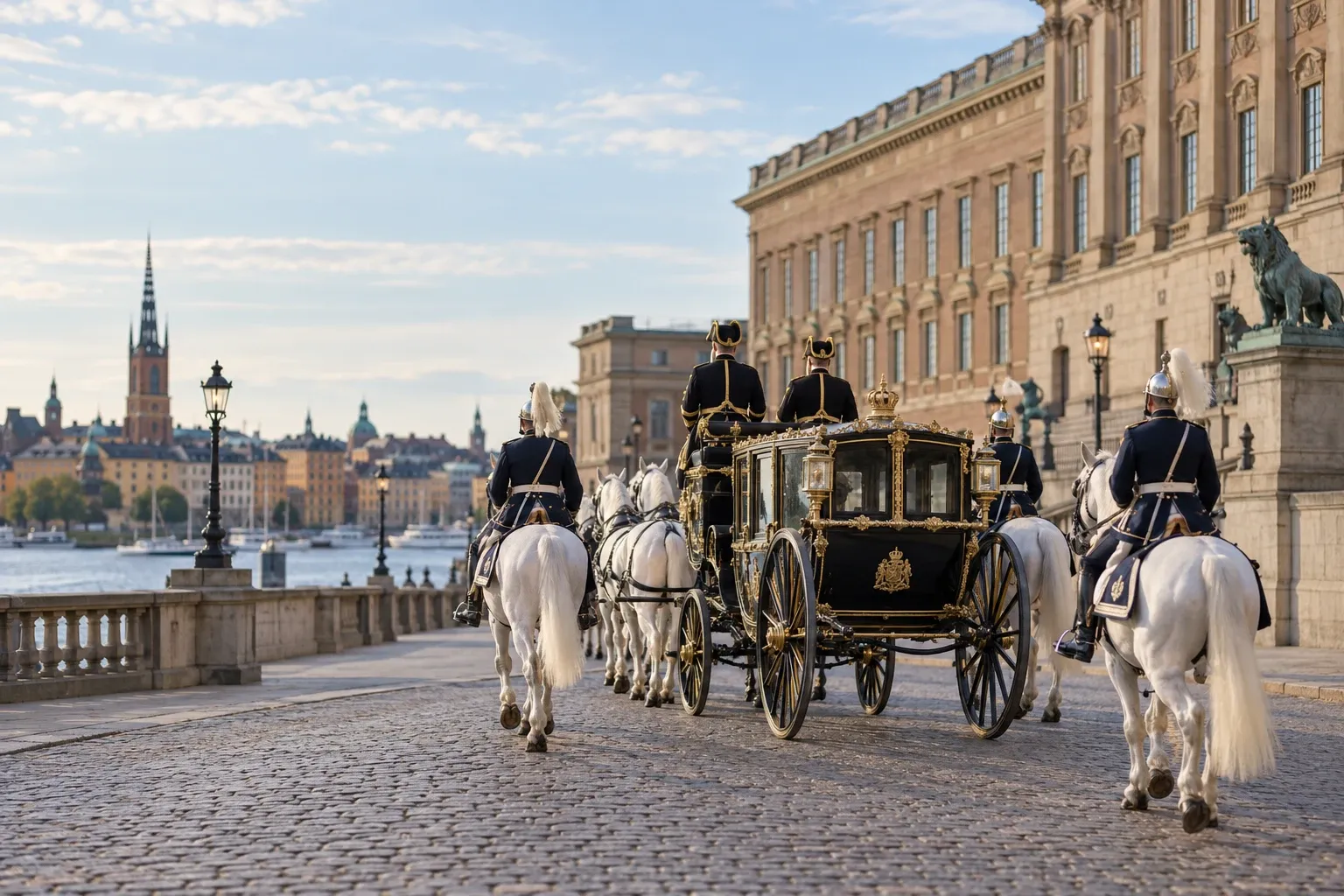
Sweden’s royals are easy to see, but only on certain days. This guide covers who is who as of October 2026, where each of them lives, and the handful of dates when they appear in public. Plus the flag that shows whether the King is in Sweden.
When you need this
You’re in Stockholm and wondering whether you could actually see a royal, or you’re planning a trip around 30 April, 6 June or 14 July. Maybe you’re watching the changing of the guard and assuming the King is involved. Or you’ve read about “Princess Ines” and want to know where she fits. For the palace visit itself (tickets, opening hours, where to stand for the guard), see our guide to the Royal Palace and the changing of the guard. This page is about the people.
Who is who
Sweden is a constitutional monarchy. The King is head of state, but his duties are ceremonial and set by law, and he has no political power. Carl XVI Gustaf has reigned since 15 September 1973. He is the seventh king of the House of Bernadotte and the longest-reigning monarch in Swedish history. He turned 80 on 30 April 2026. He and Queen Silvia, married on 19 June 1976, celebrated their golden wedding on 13 June 2026, because the anniversary itself fell on Midsummer Eve.
| Who | Born | Role | Lives |
|---|---|---|---|
| King Carl XVI Gustaf | 30 Apr 1946 | Head of state | Drottningholm |
| Queen Silvia | 23 Dec 1943 | Queen consort | Drottningholm |
| Crown Princess Victoria | 14 Jul 1977 | Heir; first in line | Haga Palace, Solna |
| Prince Daniel | 15 Sep 1973 | Her husband, Duke of Västergötland | Haga Palace |
| Princess Estelle | 23 Feb 2012 | 2nd in line | Haga Palace |
| Prince Oscar | 2 Mar 2016 | 3rd in line | Haga Palace |
| Prince Carl Philip | 13 May 1979 | 4th in line, Duke of Värmland | — |
| Princess Sofia | 6 Dec 1984 | His wife, Duchess of Värmland | — |
| Princess Madeleine | 10 Jun 1982 | 9th in line | — |
Since 1 January 1980 the monarch’s eldest child inherits the throne, whatever their sex. Prince Carl Philip was born Crown Prince in 1979 and lost the title to his elder sister when the law changed. The full order of succession today:
- Crown Princess Victoria
- Princess Estelle
- Prince Oscar
- Prince Carl Philip
- Prince Alexander (born 2016)
- Prince Gabriel (2017)
- Prince Julian (2021)
- Princess Ines (born 7 February 2025)
- Princess Madeleine
- Princess Leonore (2014)
- Prince Nicolas (2015)
- Princess Adrienne (2018)
Many published lists are out of date here. Princess Ines, Prince Carl Philip and Princess Sofia’s fourth child, moved Princess Madeleine and her children one place down in 2025. If a list stops at Prince Julian, it was written before her birth.
Royal House or Royal Family?
The Royal Court draws a line that few English-language pages explain. The Royal House (Kungl. Huset) is the King and Queen plus those “close to the Throne” who are styled Royal Highness. That means the Crown Princess and her family, Prince Carl Philip, Princess Sofia and Princess Madeleine.
The wider Royal Family (Kungl. Familjen) adds the King’s other seven grandchildren and his two sisters, Princess Margaretha (born 1934) and Princess Christina (born 1943). Carl Philip’s and Madeleine’s children are princes and princesses of Sweden and in the line of succession. They are not styled Royal Highness, though: of the nine grandchildren, only Estelle and Oscar are.
Where they live
| Place | Who | Can you visit? |
|---|---|---|
| Royal Palace, Gamla stan | The King’s official residence and workplace | Yes, with a palace ticket; state ceremonies and audiences take place here |
| Drottningholm, Ekerö | The King and Queen’s private home since 1981 | The rest of the palace and the park, yes; see our Drottningholm Palace guide |
| Haga Palace, Solna | The Crown Princess’s family, since 2010 | No, a private home |
| Sollidens slott, Öland | The King’s private summer palace; he and the Queen spend much of the summer there | The park and exhibitions in season; see our Öland guide |
| Stenhammar, Flen | A state-owned estate leased by the King, run as a farm and forest | No |
Note the two Sollidens. Solliden at Skansen in Stockholm is a stage in the open-air museum. Sollidens slott on Öland is the summer palace.
Where to see them
Royal sightings are mostly free and outdoors. They are tied to a few fixed dates, though, so plan around those.
30 April: the King’s birthday
By tradition, the Swedish Armed Forces congratulate the King on his birthday in the Royal Palace’s Outer Courtyard (Yttre borggården), together with the changing of the guard. On his 80th birthday in 2026 a large crowd gathered there and sang the royal anthem, Kungssången. It is one of the rare days the King himself takes part in the guard ceremony.
6 June: National Day in Stockholm
In 2026 the King and Queen and the Crown Princess couple travelled by horse-drawn carriage from the Royal Palace to Solliden at Skansen for the televised ceremony. The King and Queen had first spent the morning at Skokloster; by 2026 they had celebrated National Day in all 21 counties. The ceremony itself is inside Skansen, a paid venue that gets crowded. A spot along the carriage route is the free option. Our Swedish National Day guide covers the rest of the day.
14 July: Victoria Day on Öland
The Crown Princess spends her birthday on Öland by tradition, with the whole family. In 2026 the family stepped out in front of Sollidens slott at about 15:50, and the public could sing to the Crown Princess together with the King. At 16:00 a carriage procession left for Borgholm’s castle ruin, where the televised Victoria concert began at 17:00. Book Öland travel early for this day.
September: the opening of the Riksdag
The royal family rides in a horse-drawn cortège from the Royal Palace to the Riksdag building, where Life Guards grenadiers parade on Riksplan. The 2026 session opened on 29 September.
State visits and ambassadors’ coaches
An incoming head of state is met by the King and Queen at the Royal Stables (Hovstallet), and they travel together by horse and carriage to the palace. Singapore’s president is due on 19–21 October 2026. About once a month, new ambassadors ride in King Karl XV’s state coach from the Foreign Ministry at Gustaf Adolfs torg to the palace’s Inner Courtyard. Sweden is one of few countries that keeps this carriage tradition.
Everywhere else
The Royal Court publishes a selection of the family’s public engagements, with places and times, as its Officiella program. Local visits around Sweden often draw small, relaxed crowds. The 10 December Nobel Prize ceremony, where the King hands each laureate their diploma and medal, is for invited guests only. Watch it on television. See the Nobel Prize in Stockholm.
The palace flag: is the King even here?
Look at the Royal Palace roof before you plan around the King.
| Flag on the Royal Palace | What it means |
|---|---|
| Large three-tailed flag with the great coat of arms | The King is in Sweden (or just outside it) and exercising his office |
| Three-tailed flag with the lesser coat of arms | The Crown Princess is temporary regent, for example while the King is far abroad |
| Small storm flag | Bad weather; the guard chose a smaller flag |
At Drottningholm a flag flies only when the King and/or Queen are at home. Haga flies its royal flag when the Crown Princess’s family is in residence. A two-tailed pennant on any royal palace means no royal is there. The three-tailed flag is reserved for the Royal House and the Armed Forces. Royal birthdays and name days are also official flag days; see Swedish flag days.
Common mistakes
- Expecting royals at the changing of the guard. It is a military ceremony run by the Armed Forces. The King comes out on his birthday; on other days you see soldiers, not royals.
- Going to Drottningholm to spot the King. It is his home. Visitors see the public palace, theatre and park, not the family.
- Thinking the King runs the government. The Speaker proposes and the Riksdag approves the prime minister; the King chairs ceremonial councils. Our guide to how Sweden is governed explains the rest.
- Calling all the grandchildren “Royal Highness”. Only Estelle and Oscar hold that style.
- Hanging around private gates. Haga Palace and Drottningholm’s southern wing are homes. No tour includes them, and loitering gets you nothing but attention from security.
If you are introduced, the formal address is Ers Majestät (Your Majesty) or Ers Kungliga Höghet (Your Royal Highness). In less formal settings, the language council advises Kungen (the King) or Kronprinsessan (the Crown Princess). The du and first names guide explains why royals are one of the few exceptions to Swedish informality.
Practical information
| Item | Cost or rule |
|---|---|
| Royal birthdays, carriage processions, changing of the guard | Free |
| National Day ceremony at Skansen | Skansen admission; varies by season, lowest online |
| Sollidens slott park, Öland (2026 season) | Adult 150 kr, student 100 kr, age 7–18 70 kr, under 7 free; bought on site (checked 2026-10-14) |
| Royal Palace, Drottningholm and other royal palaces | Separate palace tickets; see the palace guides |
| Changing of the guard | 12:15 weekdays and Saturdays, 13:15 Sundays and holidays |
| Upcoming engagements | The Royal Court’s Officiella program (a selection) |
FAQ
Who is in the Swedish royal family?
King Carl XVI Gustaf and Queen Silvia; their children Crown Princess Victoria, Prince Carl Philip and Princess Madeleine; Prince Daniel and Princess Sofia; nine grandchildren; and the King’s sisters Margaretha and Christina. Only the King, Queen, the Crown Princess’s family, Carl Philip, Sofia and Madeleine form the Royal House, styled Majesty or Royal Highness.
Who is next in line to the Swedish throne?
Crown Princess Victoria, the King’s eldest child, followed by her daughter Princess Estelle and son Prince Oscar. Sweden has used equal succession since 1980, so the eldest child inherits regardless of sex. Prince Carl Philip is fourth, then his children Alexander, Gabriel, Julian and Ines, then Princess Madeleine and her three children.
Where does the Swedish royal family live?
The King and Queen live at Drottningholm Palace outside Stockholm, their home since 1981; the Royal Palace in Gamla stan is the King’s official residence and workplace. The Crown Princess’s family lives at Haga Palace in Solna. Each summer the King and Queen spend much time at Solliden, their private palace on Öland.
Can you see the King of Sweden in Stockholm?
Yes, on a few fixed days. On his birthday, 30 April, the Armed Forces congratulate him in the Royal Palace’s Outer Courtyard; on 6 June the royal couple ride by carriage to Skansen; in September the family rides to the Riksdag’s opening. State visits and ambassadors’ audiences also bring carriages through central Stockholm.
Does the King attend the changing of the guard?
Normally no. The changing of the guard at the Royal Palace is run by the Swedish Armed Forces every day, at 12:15 on weekdays and Saturdays and 13:15 on Sundays and holidays, and no royal takes part. The notable exception is the King’s birthday, when he comes out to receive the guard and the Armed Forces’ congratulations.
How can I tell if the King is at the Royal Palace?
Look at the flag on the palace roof. A large three-tailed flag with the great coat of arms means the King is in Sweden and exercising his office, not necessarily inside the building. A three-tailed flag with the lesser coat of arms means the Crown Princess is acting as temporary regent. At Drottningholm a flag flies only when the King or Queen is home.
Where can I see the Crown Princess?
Her birthday, 14 July, is the surest day: the family traditionally gathers at Solliden on Öland, the public can sing to her in front of the palace, and a carriage takes her through Borgholm to the evening Victoria concert. She also takes part in National Day, the Riksdag’s opening and incoming state visits.
Related guides
- Royal Palace and the changing of the guard — tickets, times and where to stand on 30 April.
- Swedish National Day — the full 6 June programme and what closes.
- Öland — Solliden, Borgholm and getting there for 14 July.
- Drottningholm Palace — visiting the palace the King and Queen call home.
- How Sweden is governed — what the King can and cannot do.
Facts verified 2026-10-14. Sources: the Royal Court of Sweden (Kungl. Hovstaterna), Försvarsmakten, Sveriges riksdag, Nobel Prize Outreach, Skansen, Sollidens slott, TT — full register in this topic’s source file. Found something outdated? Tell us and we’ll fix it.