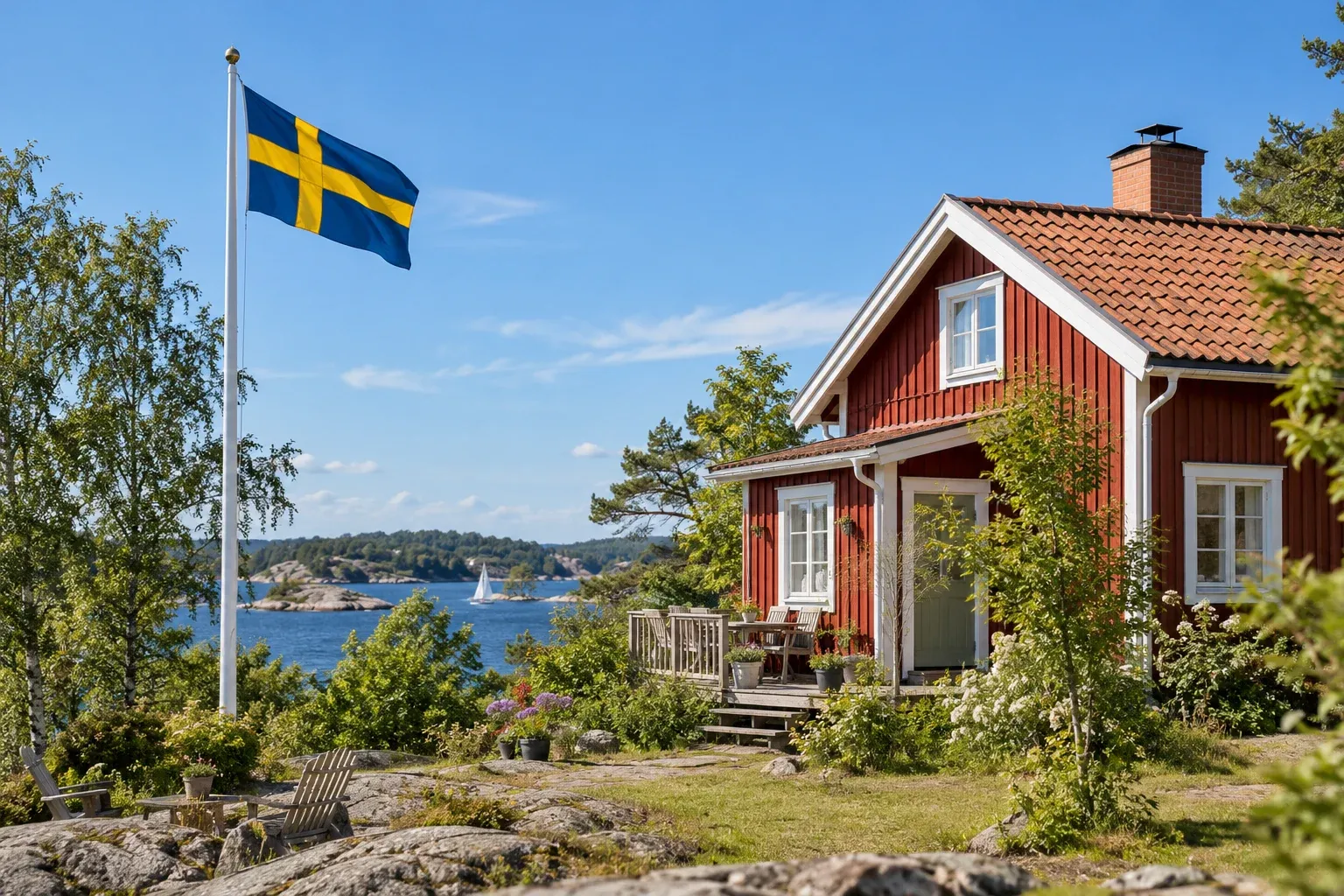
Flags on every bus on an ordinary Tuesday, a blue-and-yellow streamer above every red cottage: Sweden flies its flag more than most countries. Here is what the official days are, which rules are law and which are custom, and what it means at your rental.
When you need this
You notice flags on public buildings and buses and wonder whether something is closed. You are renting a stuga (cottage) with a flagpole and want to know whether to touch it. You are planning around National Day on 6 June or Midsummer. Or a flag is at half-mast and you want to know what it means. All of these have short, fixed answers.
The official flag days
The list of official flag days, allmänna flaggdagar, is a one-section government ordinance, Förordning 1982:270. Its current wording has applied since 1 January 2024 and has 19 entries. Seventeen come every year; the two election days come only in election years.
| Date | Flag day | Also a public holiday? |
|---|---|---|
| 1 January | New Year’s Day | Yes |
| 28 January | King Carl XVI Gustaf’s name day | No |
| 12 March | Crown Princess Victoria’s name day | No |
| Easter Sunday (28 March in 2027) | Easter Sunday | Yes |
| 30 April | The King’s birthday | No |
| 1 May | May Day | Yes |
| Whit Sunday (16 May in 2027) | Whit Sunday | Yes |
| 29 May | Veterans’ Day | No |
| 6 June | National Day and Swedish Flag Day | Yes |
| European election day (next in 2029) | Sweden’s election to the European Parliament | No |
| Midsummer Day (26 June in 2027) | Midsummer Day | Yes |
| 14 July | The Crown Princess’s birthday | No |
| 8 August | Queen Silvia’s name day | No |
| Riksdag election day (next in 2030) | National parliamentary election, second Sunday in September | Falls on a Sunday |
| 24 October | UN Day | No |
| 6 November | Gustavus Adolphus Day | No |
| 10 December | Nobel Day | No |
| 23 December | The Queen’s birthday | No |
| 25 December | Christmas Day | Yes |
Most flag days are ordinary working days. A flagged weekday tells you there is a royal birthday, a name day or an anniversary, not that shops are shut. For what actually closes, see Swedish public holidays.
Recently changed — older lists are wrong. The ordinance changed three times in 2023. The European Parliament election day became a flag day from 1 April 2023. A one-off flag day on 15 September 2023 marked the King’s 50 years on the throne, and it was removed again from 1 January 2024. Parliament has also approved that, after the next change of monarch, only the monarch’s and the heir’s birthdays will remain as royal flag days. The name days will go. Until then the list above applies.
What about Sámi National Day? On 6 February many municipalities, especially in Sápmi, fly the Sámi flag beside the Swedish one. It is not an official flag day, though. Parliament has rejected motions to add it twice, in January 2025 and again on 25 February 2026 (284 votes to 19), saying the flag days had recently been reviewed. Municipalities also flag locally on days such as Sweden Finns’ Day (24 February), Europe Day (9 May) and Tornedalians’ Day (15 July).
Law or custom? What’s actually regulated
The rules come in three layers, and only two of them are law.
| Layer | What it covers | Status |
|---|---|---|
| Flag law (Lag 1982:269) | Design: blue with a yellow cross, proportions 10:16; three-tailed flag reserved for the royal family and the military; no letters, marks or symbols added | Law |
| Flag-day ordinance (1982:270) | The list of official days | Law, but only a list: it obliges no private person to fly anything |
| Flying times, pennant, half-mast | When to hoist and lower, how to fly | Recommendation from Stiftelsen Sveriges nationaldag, published by Riksarkivet (the National Archives) |
The recommended times: hoist at 08.00 from 1 March to 31 October and at 09.00 from November to February. Lower at sunset, at the latest 21.00, every day of the year. A floodlit flag may stay up after dark. One flag per pole, hoisted fully to the top on a taut line, whole and clean. Public bodies hoist the Swedish flag on every pole on official flag days. On weekdays, public employers often adjust the times to office hours.
None of this is policed. The flag law has no penalty provision, and the official guidance itself says it is better to fly the flag than to hold back for fear of getting it wrong. One thing is law, though: don’t add text, logos or symbols to a Swedish flag. Using the flag in a trademark needs permission from PRV, the Swedish Intellectual Property Office.
Midnight sun, same rule. North of the Arctic Circle in June the sun never sets. The recommendation still says the flag comes down by 21.00.
The countryside pennant
The long streamer you see on countryside flagpoles is the vimpel, the pennant. It is split lengthwise into blue and yellow and tapers to a point. It does not replace the flag. Its job is to dress the pole when no flag is flying, which is why it may stay up day and night. Flown correctly, the blue side is on top and it is one-third to one-half as long as the pole is high.
Two details that Swedes themselves often get wrong:
- The pennant is never flown at half-mast. Only the Swedish flag is.
- The “cross pennant” (korsvimpel), a streamer printed with the cross, is advised against by Riksarkivet. It has no tradition behind it and imitates the flag in proportions the law doesn’t allow.
Flagpoles at cottages and rentals
A white flagpole with a pennant is a classic feature of Swedish countryside homes and summer cottages. Families hoist the flag on flag days, at Midsummer and for birthdays. In everyday Swedish use it is festive, not political. Riksarkivet stresses that the flag, small balcony flags included, represents Sweden, not any ethnic group, and that anyone living in Sweden may use it.
If your rental has a flagpole:
- Leave the owner’s flag and pennant as you found them, unless the host invites you to hoist the flag. A pennant that is already up can simply stay up.
- If you hoist the flag, take it down at sunset or by 21.00. A flag left out overnight looks forgotten; the pennant is the one that stays up.
- You may fly your own country’s flag. Official guidance explicitly welcomes foreign citizens flying their own national flag. Just ask the host before swapping their equipment.
Buying one to take home? Flag length should be about a quarter of the pole’s height: a 3 m flag on a 12 m pole. In strong wind, Swedes hoist a small storm flag so the pole doesn’t snap. No official rules govern the flagpole itself, but at a normal house it should rise no more than 3.5 m above the roof ridge.
Half-mast
A flag at half-mast marks a death or a funeral. That can be a national event, or locally the death of someone connected to that building or household. The flag is hoisted to the top first, then lowered so its middle sits at two-thirds of the pole’s height (mid-pole on a wall-mounted pole). Only the Swedish flag goes to half-mast, and half-mast takes precedence over a flag day.
Mistakes to avoid
| Mistake | Why it’s wrong | Do this instead |
|---|---|---|
| Assuming a flag day means shops are shut | Most flag days are working days | Check the public-holiday list |
| Treating 6 February as an official flag day | Parliament rejected it in 2025 and 2026; it is flagged locally | Expect Sámi flags in Sápmi, not everywhere |
| Thinking the hoisting times are law | They are a recommendation | Follow them as courtesy |
| Burning a worn-out flag | Polyester melts and gives off toxic smoke | Cut it into plain blue and yellow pieces, then throw them away |
| Writing names or slogans on the flag | Conflicts with the flag law | Use flag-coloured items instead |
Practical information
| Item | Detail |
|---|---|
| Official flag days | 19 listed: 17 every year plus the Riksdag and European election days |
| Next flag days | 24 October 2026 (Saturday), 6 November (Friday), 10 December (Thursday), 23 December (Wednesday), 25 December |
| Hoist | 08.00 from 1 March to 31 October; 09.00 from 1 November to end of February (recommendation) |
| Lower | At sunset, by 21.00 at the latest; floodlit flags may stay up |
| Pennant | May fly day and night; blue on top; never at half-mast |
| Half-mast | Only the Swedish flag; two-thirds of the pole; takes precedence over flag days |
| Cost of flying a flag | 0 kr: no permit or fee |
| Flag in a trademark | Needs permission from PRV |
| Flags, pennants, poles | Prices vary by retailer and size; not listed here |
FAQ
What are the official flag days in Sweden?
The ordinance lists 19: New Year’s Day, 28 January, 12 March, Easter Sunday, 30 April, 1 May, Whit Sunday, 29 May, 6 June, Midsummer Day, 14 July, 8 August, 24 October, 6 November, 10 December, 23 December and Christmas Day, plus the Riksdag and European election days in election years. Many are royal birthdays or name days and ordinary working days.
What time do you raise and lower the Swedish flag?
By official recommendation, not law: hoist at 08.00 from 1 March to 31 October and at 09.00 from November to February, then lower at sunset, at the latest 21.00, every day of the year. A floodlit flag may stay up after dark. Public employers often adapt the times to working hours on weekdays.
What is the long blue and yellow pennant on Swedish flagpoles?
It is the vimpel, a long streamer split lengthwise into blue and yellow and tapering to a point. It dresses the flagpole when no flag is flying, so it may stay up day and night, blue side on top. It does not replace the flag on flag days and is never flown at half-mast.
Why do so many Swedish houses have flagpoles?
A flagpole with a pennant is a traditional feature of Swedish countryside homes and summer cottages, and flying the flag is a festive, mostly non-political custom: families hoist it on flag days, Midsummer and birthdays. Riksarkivet stresses that the flag represents Sweden, not any group, and may be used by everyone living in Sweden.
Can I fly my own country’s flag in Sweden?
Yes. Foreign citizens may hoist their own national flag in Sweden, and official guidance explicitly welcomes it on private or national occasions. Permanent residents are also welcome to fly the Swedish flag on flag days. At a rental cottage, ask the host before swapping their flag or pennant — the pole and its equipment are theirs.
Is Sámi National Day an official flag day?
No. Sámi National Day on 6 February is not in the flag-day ordinance, and Parliament has rejected motions to add it twice, in January 2025 and again on 25 February 2026 (284 votes to 19), noting that flag days had recently been reviewed. In practice many municipalities, especially in Sápmi, fly the Sámi flag beside the Swedish flag that day as a local decision.
What does a flag at half-mast mean in Sweden?
It marks a death or funeral — a national event, or locally the death of someone connected to that building or household. Only the Swedish flag is flown at half-mast: it is hoisted to the top, then lowered to two-thirds of the pole. Half-mast overrides a flag day, and pennants are never lowered to half-mast.
Related guides
- Swedish National Day — what happens on 6 June, Swedish Flag Day
- Swedish public holidays — which flag days actually close shops
- Midsummer in Sweden — the most flag-filled weekend of the year
- Renting a stuga — where you’ll meet the flagpole and pennant
- Sámi culture guide — 6 February and the Sámi flag
Facts verified 2026-10-05. Sources: Sveriges riksdag (flag law, flag-day ordinance, proposition 2021/22:232 and committee report 2024/25:KU8), Svensk författningssamling, Riksarkivet and Höör municipality — full register in this topic’s source file. Found something outdated? Tell us and we’ll fix it.