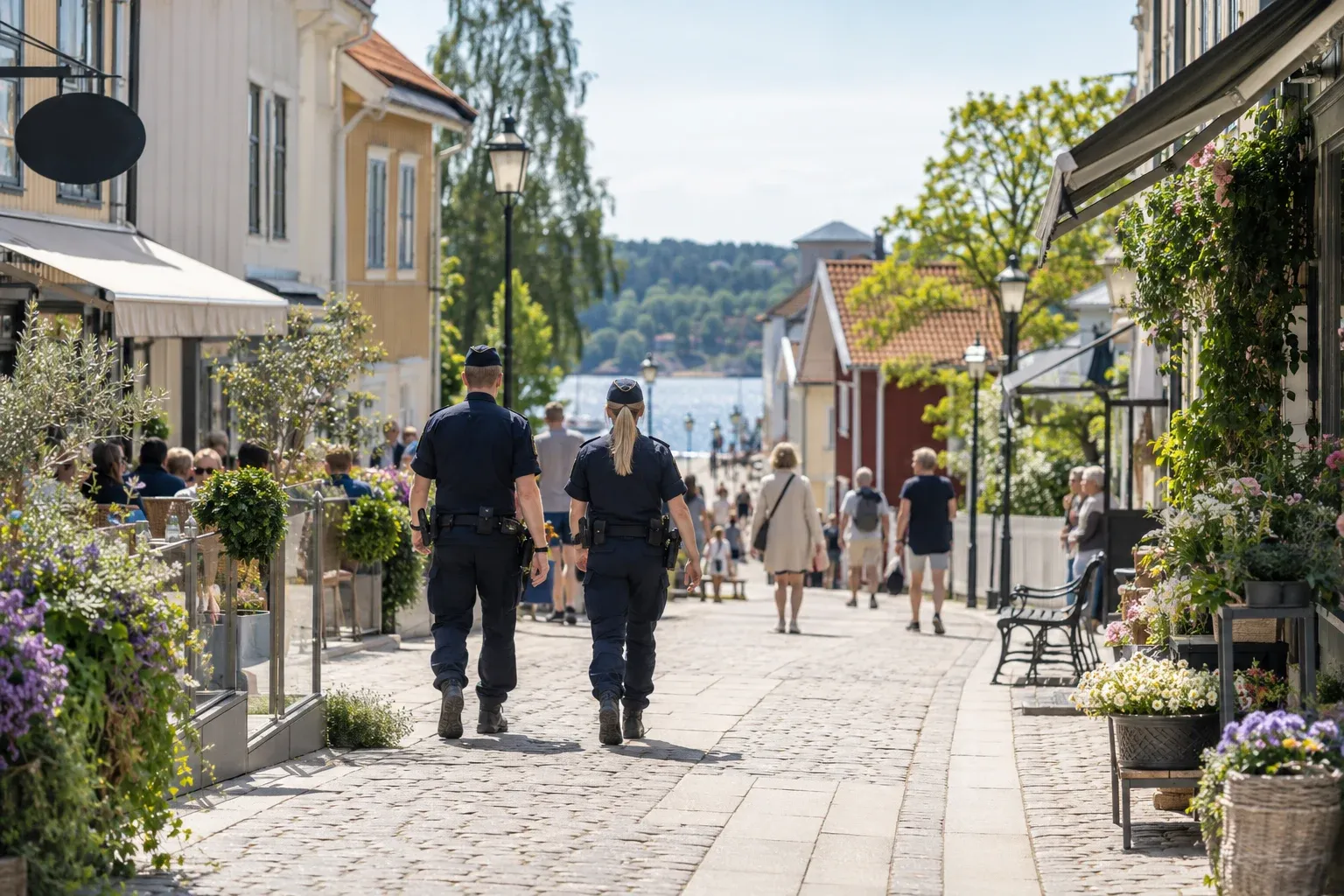
Sweden’s police are one national force with fairly broad street powers, which grew in 2024. Here is how to reach them, what an officer may do to you, what a säkerhetszon is, and how to tell a real officer from a fake.
When you need this
- Something has been stolen and you need the right number or door
- An officer has stopped you on the street, at a station or at a festival
- You walk into an area with signs saying säkerhetszon
- Someone in plain clothes says they are police and you want to be sure
- Your hotel says “just go to the police station” on a Saturday
- You are asked to come along as a witness after something happened nearby
- A guard at a bar, station or event is telling you to leave
One national police force
Sweden has a single police authority, Polismyndigheten (the Swedish Police Authority), plus the Security Service, Säkerhetspolisen. There are no city, regional or municipal police forces. Every station and phone line reaches the same authority.
The Police Act (polislagen) sets the job: prevent and detect crime, keep public order, investigate offences and give the public “protection, information and other help”. It also sets the ground rule for everything an officer does: an intervention must be defensible, and force may be used only as far as needed.
How to reach the police
| Situation | Contact |
|---|---|
| Crime happening now, someone in danger | 112 (free) |
| Report a crime that is over, give a tip, ask a question | 114 14, around the clock |
| Same, from a foreign mobile or from abroad | +46 77 114 14 00 |
| Report online | Only with a Swedish personal identity or coordination number |
The 114 14 line is answered in Swedish and English. Violent and sexual crime, threats and lost passports are phone-or-station reports for everyone, and the online form is closed to visitors without a Swedish ID number. The step-by-step reporting guide is in how to report a crime as a visitor, and the numbers in depth are in Sweden’s emergency numbers.
Police stations keep office hours
A Swedish police station is not a 24-hour counter. Stations list separate services — reporting a crime, handing in found property, collecting seized goods — each with its own hours, and for some you need to book a time or wait to be called in. When we checked, even Stockholm’s main Kungsholmen station took walk-in crime reports on weekdays only, closed at weekends.
In rural Sweden stations are far apart and many have short or appointment-only hours. Check the station’s page on polisen.se before you go, or simply phone 114 14, which never closes. The separate passport offices (passexpedition) issue Swedish passports and ID cards; they cannot replace a visitor’s foreign passport — that is the embassy’s job (see a lost or stolen passport).
When an officer may frisk you
A kroppsvisitation (frisk) is allowed in three situations under the Police Act:
| Situation | What the officer needs |
|---|---|
| You are being arrested, taken into custody or removed | Only that the frisk is needed for safety or to establish your identity |
| Searching for weapons, anywhere | That “with regard to the circumstances” you can be assumed to carry a weapon that could be forfeited |
| Inside a declared security zone | Nothing about you personally — only that you are in a public place in the zone |
The middle row changed on 8 November 2024. The bar used to be a “particular reason” to believe you carried a weapon; it is now circumstances suggesting one. Vehicles and boats can be searched on the same basis. Many English explainers still describe the older, stricter rule.
The practical point: a knife in your pocket or bag is far more likely to be found than you might expect, and Sweden’s knife law then applies in full.
Security zones: säkerhetszon explained
Since 25 April 2024 the police can declare a säkerhetszon (security zone) in a defined area. The legal test is strict: a conflict between groups must create an evident risk of shootings or explosions there, and the zone must be of exceptional importance to prevent them. Inside it, officers may frisk anyone and search any vehicle for weapons — but only in public places.
Each decision lasts at most two weeks, must be published on polisen.se at once with the area defined, must be lifted when the grounds lapse, and can be appealed to an administrative court within two weeks. Polisen says a zone can be extended with a new decision, and describes the frisk as being like airport screening, over clothing.
Zones are much rarer than the news coverage suggests. Polisen’s own report counts five in 2024–2025 — in Norrköping, Södertälje, two in Eskilstuna and one in Örebro — fewer than it had forecast, and no weapons or explosives were seized in any of them. In spring 2026 a zone was also declared in Stockholm’s embassy quarter, Diplomatstaden.
Identity, questioning and your rights
Swedes have no general duty to carry ID, but visitors do in practice. Any non-Swedish citizen must hand over a passport or other proof of the right to stay when an officer asks, under conditions explained in the ID duty that applies to visitors. Beyond that:
- If you are suspected of an offence, give your name and address. A suspect who is unknown and refuses, or has no home in Sweden and may leave the country, can be remanded however minor the offence.
- If you witness a crime, you must go with an officer to immediate questioning when told to. Nobody who is not arrested has to stay for questioning longer than six hours (twelve for a possible suspect, if exceptionally important).
- Identification custody for a stranger believed to be wanted is limited to six hours, twelve in exceptional cases.
- As a suspect you must be told of your right to a defence lawyer, to an interpreter and translation of key documents, and your right not to comment on the suspicion or help prove your own guilt. The state pays a public defender up front, but a convicted person may have to repay part or all of it.
- On-the-spot fines (ordningsbot): signing one equals a final judgment, so disagree before you sign. It must be paid within three months; see paying a Swedish fine.
Every frisk, removal and detention must be recorded, naming who decided, on what grounds and who took part.
Recognising a real officer
Uniformed officers are marked POLIS and have worn body cameras since 2023. The camera pre-records a silent minute on a loop; when the officer starts a recording it beeps three times and its light turns from green to red.
Plain-clothes officers are harder to spot, which is why the law matters: every officer on duty must be able to identify themselves with a polislegitimation (police ID card) unless special reasons prevent it. The card carries the officer’s photo, name, the issuing authority, a card number and where it can be checked. Ask to see it. A real officer will not ask for your card codes or valuables — calls and visits like that are a known scam, covered in fake police callers and other scams.
Police, ordningsvakt or väktare?
| Police officer | Ordningsvakt | Väktare | |
|---|---|---|---|
| Who | Polismyndigheten | Licensed public-order guard under police command | Private security guard |
| Where you meet them | Anywhere | Bars, clubs, stations, events | Shops, malls, offices |
| Remove you under the Police Act | Yes | Yes | No |
| Frisk you | Yes, as above | Only when detaining you, to establish identity | No |
| Detain you | Yes | Yes, then hand you to the police | Only if caught in the act of an offence carrying prison, then hand you to the police |
An ordningsvakt must follow an officer’s instructions. Summer festivals, Pride and big concerts bring more of them, along with bag checks; the organisers’ own rules come on top of the law. See nightlife and door staff for club entry.
Practical information
| Item | Detail |
|---|---|
| Emergency | 112 — free, Swedish and English |
| Non-urgent police | 114 14, 24 hours; +46 77 114 14 00 from a foreign mobile; charged at your own rate |
| Online report | Requires a Swedish personal identity or coordination number |
| Station counters | Office hours vary by station; Kungsholmen, Stockholm: crime reports weekdays 10:00–16:00, closed weekends (checked 2026-10-06) |
| Security zones | Max two weeks per decision; published on polisen.se |
| Identification custody | Max 6 hours, 12 if exceptionally important |
| Witness questioning | Max 6 hours unless arrested |
| Unpaid ordningsbot | Passed to Kronofogden with a 600 kr fee |
FAQ
What is the police phone number in Sweden?
Call 112 for anything urgent — a crime in progress or someone in danger. For everything else, such as reporting a stolen phone or giving a tip, call 114 14, open around the clock and answered in Swedish and English. From a foreign mobile the short number may not connect, so dial +46 77 114 14 00. Unlike 112, the 114 14 line is not free.
Are Swedish police stations open 24 hours?
Generally no. Stations keep reception hours for reporting crimes, handing in found property and other errands, and many are closed at weekends. When we checked, even Stockholm’s main Kungsholmen station took walk-in reports on weekdays only. The phone line 114 14 is the round-the-clock route, and each station’s current hours are listed on polisen.se.
Can Swedish police search me without a reason?
Not without any reason, outside a declared security zone. Since 8 November 2024 an officer may frisk you for weapons if the circumstances suggest you carry one that could be forfeited, and may frisk you when arresting or removing you. Inside a säkerhetszon, published on polisen.se, officers may frisk anyone in public places for weapons with no individual suspicion.
What is a säkerhetszon in Sweden?
A security zone: a defined area where the police have decided there is an evident risk of shootings or explosions linked to a conflict between groups. For up to two weeks per decision, officers may frisk people and search vehicles there for weapons without suspicion. Five zones were declared in 2024–2025 and one in Stockholm in 2026; each is published with a map.
Do I have to show ID to the Swedish police?
Swedes do not, unless suspected of a crime or driving. Visitors are different: any non-Swedish citizen must hand over a passport or other proof of the right to stay when an officer asks, under the conditions set by the Aliens Act. If you are suspected of an offence, refusing your name can lead to detention. Carry your passport or EU ID card.
How can I tell if someone is really a police officer?
Uniformed officers are marked POLIS and have worn body cameras since 2023. Every officer on duty must be able to show a police ID card with photo, name and card number unless special reasons prevent it — so ask. Real police never need your card codes or valuables; if in doubt, call 114 14 and check before handing anything over.
Do Swedish police speak English?
Yes, as a rule. The 114 14 line is answered in Swedish and English, and so is 112. If you are suspected of a crime and do not master Swedish, you have a legal right to an interpreter during questioning and to translation of key documents; a crime victim reporting an offence can also ask for an interpreter.
Related guides
- Reporting a crime as a tourist — what to say, interpreters and the case number your insurer needs
- 112 and Sweden’s emergency numbers — every number, and why 114 14 may fail from a foreign SIM
- Do you have to carry ID in Sweden? — the Aliens Act duty an officer can enforce
- Sweden’s knife law — what a frisk will find and what happens next
- Is Sweden safe? — the crime picture behind the new powers
Facts verified 2026-10-06. Sources: Sveriges Riksdag (Police Act, Police Ordinance, Code of Judicial Procedure and other statute texts), Svensk författningssamling, Polismyndigheten — full register in this topic’s source file. Found something outdated? Tell us and we’ll fix it.