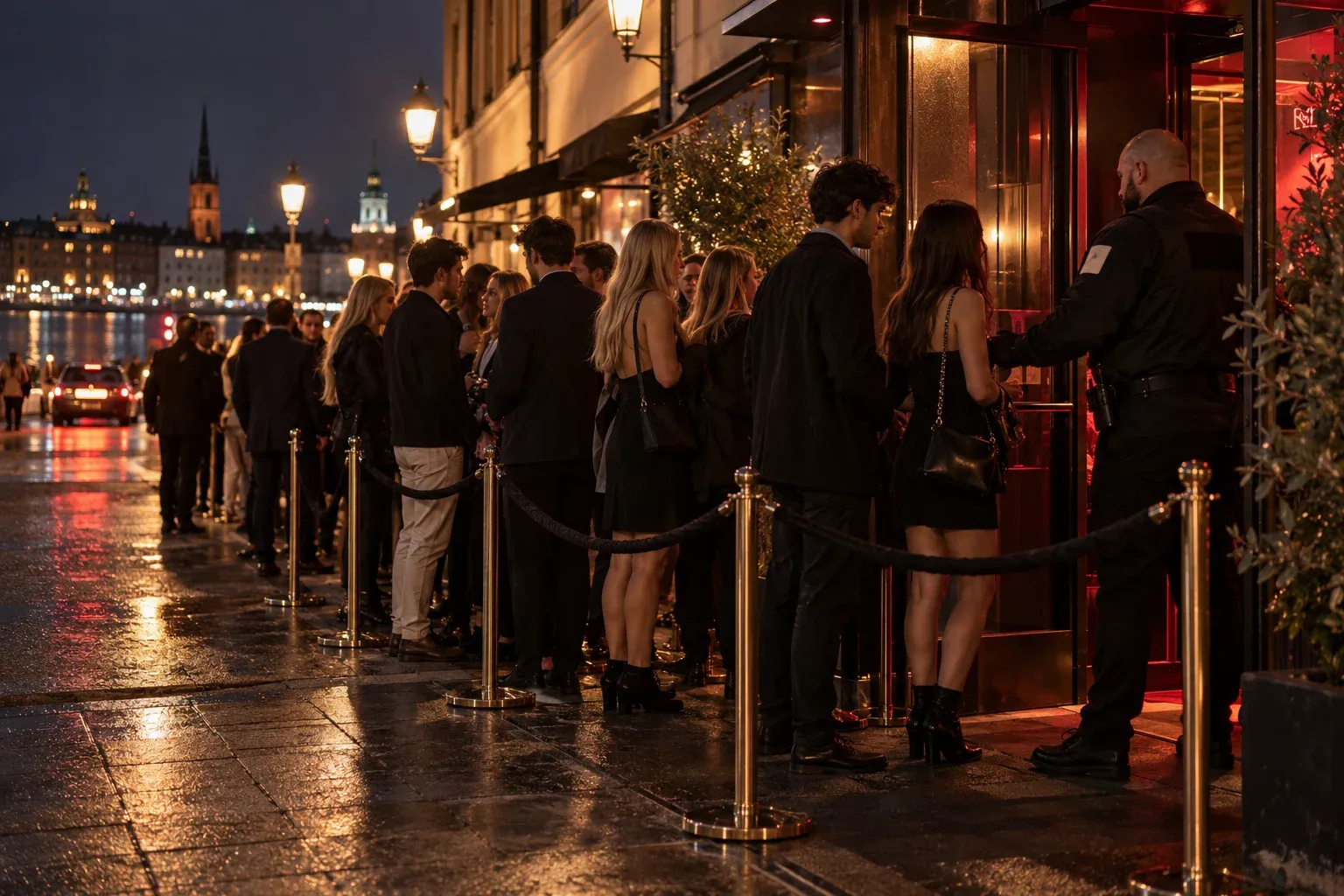
A Swedish night out runs on three separate sets of rules: the law, the venue’s own policy and the people at the door. Mix them up and you end up arguing “but the law says 18” in a queue where that argument cannot win.
When you need this
You’re 21, it’s Saturday in Stockholm, and the club your friends picked says 23. You’re traveling with a mixed-age group and want to stay together. Or you’re in the queue, someone in uniform is waving people away, and you want to know what they can actually do.
Three layers: the law, the venue, the door
| Layer | Who decides | What it sets |
|---|---|---|
| The law | Parliament and the municipality | Serving age 18, no serving to the noticeably drunk, serving hours, no drinks out the door |
| The venue | The club itself | Door age, ID policy, dress code, guest list, entrance fee, coat check |
| The door staff | Police-appointed ordningsvakter or ordinary hosts | Who gets in tonight, and who has to leave |
The law is the floor; everything above it is the venue’s call. The one thing a venue may never do is refuse you because of ethnicity, religion, sexual orientation or a similar protected ground.
Club age limits: why 23 is legal
The legal serving age in any licensed bar, restaurant or club is 18. But Sweden’s Discrimination Act, which otherwise forbids age discrimination in services, expressly allows licensed venues to set a higher minimum age for entry. That is why a pub serves your 19-year-old while the club next door says 23.
In Stockholm and other big cities, 20, 23 and 25 are all common, and the number often rises on Fridays and Saturdays. Small-town pubs usually stay at 18. The exception covers entry only: once you are inside and of serving age, you can’t be refused a drink just for being too old.
Mixed-age group? Pick a bar or pub rather than a club, so nobody is left on the pavement.
What ID to bring
Swedish law lists no accepted documents. The venue only has to be satisfied of your age, so every club sets its own policy. Systembolaget, the alcohol monopoly, accepts passports and EU/EEA national ID cards but not non-Nordic driving licenses or photos of ID — a useful benchmark for what a careful door will want.
- Passport: recognized at every door. Bring it.
- National ID card: usually fine.
- Foreign driving license: accepted at one club, refused at the next.
- Photo on your phone: a gamble.
Have it in your hand before you reach the front. The word you’ll hear is leg (short for legitimation, ID).
Ordningsvakt or bouncer?
Not everyone at the door has the same power. An ordningsvakt is a security guard appointed by the Police Authority: at least 20, trained, uniformed, carrying handcuffs and a baton, and working under police command. A plain host or bouncer — an entrévärd — has no special powers at all.
| Ordningsvakt | Host / bouncer (entrévärd) | |
|---|---|---|
| Appointed by | The Police Authority | The venue |
| Uniform | Required | Venue’s choice |
| Can refuse entry | Yes, also with statutory power | Yes, on the venue’s behalf |
| Can remove or temporarily detain | Yes, if you disturb public order or to prevent a crime | No — only a citizen’s arrest |
| Must hand a detained person to police | Promptly | Promptly, after a citizen’s arrest |
An ordningsvakt may refuse entry to, remove or, if that is not enough, temporarily detain someone whose behaviour disturbs public order or poses an immediate danger to it, and may frisk someone they are detaining or removing. Every intervention must be proportionate. A host without the appointment can only do what any member of the public can: stop someone caught in the act of a crime that can carry prison and hand them to the police.
Freshness note: most English pages still cite the 1980 Act on ordningsvakter. It was repealed on 1 January 2024 and replaced by Lag (2023:421), last amended in September 2026. The powers you meet at the door are the same; the citation is not.
When the door says no
Age, dress code, intoxication, a full venue or a guest-list night are all lawful reasons to refuse you, and the decision is final. Arguing with an ordningsvakt who has decided you are disturbing order can end with removal or temporary custody — touching or obstructing one turns a refused entry into a police matter.
What a club may not do is refuse you because of ethnicity, religion, sexual orientation, transgender identity or a similar ground. That is unlawful discrimination, the venue can be ordered to pay compensation, and refusing someone on those grounds can be a crime (olaga diskriminering) for both business and doorman. Complaints go to the Equality Ombudsman (Diskrimineringsombudsmannen, DO).
The coat check
Many city clubs make a paid garderob (coat check) a condition of entry. Before you grumble, know what the fee buys you:
| Situation | Who carries the risk |
|---|---|
| Paid, staffed coat check | The venue: it must compensate a lost or damaged coat unless it shows it wasn’t negligent; a “no responsibility” sign has no effect |
| Phone or wallet left in the pockets | You, unless the venue promised to cover such items |
| Free, unattended rail | You, entirely |
Empty your pockets before handing over the coat, keep the ticket, and use the staffed check rather than the free rail.
Inside: hours, payment and prices
Hours. Serving stops at 01:00 by default unless the municipality allows later, and the venue must be empty 30 minutes after serving ends. Stockholm commonly licenses clubs to 03:00 and some to 05:00. Hours sit on each venue’s license, so one street can have bars closing at 01:00 and clubs at 03:00.
Too drunk ends the night. Staff may not serve anyone noticeably intoxicated, and in Stockholm such guests must be shown out. No manager can overrule that.
No drinks out the door. You may not carry a served drink out of a licensed venue — including past the barrier of the terrace.
Payment. Swedish businesses may lawfully refuse cash, and many city bars and clubs are card-only. A foreign contactless card or phone wallet covers entrance, coat check and drinks. Tipping at the bar is not expected; see tipping in Sweden.
Prices. Alcohol tax and 25% VAT are already about half of a Systembolaget shelf price, and the venue adds its own markup on top — which is why a club drink costs several times the shop price. See alcohol prices in Sweden.
Drugs: zero tolerance means zero
Using any narcotic, cannabis included, is a crime in Sweden — not only carrying or selling it. Police may require a urine or blood test from anyone reasonably suspected, and prosecutors’ normal penalty for use is 30 day-fines, entered in the criminal record. What is tolerated at home is not here. Full detail: Sweden’s drug laws.
Getting home
- Stockholm: the metro runs all night at weekends; on other nights, night buses — line numbers ending in 90 — take over. See Stockholm public transport.
- Gothenburg and Skåne: night services differ; see Gothenburg public transport and Skåne public transport.
- Taxi: prices are free and vary between cars at the same rank. Read the jämförpris (comparison price for a 10 km, 15-minute trip) on the window before you get in, or book a fixed price by app. See taxis in Sweden.
Practical information
| Item | What to know |
|---|---|
| Serving age | 18 (law) |
| Club door age | Venue’s choice; 20, 23 or 25 common in big cities |
| ID | No statutory list; passport always safest |
| Serving hours | 11:00–01:00 default; Stockholm clubs commonly to 03:00, some to 05:00 |
| Venue empty | 30 minutes after serving ends |
| Entrance fee | Set by venue and night; check its page |
| Coat check | Set by venue; paid and staffed = venue liable for the coat |
| Payment | Card or phone wallet; cash often refused |
| Drug use (minor case) | Normal penalty 30 day-fines |
| Ordningsvakt law | Lag (2023:421), in force since 1 January 2024 |
| Emergency | 112 |
FAQ
What is the age limit for clubs in Sweden?
The legal serving age is 18, but each club sets its own minimum entry age, and Swedish discrimination law expressly allows it. In Stockholm and other big cities, 20, 23 and 25 are common, and the limit often rises on Fridays and Saturdays. Check the venue’s own page before queuing; the door’s decision is final.
What ID do Swedish clubs accept?
Swedish law lists no accepted documents; the venue only has to be satisfied of your age, so each club sets its own policy. A passport is the one document every door recognizes. National ID cards usually work too, but a foreign driving license may be accepted at one club and refused at the next. Phone photos are a gamble.
What is an ordningsvakt?
A door or security guard appointed by the Police Authority, at least 20, trained and uniformed, working under police command. An ordningsvakt may refuse entry to, remove or temporarily detain someone who disturbs public order, and must hand a detained person to the police promptly. Ordinary hosts and bouncers without the appointment have no special powers.
Do I have to pay for the coat check in Swedish clubs?
Often, yes: many city clubs make a paid coat check a condition of entry. The upside is legal: if you paid for a staffed coat check, the venue is liable for your coat unless it shows it was not negligent, and a disclaimer sign does not change that. Things left in the pockets are usually not covered.
What time do clubs close in Sweden?
Serving stops at 01:00 by default unless the municipality allows later, and the venue must be empty 30 minutes after serving ends. Stockholm commonly licenses clubs to 03:00 and some to 05:00. Hours sit on each venue’s license, so the same street can have bars closing at 01:00 and clubs at 03:00.
Can a Swedish club refuse me entry?
Yes, for many reasons: age, dress code, intoxication, a full venue or a guest-list night. What it may not do is refuse you because of ethnicity, religion, sexual orientation, transgender identity or a similar protected ground. That is unlawful discrimination, can be a crime for the doorman and the venue, and can be reported to the Equality Ombudsman.
Can I pay with cash in Swedish bars and clubs?
Not reliably. Swedish businesses may lawfully refuse cash, and many city bars and clubs are card-only for entrance, coat check and drinks. The 2026 duty to accept cash covers grocery stores and pharmacies, not nightlife. A foreign contactless card or phone wallet works almost everywhere; keep a little cash only as a backup.
Related guides
- Age limits and ID checks for alcohol — the full age map, including why Systembolaget is 20.
- Drinking in Sweden — serving licenses, bar hours and the June 2026 no-food-needed change.
- Swedish drinking culture — toasts, rhythm and why saying no is normal.
- Sweden’s drug laws — why zero tolerance is meant literally.
- Taxis in Sweden — getting home without being overcharged.
Facts verified 2026-10-01. Sources: Sveriges Riksdag (the Act on Ordningsvakter, Police Act, Alcohol Act, Discrimination Act, Penal Code, Consumer Services Act and Code of Judicial Procedure), Polismyndigheten, Konsumentverket, Stockholms stad, Åklagarmyndigheten, Sveriges Riksbank, SL and Transportstyrelsen — full register in this topic’s source file. No club or venue is endorsed. Found something outdated? Tell us and we’ll fix it.