Swedish sun is gentler than the Mediterranean’s, but it burns, and it burns where visitors least expect it: on a cold spring snowfield, on a grey day at the lake, on an open boat. Here are the official numbers and what to actually do with them.
When you need this
You’re packing for Sweden and wondering whether sunscreen is even worth the space. You’ve booked a March ski week in the mountains, a kayak day in the archipelago or a June hike above the treeline. Or you got back from a bright, chilly day outdoors with a red face and sore eyes and want to know whether to see a doctor.
How strong is Swedish sun?
The UV index is the international measure of the sunburn-causing part of sunlight. Strålsäkerhetsmyndigheten (SSM), the Swedish Radiation Safety Authority, advises most people to protect themselves from UV index 3 upwards. In a Swedish summer that threshold is usually crossed between 11:00 and 15:00.
| Setting | Typical UV index | What it means |
|---|---|---|
| Swedish summer, midday | 4–7 (about 8 at the most) | Above the protection threshold on clear days |
| Mediterranean summer, for comparison | 7–10 | High to very high |
| Sweden, November–February | Under 2 | Little risk, except on snow |
| Spring snow in the mountains | Close to double the normal value | The real Swedish burn risk |
SMHI, the Swedish weather agency, gives the same summer range. The year’s peak comes around and just after midsummer, because the ozone layer thins over the summer. Clouds don’t help much: SSM points out that a cloudy midday often has a higher UV index than a clear late afternoon.
Snow: the real Swedish burn risk
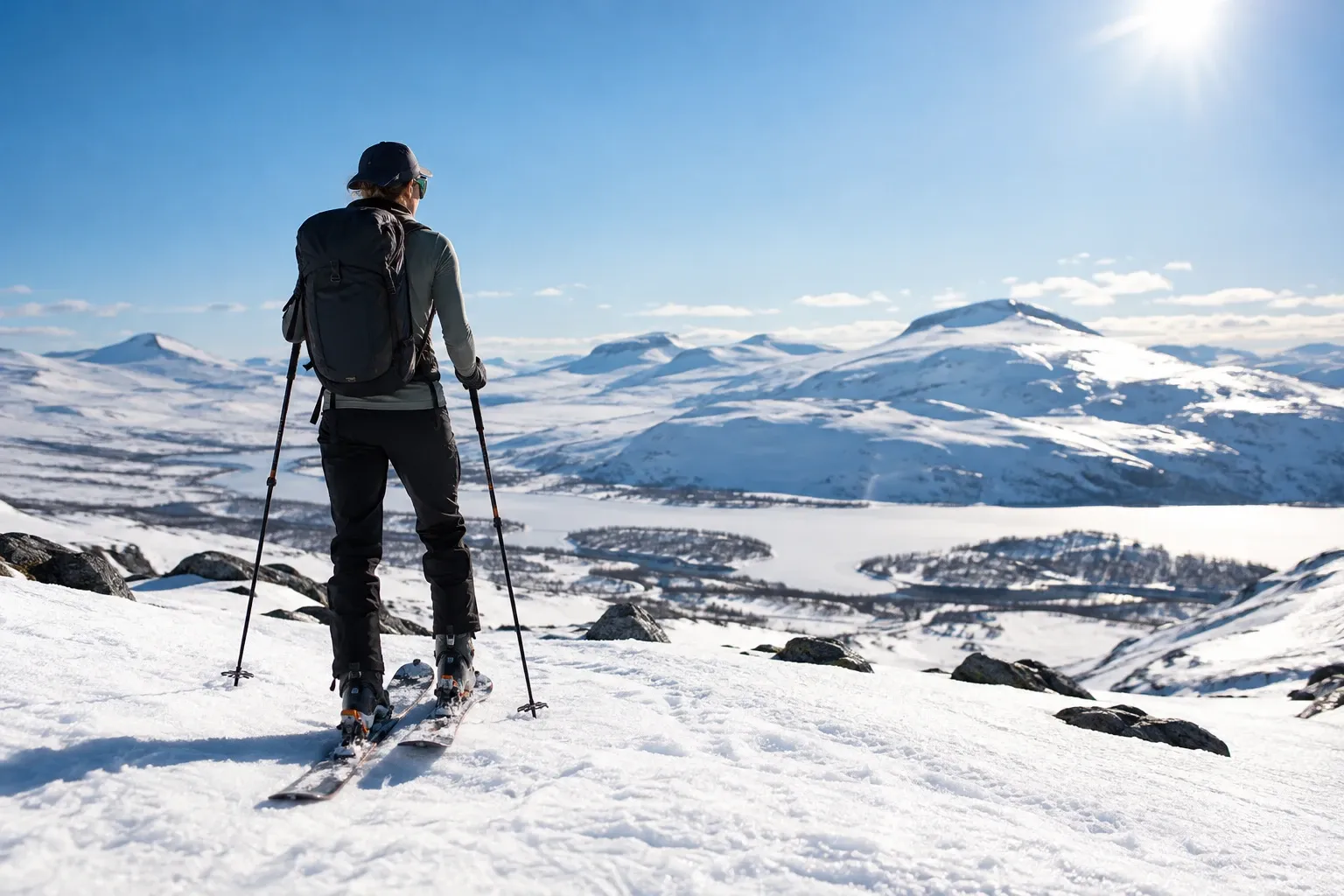
Snow reflects up to 80% of UV. SSM says that when sun and snow meet in the mountains in spring, UV can be almost twice as high as it would otherwise be. The air may be well below freezing, so nothing warns you.
Altitude adds to it. SSM’s rule of thumb is about 10% more UV per 1,000 metres. Sweden’s mountains are modest: the highest point, Kebnekaise’s north peak, is 2,096.8 m. That still means roughly 20% more UV on the summit than at sea level, before the snow is counted.
Your skin is also at its weakest in spring. A natural tan on fair skin equals only about SPF 2–3, according to SSM, and it fades over the autumn. So a February-to-April ski, snowmobile or dog-sled trip in Lapland or Jämtland needs the same protection as a summer beach day: sunscreen on every bit of exposed skin, and sunglasses or goggles.
Beaches and water: the myth
You’ll read that water reflects the sun and that’s why beaches burn. SSM says the opposite in so many words. You get more UV on a beach because the horizon is open: you receive both direct sunlight and the UV scattered across the whole sky. The water itself isn’t the reflector.
Two practical consequences follow:
- Swimming doesn’t protect you. UV passes through water, so your shoulders burn while you’re in the lake or sea.
- A boat at sea gets the same open-sky dose. A kayak or sailing day in the archipelago or on a big lake is a full-exposure day, even under thin cloud.
Shade helps but isn’t complete. It cuts UV by up to half; the blue sky still scatters UV in under a parasol. For lake swimming, see lake swimming in Sweden; for the coast, Swedish beaches.
The midnight sun: what it does and doesn’t do
North of the Arctic Circle the sun stays above the horizon all night in early summer. In Kiruna it lasts from about 29 May to 14 July, in the almanac year SMHI quotes. That doesn’t mean 24 hours of burning sun.
UV follows the height of the sun. SSM explains that it rises as the sun climbs, peaks when the sun is highest and falls as it sinks. At midnight the sun hangs low near the horizon, so the night hours carry little UV. The burning hours in Lapland are still around midday.
What the midnight sun really changes is behaviour. It’s easy to hike, paddle or fish for ten or twelve hours because it never gets dark, and the total dose adds up over a day like that. Where and when you’ll see it is covered in the midnight sun in Sweden.
How to protect yourself: the Swedish order
SSM’s advice puts sunscreen last, which surprises many visitors. In order:
- Take breaks from the sun 11:00–15:00 when the UV index is 3 or more, and use shade.
- Cover up. Clothing is the best protection, because fabric absorbs both UVA and UVB. Loose, tightly woven, darker fabric works best; a blue cotton shirt beats a white T-shirt.
- Wear a wide-brimmed hat and sunglasses, ideally with side protection in strong sun.
- Use sunscreen where clothes don’t cover: medium (SPF 15–25) or high (at least SPF 30) protection.
- Apply plenty and reapply after a few hours, and after swimming or sweating.
The reason for that order: SSM says a T-shirt equal to SPF 10 usually protects better than SPF 15–20 sunscreen, because most people apply only 20–50% of the amount the label assumes. Swedes are also told to check their medicines. Some prescription drugs, and skin products with retinol or certain acids, make skin more sensitive to UV, so read the leaflet or ask a pharmacy.
You’ll find sunscreen, after-sun and hydrocortisone cream over the counter at any pharmacy (apotek), and sunscreen in ordinary supermarkets too; see pharmacies in Sweden. For the live UV index, use SSM’s free “UV-index idag” service. It gives a four-day, clear-sky forecast for Swedish places and can be saved to your phone’s home screen. Its sister tool, “Min soltid”, estimates how long you can stay out unprotected for your skin type.
Children and babies
SSM’s advice for children is stricter:
- Babies under one should not be in direct sunlight at all. Use a parasol, sun tent or pram cover, plus clothes and a hat, because scattered UV reaches into the shade.
- For older children, clothes, a hat and sunglasses come first. Add a water-resistant sunscreen made for children, at least SPF 30, but never as the only protection.
- At the beach, keep children in the shade as much as possible, and top up sunscreen after play in the water.
More for families is in Sweden with a baby.
Eyes and snow blindness
Snöblindhet (snow blindness) is a temporary injury to the cornea from strong light reflected off snow, sea or white sand. According to 1177, the regions’ health information service, it usually shows six to twelve hours after exposure. That means the evening after a bright ski day, not on the slope.
| Symptom | What to do |
|---|---|
| Pain, light sensitivity, tears, red eyes | Rest in a dark room; avoid bright screens |
| A gritty feeling, trouble keeping eyes open | An over-the-counter eye ointment with paraffin and petroleum jelly, from a pharmacy, can soothe |
| No better, or worse, after two days | Contact a health centre (vårdcentral) |
Prevention is simple: sunglasses in strong light, and on snow, tinted ski goggles with UV protection or sunglasses.
If you burn
1177’s self-care advice is to keep the burned skin out of the sun for a few days, cool it with cold water, a cooling balm or a moisturising lotion, and use over-the-counter hydrocortisone cream if it itches or stings. Painkillers help with the pain. Ask a doctor or child health centre (BVC) before using hydrocortisone on a child under two.
See a health centre if blisters cover an area larger than your hand. If a child has blisters over an area larger than the child’s own hand, contact a health centre or out-of-hours clinic at once. For advice, call 1177 in Sweden or +46 771-11 77 00 from a foreign phone. How 1177 works and healthcare for tourists explain what happens next and what it costs.
Spring and early summer also bring soleksem, sun rash: small, very itchy red spots, bumps or blisters a few hours or days after sun. It’s treated the same way, with a break from the sun and hydrocortisone. A solarium “base tan” before the trip doesn’t prevent any of this; SSM advises against it.
Practical information
| Item | Detail |
|---|---|
| Protection threshold | UV index 3 or higher (SSM) |
| Swedish summer midday UV | Usually 4–7 |
| Strongest hours in summer | 11:00–15:00 |
| Snow reflection | Up to 80%; UV can nearly double |
| Altitude | About +10% UV per 1,000 m |
| Recommended sunscreen | SPF 15–25 (medium) or at least SPF 30 (high); children at least SPF 30 |
| UV forecast | SSM “UV-index idag”, free |
| Advice line | 1177 in Sweden; +46 771-11 77 00 from abroad (free advice, normal call rates) |
| Sunscreen prices | Vary by brand and shop; not listed here |
FAQ
Do I need sunscreen in Sweden?
Yes, as a complement. Strålsäkerhetsmyndigheten advises protection when the UV index is 3 or higher, and a Swedish summer midday usually reaches 4–7, typically between 11:00 and 15:00. Its order is a midday break, shade, clothing, a wide-brimmed hat and sunglasses, then sunscreen of SPF 15–25 or at least SPF 30 on skin that clothes leave bare.
Can you get sunburned under the midnight sun?
Not much at midnight. UV follows the height of the sun, and the midnight sun hangs low near the horizon, so the night hours carry little UV. The burning hours are still around midday. The real effect of the midnight sun is that people stay outdoors far longer, so total exposure adds up on long hiking and paddling days.
How strong is UV on snow in Sweden?
Strong enough to matter even when it feels cold. Snow can reflect up to 80% of UV, and Strålsäkerhetsmyndigheten says sun and snow together in the spring mountains can make UV almost twice as high. Altitude adds about 10% per 1,000 metres. Treat a bright March or April ski day like a summer beach day, face and eyes included.
Does water reflect UV and make you burn faster?
Less than people think. Strålsäkerhetsmyndigheten says you get more UV on a beach because the horizon is open, so both direct and scattered sky radiation reach you, not because water reflects it. Water also lets UV through, so swimming does not protect you. On a boat at sea the same open-sky effect applies.
What is snow blindness and what should I do?
It is a temporary injury to the cornea from strong light reflected off snow, sea or white sand. Symptoms usually appear six to twelve hours later: pain, light sensitivity, tears and a gritty feeling. Rest in a dark room; it usually passes in a day or two. If it is not better after two days, contact a health centre.
When should I see a doctor for sunburn in Sweden?
Most sunburn heals on its own: keep out of the sun, cool the skin and use over-the-counter hydrocortisone if it itches. 1177 advises a health centre if blisters cover an area larger than your hand, and urgently if a child has such blisters. Call 1177 for advice, or +46 771-11 77 00 from a foreign phone abroad.
Is the UV index in Sweden ever high in winter?
Not on its own. In the months around the winter solstice the sun is so low that the UV index rarely exceeds 2. Snow changes that: on a sunny day it can nearly double the index, which is why late-winter ski and snowmobile trips in the mountains still call for sunscreen, sunglasses or goggles.
Related guides
- Heatwaves in Sweden — the other summer sun risk: heat warnings, heat stroke and staying cool.
- The midnight sun in Sweden — where and when the sun stays up all night.
- Packing for a Swedish winter — goggles, layers and the rest of the snow kit.
- Mountain safety in Sweden — weather, avalanches and huts beyond the sun.
- Sweden with a baby — the under-one sun rule and everyday baby logistics.
Facts verified 2026-10-15. Sources: Strålsäkerhetsmyndigheten (SSM), 1177, SMHI, Stockholm University — full register in this topic’s source file. Found something outdated? Tell us and we’ll fix it.