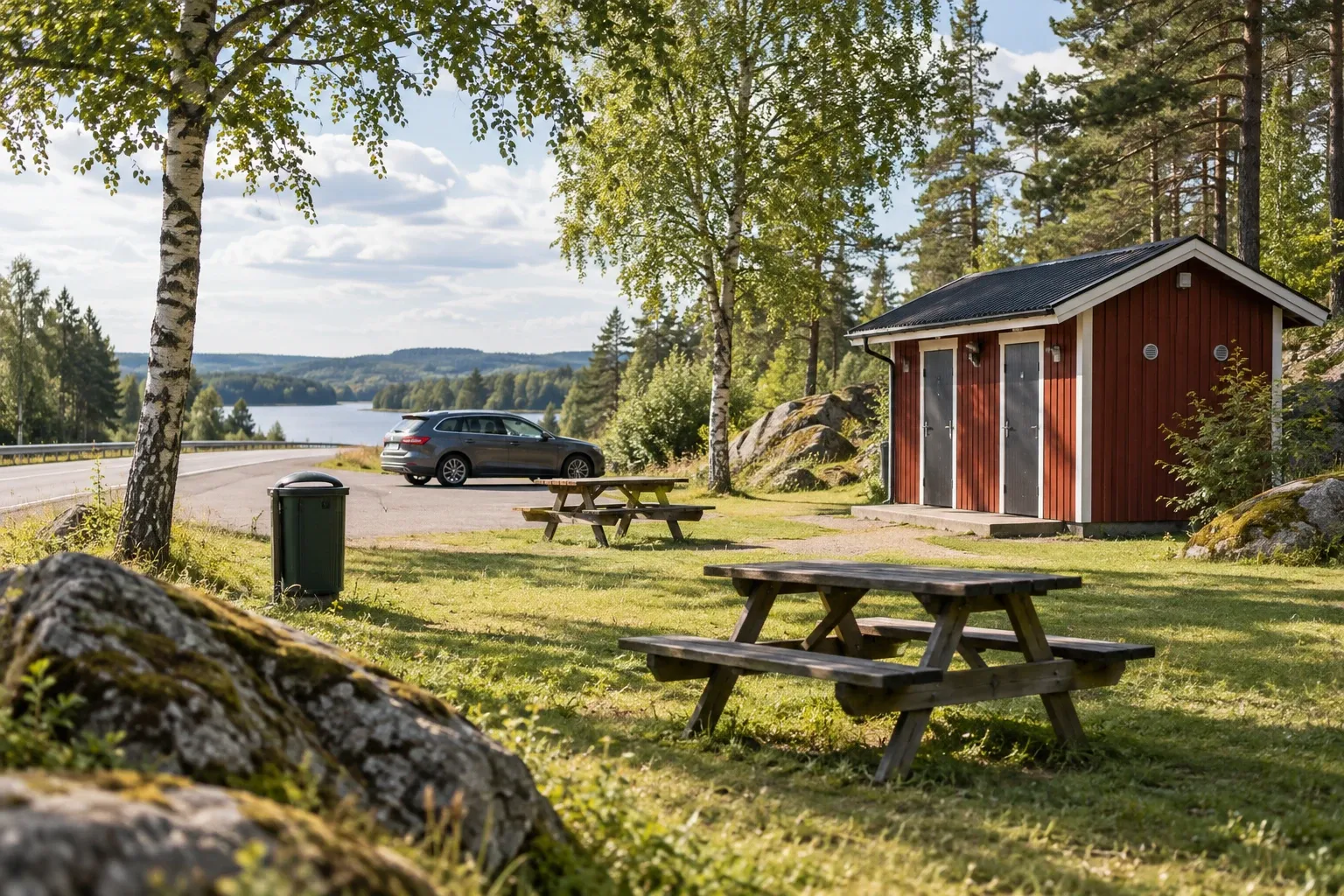
Swedish rest areas are simple: a toilet building, picnic tables, bins and parking, all free. They are not service areas with fuel and a restaurant. Here is what to expect, how to find them, and how to plan food and breaks around them.
When you need this
You’re planning a long drive and want to know where the toilet and lunch stops will be. Or the children need a toilet in the next 20 minutes, and you’re wondering whether the next blue sign means food, fuel or only a toilet. Or you’re getting drowsy on a long stretch of the E4, E6 or E18 and need a safe place to stop.
What a Swedish rest area has
A rastplats (rest area) is a lay-by built for a break. Trafikverket, the Swedish Transport Administration, runs about 270 of them on the state road network, from Karesuando in the far north to Björesjö in the far south. A motoring organisation that inspects them all counts about 300, because a few are private.
Standards and equipment vary, but the basic kit is the same everywhere. Every rest area on Trafikverket’s rest-area map has:
| Always there | Sometimes there | Usually not there |
|---|---|---|
| Toilets, adapted for people with disabilities | Coffee or ice cream for sale | A restaurant or shop |
| Seating with tables | A latrine point for motorhome cassettes | Fuel |
| Litter bins | Local visitor maps from the municipality | Staff |
| Information boards | Notice boards where posters are allowed |
There’s no charge for any of it. A contractor inspects and cleans each site once a day, and twice a day from 1 June to 31 August: once between 06:00 and 10:00 and again between 15:00 and 20:00. A sign on the building shows when it was last cleaned, and a posted phone number takes reports about upkeep. There’s no QR code or web form at the site.
Food: the gap visitors don’t expect
If you know the German Raststätte or the French aire de service, adjust your plans. In Sweden, fuel, food and the rest area are usually separate stops. Trafikverket says you can buy coffee or an ice cream at some rest areas. Otherwise, its advice is to bring something to eat.
That makes a packed lunch the simplest strategy. The tables are standard, so a thermos and sandwiches turn any rest area into a lunch stop. For a hot meal or coffee, leave the main road at an exit signed with a restaurant or café symbol, or stop at a fuel station with a shop.
Fuel stations are not a sure thing either. Only about a third of Swedish fuel stations have a shop; the rest are unstaffed pumps with a card terminal. In the inland north, stations are far apart. Our guide to paying at Swedish fuel stations explains the pumps.
Reading the signs
Sweden uses blue H-series service signs, defined by Transportstyrelsen, the Swedish Transport Agency. Learn six and you can plan the next stop before you reach the exit.
| Sign | Symbol meaning | What you’ll find |
|---|---|---|
| H13 Rastplats | Rest area | A rest area with a toilet that is also accessible to people with reduced mobility |
| H14 Toalett | Toilet | An accessible toilet |
| H5 Servering | Café | A place serving drinks and simple meals |
| H6 Restaurang | Restaurant | A restaurant |
| H3 Drivmedel | Fuel | A fuel station, sometimes with the company’s emblem |
| H27 Laddstation | EV charging | A charging station |
On bigger roads, an advance service sign (H23) lists the services at the next exit, with the distance in kilometres. That’s your cue to choose fuel, food or a rest area in good time. For the rest of the sign system, see Swedish road signs explained.
To plan ahead, use Trafikverket’s free traffic-information map. It has a rest-area layer and shows which sites have a cassette-emptying point. The map is in Swedish only.
The rules
Rest areas have very few rules, and most follow from one fact. Trafikverket says a rest area is no different from any other parking place.
- Up to 24 hours. You may park at a rest area or signed parking place for up to 24 hours, and no longer. Long-term parked motorhomes, caravans, lorries and living on site are not allowed.
- A break, not a campsite. Trafikverket says rest areas are for a temporary break and rest, not overnight stays. A night within the 24 hours is fine, and even a tent is acceptable if it damages nothing and leaves room for others. The full picture is in overnight RV parking and the 24-hour rule.
- Motorway stopping ban. On a motorväg (motorway) or motortrafikled (expressway), and on their slip roads, you may stop or park only at places signed as parking or rest areas. That’s the law, under the Traffic Ordinance.
- Signs come first. A local prohibition or time-limit sign at a particular rest area replaces the 24-hour default.
- No grey water. Where a rest area has a latrine point, it takes loose toilet cassettes only. Grey water may not be emptied at a rest area at all.
- Bin everything. Littering is an offence, and a minor case can bring a police on-the-spot fine.
Food waste matters for another reason too. African swine fever reached Sweden in 2023, and the country was declared free of it in September 2024. Authorities still ask travellers never to leave food waste where wild animals can reach it, and they name rest areas specifically. The virus survives a long time in cold-smoked pork, ham and sausage, and wild boar pick it up from scraps. Use the bin and never feed the animals.
When a toilet is closed
Many guides say rest-area toilets are “always open”. Trafikverket doesn’t say that. It promises toilets at every rest area on its map, and in 2026 it closed some:
- Rastplats Kiruna on the E10 was closed “until further notice” in January 2026 after vandals wrecked the toilets. We found no reopening notice by mid-October 2026.
- Halltorp and Ekerum on Öland had no toilets during a rebuild that started in October 2026, with reopening expected around the start of November.
- Stockholm county had a single rest area in the 2025 national inspection, and it was closed for the whole inspection period.
Professional drivers’ unions also report rest areas without working toilets. So on a long drive, check the map before you rely on one site, and keep a second stop in mind, such as a town or a fuel station. Around Stockholm, plan breaks at fuel stations or in town. For toilets off the road, see public toilets in Sweden.
Breaks, tiredness and night stops
Trafikverket builds one or two new rest areas a year and says traffic safety comes first, because driver fatigue contributes to crashes every year. VTI’s research director has put fatigue as a contributing cause in about 20 percent of crashes. That’s an estimate, and the true share is unknown. Trafikverket’s advice is simple: start the trip rested, take regular breaks (ideally at its rest areas), and pick quieter times and days at peak holidays.
Two things follow:
- Stop before you feel you need to. Don’t drive on drowsy because the next rest area is “close”; any safe parking place is better.
- Never use the motorway shoulder as a lay-by. It’s unlawful outside an emergency and puts you right beside fast traffic. Our guide to pulling onto the shoulder explains why it is not a lay-by.
After dark, many drivers feel uneasy at rest areas. In a 2024 survey by a motoring organisation, 61.6 percent of respondents said they felt unsafe there, especially in the evening. Pick a well-lit, busier site, lock the car on the way to the toilet and keep valuables out of sight. In the north, darkness comes by mid-afternoon in winter, so this applies early in the day.
Leave the lorry bays alone. Heavy vehicles need them for their drivers’ rest. A 2025 inspection found heavy traffic already crowds cars out at some sites, so use the car spaces.
Sleeping in the car? It’s legal within the 24 hours unless a sign says otherwise. See sleeping in your car in Sweden, and for motorhome waste, motorhome service stations.
Practical information
| Item | Detail |
|---|---|
| Number of state rest areas | About 270 (Trafikverket); about 300 including private ones |
| Using the rest area, toilets and tables | Free (checked 2026-10-15) |
| Parking limit | Up to 24 hours, unless a sign says otherwise |
| Cleaning | Twice a day 1 June–31 August; once a day the rest of the year |
| Food | Coffee or ice cream at some; most sell nothing |
| Littering, minor case | Police on-the-spot fine of 800 kr (checked 2026-10-15) |
| Motorhome emptying | Cassettes only, where a latrine point exists; never grey water |
| Finding them | Trafikverket’s traffic-information map (Swedish only); H13 signs |
| Reporting a fault | Phone number posted at every rest area |
FAQ
Are toilets at Swedish rest areas free?
Yes. Trafikverket’s rest areas charge nothing, and every rest area on its rest-area map has toilets, adapted for people with disabilities. They are unstaffed and cleaned once a day, twice a day in summer. A toilet can be closed after vandalism or during rebuilding, so for a long drive keep a second stop, such as a fuel station or a town, in mind.
Can you buy food at Swedish rest areas?
Usually not. A Swedish rest area is toilets, tables and bins; Trafikverket says you can buy coffee or an ice cream at some, and otherwise advises bringing food. For a meal, watch for the blue service signs: H6 marks a restaurant, H5 a café serving drinks and simple meals. Fuel stations with shops sell snacks and coffee.
How long can I stay at a rest area in Sweden?
Up to 24 hours. Trafikverket treats rest areas like other parking: you may park there for up to a day but no longer, and long-term parked motorhomes, caravans, lorries and living on site are not allowed. It calls them places for a temporary break rather than overnight stays. A local sign can set a shorter limit.
Can I sleep at a rest area in Sweden?
Yes, within the 24-hour limit, unless a sign forbids it. Trafikverket says rest areas are meant for breaks rather than overnight stays, but parking for up to 24 hours is allowed, and even a tent is acceptable if it damages nothing and leaves space for others to rest. Park in a car space, not a lorry bay, and move on next morning.
How do I find rest areas in Sweden?
Use Trafikverket’s free traffic-information map, which has a rest-area layer and shows which ones have a latrine point. It is in Swedish only. On the road, the H13 sign marks a rest area with an accessible toilet, and the advance service sign lists what the next exit offers and how far away it is.
Can I stop on the motorway shoulder for a break?
No. On a Swedish motorway or expressway, and on their slip roads, vehicles may stop or park only at places signed as parking or rest areas. The shoulder is for emergencies. If you are tired, hungry or lost, drive on to the next signed rest area or exit, even if it is several kilometres away.
Are Swedish rest areas safe at night?
Generally yes, but many drivers feel uneasy there after dark: in a 2024 survey by a motoring organisation, 61.6 percent of respondents said they felt unsafe at rest areas, especially in the evening. Choose a lit, busier site, lock the car on the way to the toilet and keep valuables out of sight. In an emergency, call 112.
Related guides
- Public toilets in Sweden — where to go in towns, and why city toilets want a card.
- Overnight RV parking and the 24-hour rule — staying the night at a rest area in a motorhome.
- Paying at Swedish fuel stations — the other road stop, and how unstaffed pumps work.
- Checking road conditions — how to use Trafikverket’s map, rest-area layer included.
- Swedish road signs explained — the rest of the sign system.
Facts verified 2026-10-15. Sources: Trafikverket, Transportstyrelsen, Sveriges Riksdag (Trafikförordning 1998:1276), Länsstyrelsen Uppsala, Jordbruksverket, Naturvårdsverket, Riksförbundet M Sverige — full register in this topic’s source file. Found something outdated? Tell us and we’ll fix it.