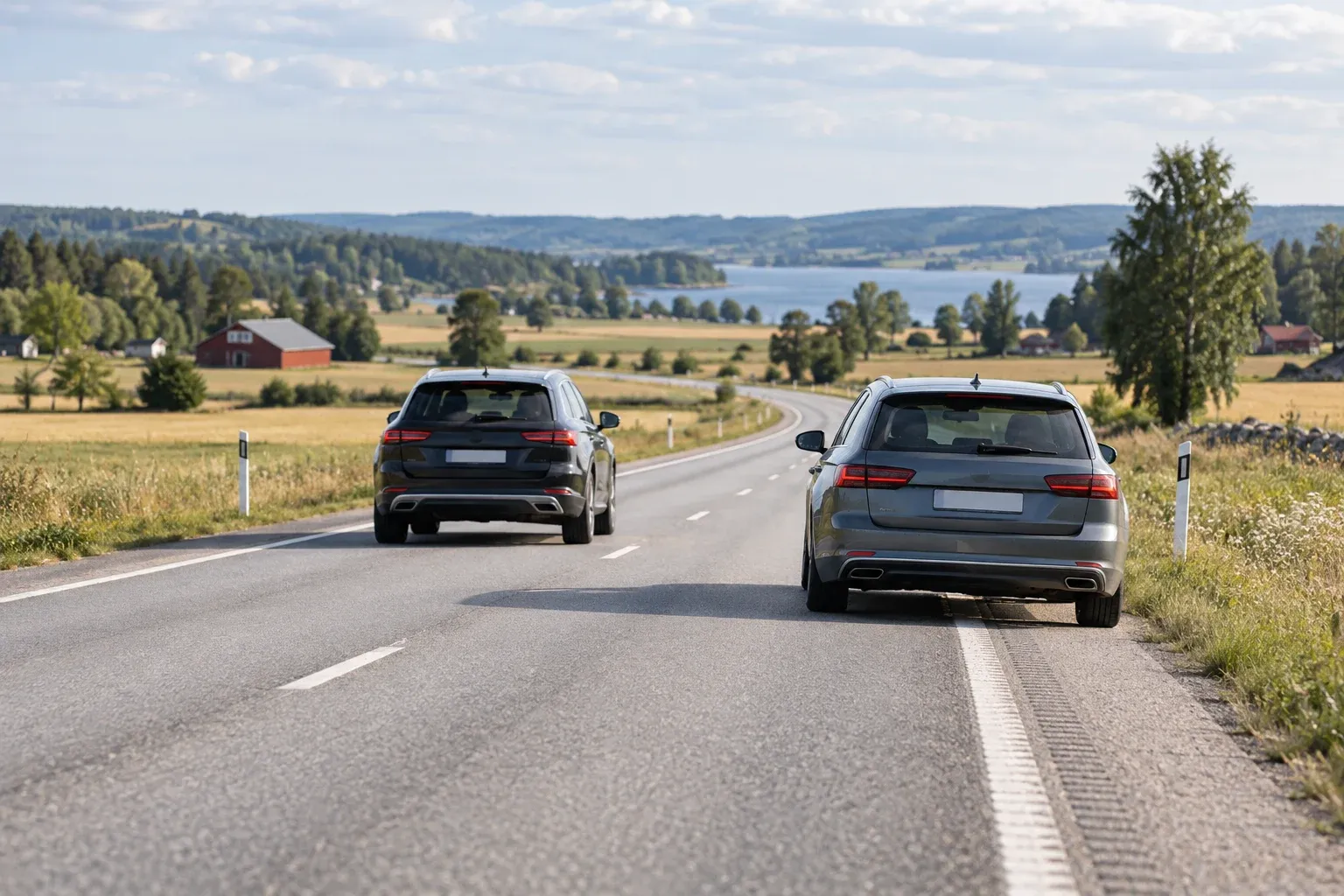
The car ahead drifts right onto the paved shoulder, still rolling, and leaves you a gap. Nobody is broken down. It’s a Swedish road habit with a legal basis, a few hard limits and a long history, and it pays to know which part is law and which is manners.
When you need this
You’re on a two-lane country road and the driver in front moves onto the shoulder. Should you pass? Or a car is closing fast behind you, and you wonder whether you’re expected to pull over. Maybe an oncoming car is overtaking toward you and seems to assume you’ll make room. Or the driver you just let past blinked their hazard lights at you. And if you’re driving a motorhome or towing a caravan, you want to let the queue behind you past without breaking a rule.
What the law says
The rule sits in one paragraph of the Swedish traffic ordinance, trafikförordningen (SFS 1998:1276), chapter 3, section 12. It does three things:
- It tells certain road users that they must use the shoulder.
- It lets any other vehicle use the shoulder temporarily (tillfälligt) when that is needed to ease the way for other traffic.
- It forbids that second use wherever the carriageway is bounded by a solid edge line.
So for an ordinary car, moving onto the shoulder to let someone pass is permitted, not required, and only where the edge line is broken. Behind a solid edge line you stay in your lane: no wheel may cross a solid line except in a short list of cases, such as passing an obstacle or reaching a driveway.
What the law does require of a car driver who is being caught up is simpler. When you notice someone wants to overtake you, keep as far right as possible in your lane, and don’t speed up or do anything else that makes the overtake harder. Speeding up while being overtaken is a finable offence in its own right.
Who must, who may, who may not
| Road user | Broken edge line | Solid edge line |
|---|---|---|
| Cyclists (where there is no cycle path), mopeds | Must use the shoulder if it’s usable | Must use it; may cross the line to reach it |
| Vehicles built for 40 km/h or less (tractors, A-traktor cars) | Must use the shoulder if it’s usable | Must use it; may cross the line to reach it |
| Horse-drawn vehicles, riders, people driving livestock | Must use the shoulder if it’s usable | Must use it |
| Cars, motorhomes, trucks, buses | May use it temporarily to let others pass | May not use it |
| Pedestrians (where there’s no footway) | Use the shoulder, walking on the left | Use the shoulder, walking on the left |
The duty for slow vehicles lapses if the shoulder is too narrow or unsuitable, for example rough, blocked or under snow. The pedestrian row matters most: the shoulder you’re about to move onto is where people walk, and they walk facing you.
Motorways and expressways have solid edge lines, so the custom never applies there. You also may not stop on them except at signed parking or rest areas. If you break down where the limit is above 50 km/h, set out your warning triangle.
When you’re the one being caught up
Use this sequence when a faster car closes in behind you:
- Check the edge line. Broken, with a wide paved shoulder: you may ease right. Solid: stay in your lane and keep right.
- Look ahead along the shoulder. Move over only if it’s clear: no cyclist, walker, parked car, junction or narrowing.
- Hold a steady, slightly reduced speed. Don’t brake hard on the shoulder with traffic close behind.
- Never accelerate while someone is overtaking you.
- Before rejoining, give way. Coming back from the shoulder, you yield to traffic on the carriageway, so check your mirrors first.
If you’re driving a slow or wide vehicle on a narrow, winding or busy two-way road, the law goes further: you must slow down and, if needed, pull aside as soon as possible to make overtaking easier. In a motorhome or with a caravan, that means using lay-bys or a usable shoulder instead of leading a long queue.
When you’re the one overtaking
The custom creates a trap for drivers who expect it. Swedish law lets you overtake only if the lane you need is free of oncoming traffic for a long enough stretch, and only if you can get back to the right without danger. An oncoming driver’s willingness to move aside is not part of that test.
Treat the shoulder as a bonus, never a plan:
| Situation | What to do |
|---|---|
| Car ahead moves onto the shoulder, oncoming lane clear | Overtake normally, pass briskly, return right without cutting in |
| Car ahead moves over, oncoming traffic present | Wait; the lane you need still has to be free |
| You’re tempted to overtake toward an oncoming car that might move aside | Don’t; it’s illegal and was a known cause of serious crashes |
| Solid centre line | No overtaking across it, whatever the car ahead does |
Keep your distance while you wait. The law expects a gap that avoids a collision if the car ahead slows or stops, and a car easing onto the shoulder may well do either.
The hazard-light thank-you
After you let someone past, you may see a brief blink of their hazard lights, often from a truck driver. It’s a thank-you. We could find no Swedish authority that describes or endorses it, so treat it as custom, not law.
The traffic ordinance doesn’t mention a thank-you signal at all. It says drivers give signals when needed to prevent danger, that signals must not last longer than necessary, and it lists direction indicators among the few flashing lights allowed while driving. If you want to thank someone, a blink or two is plenty; a raised hand works just as well. Don’t leave the hazards on.
Why Sweden does this
The habit is decades old and grew with Sweden’s wide-shouldered two-lane roads. In 1978 two members of parliament complained that shoulders up to three meters wide were being used as an extra lane, and that drivers flashed their lights to push slower traffic onto them. At the time, the rule let slow vehicles use the shoulder temporarily, if it could be done without danger.
A later rule change made things worse. A 1989 motion explained that the wording had moved from “may temporarily use” to text many read as “shall use”, and that many drivers now believed the driver being caught up was obliged to pull over. Oncoming drivers overtook expecting the other side to make room. Truck drivers’ unions campaigned under the slogan “Vägrenskörning avgör jag – inte du”: I decide when I drive on the shoulder, not you. Today’s ordinance again says tillfälligt, temporarily.
Sweden then rebuilt its most dangerous wide roads. In the 1990s the so-called 13-metre roads, about 3,700 km of them, saw almost 100 deaths a year. From 1998 the road administration began converting them to 2+1 roads with a barrier between the directions, a design later extended to narrower roads. Barrier roads have solid edge lines and no room for the custom, and conversions continue: 33 km of road 56 between Katrineholm and Alberga was finished in 2024 and 2025. So a stretch you remember with wide shoulders may now have a barrier.
Mistakes to avoid
- Thinking you must pull over. In a car it’s optional; the duty is to keep right and not speed up.
- Doing it behind a solid edge line, on motorways, expressways and barrier roads.
- Overtaking toward an oncoming car and expecting it to make room.
- Braking hard on the shoulder with traffic close behind.
- Cutting back in without checking your mirrors or giving way.
- Parking on a motorway shoulder for anything other than a breakdown.
In winter, snow and plough banks often hide the shoulder; don’t move onto one you can’t see. In the dark season, move over only when your headlights show the shoulder clear of walkers and cyclists. In summer, expect motorhomes and caravans, and visitors who don’t know the custom at all.
Practical information
| Item | Detail |
|---|---|
| The rule | Trafikförordningen 3 kap. 12 §: cars may use the shoulder temporarily to let others pass |
| Where it’s banned | Wherever the edge line is solid, including motorways and 2+1 roads |
| Must use the shoulder | Cyclists, mopeds, vehicles built for 40 km/h or less, horses, livestock |
| Moving over on a broken edge line | 0 kr |
| Obstructing an overtake, e.g. speeding up | 1,000 kr on-the-spot fine for a motor-vehicle driver (as of October 2026) |
| Crossing a solid line | 1,500 kr on-the-spot fine for a motor-vehicle driver (as of October 2026) |
| Hazard-light thank-you | Informal custom; not in the ordinance |
| Who the rules apply to | Everyone driving in Sweden, tourist or resident, Swedish or foreign plates |
FAQ
Why do Swedish drivers pull onto the shoulder?
To let faster traffic pass without using the oncoming lane. Sweden built many two-lane roads with wide paved shoulders, and the traffic ordinance lets any driver use the shoulder temporarily when that eases the way for others. Over decades it became a habit and a courtesy. It is permitted, not required, and only where the edge line is broken.
Is driving on the shoulder legal in Sweden?
Yes, temporarily, when needed to let other traffic past, and only where the edge line is broken. Where a solid edge line bounds the road, only cyclists, mopeds, vehicles built for 40 km/h or less and horses may use the shoulder. Crossing a solid line in a car carries a 1,500 kr on-the-spot fine as of October 2026.
Do I have to pull over when someone wants to pass me?
No, not in a car. You must keep as far right as possible in your lane and must not speed up or otherwise make the overtake harder. Only slow or wide vehicles on narrow, winding or busy roads must slow down and pull aside when needed. Moving onto the shoulder is your choice, and only where it is safe.
Can I overtake expecting oncoming cars to move onto the shoulder?
No. You may overtake only if the lane you need is free of oncoming traffic for a long enough stretch and you can get back safely. Drivers who counted on oncoming traffic moving aside caused serious crashes, a problem raised in parliament in 1989. Treat any oncoming car as staying in its lane.
Why did the driver blink their hazard lights after I let them pass?
It was a thank-you. A brief blink of the hazard lights is an informal signal you will see on Swedish roads, often from truck drivers. No authority describes it, and the traffic ordinance does not mention it; it only says signals should not last longer than necessary. A quick blink or a raised hand is enough.
Can I do it on a motorway or a 2+1 road?
No. These roads have solid edge lines, and behind a solid edge line only cyclists, mopeds and slow vehicles may use the shoulder; cyclists and mopeds are banned from motorways anyway. On a motorway or expressway you may not stop on the shoulder either, except in a breakdown, when the warning triangle goes out.
Related guides
- Driving in Sweden: the everyday road rules around this custom
- Swedish road signs and markings: solid and broken lines, 2+1 roads and lane signs
- 2+1 roads explained: the barrier roads that replaced many wide shoulders
- EPA and A-tractors: the 30 km/h vehicles that must use the shoulder
- Cycling in Sweden: who else is on the shoulder, and their rules
Facts verified 2026-10-14. Sources: Sveriges Riksdag (Trafikförordningen, Riksdag motions 1977/78 and 1988/89), Åklagarmyndigheten, VTI, Trafikverket — full register in this topic’s source file. Found something outdated? Tell us and we’ll fix it.