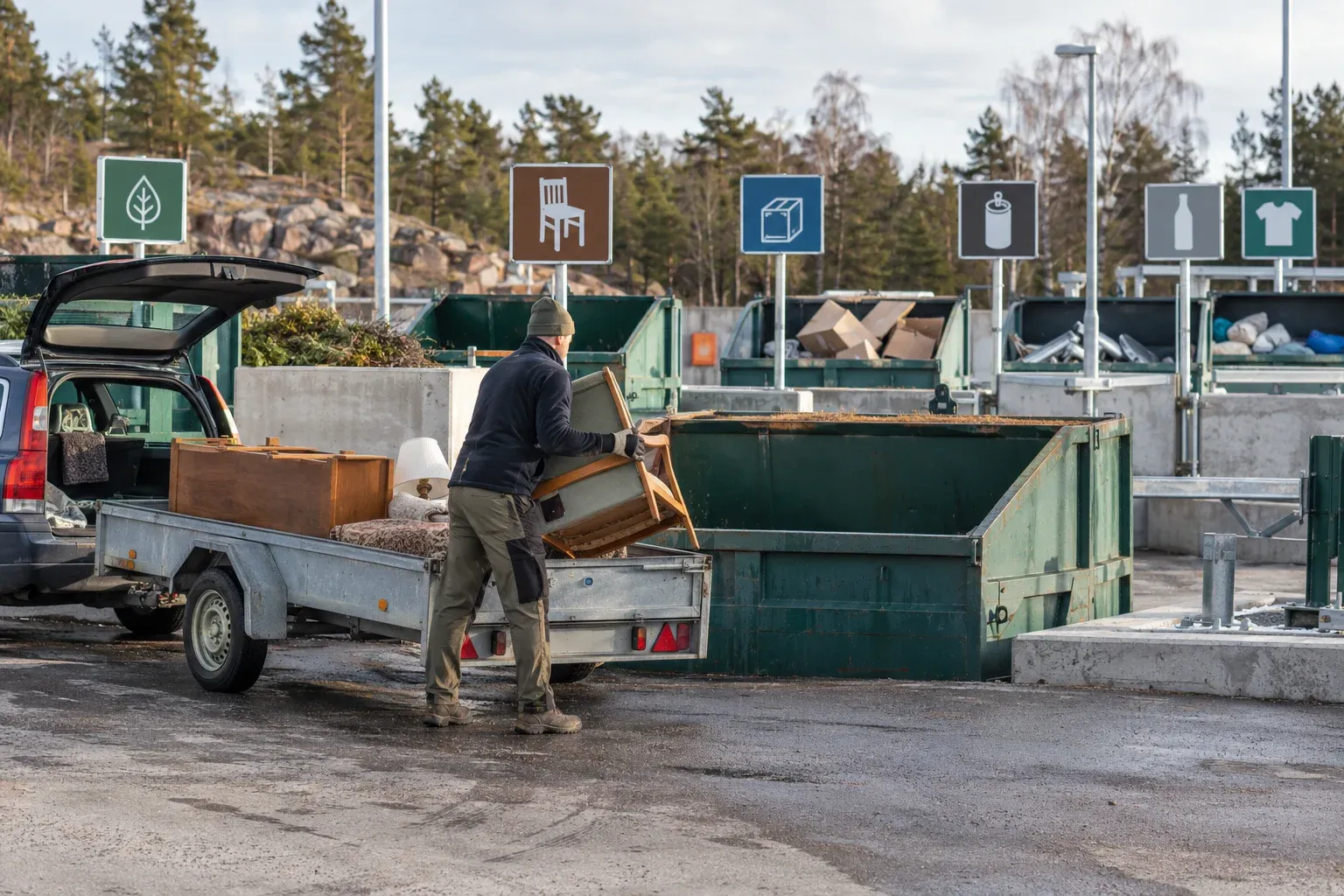
Got an old sofa, a dead fridge or a half-empty tin of paint? In Sweden none of it goes in the bin. It goes to a staffed recycling centre run by your municipality, where you sort it yourself, and as a household you normally pay nothing.
When you need this
You’re moving out at the end of a contract or a semester, with a bed and a bookcase you can’t take home. Maybe the kettle has died, or the cabin project left you with solvents and a gas canister. Or perhaps your host has simply said “take it to the tip” and you have no idea where that is.
What a recycling centre is
The återvinningscentral (ÅVC) is a drive-through yard with a labelled container for every material: wood, metal, electronics, combustibles, garden waste, hazardous waste. Staff stand by to help. The law names these centres. Every municipality must run a collection system for household waste that isn’t collected at your door, sized to its population, and a staffed recycling centre is one of the permitted forms. Smaller places may use drop-off points or temporary collection days instead.
Behind the centre sits a sorting duty that applies to every household, a visitor’s included. Bulky waste (grovavfall or grovsopor), textiles, electrical and electronic waste, batteries, hazardous waste and medicines must each be kept out of the ordinary bins. They then go to the municipal system, or to a producer-responsibility scheme where one applies.
Where each thing goes
| You have | Where it goes |
|---|---|
| Sofa, bed, mattress, broken furniture, scrap metal | Recycling centre, sorted by material |
| Working furniture, homeware, clothes | Second-hand shop, charity, or the centre’s reuse point (återbruk) |
| Fridge, washing machine, TV, lamps, light bulbs | Recycling centre (electrical waste) |
| Small electrical items | Recycling centre, or a large electronics shop for free |
| Paint, solvents, gas canisters, sprays, chemicals | Recycling centre or a miljöstation, in original containers |
| Worn-out clothes and textiles | Textile collection point, often at the centre |
| Leftover medicines | A pharmacy, not the centre |
| Old tyres | A tyre seller or the tyre producers’ scheme |
| A scrapped car | An authorised car dismantler only |
| Packaging, pant cans, small batteries | The ordinary bins, the shop’s pant machine, a battery box |
Centres take sorted waste only, so do the sorting at home and not in the queue. Sites also differ in what they accept and in their daily or yearly limits; Stockholm’s guide, for example, caps tyres per year. Check your municipality’s A–Z sorting guide before you load the car.
Thinking of fishing something useful out of a container? Generally you can’t. Operators such as Sysav forbid it, and reuse goes through the official reuse point.
Free for households, not for firms
For a private household, the visit is normally free because the municipal waste fee pays for it. Businesses pay per visit. That includes a handyman, removal firm or cleaning company dropping off your waste, because they count as a business.
How you get through the gate depends on the operator:
| Operator (example) | Access | What to watch |
|---|---|---|
| Stockholm Vatten och Avfall | No card or ID needed | Number-plate cameras invoice vans registered to a company or sole trader automatically |
| Sysav (Skåne) | Driving licence or Sysav app opens the barrier | A yearly quota of free visits per adult |
| Other municipalities | Resident cards or visit caps in places | Check the local website |
If you’re bringing household waste in a van registered to a company or a sole trader, Stockholm asks you to apply online in advance and speak to the staff before unloading. Otherwise the invoice arrives automatically. Stockholm also limits vehicles to combinations you can drive on a B licence and a 3.5-tonne maximum. The staff have the final word on whether your load counts as household or business waste.
Hazardous waste, electronics and clothes
Hazardous waste (farligt avfall) means paint, solvents, petrol, gas canisters, sprays and garden chemicals. Never put it in the bin or down the drain. Keep it in its original container, don’t mix products, label anything uncertain and hand it to the staff. Packaging that still holds hazardous residue counts as hazardous waste too.
Electronics (elavfall) go in whole, built-in battery and all. Wipe your phone or laptop first, or use a reuse box that guarantees data erasure; Bromma’s centre in Stockholm has one. Shops help too. Any shop selling electrical goods must take back an old item when you buy its replacement. Shops with at least 400 m² of electrical-goods floor space must accept small items, with no side over 25 cm, free and with no purchase required.
Clothes and textiles have been banned from residual waste since 1 January 2025. Wearable items go to second-hand first, and the rest to the textile collection point. The exemptions are socks and underwear, plus textiles that are mouldy, infested or too dirty or worn to reuse or recycle.
No car? Other routes
- Your building’s bulky-waste room. The municipality can require property owners to arrange bulky-waste sorting, and a lease can’t contract that away. In Stockholm, owners must offer it at least twice a year. Ask the landlord or housing cooperative.
- Paid pickup. Many municipalities collect bulky waste or fridges for a fee, or rent out large bags (storsäck) and containers.
- Mobile rounds. Stockholm’s Returrundan makes hour-long stops at walk-up spots and takes anything that fits in a moving box: small furniture, textiles, small electronics and hazardous waste. The city also runs weekend walk-up drop-offs from April to October.
- Shops for small electrical items, and pharmacies for medicines.
- Charities and second-hand shops for things that still work. See our guide to second-hand and loppis in Sweden.
Visitors and holiday rentals
Recycling centres exist for the municipality’s households, and access depends on the operator. Some let anyone in without ID; others open the barrier only for a driving licence, an app or a resident card. On a short stay, ask the host before driving anywhere. At many holiday houses, removing rubbish is part of the guest’s job, but the host knows the local arrangement. Everyday rubbish never needs the centre anyway: food waste and packaging go in the property’s bins, as explained in our guide to sorting everyday rubbish.
What is changing: 2025–2028
| Date | Change |
|---|---|
| 1 January 2025 | Textile waste banned from residual waste |
| 1 October 2025 | Exemptions for dirty, mouldy or infested textiles |
| 1 January 2027 | Packaging collected at or near every property; roadside stations kept for bulky packaging |
| 1 January 2028 | Bulky waste must itself be sorted into cardboard, plastic, metal and glass |
Mistakes to avoid
- Leaving a mattress or sofa at a packaging station or beside a bin. That’s littering. Minor cases bring an 800 kr on-the-spot fine, serious dumping can mean fines or prison, and municipalities spend heavily clearing it up.
- Turning up with an unsorted trailer.
- Assuming every centre takes everything in any quantity.
- Arriving in a company van without arranging it first.
- Binning worn clothes, which has been banned since 2025.
- Taking medicines to the centre instead of a pharmacy.
- Expecting the staff to carry heavy items for you. Bring a helper.
Practical information
| Item | What applies |
|---|---|
| Household visit to the ÅVC | Free, paid through the municipal waste fee; some operators cap free visits per year |
| Business or tradesperson visit | Charged per visit, at local prices |
| Bulky-waste pickup, bags, containers | Paid service, at local prices |
| Small electrical items at large electronics shops | Free, no purchase needed (shops of 400 m² or more, items up to 25 cm) |
| Minor littering fine (ordningsbot) | 800 kr |
| Opening hours and access | Set locally; check the municipal or waste-company website |
FAQ
Is the recycling centre free in Sweden?
For private households, normally yes. The municipal waste fee covers it, so you pay nothing at the gate. Some operators give each adult a set number of free visits per year and charge after that. Businesses, and tradespeople bringing your waste, pay per visit. Vans registered to a company may be invoiced automatically by number-plate cameras unless the load is arranged as household waste.
Can I leave furniture next to the bins in Sweden?
No. Furniture and other bulky items left beside a container, at a packaging station or on the street count as littering, which is banned outdoors where the public has access. Minor cases bring an 800 kr on-the-spot fine, and serious dumping is punishable by fines or up to a year in prison. Take bulky items to the recycling centre or book a pickup.
What can you take to an återvinningscentral?
Bulky household waste such as furniture, mattresses and scrap metal, plus electronics, white goods, light bulbs, batteries, hazardous waste like paint, solvents and gas canisters, textiles, garden waste and items for reuse. Waste must be sorted before you arrive. Sites differ in what they accept and in quantity limits, so check the local sorting guide. Medicines go to a pharmacy instead.
How do I get rid of bulky waste without a car?
Check whether your apartment building has a bulky-waste room or regular collection days, and ask the property owner if not. Many municipalities sell a paid pickup or rent out bulky bags. Some cities run mobile walk-up rounds for smaller items, and electronics shops take back small electrical goods. Charities sometimes collect usable furniture.
Can tourists or non-residents use Swedish recycling centres?
Centres exist for the municipality’s households, and access depends on the operator. Some let anyone in without ID, while others open the barrier only for a driving licence, an app or a resident card. A visitor in a holiday rental should ask the host first, because disposing of what the stay produces is usually arranged through the property.
Where do I throw away old clothes in Sweden?
Not in the ordinary bin. Since 1 January 2025 textile waste must be sorted out and left at a textile collection point, often at the recycling centre or a recycling station. Wearable items should go to second-hand first. Socks, underwear, and textiles that are mouldy or too dirty or worn to reuse may go in residual waste.
Related guides
- How to sort everyday rubbish: food waste, packaging and the bins at home
- Second-hand and loppis in Sweden: sell or give away what still works
- Staying in a Swedish apartment: waste rooms, laundry rooms and house rules
- What a Swedish cabin expects from you: the departure routine, rubbish included
- Pharmacies in Sweden: where leftover medicines belong
Facts verified 2026-10-06. Sources: Riksdagen (Avfallsförordning 2020:614, Förordning 2022:1276), sopor.nu and Avfall Sverige, Naturvårdsverket, Åklagarmyndigheten, Stockholm Vatten och Avfall, Sysav, El-Kretsen — full register in this topic’s source file. Access rules, fees and accepted items vary by municipality. Found something outdated? Tell us and we’ll fix it.