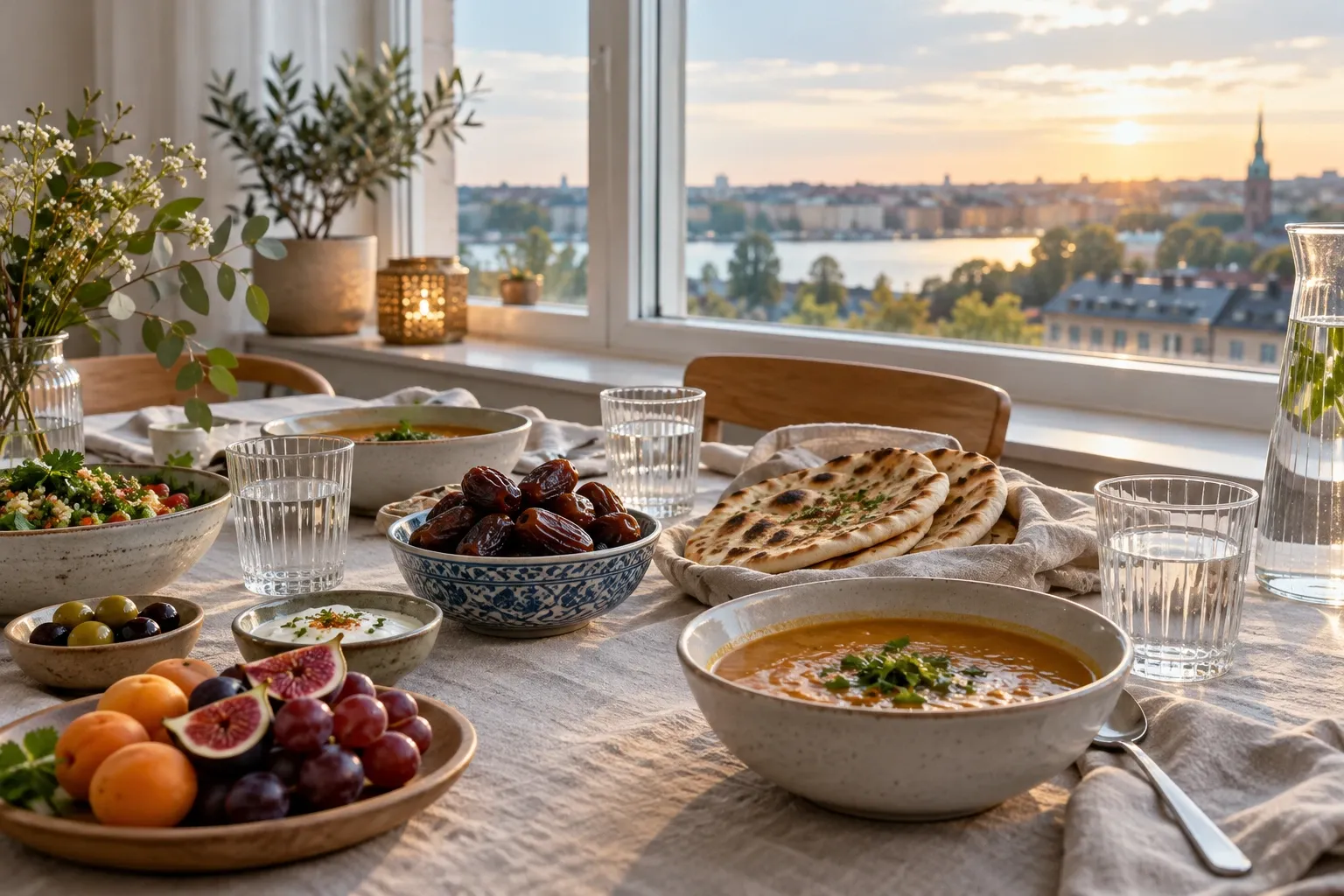
Most of what you’ll read about Ramadan in Sweden describes 20-hour fasts under a sun that never sets. That was the 2010s. For the next decade Ramadan is a winter month here, and the real questions are timetables, Eid leave, school and health.
When you need this
You’re planning a trip that overlaps Ramadan, or moving to Sweden and wondering what fasting here is like. You’ve read an old article about 20-hour fasts in Kiruna and want to know if it still applies. Or you’re a parent whose child wants to fast at a Swedish school, or you have diabetes and need to plan your medicines.
If you’re mainly after halal food, the halal label and prayer rooms at Arlanda, start with our guide to halal food in Sweden. This page is about the fast itself.
Ramadan is a winter month now
Ramadan follows the Islamic lunar calendar, which is 10 to 11 days shorter than the solar year. So the month starts earlier every year and slowly travels through all four seasons.
| Ramadan | Expected start | Season in Sweden |
|---|---|---|
| 2027 | Monday 8 February (ends 8 March; Eid al-Fitr 9 March) | Late winter |
| 2028 | 28 January (ends 25 February) | Winter |
| 2029 | About 16 January | Midwinter |
| 2031 | About 15 December | Darkest weeks |
| 2032 | About 4 December | Darkest weeks |
| 2045–2048 | About 15 July → about 12 June | Summer: the long fasts return |
Dates beyond 2028 are projections. The month begins with the new moon, so the start can differ by a day between communities. Confirm with your mosque in the weeks before.
The headlines you remember come from the other end of the cycle. On the first day of Ramadan in July 2012, the sun in Kiruna rose around 01:45 and set after 23:30. In June 2015 Swedish and European imams met in northern Sweden to agree guidelines. That world comes back, but not until the mid-2040s.
How long is the fast?
The fast runs from dawn to sunset. Dawn, gryning, comes well before sunrise, so a fast is always longer than the daylight. A common mistake is to read “sunrise to sunset”, which some popular summaries say. For Ramadan 2027 that gives fasts of roughly 10 to 14 hours, depending on where you are and how far into the month.
There is a twist. At the start of Ramadan 2027 the far north has the shorter fast, because its winter days are short. By the end of the month that has flipped. Northern days lengthen much faster in spring, and dawn moves earlier, so Kiruna’s fast ends up about half an hour longer than Malmö’s. The exact minutes for three cities are in the Practical information table below.
Your mosque’s timetable may differ from any app by a few minutes or more. Dawn is defined by how far the sun sits below the horizon, and there is more than one convention for the angle. At Swedish latitudes that choice matters, so take your times from the community you pray with.
How fasting times are set this far north
No Swedish law or authority sets Ramadan dates or fasting times. Communities choose a calculation and publish their own timetables, and Swedish imams have proposed different solutions over the years.
The difficulty is light. SMHI, the Swedish weather service, notes that in summer it never gets fully dark from roughly the Dalälven river northwards. The religious dawn is measured against that darkness. In 2015 the spokesperson for Sweden’s Islamic Association put it bluntly: in Stockholm’s summer months there is “no real dawn”.
Swedish Muslims have handled this in several ways:
- A southern Swedish city’s times. In 2012 Muslims in Luleå and Boden used the times of Stockholm, Uppsala or Malmö.
- The nearest place with a clear night, a common reading of international rulings.
- Mecca or Medina times, which some scholars argue for.
- Splitting the day into two 12-hour halves, listed by SVT among the options.
The ruling most cited in Europe sorts the world into latitude bands. It comes from the Muslim World League’s Islamic Fiqh Academy, and the European Council for Fatwa and Research endorses it. From 48 to 66 degrees north, dawn and night-prayer times are estimated in summer; that band covers most of Sweden. Beyond 66 degrees, roughly Swedish Lapland, all times, fasting included, are estimated from 45 degrees. Rulings cited by European scholars also allow an unbearably long fast to be broken and made up later.
These are religious rulings, not Swedish law, and they matter mostly in summer. In a winter Ramadan nearly everyone simply follows local dawn and sunset.
The December Ramadans and the summer return
Two stretches of the cycle bring Sweden’s latitude back into play.
Early 2030s: polar night. Ramadan starts in mid-December 2031 and early December 2032. In Kiruna the sun does not rise at all for about 27 days around 22 December. So part of those months have no sunrise in the far north, and the “beyond 66 degrees” rulings apply in reverse. See our guide to polar night in Sweden.
Mid-2040s: the midnight sun. Projected starts move from about 15 July 2045 to about 12 June 2048. Kiruna’s midnight sun runs from about late May to mid-July, so those Ramadans fall partly or wholly under a sun that does not set. The midnight sun guide has the windows place by place.
Eid, school and work
Eid is not a public holiday in Sweden. The Public Holidays Act lists Sundays and Christian and national days only. Shops, offices and schools run as normal on Eid al-Fitr, so a day off has to be arranged. See the full list of Swedish public holidays.
At school, leave is the principal’s (rektor’s) decision. The Education Act allows shorter leave for personal matters and longer leave only for exceptional reasons. Parents apply in advance, as for any day off.
Fasting pupils. In March 2026 the government said voluntary fasting can express the religious freedom that applies in Sweden. It also said children must not be pressured into religious practice, and staff must report suspected harm to children to social services. Schools must offer nutritious meals, and the minister noted that pupils who skip them may struggle to concentrate. There is no national guideline on Ramadan in school. Proposals for a stronger student health service (SOU 2025:113) are still being prepared. Talking to the school early, and involving the student health service (elevhälsa) if a child struggles, is the government’s own advice. Our guide to Swedish schools for newcomers explains how they work.
At work, religion is a protected ground under Swedish discrimination law. The Equality Ombudsman (Diskrimineringsombudsmannen, DO) handles complaints. An Eid day off is still ordinary leave by agreement with your employer.
Fasting with diabetes
Islamic practice exempts people who are ill, elderly, pregnant, diabetic or menstruating. Sweden’s clinical guidance for type 2 diabetes says the same in medical terms:
- People at very high risk are advised not to fast. That includes HbA1c above 86 mmol/mol, pregnancy, recurrent or unrecognised hypoglycaemia and acute illness.
- Others should check blood sugar regularly, especially on insulin or sulfonylureas.
- SGLT2 inhibitors should not be newly started for a fast, and good fluid intake matters.
See your doctor well before Ramadan. In Sweden, the 1177 medical advice line and pharmacies can help with questions during the month.
Visiting Sweden during Ramadan
Ramadan in a Swedish city is easy to observe and easy to join. In Stockholm, the Stockholm Mosque on Södermalm, opened in 2000, holds evening and Taraweeh prayers. Mosques and cultural organisations host open iftars, and anyone curious can ask about them.
Two practical points. In February, hotel breakfasts usually open after the fast has begun, so plan your own pre-dawn meal (suhoor). And since Eid closes nothing, opening hours on the day are normal. For halal shopping and restaurants, see our halal guide.
Practical information
| What | Detail (Ramadan 2027 unless stated) |
|---|---|
| Dates | Expected Monday 8 February – 8 March 2027; Eid al-Fitr 9 March. Next: from 28 January 2028 |
| Malmö fast, computed dawn → sunset | 8 Feb: 05:42 → 16:57 (about 11 h 15 min) · 8 Mar: 04:39 → 17:57 (about 13 h 18 min) |
| Stockholm fast, computed dawn → sunset | 8 Feb: 05:22 → 16:23 (about 11 h) · 8 Mar: 04:09 → 17:33 (about 13 h 24 min) |
| Kiruna fast, computed dawn → sunset | 8 Feb: 05:10 → 15:22 (about 10 h 12 min) · 8 Mar: 03:20 → 17:11 (about 13 h 51 min) |
| How the times were computed | Muslim World League convention (dawn at 18° below the horizon), checked 2026-10-15; other conventions give a later dawn and a shorter fast |
| Who sets your times | Your mosque or community, not a Swedish authority |
| Eid al-Fitr | Not a public holiday; normal opening hours |
| School leave | Apply to the principal (rektor) in advance |
| Diabetes | See your doctor before Ramadan; very high risk means do not fast |
FAQ
How long is the fast in Sweden during Ramadan 2027?
Roughly 10 to 14 hours. Ramadan 2027 is expected from 8 February to 8 March, in the Swedish winter. Computed from dawn to sunset, Stockholm’s fast grows from about 11 hours to about 13 hours 24 minutes over the month; Kiruna’s from about 10 to almost 14. Your mosque’s timetable may differ slightly, because dawn can be calculated in more than one way.
Do Muslims in Sweden really fast 20 hours?
Not now. Those reports date from the summer Ramadans of about 2012 to 2018, when Kiruna’s sun rose before 02:00 and set after 23:30. Ramadan moves about 11 days earlier each year, so it falls in winter through this decade and in December in the early 2030s. Long summer fasts are projected to return around 2045 to 2048.
How do Muslims in northern Sweden decide when to fast?
Each community chooses. In summers without a real night, Swedish Muslims have followed the times of a southern Swedish city, the nearest place with a clear night, or Mecca. The ruling endorsed by the European Council for Fatwa and Research estimates times from 45 degrees north beyond the Arctic Circle. In winter Ramadans, most simply follow local dawn and sunset.
Is Eid a public holiday in Sweden?
No. Sweden’s Public Holidays Act lists Sundays and Christian and national days only, so Eid al-Fitr is an ordinary day: shops, offices and schools keep normal hours. Employees arrange a day off with their employer. A pupil’s parents can apply to the school principal for a short leave, which the principal decides on case by case.
Can children fast during Ramadan at a Swedish school?
Voluntary fasting is allowed. The government has said it can express religious freedom, but children must not be pressured into it, and staff must report suspected harm to social services. Schools must offer nutritious meals, and pupils who skip them may struggle to concentrate. Talk to the school early, and involve the student health service if the child struggles with energy or concentration.
Is it safe to fast with diabetes in Sweden?
It depends on your risk level, so ask your doctor well before Ramadan. Swedish clinical guidance advises people at very high risk, including pregnancy, recurrent hypoglycaemia or very high HbA1c, not to fast. Others should check blood sugar regularly, especially on insulin or sulfonylureas, and keep fluid intake high if they take SGLT2 inhibitors.
Related guides
- Halal food in Sweden — what the halal label means here, and the Arlanda prayer rooms
- The midnight sun in Sweden — the summer light behind the long-fast years
- Polar night in Sweden — the far north in the December Ramadans of the early 2030s
- Swedish public holidays — the full list, and why Eid isn’t on it
- Swedish schools for newcomers — how schools, leave and student health work
Facts verified 2026-10-15. Sources: Sveriges riksdag (Public Holidays Act, Education Act, written answer 2025/26:543), SMHI, Diskrimineringsombudsmannen, 1177 för vårdpersonal, Visit Stockholm, Sveriges Radio, SVT, Sverige för UNHCR and published high-latitude fiqh rulings — full register in this topic’s source file. Found something outdated? Tell us and we’ll fix it.