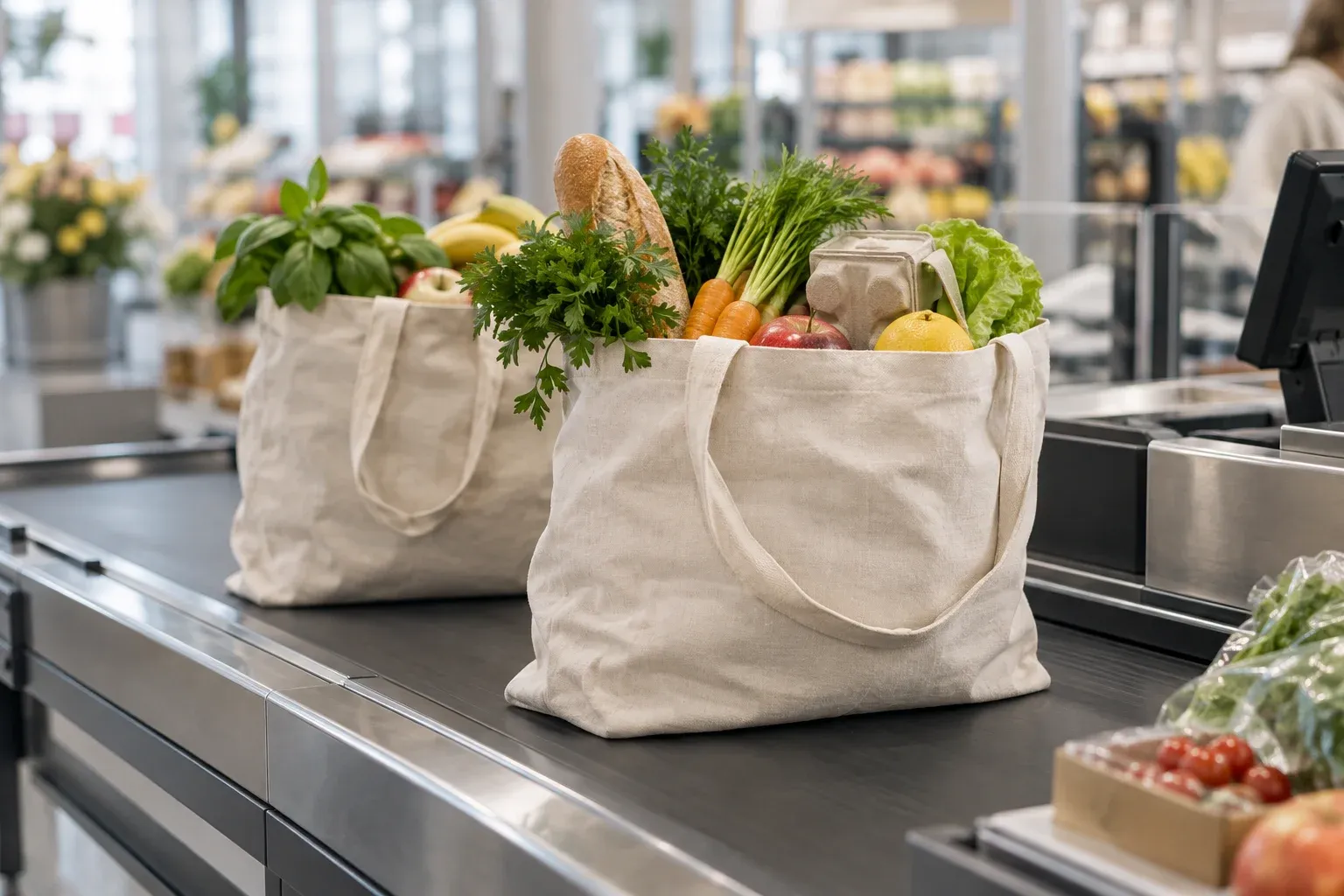
The tax is gone, but the habit stayed. Here is what the tax was, why Sweden scrapped it, what a bag costs at the till now, and the two moments (staffed till and self-checkout) where it actually matters to you.
When you need this
You will meet this topic within an hour of your first grocery run. The cashier finishes scanning and asks “Vill du ha en påse?” (do you want a bag?), and a yes adds a few kronor to the receipt. Or you are at a self-checkout, the screen tells you to scan your bags, and you realize the rack of bags next to you is merchandise, not a free service.
It also matters before the trip. If you read a guide that says Sweden taxes plastic bags at 3 kr each and a bag costs 7 kr, you are reading something written between 2020 and 2024. And if you are moving here, it explains why every Swede seems to own three tote bags.
The tax is gone: the freshness catch
Sweden no longer has a plastic bag tax. It applied from 1 May 2020 and ended on 1 November 2024, after the Riksdag (parliament) decided to abolish it. The Swedish Tax Agency, Skatteverket, announced the end date in September 2024, and the statute record shows the law repealed by SFS 2023:802.
A lot of English-language content has not caught up. Travel pages, forum answers and some budget guides still describe the tax as current. If a source mentions a 3 kr bag tax without saying it ended, check its date: it predates November 2024.
What did not go away is the charge. Swedish shops still sell carrier bags instead of handing them out, because that is their own pricing, not a legal requirement tied to the old tax. So the practical advice is unchanged: bring a bag.
What the tax was
The law was Lag (2020:32) om skatt på plastbärkassar, the Act on tax on plastic carrier bags. It covered any carrier bag made of plastic to more than a negligible extent, and it had two rates:
| Bag type | Tax per bag (May 2020 – Oct 2024) |
|---|---|
| Ordinary plastic carrier bag | 3 kr |
| Very thin bag under 15 micrometers and up to 7 liters (the produce-section kind) | 30 öre |
| Paper bag | Not covered |
Shops passed the cost on. According to SVT’s reporting, the price of a supermarket carrier bag went from about 4 kr to about 7 kr when the tax arrived. Naturvårdsverket, the Swedish Environmental Protection Agency, notes that shops also began charging for the thinnest bags, including the ones for loose fruit and vegetables.
The point was an EU target. The EU caps use of thin plastic carrier bags (15–50 micrometers thick) at 40 per person per year, and member states can meet it either by keeping consumption under the cap or by making sure bags are not given away free at the till. Sweden chose a tax to get there.
Why Sweden scrapped it
The tax worked faster than expected. Naturvårdsverket’s figures for thin carrier bags tell the story:
| Year | Thin plastic carrier bags per person |
|---|---|
| 2017 | 83 |
| 2019 | 74 |
| 2020 | 55 (tax from May) |
| 2021 | 14 |
| 2023 | 17 |
| 2024 | 19 (tax ended 1 Nov) |
| 2025 | 23 |
In September 2023 the government, in a budget agreement with the Sweden Democrats, proposed scrapping the tax. Its reasoning: Swedes were using fewer than 20 bags a year, well under the EU ceiling of 40, so the tax was no longer needed, and it carried costs of its own, such as administration and possibly higher use of alternative bags. The government added that it would follow consumption closely. The Riksdag agreed, and the tax ended on 1 November 2024.
What happened next
Bags got cheaper and people bought more of them, but not dramatically more. A year after the repeal, SVT reported that bags were back at about 4 kr, and that ICA and Coop had seen plastic bag sales rise by about 50 percent, with Axfood (Willys, Hemköp) at about 30 percent. Axfood also noted that the share of plastic bags is still far below where it was before the tax.
Naturvårdsverket’s 2025 count backs this up: 23 thin bags per person, up from 19 and the highest since 2020. Sweden still meets the EU target comfortably, and the agency says it remains to be seen whether this is a lasting trend. The very thin produce bags rose too, to 15 per person, though they are still far below the 48 of 2020.
For you, the takeaway is simple. The rule changed, the till did not: a carrier bag still costs money, and most Swedes still bring their own.
The bag at the till
Here is how the moment plays out, and how to handle it.
- At a staffed till, the cashier asks “Vill du ha en påse?” Answer “nej tack” (no thanks) if you have a bag, or “ja, en påse” (yes, one bag). The bag is added to your receipt.
- At a self-checkout, bags hang on a rack by the kiosk. Take one and scan it like any other item, or bring your own and skip the step. Leaving with an unscanned bag means leaving with an unpaid item, and receipt checks at exit gates are routine. See self-checkout in Sweden for how the kiosks work.
- In the produce section, whether the thin fruktpåse costs anything is store policy since the tax ended. Look at the sign on the dispenser.
- Paper or plastic? Paper bags were never taxed and sit next to the plastic ones at many tills. Price and choice vary by store.
A few things make life easier on a longer stay:
- Pack one foldable bag in your day bag. It covers supermarkets, Systembolaget and market stalls.
- Supermarkets sell sturdier reusable bags at the till if you are staying a while.
- On a self-scanning trip, put your own bag in the trolley and pack as you scan.
- When a plastic bag is worn out, it goes in plastic-packaging recycling. Don’t use it for food waste where your municipality uses paper food-waste bags; recycling in Sweden explains the bins.
Rules that still apply
The tax is gone, but bags are not unregulated. These rules sit with businesses, not shoppers:
- The EU target continues. The 40-bag ceiling now runs through EU Regulation 2025/40 on packaging, for 2025 and every year after. Very thin produce bags (under 15 micrometers) and thick bags (50 micrometers or more) are outside the target.
- Shops must inform. Naturvårdsverket states that shops and restaurants that sell or give away plastic carrier bags must tell customers about the bags’ environmental impact.
- Producers report. Anyone who makes or imports plastic carrier bags must report the numbers to Naturvårdsverket by 31 March each year.
None of this differs between tourists, EU citizens and people registered in Sweden (folkbokförda). Everyone pays the store’s price at the till, and there was never a visitor refund on the tax.
One honest caveat: consumption rose in 2025, and the government said it would watch it. A new instrument is possible if the trend continues. This page records the rules as checked on 2026-10-14.
Mistakes to avoid
- Assuming bags are free because they are at home. Say “nej tack” or bring your own.
- Believing the tax still applies. It ended on 1 November 2024; trust sources dated after that.
- Forgetting to scan the bag at self-checkout, then getting stopped at the receipt gate.
- Buying a new bag every visit on a two-week self-catering stay. Keep one and reuse it.
- Putting food waste in a carrier bag where the municipality uses paper food-waste bags.
Practical information
| Item | Details (checked 2026-10-14) |
|---|---|
| Plastic bag tax | None. Abolished 1 November 2024 |
| Plastic carrier bag at a supermarket | About 4 kr as of October 2025; each store sets its price |
| Bag price while the tax applied (2020–2024) | About 7 kr, of which 3 kr tax |
| Produce bags (fruktpåse) | Store policy; check the dispenser sign |
| Self-checkout | Scan every bag you take |
| Tourists vs residents | Same price for everyone |
FAQ
Does Sweden still have a plastic bag tax?
No. The tax of 3 kr per plastic carrier bag, introduced on 1 May 2020, was abolished on 1 November 2024 after a Riksdag decision. Shops still charge for bags, because selling them is their own policy, but the price no longer includes any tax. Pages quoting a 3 kr tax or a 7 kr bag are describing 2020 to 2024.
How much does a shopping bag cost in Sweden?
A plastic carrier bag costs about 4 kr in Swedish supermarkets as of late 2025, down from about 7 kr while the tax applied. Each store sets its own price, and paper bags are usually sold next to plastic ones. Sturdier reusable bags cost more. Nothing is free at the till, so bringing your own bag is the cheapest option.
Are plastic bags free in Swedish shops?
Carrier bags at the till are not free in Swedish supermarkets; you pay a few kronor per bag. The thin produce bags for loose fruit and vegetables are a separate case: during the tax they were charged too, and since November 2024 it is up to each store. Look at the sign on the dispenser before assuming either way.
Why did Sweden abolish the plastic bag tax?
The tax was introduced to meet an EU ceiling of 40 thin plastic carrier bags per person per year. By 2023 Swedes used fewer than 20, so the government argued the tax was no longer needed and had costs of its own. It was part of a budget deal with the Sweden Democrats, and the Riksdag ended the tax on 1 November 2024.
Did people start using more plastic bags after the tax ended?
Yes, somewhat. Naturvårdsverket counted 23 thin carrier bags per person in 2025, up from 19 in 2024, and retailers reported sales up by about 30 to 50 percent. That is still far below the 74 per person of 2019 and well under the EU ceiling of 40.
Do tourists pay the same for bags as residents?
Yes. The bag price is set by the store and charged to everyone at the till, whether you are a tourist, an EU citizen or registered in Sweden. There was never a refund for visitors, and since November 2024 there is no tax left to refund anyway.
Related guides
- Swedish supermarkets explained: the chains where you meet the bag question every day
- Shopping in Sweden: what else gets added at the till, from deposits to member prices
- Self-checkout in Sweden: how to scan your bag and get through the exit gate
- Pant: the bottle and can deposit: the other small charge on your receipt, and how to get it back
- Recycling in Sweden: where worn-out bags and packaging go
- Grocery prices in Sweden: what a food shop actually costs
Facts verified 2026-10-14. Sources: Skatteverket, Sveriges Riksdag (Lag 2020:32, SFS 2023:802, Förordning 2022:1274), Regeringen, Naturvårdsverket, European Commission and SVT. Full register in this topic’s source file. Found something outdated? Tell us and we’ll fix it.