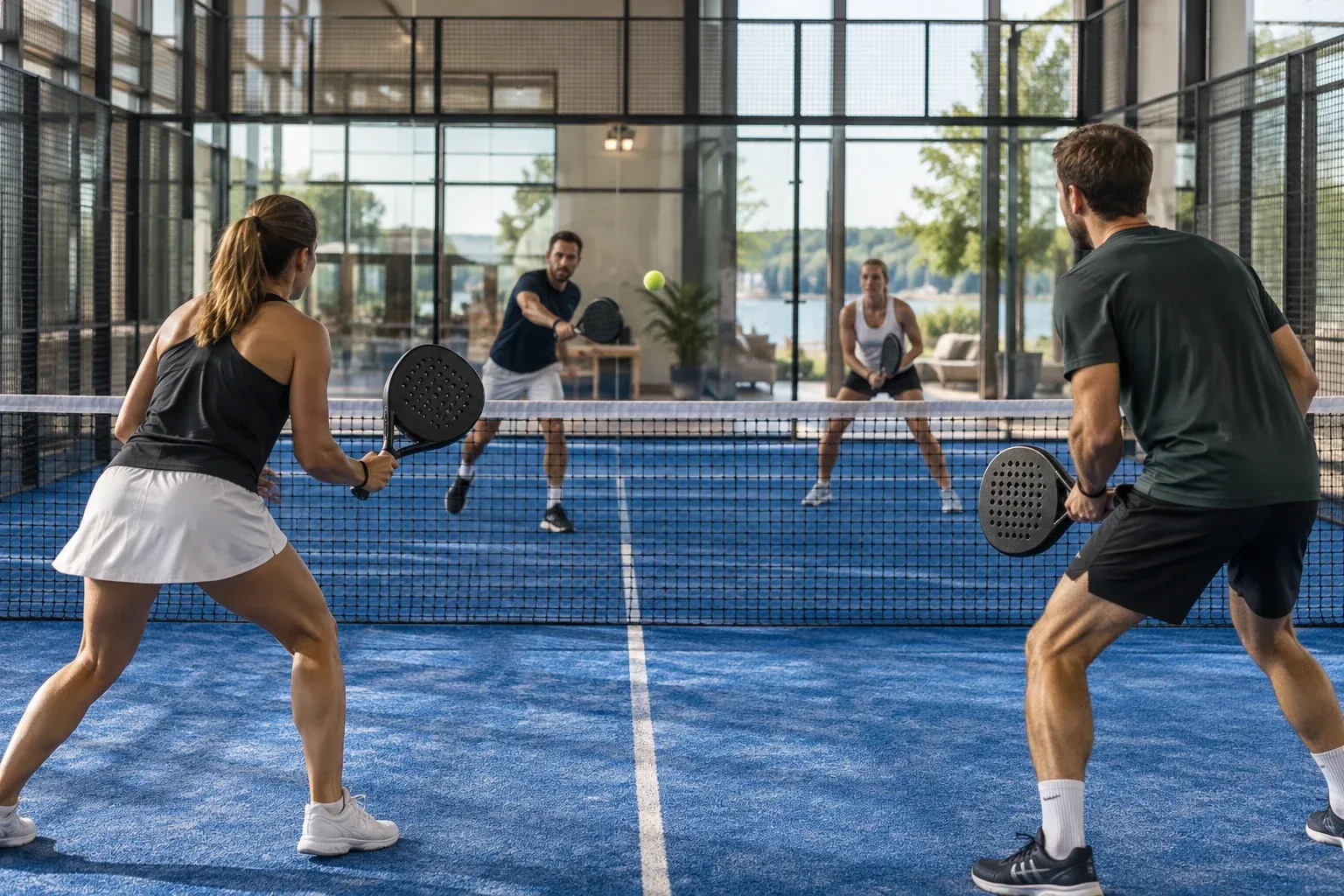
Sweden went padel-mad between 2019 and 2021, then built more halls than it could fill. The sport survived the crash, and getting on a court as a visitor is easy once you know how Swedish venues work. Here’s the booking routine, the rules and what changed in 2026.
When you need this
Swedish friends or colleagues have invited you to a game. Or you play at home and want to keep going on your trip, or you’ve walked past a padel hall and want to try without owning a racket. Maybe you’re staring at a Swedish booking app, or you know tennis and wonder what’s different. And maybe you’ve just noticed how many halls look half-empty.
The boom and the bust
Padel is a racket sport for two pairs on an enclosed court 10 metres wide and 20 metres long. Its walls of glass or brick stay in play after the ball has bounced, much as in squash. The modern rules date from 1974, and the scoring is the same as tennis.
Sweden took to it faster than almost anywhere. The Swedish Padel Federation (Svenska Padelförbundet) worked with the national booking platform Matchi to estimate the whole market, and the curve tells the story:
| Year | Unique people who booked a court | Booked court hours |
|---|---|---|
| 2019 | about 170,000 | 1.8 million |
| 2020 | 410,000 | 4.6 million |
| 2021 | 540,000 | 5.8 million |
| 2022 | 421,000 | 5.3 million |
Then the halls ran into trouble. A 2023/24 motion in the Riksdag, Sweden’s parliament, noted that the boom had given way to bankruptcies covering more than 120 halls, some standing empty or turned into warehouses and shops. The federation’s 2025 annual report says its member clubs fell from 254 to 224 during the year. Part of that was clearing out inactive clubs, but many clubs had also lost access to their venues.
The federation reads its booking data as a shift towards organised play: fewer people book courts, but each booking is for more players, through courses, leagues and clubs (see Swedish club life). For you, that means a sport still widely played, with halls in towns of every size, from Skara and Sjöbo to Nälden in Jämtland. The venues are leaner now, though, and many run without staff.
How to book a court
You book the court, not a place on it. The price is per court per hour, and the person who books pays the whole court.
- Gather four players. The federation’s rule summary says the normal 10×20 m court is always played as doubles. Some halls also have narrower single courts; Sjöbo Padelcenter, for example, has five doubles and two single courts.
- Find a venue. Search a national booking platform or the venue’s own site, where courts, opening hours and prices are listed. Matchi, the federation’s statistics partner, lists padel alongside tennis, badminton, squash and other racket sports.
- Book and pay by the hour. Each venue sets its own prices, often with lower rates for members and children. At Loftahammars GK, for example, members pay less than non-members, and children up to 15 who book get a reduced rate. Booking and cancellation terms are the venue’s or platform’s own, so read them before you pay.
- Sort out the split first. Swedes often settle shares by Swish, the mobile payment app, but it needs a Swedish bank account and BankID, so visitors can’t use it. Agree on another way before you play; Swish for tourists explains the alternatives.
No licence or club membership is needed for casual play. A competition licence from the federation only matters for sanctioned tournaments. It’s free for children up to 12, and since 2026 it is also sold as a monthly or quarterly licence.
Rackets, balls and getting in
Equipment rules differ from venue to venue:
| Venue (example) | Rackets | Balls |
|---|---|---|
| Loftahammars GK | Rent or buy | Buy |
| Skara Padel | Free loan with the court | Free with the court |
| Hallströms Padel, Nälden | Rent on site | Buy on site |
At unstaffed halls, contact the venue before your slot if you need a racket, since the desk may be closed.
Getting in. Many halls are unstaffed. At Hallströms Padel the door code is in your booking in the app and in your confirmation e-mail, and the lights switch on five minutes before your slot and off five minutes after it. So don’t count on walking in: without a booking there may be nobody to open the door. Your hour ends when the next booking starts.
Courts are covered with sand that needs sweeping and topping up; one hall reports three to four tonnes per court. Take your water bottles and balls with you when you leave. Unstaffed access works much like the 24/7 hours at gyms in Sweden.
The rules in two minutes, and what changed in 2026
The sport’s rulebook is the International Padel Federation’s (FIP) Rules of Padel. It binds sanctioned competitions and works as a shared convention in casual games. The current text has applied since 1 January 2026.
- Scoring: 15, 30, 40, game, as in tennis. Sets go to six games with a two-game margin, there’s a tie-break at 6–6, and matches are best of three sets.
- Serve: underhand. Bounce the ball inside your own service box and hit it at or below waist height, with at least one foot on the ground, diagonally into the receiver’s box. You get two serves, and a serve that clips the net and lands in is replayed.
- The glass and the mesh: a serve may bounce up into the opponents’ glass, but if it hits the metal mesh it’s a fault.
- The opponents’ walls: in a rally the ball must bounce on the opponents’ ground before it touches their walls. Straight into their glass or fence is out.
- Your own wall: you may play the ball off your own glass to get it back over the net. If you hit the mesh on your own side, you lose the point.
- Other ways to lose a point: touching the net or post, being hit by the ball, or hitting the ball twice.
- Volleys are allowed, except when returning a serve, and the lines only matter on the serve.
- Out-of-court play through the doors is allowed only on courts with an approved safety area: at least 2 m by 4 m on each side, 3 m high. On other courts, reaching outside loses the point.
New in 2026. The FIP General Assembly approved a third scoring option, the Star Point, on 28 November 2025, and the professional tours use it from 2026. A game can now go to deuce three times; at “deuce 3” one deciding point settles it. The other two options remain: classic advantage, and golden point, where the deciding point comes at the first deuce. Agree on which one you’re using before the first game.
The 2026 text also says the server stands with one foot behind the service line. The federation’s Swedish serve page still says both feet, and its rules page notes that the 2026 revision hasn’t been translated into Swedish yet. If a Swedish rule sheet disagrees with the FIP text, the FIP text is the current one.
Padel for tennis players
| Padel | Tennis | |
|---|---|---|
| Court | 10×20 m, fully enclosed by walls and mesh | Open court, no walls |
| Format | Doubles on the standard court | Singles or doubles |
| Serve | Underhand, after a bounce, at or below the waist | Overhead, ball tossed |
| Walls | In play after a bounce | Not part of the game |
| Racket | Solid, perforated, no strings, max 45.5 cm, wrist cord compulsory | Strung |
| Scoring | Same as tennis, plus Star Point or golden point options | Tennis scoring |
| Lines | Only matter on the serve | Matter on every shot |
The habit that costs tennis players most points is going for the opponents’ back glass on the full. In padel it has to bounce first. Wear the wrist cord, too: in an enclosed court a racket that slips can hit your partner.
Practical information
| Item | What to know |
|---|---|
| Court hire | Per court per hour, set by each venue; often lower for members and children |
| Racket | Rented for a small fee at some venues, free with the court at others |
| Balls | Sold at the venue in tubes; free with the court at some |
| Booking | Online through a booking platform or the venue’s own site; read the terms |
| Access | Door code in the booking at unstaffed halls |
| Licence | Not needed for casual play; competition licence free for children up to 12 |
| Rules | FIP Rules of Padel, applied from 1 January 2026 |
| Bring | Three other players, indoor sports shoes, water, a payment card |
FAQ
How do I book a padel court in Sweden?
Book online, usually through a national booking platform or the venue’s own app or website, where you choose a court and an hour and pay for the whole court. Prices are set by each venue and often differ for members, non-members and children. Many halls are unstaffed, so the door code comes with your booking. Read the venue’s booking and cancellation terms before paying.
Can I rent a padel racket in Sweden?
Often, yes. Some venues rent rackets for a small fee and sell balls at the desk, while others lend rackets and balls free when you book a court. At unstaffed halls, contact the venue before your slot if you need a racket, since the desk may be closed. Bring your own if you play regularly.
What are the basic rules of padel?
Two pairs play on an enclosed 10×20 m court with tennis scoring. You serve underhand after bouncing the ball, diagonally into the opponents’ box. After a bounce, the ball may come off the walls and stay in play. It must bounce on the opponents’ ground before touching their walls, and hitting the mesh on your own side loses the point.
What changed in the padel rules in 2026?
The International Padel Federation’s rules applied from 1 January 2026 add a “Star Point” option: a game can reach deuce three times before one deciding point. The server may now stand with one foot behind the service line. The Swedish Padel Federation had not translated the 2026 revision when we checked, so older Swedish rule sheets may differ.
How is padel different from tennis?
The court is smaller and fully enclosed, and the walls are part of the game. Padel is played in doubles, the serve is underhand after a bounce, and the racket is solid and perforated with no strings, at most 45.5 cm long with a compulsory wrist cord. Scoring is the same as tennis, and the lines only matter on the serve.
Is the padel boom in Sweden over?
The building boom is. Matchi booking data show unique bookers rising from about 170,000 in 2019 to 540,000 in 2021, then falling to 421,000 in 2022. A Riksdag motion noted bankruptcies covering over 120 halls. In 2025 the federation’s member clubs fell from 254 to 224, many after losing their venues. The sport itself is still widely played.
Do I need a licence or club membership to play padel in Sweden?
No, not for casual play. Anyone can book a court at a venue that takes public bookings, although members often pay less. A licence from the Swedish Padel Federation is needed only for sanctioned tournaments; it is free for children up to 12, and from 2026 monthly and quarterly licences are also sold.
Related guides
- Gyms in Sweden — the same unstaffed, app-based access, for your other workouts
- Swedish club life — why so much Swedish sport, padel included, runs through clubs
- Swish for tourists — how to settle your share of the court without Swish
- Golf in Sweden — another sport you book by the slot
- Sweden with kids — more active days for the whole family
Facts verified 2026-10-06. Sources: Svenska Padelförbundet, International Padel Federation (FIP), Sveriges riksdag, Företagarna, venue pages for Loftahammars GK, Skara Padel and Hallströms Padel, Matchi, Swish — full register in this topic’s source file. Prices and booking terms are each venue’s own; check the venue’s page. Found something outdated? Tell us and we’ll fix it.