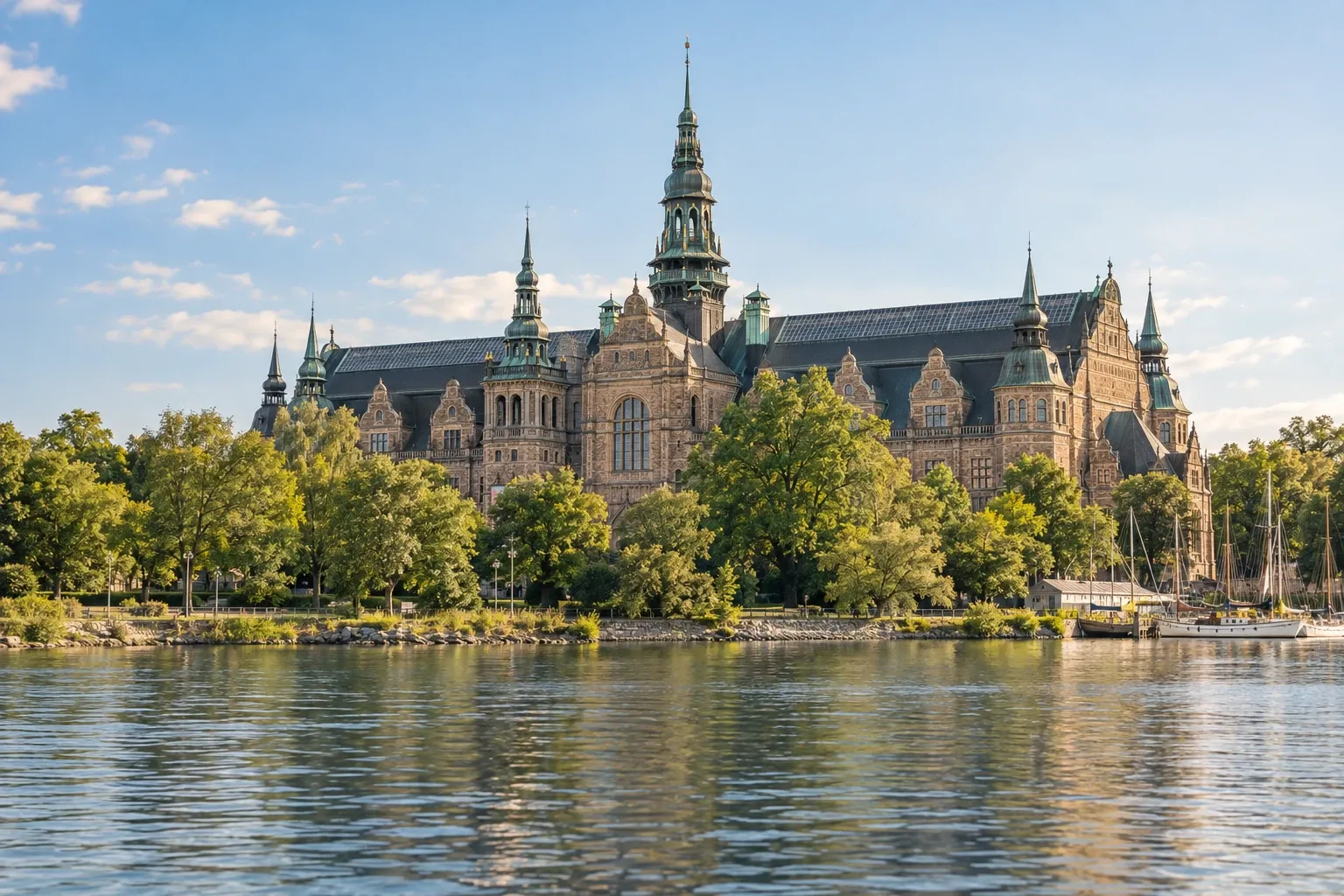
The palace-like building at the start of Djurgården is where Sweden keeps the story of ordinary life: kitchens, feast tables, work clothes and festivals. Two rules catch visitors out: what children pay depends on the school calendar, and backpacks stay out of the exhibitions.
When you need this
You have half a day on Djurgården and are choosing between its museums. Or it is raining, dark or Christmas, and you need somewhere open every day. You may be travelling with children and wondering whether they pay, or arriving with a backpack or a suitcase. If any of these fit, the details below will save you a queue, a fee or a trip back to the hotel.
What kind of museum this is
Nordiska museet (the Nordic Museum) calls itself Sweden’s largest museum of cultural history. It holds more than one and a half million objects about life in Sweden and the Nordic countries from the 16th century to today, plus about six million photographs, a library of more than 250,000 books and journals, and archives filling more than 4,500 metres of shelving.
Think of it as the indoor half of a pair. Artur Hazelius opened his first exhibition, the Scandinavian-Ethnographic Collection, on Drottninggatan in 1873. In 1880 he made it a foundation (stiftelse) and named it Nordiska museet. In 1891 he opened Skansen, the open-air museum of buildings, which the same foundation ran until 1963. Since then Skansen has been a separate foundation, though the two remain closely linked.
Why adults always pay. Nordiska museet is a foundation, not a government agency. The state appoints its board and in 2025 paid 65 percent of its running costs, but the museum was never part of Sweden’s 2016–2022 free-entry reform for state museums. Its 2015 annual report described a free evening each week; today’s price list has none for adults. If you want a free museum evening, Nationalmuseum has one on Thursdays, and our guide to free museums in Stockholm lists the rest.
What to see inside
The museum has four floors. The main exhibitions:
| Exhibition | Where | What it is | Time |
|---|---|---|---|
| Nordic Life (Nordbor) | Top floor, level 4 | 500 years in 27 rooms, told through four seasons and 22 real people from the collections | 1–2 hours |
| The Arctic – While the Ice Is Melting | Great Hall | Life in the Arctic, home to four million people; you walk through a model iceberg | About 45 minutes |
| Table Settings (Dukade bord) | Level 3 | Laid tables from the 16th century to about 1950, from banquets to coffee parties; on display since 1955, according to the museum | 30–45 minutes |
| Nordic Moments | Level 3 | Rotating photographs from the museum’s collection, in seven rooms | Varies |
| The 1940s Flat (Folkhemslägenheten) | Great Hall | A furnished 1947 two-room flat from the folkhem (“People’s Home”) era | 15–30 minutes |
| Dollhouses | Great Hall | Eight homes in miniature from the 19th and 20th centuries | 15–30 minutes |
Nordic Life is the reason to come. It opened in 2024, fills the whole top floor, and the museum says it was named Exhibition of the Year 2024. You enter in the 1500s and walk forward through time and seasons: a Forest Finn settlement, a 1600s noble estate, an 18th-century bourgeois home, a 19th-century village, and finally a “three rooms and a kitchen” flat from 1965–1975, when about a million homes were built. That last room is the story behind Stockholm’s Million Programme suburbs.
Sámi history runs through Nordic Life rather than in a separate room. The old Sápmi exhibition closed in February 2022; our Sámi culture guide explains where else to see Sámi culture.
Use the free audio guide. It opens in your phone’s browser at guide.nordiskamuseet.se or by QR code, so no download is needed, and there is an app if you want it offline. Nordic Life, Table Settings and The Arctic have tracks in Swedish and English. Selected Nordic Life tracks also come in French, German and Spanish using AI voices. There is a Sámi history track in Swedish and English and an audio-described track in Swedish. The Nordic Life track runs about 45–50 minutes. Bring headphones; the free Wi-Fi is called “NM-Guest”.
How long to allow. The museum’s own suggestions:
- One hour: Nordic Life alone, or a fast lap of everything.
- Two hours: all the exhibitions.
- Half or full day: add lunch, the family spaces and the building’s details.
The building itself
Isak Gustaf Clason won the design competition in 1883, and the museum opened on 8 June 1907, six years after Hazelius died. The building is 153 metres long, and its spire rises 81 metres. Inside, the Great Hall (Stora hallen) is about 126 metres long and 24 metres high, with 68 columns of Kolmården marble. Until electric light came in the 1930s, the ceiling lanterns were the only light, and the museum once closed in the darkest months.
At the far end stands Carl Milles’s six-metre painted oak statue of King Gustav Vasa, unveiled in 1925. It marks where the museum’s story begins, in 1523. The museum lists ten building highlights that take 30–60 minutes:
- the east portal, with Carl Eldh’s reliefs and mottos by August Strindberg
- the star vault in the vestibule
- lynx, wolves and bears carved on the column capitals
- the painted lantern above Gustav Vasa
- the 2023 Jubilee Lift and Jubilee Bridge, which make the top floor fully accessible
- the courtyard entrance with Outi Pieski’s art portal Two Directions
Opening hours
| Period | Hours |
|---|---|
| September–May | Daily 10:00–17:00, Wednesdays to 20:00 |
| June–August | Daily 10:00–17:00 |
| 9 December 2026 | Closes 15:00 |
| 13 December 2026 | Closes 15:30 |
| 23 December 2026 | Closes 17:00 |
| 24 and 25 December | Open |
The museum is open every day, Christmas Eve included, but publishes no separate hours for 24 and 25 December. On 28 October it closes at 17:00 for regular visits but stays open for its Night at the Museum event. The archives and library are free, with their own hours from September to May: Wednesdays 12:00–18:00 and Thursdays 12:00–16:00.
When to go. The museum says it is busiest at weekends and on weekdays until about 13:00. Weekday afternoons, and Wednesday evenings outside summer, are the quiet times. For other indoor plans, see rainy day in Stockholm.
Tickets and what children pay
Buy at the desk on the day; you do not need to book for the museum or Nordic Life, only for some events. A pre-booked ticket still has to be shown at a reception desk, and a fast lane opens only when it is busy. The shop, restaurant, archives and library need no ticket.
The children’s rule changed on 1 July 2025. Children aged 3–18 now pay at weekends, on public holidays and in school holidays. The ticket includes the Children’s Playhouse and the Time Vault, which used to cost extra. On school days during term, they are still free. The museum follows the City of Stockholm’s term dates, so a weekday in a Swedish school holiday counts as a holiday even if it is term time where you live. Guides written before mid-2025 that call children “always free” are out of date.
Seniors and students with valid ID pay a reduced rate, and a guide or personal assistant always enters free. An annual card covers this museum and the foundation’s four summer sites: Julita Manor, Tyresö Palace, Svindersvik and Härkeberga. A commercial city pass and a ticket reseller’s pass are accepted at the desk. All prices are in the table below.
Bags, payment and house rules
- No backpacks in the exhibitions. The museum says this is for safety reasons; bags up to A4 size are allowed.
- Lockers are free but small: 31 × 33 × 37 cm, enough for an A3-size bag, on level 1.
- Larger bags and suitcases cannot be stored, and luggage may not be left unattended. Coming from the airport or a cruise ship? Leave bags first; see luggage storage in Sweden.
- No cash. Card or Swish only, and Swish needs a Swedish bank account and BankID, so in practice bring a card (Swish for tourists).
- No food or drink in the exhibitions. You may bring your own food to the picnic tables in the Great Hall, which have microwaves, or to the courtyard tables.
- Photos for personal use are fine, without flash or tripod.
- Only assistance and guide dogs are allowed inside.
The restaurant in the Great Hall keeps museum hours and serves lunch from 11:00 to 15:00.
Visiting with children
- Children’s Playhouse (Lekstugan), ages 5 and up: role-play on an 1890s farm, about 45 minutes. The hours pages list weekdays 13:00–16:00 and weekends and holidays 11:00–16:00, but the English family page says weekends only, so ask at reception on a weekday.
- Time Vault (Tidsvalvet), ages 8 and up: an interactive trip through children’s history in the basement vaults, with timed entries. It is mostly in Swedish; the museum says English texts are limited.
- Family trails: Mission: Arctic through the iceberg, with an English map, and, from the autumn 2026 school break, Mission: Väsen, a hunt for folklore creatures through six hand-built cabinets around the museum.
- Prams are welcome, with an unattended pram park outside the Playhouse in the Great Hall.
Getting there
The museum is at Djurgårdsvägen 6–16, on the right just after Djurgårdsbron and directly in front of the Vasa Museum.
| Route | How |
|---|---|
| Tram | Line 7 from T-Centralen to Nordiska museet/Vasamuseet |
| Bus | 67 to Nordiska museet/Vasamuseet; 69 or 76 to Djurgårdsbron |
| Metro | Red line 13 to Karlaplan, then walk |
| Ferry | Djurgården ferry to Allmänna gränd; during the Slussen works it leaves from a temporary pier on Skeppsbron |
| Car | Limited parking; Djurgårdsbron is closed to private cars at certain times |
Any SL ticket is valid on the tram and ferry; see our Stockholm public transport guide.
Accessibility
- Step-free entrances, without thresholds and with an automatic door, to the right of the main entrance on Djurgårdsvägen and in the courtyard.
- Lifts reach the exhibitions, and ramps serve the restaurant and some exhibitions.
- Accessible toilet on level 1, opposite the shop, with a 90 cm door.
- Accessible parking by the main entrance, at the northern end towards Strandvägen and one space at the southern end.
- Loan wheelchairs, magnifiers and torches at reception.
- Stairs are marked on the top and bottom steps, but not every staircase has a handrail.
More in wheelchair-accessible Stockholm.
Christmas and coming exhibitions
Christmas is a good time to come. The eight-metre tree in the Great Hall is lit on the first Sunday of Advent, 29 November 2026, and a Christmas market follows on 5 December. The museum is open on Christmas Eve and Christmas Day, as it says on its Christmas page; see Swedish Christmas traditions.
In Nordic Moments, Nina Varumo’s photographs of Laestadian revival congregations in the Torne Valley and Norrbotten run until 6 January 2027. On 22 January 2027, Threads opens on level 3: more than 400 objects linking Nordic textile traditions with ancient Greek vases, including a six-month loan from the Metropolitan Museum of Art.
Mistakes to avoid
- Assuming children are always free. At weekends and in school holidays they pay.
- Expecting a free evening. There is none for adults.
- Arriving with luggage. There is nowhere to leave it.
- Bringing only cash.
- Looking for the Sápmi exhibition. It closed in 2022.
- Leaving without looking up. The Great Hall is half the visit.
Practical information
| Item | Detail |
|---|---|
| Location | Djurgårdsvägen 6–16, Djurgården, Stockholm |
| Open | Daily 10:00–17:00; Wednesdays to 20:00, September–May |
| Adult | 170 kr |
| Senior; student with valid ID | 150 kr |
| Child 3–18, weekends, public and school holidays | 75 kr (includes Playhouse and Time Vault) |
| Child 3–18, school days in term | Free |
| Under 3 | Free (prices start at age 3) |
| Guide or personal assistant | Free |
| Annual card (five sites, one person) | 400 kr |
| Private Nordic Life tour, weekday, up to 15 people | 4,000 kr per group plus 85 kr each |
| Lockers, audio guide, Wi-Fi | Free |
| Payment | Card or Swish; no cash |
| Bags in exhibitions | Up to A4; no backpacks |
Prices from the museum’s admission pages, checked 2026-10-15.
FAQ
How much does Nordiska museet cost?
In 2026 an adult ticket costs 170 kronor, and seniors and students pay 150. Children aged 3 to 18 pay 75 kronor at weekends and in school holidays, which includes the Playhouse and Time Vault, and enter free on school days in term. Under-3s are free. Payment is by card or Swish only; no cash.
Is Nordiska museet free?
Not for adults, at any time. The museum is a state-funded foundation and was never part of Sweden’s free-entry reform for state museums, and its current price list has no free evening. Children are free on school days during term, and the shop, restaurant, archives and library need no ticket. Guides or personal assistants also enter free.
What are Nordiska museet’s opening hours?
Every day 10:00–17:00, with Wednesdays open until 20:00 from September to May; in June, July and August the museum closes at 17:00 daily. It is open on Christmas Eve and Christmas Day. In 2026 it closes early on 9 December (15:00), 13 December (15:30) and 23 December (17:00).
What is there to see at Nordiska museet?
Five hundred years of everyday Nordic life. The top floor holds Nordic Life, 27 rooms following real people through four seasons from the 1500s to today. The Great Hall has the Arctic exhibition, a reconstructed 1940s flat, eight dollhouses and Carl Milles’s oak Gustav Vasa. Level 3 has historic table settings and the photo gallery Nordic Moments.
Can I bring a backpack into Nordiska museet?
No. Backpacks are not allowed in the exhibitions; bags up to A4 size are. Put the backpack in a free lockable locker on level 1, which holds an A3-size bag (31 × 33 × 37 cm). Larger bags and suitcases cannot be stored at the museum and may not be left unattended, so drop luggage elsewhere first.
Is Nordiska museet good for children?
Yes, with some planning. The Children’s Playhouse recreates an 1890s farm for ages 5 and up, the Time Vault is an interactive trip through children’s history for ages 8 and up, though mostly in Swedish, and family trails run in English. Picnic tables with microwaves are in the Great Hall. Weekend and holiday entry for children costs 75 kronor.
How long do you need at Nordiska museet?
Plan two hours for all the exhibitions at a steady pace. With one hour, the museum suggests concentrating on Nordic Life, which has a free audio guide of about 45–50 minutes. A half or full day lets you add lunch, the family spaces and the building’s ten architectural highlights, which take 30–60 minutes on their own.
Is Nordiska museet wheelchair accessible?
Largely. A step-free entrance with an automatic door is to the right of the main entrance on Djurgårdsvägen, and another is in the courtyard. Lifts reach the exhibitions, ramps serve the restaurant and some exhibitions, and an accessible toilet is on level 1. Wheelchairs, magnifiers and torches can be borrowed at reception, and assistants enter free.
Related guides
- Djurgården — the island around the museum, and how to fit its sights into one day.
- Vasa Museum — directly behind, on the same tram stop.
- Skansen — Hazelius’s open-air museum, the outdoor half of the same story.
- Free museums in Stockholm — where adults can get in free, since here they cannot.
- Luggage storage in Sweden — where to leave the bags this museum cannot hold.
Facts verified 2026-10-15. Sources: Nordiska museet (official site, Swedish and English pages, and annual reports 2015 and 2025), SL, the City of Stockholm, Swish, SVT and Minoritet.se — full register in this topic’s source file. Prices and hours are the museum’s 2026 figures. Found something outdated? Tell us and we’ll fix it.