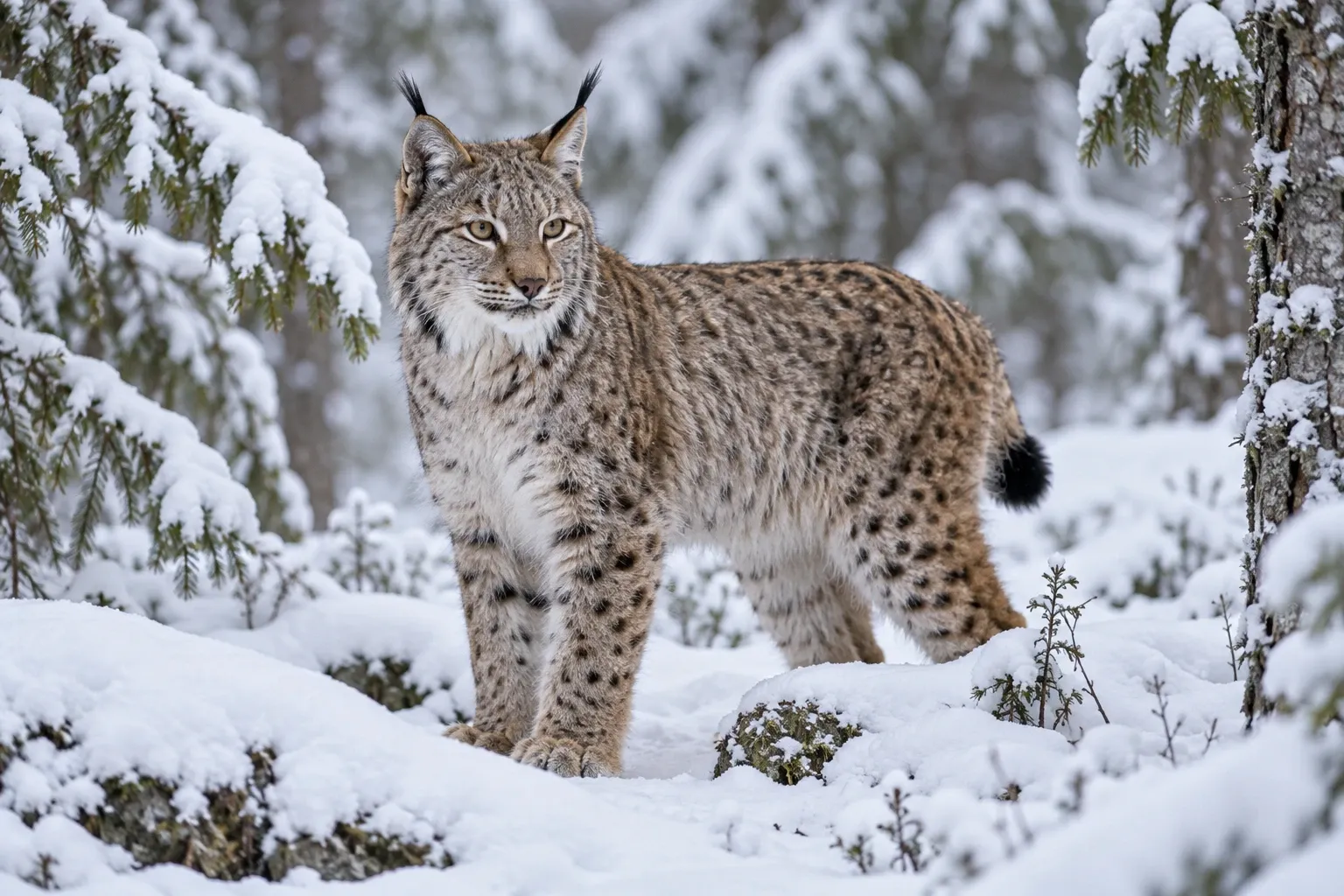
Lynx and wolverine are Sweden’s quiet large carnivores. This guide covers where each one lives and how dangerous they are. It also covers reading their tracks, the few rules a visitor can break, and what this year’s hunts mean for your trip.
When you need this
You’re hiking, skiing or driving through Swedish forest or mountains and wonder what lives there. Maybe you’ve found big round paw prints in the snow, or a five-toed track crossing a ski trail. Maybe a lynx strolled past a house you’re staying in. You might have a dog with you, have hit an animal on the road, or have read about a predator hunt in the news and want to know if it affects you.
The two animals at a glance
The lynx (lodjur) and the wolverine (järv) belong to the stora rovdjur, the large carnivores. That group also includes bear, wolf and golden eagle. They have little in common apart from being shy.
| Lynx (lodjur) | Wolverine (järv) | |
|---|---|---|
| Family | Cat | Weasel family; looks more like a small bear |
| Sweden’s population | About 1,500 (winter 2025/26) | 675–731 (2025, DNA survey) |
| Scandinavian total | About 2,031 | 1,040–1,118 |
| Size | Adults averaged 18.7 kg in the 2025 hunt (males 20.1, females 15.4) | Heaviest of 25 shot in 2024: a 14.5 kg male |
| Range | All of Sweden except Gotland | Mountains and forests of the north and centre |
| Main food | Roe deer in the south; reindeer, grouse and small mammals further north | Reindeer in winter; carrion, rodents, eggs and birds |
| Active | Mainly at night | Depends on snow; often scavenges |
Naturvårdsverket, the Swedish Environmental Protection Agency, calls the lynx population stable. The wolverine has been above its national reference value since 2019. Sweden switched to counting wolverines by DNA from the 2024/25 season, so don’t compare today’s figure with older counts of litters.
Where they live
Lynx live on the whole Swedish mainland. Gotland has none, because lynx don’t reach the islands. They’re forest animals, but they don’t keep to wilderness. In Västmanland the county board has found lynx family groups just outside Västerås. Females use home ranges of 200–600 km², and males use about twice as much.
Wolverines are tied to reindeer. Their Scandinavian range follows the herding land, in the mountains and mountain-near forest of the north. Since the 1990s they’ve also settled in forest land further south. Today they’re established in the northern and central management areas, but not in the south. Naturvårdsverket has said it wants the population to spread further south.
Are they dangerous?
To people, the lynx is not a documented threat. The Swedish sources we read record no case of a lynx attacking a person. County board carnivore staff have said publicly that lynx don’t attack people and that healthy adult wild lynx keep away from them. The exception that makes the news is a young or orphaned lynx that acts tame near houses. Don’t feed it or approach it. Report it to the county board (Länsstyrelsen).
For wolverines we found no official statement either way. The animal lives in sparsely populated mountain country, and its conflict is with reindeer, not hikers.
To dogs, the lynx is the main predator risk. In 2025 large carnivores attacked 36 dogs in Sweden. Lynx were behind 19 attacks, wolves 15, and bear and wolverine one each. A county officer has said lynx attacks usually follow the dog showing interest first. Keep your dog close; see dogs in Swedish nature for the full picture.
Finding them: tracks and timing
Most visitors will only ever see tracks, and in snow you can read them yourself. Viltskadecenter, the Swedish Wildlife Damage Centre, gives these features:
| Feature | Lynx | Wolverine |
|---|---|---|
| Toes | Usually four, uneven like fingers; the “middle finger” reaches furthest forward | Five, on both front and hind feet |
| Size | 6–10 cm long, front and hind | Front foot 11–14 cm including the heel pad |
| Look | Round, pads set far apart; much larger in loose snow, where the furred paw spreads | The larger front heel pad always shows |
| Claw marks | May or may not show | — |
| Easily confused with | Fox or dog tracks on hard snow | Otter (also five toes, but front foot only 6–8 cm) |
Lynx tracks vary from fox-sized to wolf-sized, so size alone proves little. Trackers note that lynx like rough, steep slopes and often visit fox or badger dens.
Timing matters as much as place. The official lynx survey runs from 1 October to the end of February and depends mostly on tracking snow. That’s your season too. If you find tracks, report them. The public’s observations feed the survey, and county boards ask for reports through Skandobs, the observation site and app run with Naturvårdsverket. Two or more lynx travelling together probably means a female with young, which is exactly what the survey counts.
Seeing one alive
In the wild, sightings are luck. Lynx are nocturnal, and wolverines live far from most people. If you want to be sure, go to Skansen in Stockholm. Its zoo keeps both species as part of European zoo conservation programmes.
The rules that apply to you
Both species are strictly protected, and a handful of rules bind every visitor:
- Don’t disturb them or their dens. The Species Protection Ordinance (artskyddsförordningen) forbids deliberately disturbing lynx and wolverines, especially while they mate or raise young, and damaging their breeding sites. Wolverine cubs are born in February–March in a den dug into a snowdrift by a cliff, a slope or a boulder field. The family leaves around the turn of April–May. Skiers and snowmobilers in the mountains should keep well away from any den they notice.
- Report a collision. If your car hits a lynx or wolverine, mark the spot and call the police on 112 as soon as possible, even if the animal ran off. This is the same duty as for moose and bear; see wildlife collisions in Sweden.
- Leave a dead animal where it lies. A dead lynx or wolverine belongs to the state (statens vilt). Report the find to the police, and don’t take it or any part of it.
- Keep your dog under control. From 1 March to 20 August dogs must not run loose where there is game. If a lynx or wolverine attacks your dog, you may try to scare it off. Only the owner or keeper may kill it, and only in narrow situations, such as during an attack when it can’t be scared off. The killing must then be reported to the county board.
- Hunts don’t close the forest. The right of public access still applies, and “Jakt pågår” (hunting in progress) signs don’t ban you from the area. See hiking during hunting season.
Licence hunts in 2026: what changed
Both animals are protected, but both are also hunted. County boards may allow protective hunts (skyddsjakt) year-round against serious damage to reindeer or livestock. Above set minimum levels, they may also decide licence hunts (licensjakt).
- Lynx: in 2026, 14 county boards decided licence hunts on 153 lynx, against 87 in 2025. Hunts open on 1 March and run at most to 31 March, or to 15 April in the northern management area (Norrbotten, Västerbotten, Jämtland and Västernorrland). In April 2026 Naturvårdsverket gave every county board except Gotland’s the power to decide lynx hunts until 29 April 2029. The national reference value is 870 lynx.
- Wolverine: in April 2026 Naturvårdsverket gave the same three-year power for wolverine to the four northern county boards. A wolverine hunt runs within 1 October–31 December. Jämtland allowed 10 wolverines in 2026. All 10 were shot and the hunt was called off on 11 October. Jämtland shot 25 in 2024. The reference value reported to the EU in 2025 is 600 wolverines.
For a visitor the effect is small: there’s no general season, the hunts are short, and you keep your right of access. Rovbase, the public Scandinavian carnivore database, shows where animals were shot or found dead. For how these hunts fit the rest of the hunting year, see hunting seasons in Sweden.
Why reindeer herders count them
Lynx and wolverine both kill reindeer, and reindeer are the wolverine’s key winter prey. Compensation isn’t mainly paid per dead reindeer. Instead the state pays each Sami herding community (sameby) for every lynx, wolf and wolverine reproduction documented on its grazing land. The government sets the amount on the proposal of Sametinget, the Sami Parliament. Only after a mass kill, many reindeer in a short time, does Sametinget pay per animal. So the winter survey isn’t just science: it sets what herders are paid. Jämtland’s management target, for example, is 34 wolverine reproductions, about 213 animals. Reindeer herding land explains how the north works.
Practical information
| Item | Detail |
|---|---|
| Lynx in Sweden | About 1,500 (survey 2025/26; Scandinavia about 2,031) |
| Wolverines in Sweden | 675–731 (2025; Scandinavia 1,040–1,118) |
| National reference values | Lynx 870; wolverine 600 |
| Lynx licence hunt 2026 | 153 lynx in 14 counties; 1 March to 31 March, to 15 April in the north |
| Wolverine licence hunt 2026 | Jämtland, 10 animals; 1 October–31 December, called off 11 October |
| Best season for tracks | Snow season; lynx survey runs 1 October–end of February |
| Wolverine den season | Cubs born February–March; dens left around the turn of April–May |
| Report tracks or sightings | Skandobs or your county board; free |
| After a collision | Mark the spot, call 112 |
| Watching in the wild | Free where the right of public access applies |
FAQ
Are lynx dangerous to humans?
No case of a lynx attacking a person appears in the Swedish sources we read, and county board carnivore staff have said publicly that lynx do not attack people and that healthy adult wild lynx keep away from them. Young or orphaned lynx can act tame near houses; leave them alone and tell the county board. The real risk is to loose dogs.
Where can I see a lynx or wolverine in Sweden?
In the wild, almost certainly only as tracks. Lynx live on the whole mainland but are nocturnal and shy; wolverines live in the northern mountains and forests, far from most people. Winter snow is your best chance to find tracks. To see the animals themselves, Skansen in Stockholm keeps both, in European zoo conservation programmes.
How many lynx and wolverines are there in Sweden?
About 1,500 lynx after the 2025/26 survey, out of roughly 2,031 in Scandinavia, a population Naturvårdsverket calls stable. The 2025 DNA survey put wolverines at 675–731 in Sweden and 1,040–1,118 across Scandinavia. Both are above their national reference values, 870 lynx and 600 wolverines.
Is it legal to hunt lynx and wolverine in Sweden?
Only when a county board decides it. Both are protected, but counties may allow protective hunts and, above set minimum levels, licence hunts. In 2026, 14 counties decided licence hunts on 153 lynx from 1 March, and Jämtland allowed 10 wolverines from 1 October; all 10 were shot by 11 October. There is no general season.
How do I tell lynx and wolverine tracks apart?
Count the toes. A lynx track is round, 6–10 cm long, usually with four toes of uneven length and pads set far apart. A wolverine shows five toes on front and hind feet, and its front foot including the heel pad is 11–14 cm long. Beware: fox and dog tracks in hard snow can look like a small lynx’s.
What should I do if I hit a lynx or wolverine with my car?
Mark the spot at the roadside and call the police on 112 as soon as possible, even if the animal ran off. This duty applies to lynx and wolverine just as to moose and bear. Do not follow the animal or take the carcass: a dead lynx or wolverine belongs to the state. Our wildlife-collision guide covers the details.
Can a lynx attack my dog?
Yes, and it happens more than with wolves. In 2025 large carnivores attacked 36 dogs in Sweden, 19 of them by lynx. A county board officer has said attacks usually follow the dog showing interest first. Keep your dog close, leashed from 1 March to 20 August by law, and you may try to scare off a lynx that attacks.
Related guides
- Wildlife in Sweden: the full species picture, with every population figure dated.
- Wolves in Sweden: the other carnivore that takes dogs, with its own encounter advice.
- Bears in Sweden: the one large carnivore where encounter technique really matters.
- Dogs in Swedish nature: leash rules and every other seasonal risk to your dog.
- Reindeer herding land: why the north manages predators the way it does.
Facts verified 2026-10-15. Sources: Naturvårdsverket, Länsstyrelsen Jämtland and Kronoberg, SVA, SLU Viltskadecenter, Svenska Jägareförbundet, Sveriges Riksdag (jaktförordningen 1987:905, artskyddsförordningen 2007:845, viltskadeförordningen 2001:724) — full register in this topic’s source file. Found something outdated? Tell us and we’ll fix it.