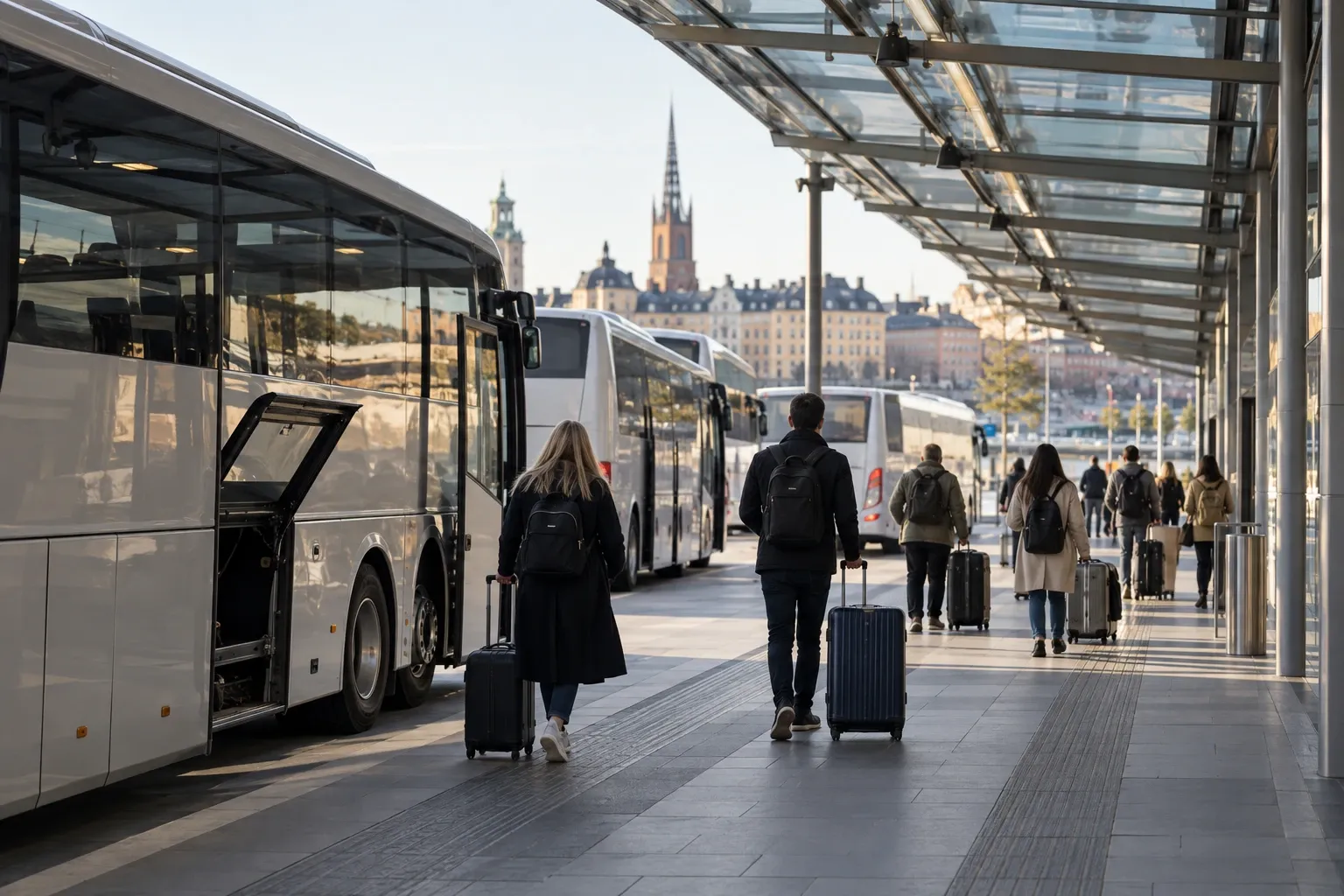
Coaches are Sweden’s budget way between cities, and in the north they reach many towns the railway doesn’t. Here is how the market works, what to book and pack, and what you can claim when a coach runs late.
When you need this
You’re comparing the bus and the train between Stockholm, Gothenburg or Malmö and want the cheaper option. Or engineering works have closed the railway and you’d rather take a direct coach than a replacement bus. Maybe the town you’re heading to has no station, which is common in Norrland. Or your coach is already two hours late and you want to know what the operator owes you.
How the coach market works
Long-distance coaches are a commercial business. Operators choose their own routes, set their own fares and sell their own tickets. Swedish law still requires them to tell the regional transport authority when they start or stop a service, and to send their timetables to the national traveller-information system. That’s why every coach shows up in a journey planner, even though no shared ticket covers them all.
Two networks dominate between the big cities:
- FlixBus bought Swebus Express in 2018 and retired the Swebus name. Part of its Swedish network is run by partner companies and sold in the FlixBus app. The Ybuss lines from Stockholm to Sundsvall and Umeå are the standing example.
- Vy, the Norwegian group, renamed Nettbuss in 2019. It sells its coaches as Vy Bus4You and Vy express, with stops from Malmö to Karlstad and on to Oslo and Copenhagen.
Out of date elsewhere: guides that still send you to Swebus or Nettbuss are describing companies that no longer trade under those names. Look for FlixBus and Vy.
In the far north the picture changes. There, the county transport authorities (Länstrafiken) run their own long-distance lines, and those are part of regional ticketing. More on that below.
Coach or train?
The coach usually wins on price and loses on time between the big cities, but not always. Both coaches and long-distance trains price every departure separately and get dearer as seats sell, so an early train ticket can undercut a last-minute coach. Check your actual date on both before deciding.
| Express coach | Long-distance train | |
|---|---|---|
| Price | Usually lower; rises as departure nears | Also set per departure; early tickets can be cheap |
| Journey time | Usually longer between big cities | Usually shorter |
| Rail passes (Interrail/Eurail) | Not valid | See our Interrail guide |
| Regional travel cards | Not valid on commercial coaches | Varies by operator |
| Pet dogs | Not on FlixBus | Allowed on many trains under each operator’s terms |
| Winter | Snow and ice slow the road more | Less affected |
For the train side of the comparison, see how to buy train tickets in Sweden without overpaying.
Booking and fares
Book on the operator’s own website or app. FlixBus says tickets are often cheapest a few weeks before travel, and Friday evenings and the big holidays (Easter, midsummer, Christmas) are when fares are highest and seats scarcest.
A journey planner is the best first search, because it shows every operator on a route, including county lines and partner lines sold under another brand. Then book with whichever operator runs the departure you want.
Read the cancellation terms before you pay. On FlixBus, changing a booking counts as cancelling it. You can cancel up to 15 minutes before departure, but the refund is a voucher, on a sliding scale that depends on how far ahead you cancel. Booking and service fees aren’t refunded at all. The scale is in the table at the end of this page. Other operators set their own terms.
Your other tickets won’t work. A regional travel card, a ticket in a regional app or an Interrail or Eurail pass is not a coach ticket. Commercial coaches sell only their own tickets, so buy one from the operator before you board. For local buses at either end of your trip, see how to pay for buses in Sweden.
Luggage, bikes, prams and pets
FlixBus is the best-documented example. Other operators set their own limits, so check when you book.
- Included: one small hand bag and one hold suitcase. Weights and sizes are in the table at the end of this page.
- Extra bag or bulky item (a large instrument, sports gear in a bag): one each per passenger, for a fee. Space is limited, so add them when you book.
- Pram: a foldable pram travels free as special baggage, but call the operator at least 48 hours ahead.
- Wheelchair: a foldable wheelchair travels free with 36 hours’ notice. A wheelchair space in the passenger area needs 7 days’ notice.
- Bike: only on some routes, and it must be pre-booked. No e-bikes, tandems or tricycles. Our guide to bikes on trains and buses in Sweden has the full rules.
- Dogs: FlixBus carries only assistance dogs. With a pet dog, regional buses and many trains are the usual alternative. See dogs on Swedish public transport.
Keep valuables out of the hold. Under the conditions the bus industry agreed with Konsumentverket, the Swedish Consumer Agency, operators compensate luggage stolen from or damaged in the hold. Electronics, jewellery and cash stowed there are excluded. Your laptop belongs in your hand luggage.
Stops and seat belts
In Stockholm, coaches leave from Cityterminalen, Stockholm’s central coach terminal beside Stockholm Central station. In Gothenburg they use the Nils Ericson Terminal next to Gothenburg Central. Smaller towns use street stops, so check the exact stop name on your ticket.
Wear your seat belt. Swedish law requires everyone over three on a coach fitted with belts to take a belted seat if one is free and to wear the belt. Only local trips in built-up areas are exempt. A passenger who doesn’t buckle up can be fined, and staff and group leaders must make sure children under 15 are belted.
When your coach is late: the line-length rule
This is where most advice goes wrong. Sweden has two sets of delay rules for buses, and which one applies depends on the scheduled length of the whole line, from its first stop to its last, not on how far you ride. A 90 km hop on a Stockholm–Gothenburg coach is still a trip on a line of over 250 km.
| Whole line’s length | Rules that apply | What a delay gets you |
|---|---|---|
| Under 150 km | Swedish law (Lag 2015:953) | Price reduction from a 20-minute arrival delay (50%, 75% over 40 minutes, full fare over 60), or the reasonable cost of other transport, capped |
| 150 km or more | EU Regulation 181/2011, extended by Swedish law | Cancellation or departure delay over 120 minutes: continue, rebook or refund; 50% extra if no choice was offered |
| 250 km or more | The whole EU regulation | As above, plus disability assistance with 36 hours’ notice |
So almost every intercity coach falls under the 120-minute rule. If your departure is cancelled or more than 120 minutes late, the operator must offer you a choice: continue as soon as possible, rebook on comparable terms, or take a refund, plus a free trip back to where you started if that’s relevant. Refunds are due within 14 days. If the operator never offered the choice, you can claim the refund plus 50% of the ticket price.
On a trip scheduled for more than three hours, a cancellation or a departure delay of over 90 minutes from a terminal also gets you snacks or meals in proportion to the wait. If you’re stranded overnight, the operator must provide a hotel for up to two nights, unless severe weather or a natural disaster caused the delay.
Two things to avoid:
- Don’t take a taxi and expect the coach company to pay. The Swedish taxi-cost rule covers only lines under 150 km. On longer lines, your remedy is the choice above.
- Don’t wait too long to complain. Write to the operator within three months. It must answer within a month and give a final reply within three. If it refuses, ARN (Allmänna reklamationsnämnden, the National Board for Consumer Disputes) handles consumer disputes free of charge.
If you’re weighing the train instead, its rules are different again. See train delays in Sweden.
Coaches in the north
North of Umeå, the coast is served by county-run buses. Line 100 runs between Umeå and Haparanda and stops only at municipal centres. You can buy a ticket on board by card or at a county bus station. The cross-county Norrlandsresan ticket covers changes between the four northernmost counties’ services.
Inland, the county lines known together as Inlandstrafiken serve the inland towns. Line 46 between Östersund and Mora is one of them, connecting with the northbound interregional buses. Departures are few, so plan your return before you set off. For the mountains, see getting to the fjäll by public transport.
When the trains stop: during rail engineering works, often at holidays and in summer, coach operators add departures on the affected corridors. At Easter 2025 one operator planned 250 extra departures and ended up running about 500. A direct coach can beat a replacement bus plus a train.
Practical information
| Item | Amount or rule (checked 2026-10-14) |
|---|---|
| Coach fares | Set per departure; check the operator — not published here |
| FlixBus hand luggage | 1 bag, 7 kg, 30 × 18 × 42 cm, included |
| FlixBus hold luggage | 1 suitcase, 20 kg, 50 × 30 × 80 cm, included; 1 extra bag for a fee |
| FlixBus cancellation (voucher) | 100% 30+ days ahead · 70% 7–29 days · 40% 2–6 days · 20% under 2 days; fees kept |
| Delay over 120 min, no choice offered (line 150 km+) | Refund + 50% of the ticket price |
| Hotel after cancellation or delay (trip over 3 h) | Up to EUR 80 a night, max 2 nights |
| Other transport on a line under 150 km | Up to 1,480 kr in 2026 (1/40 of the price base amount) |
| Luggage lost from or damaged in the hold | At least EUR 1,200 under industry conditions |
| Complaint deadline | 3 months after the trip |
FAQ
Is the bus cheaper than the train in Sweden?
Usually, but not always. Both coaches and long-distance trains price each departure separately and get dearer as seats sell, so an early train ticket can undercut a last-minute coach. Coaches usually take longer between the big cities. Compare the actual departures on the operators’ own sites for your date before deciding, and book a few weeks ahead for the lowest fares.
Which companies run long-distance buses in Sweden?
FlixBus and Vy run the two main intercity networks; Swebus became part of FlixBus in 2018 and Nettbuss became Vy in 2019. Several smaller companies run lines sold through FlixBus, and in Norrland the county transport authorities run their own long-distance lines. A national journey planner shows every operator’s departures, because all must report their timetables.
Can I use my Interrail pass or SL card on an express bus?
No. Commercial express coaches sell only their own tickets, so rail passes and regional travel cards or app tickets are not valid on them. The exception is the county-run long-distance lines in the north, which are part of regional ticketing: there you pay on board by card or use the cross-county Norrlandsresan ticket.
What are my rights if my coach is late in Sweden?
It depends on the whole line’s length. On lines of 150 km or more, a cancellation or a departure delay over 120 minutes gives you the choice of continuing, rebooking or a refund, plus 50% extra if no choice was offered. On shorter lines, Swedish law gives price reductions from a 20-minute arrival delay.
How much luggage can I take on a Swedish coach?
On FlixBus, one hand bag of up to 7 kg and one hold suitcase of up to 20 kg are included, with one extra bag and one bulky item bookable for a fee. Other operators set their own limits, so check at booking. Keep electronics, jewellery and cash with you: valuables in the hold are excluded from compensation.
Do I have to wear a seat belt on a bus in Sweden?
Yes, on coaches fitted with belts. Swedish law requires everyone over three to take a belted seat if one is free and to wear the belt, and a passenger who does not can be fined. Only local trips in built-up areas are exempt. Staff and group leaders must make sure children under 15 are belted.
Can I bring my dog on a long-distance bus in Sweden?
Not on FlixBus, which carries only assistance dogs. Other coach operators set their own rules, so ask before booking. If you travel with a pet dog, regional buses and many trains are the usual alternative, each under its own operator’s terms. Our guide to dogs on Swedish public transport covers those rules operator by operator.
Related guides
- Getting around Sweden — how trains, buses, ferries and driving fit together.
- Train travel in Sweden — the faster alternative on the same corridors.
- Train delays in Sweden — your rights if you take the train instead.
- Bikes on trains and buses in Sweden — which operators take a bike, and how to book it.
- Accessible travel in Sweden — booking free assistance on every mode.
Facts verified 2026-10-14. Sources: Sveriges Riksdag (Lag 2015:953, Trafikförordningen 1998:1276, Lag 2010:1065), European Commission (Your Europe), Konsumentverket and Sveriges Bussföretag general conditions, SCB, Länstrafiken, Region Jämtland Härjedalen, FlixBus, Vy — full register in this topic’s source file. Found something outdated? Tell us and we’ll fix it.