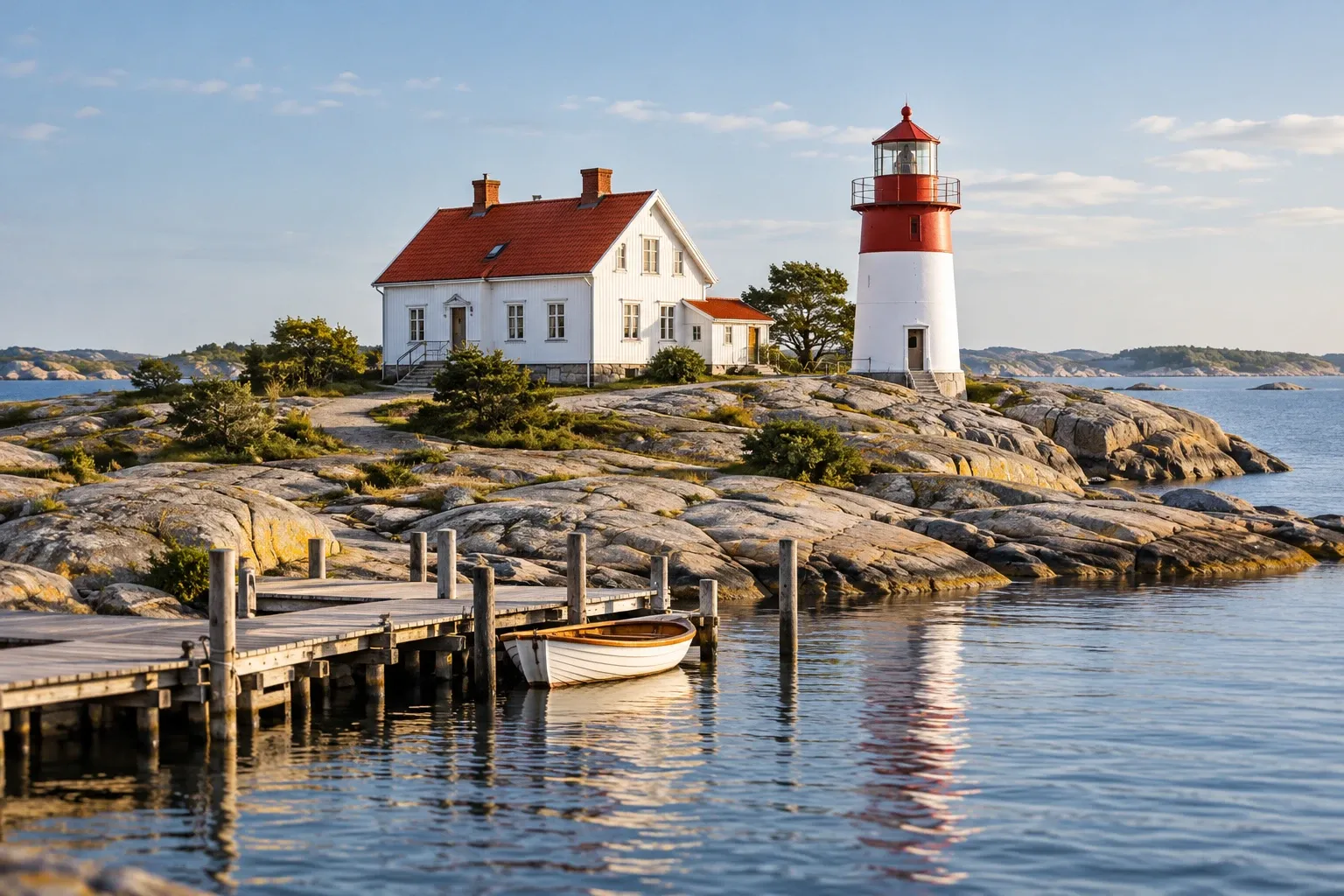
You can sleep at a Swedish lighthouse, but rarely in the tower and rarely like a hotel. It helps to know who runs the place, how the boat works and which island rules apply before you book.
When you need this
You saw a photo of a red-and-white tower on a bare rock and want to know if you can stay the night. Or you’re planning a coast or archipelago trip and want one night far out at sea. You might also be travelling with a dog, a child or a mobility need, and wondering what an island lighthouse means in practice. And if the wind is rising on the day you’re due to go out, you’ll want to know who decides whether the boat sails.
Who runs Sweden’s lighthouse stays
Sweden’s lighthouses were automated during the 20th century. Landsort’s has been unstaffed since 1963, Vinga’s since 1975 and Kullen’s since 1978. The keepers’ and pilots’ houses they left behind are now some of the country’s most remote beds. The Swedish Lighthouse Society (Svenska Fyrsällskapet), a non-profit association, counts around thirty lighthouse sites and former pilot stations that take overnight guests. It lists them on its website but books none of them.
Who you deal with depends on who owns the site:
| Route | Owner | Who runs the stay | How you book |
|---|---|---|---|
| Operator-run stay | Often the National Property Board, Statens fastighetsverk (SFV), or a local body | A tenant, a local association or STF, the Swedish Tourist Association | Directly with the operator, often with the boat as an add-on |
| Member scheme | Sjöfartsverket, the Swedish Maritime Administration | Sjöfartsverket itself | Lighthouse Society members of two years: email or lottery |
| Day visit only | Either agency | Nobody: no beds | Not bookable; many sites have tours or exhibitions |
Sjöfartsverket is responsible for about 1,100 lighthouses. Of its 260 properties, 38 sites are listed state monuments. SFV looks after about 1,700 state-owned islands (kronoholmar) and leases former lighthouse and pilot sites to the people who run hostels, cabins and conference stays there. Ownership is sometimes split. On Närsholmen on Gotland, SFV manages the buildings, Sjöfartsverket the lighthouse and the Swedish EPA the land.
The member scheme almost nobody mentions
Travel lists show Swedish lighthouse houses as if anyone could book them like a holiday cottage. Sjöfartsverket’s own keeper houses don’t work that way. Only the agency’s staff, contractors and pensioners can apply, plus members of the Swedish Lighthouse Society who have belonged for at least two years. You must stay there yourself, and you can’t pass the booking on to anyone else.
For 2027 the sites are Kullen, Sandhammaren, Hoburg, Vinga, Hållö, Hjortens udde on Lake Vänern, and Fårö. Several have restrictions: Vinga opens on 1 February, Hållö on 30 April, Fårö is closed for repairs in spring and Hjortens udde is closed in April–May. Booking for 2027 opened on 1 September 2026.
How it works:
- Join the society at least two years before the trip. Foreign members are welcome.
- Low season (3 January to late May or early June, and 21 August to 3 January 2028) is booked by email with Sjöfartsverket’s leisure-housing committee, Fritidsnämnden. The autumn weeks are released on 1 April and the spring weeks on 1 September.
- High season in between is allocated by lottery. The society’s two pages disagree on when it starts, giving 29 May and 6 June. Check the 2027 form when it appears in winter.
- In the week of 29 May to 6 June you can rent by the night rather than by the week.
- Pay three weeks before arrival. Changes and cancellations cost a fee.
The houses are modern. You only bring sheets, towels, toilet paper and cleaning products. Pets are welcome, dogs must be leashed and smoking indoors isn’t allowed.
The boat is the real booking
Most lighthouse beds are on islands, and on the outer islands the weather decides when you arrive and leave. SFV says sea conditions at Väderöbod often make landing impossible. On the boat to Stora Fjäderägg, nearly 20 km out in the Gulf of Bothnia, the operator says plainly that the skipper always decides when it sails. Gotska Sandön has no harbor at all, so getting on and off the boat is awkward.
Three habits avoid most trouble:
- Book the transfer with the bed. At several island hostels the water taxi (taxibåt) is an add-on to the room booking, and it’s the boat booking that actually gets you there.
- Keep a buffer day before any flight or train home.
- Agree times before you go. Mobile coverage can be weak: Stora Karlsö’s warden says calls may fail but texts get through.
The forecast that matters is in our guide to SMHI weather warnings. For the boats themselves, see water taxis in the Stockholm archipelago and west coast island ferries.
What a keeper’s house is like
“Lighthouse stay” covers everything from a bare hut to a comfortable B&B, and the range catches people out. You almost always sleep in the old keeper’s house (fyrvaktarbostad) or pilot’s house, not in the tower.
| What you might find | Example from the operator’s own page |
|---|---|
| No running water, no internet, outdoor toilet, wash in the sea | The keeper houses at Bergudden on Holmön |
| Self-catering kitchen; bring your own sheets if you want them | The Högbonden lighthouse hostel in the High Coast World Heritage area |
| Cabins with their own kitchens, toilets and showers | The lighthouse village (Fyrbyn) on Gotska Sandön |
| Modern flats where you bring only linen and cleaning products | Sjöfartsverket’s member dwellings |
On many islands there’s no shop or café, so you bring all your food from the mainland. Pack for one more day than you plan to stay. Självhushåll (self-catering) and utedass (outhouse) are the two words to look for in a listing. Our guide to STF hostels explains how the sheets and kitchens work across that network.
Accessibility is the weak point. Most island sites mean a boat, bare rock and uneven paths. The Högbonden hostel calls itself partly accessible and asks guests to call before booking. Mainland headland lighthouses reached by road are the realistic choice for anyone who can’t manage the landing.
Island rules that bind guests
Many lighthouse islands are nature reserves or bird sanctuaries, and their regulations are law for overnight guests too.
| Island | Rule |
|---|---|
| Stora Karlsö (Gotland) | Landing 15 March–31 August only with permission, and only at Norderhamn; parts closed 15 March–15 August; no dogs, cats or other pets ashore |
| Väderöbod (Bohuslän) | Bird sanctuary: no landing 1 April–31 July |
| Närsholmen (Gotland) | Parts of the reserve closed 15 March–15 July |
| Gotska Sandön (national park) | Tents only in the marked areas |
| Stora Fjäderägg (Kvarken) | Nature reserve: dogs on a leash |
Your accommodation allowing dogs doesn’t mean the island does. Check both before you bring a pet. Our guides to landing rules on islands and skerries and dog-friendly stays go further.
Lighthouse stays by coast
The Lighthouse Society’s list runs the full length of the coast. Use it as a map, then confirm each place is still open, because the list may lag behind changes.
| Coast | Sites with beds (examples from the society’s list) | Typical access |
|---|---|---|
| Bohuslän and Gothenburg | Pater Noster, Hållö, Vinga | Boat |
| Halland | Nidingen, Hallands Väderö | Boat |
| Skåne | Kullen, Sandhammaren, Smygehuk | Road |
| Blekinge | Utklippan | Boat |
| Gotland | Hoburg, Fårö, När, Stora Karlsö, Gotska Sandön | Road on Gotland; boat to the outer islands |
| East coast and Stockholm | Häradskär, Landsort, Huvudskär, Söderarm, Örskär | Boat |
| Gävleborg and High Coast | Storjungfrun, Rönnskär, Högbonden | Boat |
| Kvarken and Norrbotten | Bergudden, Stora Fjäderägg, Malören, Pite-Rönnskär | Ferry plus a walk or taxi boat |
A few places are worth knowing about. Vinga, west of Gothenburg, is a nature reserve that still has an active pilot service. Landsort, officially the island of Öja, has about 30 people living there year-round, a hostel, a bird station and a guest harbor. Nidingen is the only place in Sweden where the kittiwake breeds, so bring binoculars. In the far north, stays tend to be the simplest and the furthest out. For the regions themselves, see the Stockholm archipelago, Bohuslän’s west coast and the High Coast Trail.
Booking and cancelling
Swedish law gives no right of withdrawal for accommodation booked for a specific date or period, so you’re bound by whatever terms you accepted. That matters more than usual here, because weather can cancel the boat. Before you pay, check what the operator does if the transfer can’t sail: whether it moves your dates, refunds you or keeps the money.
Practical information
| Item | Detail |
|---|---|
| Sites taking overnight guests | Around 30 lighthouse and former pilot stations |
| Typical island season | Roughly late spring to early autumn, when the boats run |
| Lighthouse Society membership (individual) | 200 SEK/year in Sweden, 300 SEK/year abroad (fees labelled 2025; checked 2026-10-15) |
| Sjöfartsverket keeper house, 2027 low season | About 2,700–6,000 SEK per week or 390–860 SEK per night per dwelling (checked 2026-10-15) |
| Member scheme eligibility | Two years’ membership; high season by lottery |
| Operator-run hostels and B&Bs | Prices set by each operator, boat often extra; we don’t publish them |
| Cancellation | No statutory withdrawal right for dated stays |
| What to bring | Food plus a spare day, sheets and towels unless included, warm and waterproof layers, a power bank |
FAQ
Can you stay overnight in a lighthouse in Sweden?
Yes. The Swedish Lighthouse Society counts around thirty lighthouse sites and former pilot stations along the coast that take overnight guests. You almost always sleep in the old keeper’s or pilot’s house, not in the tower itself. Standards range from simple self-catering hostels to comfortable B&Bs, and most island sites open only in the boating season.
How do I rent a lighthouse keeper’s house from Sjöfartsverket?
Join the Swedish Lighthouse Society and wait: only members of at least two years, plus the agency’s own staff, may apply. Low-season weeks are booked by email with Sjöfartsverket’s leisure-housing committee; high-season weeks are allocated by lottery. You must stay there yourself, pay three weeks before arrival and bring your own sheets and towels.
What is a pilot station stay?
A pilot station (lotsstation) housed the pilots who guided ships through dangerous waters, often next to a lighthouse. Most closed as navigation improved — Häradskär’s closed in 1968 after about 270 years. Their buildings are now hostels, cabins or conference houses, typically on outer-archipelago islands reached by boat. Vinga still has an active pilot service.
Can I bring my dog to a lighthouse stay?
Sometimes. Sjöfartsverket’s member dwellings accept pets, with dogs on a leash, and Stora Fjäderägg allows leashed dogs because the island is a nature reserve. But some reserves ban pets ashore entirely — on Stora Karlsö you may not land a dog, cat or other pet. Check both the accommodation and the island’s reserve rules.
What happens if the boat cannot sail because of the weather?
The skipper decides. Island operators adjust departures to the weather and contact guests when times change, and on exposed islands such as Väderöbod landing is often impossible in heavy seas. Plan a buffer day before onward flights or trains, and read the operator’s terms on refunds — Swedish law gives no automatic right to cancel a dated stay.
Are lighthouse stays in Sweden suitable for people with limited mobility?
Rarely fully. Most island sites mean boarding a boat, landing on rock and walking uneven paths; Gotska Sandön has no harbor at all. A few places, such as the Högbonden lighthouse hostel, describe themselves as partly accessible and ask you to call before booking. Mainland headland lighthouses reached by road are the realistic option.
Related guides
- Treehotel and Sweden’s most unusual places to stay — the other types of unusual stay, from treehouses to the ice hotel
- Hostels in Sweden and the STF network — how sheets, kitchens and member discounts work at many lighthouse hostels
- Landing rules on Swedish islands and skerries — sanctuaries and closed seasons in detail
- SMHI weather warnings — the forecast that decides whether your boat sails
- Dog-friendly stays in Sweden — before you bring a dog to an island
Facts verified 2026-10-15. Sources: Sjöfartsverket, Statens fastighetsverk, Länsstyrelsen Gotland, Naturvårdsverket (Sweden’s national parks), Sveriges riksdag, Svenska Fyrsällskapet and STF — full register in this topic’s source file. Found something outdated? Tell us and we’ll fix it.