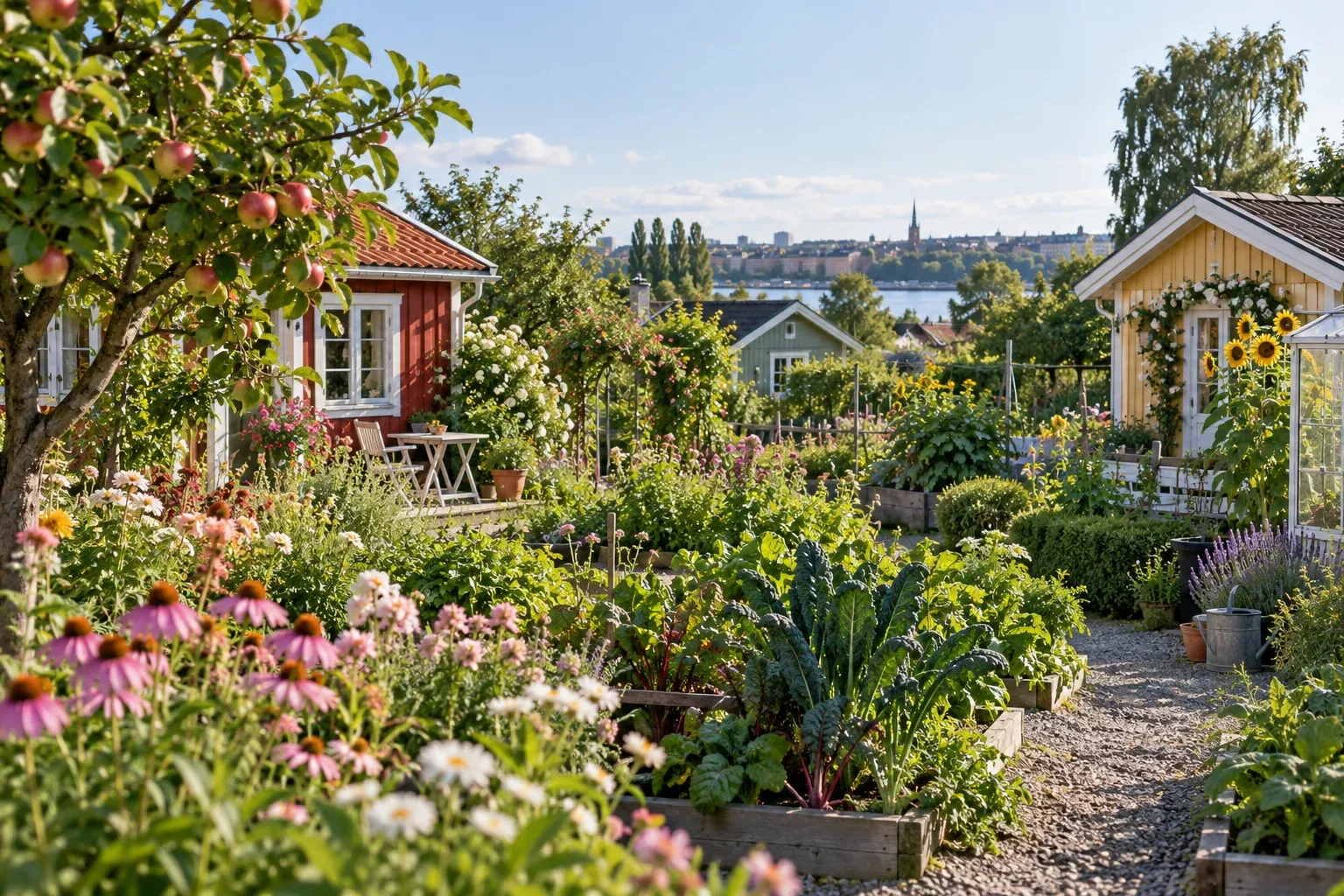
Those rows of doll-sized painted cottages you see from the train are allotment gardens, a Swedish institution since 1895. Here’s what they are, whether you can walk in, where to see the best ones, and why locals wait a decade for one.
When you need this
Maybe you’ve spotted rows of tiny garden cottages from a commuter train or a park and wondered what they are. Maybe you want a free, quiet summer walk in Stockholm or Malmö, but aren’t sure you’re allowed past the gate. Or you’re moving to Sweden and dream of your own kolonistuga (allotment cottage), or someone has offered you one to rent for a weekend.
What a kolonilott is
A koloniträdgård (allotment garden, literally “colony garden”) is an area of small garden plots, and each plot is a kolonilott. The model is almost the same everywhere: the municipality leases the land to a local association, the association allots plots to its members, and the members own whatever cottage stands on their plot. There is no national allotment law. The binding rules are the municipal lease, the local plan and the association’s bylaws.
There are two kinds of plot:
| Odlingslott (cultivation plot) | Stuglott (cottage plot) | |
|---|---|---|
| What’s on it | Beds only, no cottage | Garden plus a small cottage |
| Typical size | 20–200 m² (Malmö) | About 200–300 m² (Malmö’s classic colonies) |
| Cottage size | None | Often 14–20 m²: e.g. 14 m² plus a 6 m² veranda and 3 m² shed at Eriksdalslunden, Stockholm; up to 20 m² in Malmö’s neighborhood colonies |
| Who owns what | Plot leased | Plot leased, cottage owned by the member |
| Living there | No | Not permanently; Malmö bans it |
Most cottages are garden huts, not summer houses. Many have water only in the growing season (in Malmö, from April to October), and changes to a cottage usually need the association board’s written approval, plus a building permit from the city where required.
Today the national federation, Koloniträdgårdsförbundet (founded 1921), has 236 member associations with about 24,400 kolonister (allotment holders), from Boden in the far north to Ystad in the south.
A short history: from workers’ gardens to waiting lists
The movement reached Sweden from Denmark and Germany at the end of the 19th century. Sweden’s first allotment association was Pildammskolonin in Malmö, founded in 1895. It no longer exists, so the oldest areas still in use are Citadellet in Landskrona (1904) and Söderbrunn in Stockholm (1905).
The goal was social. Factory workers lived in cramped, drafty city flats, and a plot gave them fresh air, a place for children to play and somewhere to grow food. In Stockholm the driving forces were Anna Lindhagen, a nurse and politician who came home inspired from Copenhagen in 1903, and the bank cashier Anna Åbergsson. Their association was formed in 1906. During both world wars, allotments supplied a significant share of city dwellers’ food.
| Year | Milestone |
|---|---|
| 1895 | Pildammskolonin, Malmö: Sweden’s first allotment association (since gone) |
| 1904 | Citadellet, Landskrona |
| 1905 | Söderbrunn, Stockholm |
| 1906 | Föreningen Koloniträdgårdar i Stockholm formed; Eriksdalslunden begins |
| 1918 | First issue of the magazine Koloniträdgården |
| 1921 | Koloniträdgårdsförbundet founded |
Can you walk through an allotment garden?
Usually, yes. Stockholm’s park policy says allotment areas should be generally accessible, with clear entrances and public paths running through them, and the city has judged almost all of its areas open to the public. Eriksdalslunden on Södermalm explicitly welcomes people to stroll around, even in autumn and winter. Malmö discourages tall hedges and fences along plot boundaries, so the areas stay open and visible.
But the plots themselves are private gardens. Allemansrätten, Sweden’s right of public access, does not cover gardens or cultivated land.
Warning: picking is taking. Every apple, berry and flower on a plot belongs to someone. Walk on the shared paths and lawns, keep off individual plots and verandas, and respect any locked gate or “private” sign. Not every area is open: Stockholm said “almost all”, not all.
Allotment holders are often happy to chat about their plants if you stay on the path and show interest. A simple hej goes a long way.
Where to see allotment gardens
You’ll find allotment areas in most Swedish cities. These are verified, visitor-friendly starting points:
| Place | Why go | Note |
|---|---|---|
| Eriksdalslunden, Södermalm, Stockholm | About 140 plots on the slope down to Årstaviken, one of Stockholm’s first areas | Strollers welcome year-round |
| Kolonimuseet (allotment museum), Eriksdalslunden | The area’s history since 1906 and the city’s old tobacco growing | Summer weekends; see Practical information |
| Söderbrunn, Stockholm | Dates from 1905, among the oldest still in use | Keep to the paths |
| Citadellet, Landskrona | From 1904, by the town’s citadel; one of Sweden’s oldest | Keep to the paths |
| Almåsa fritidsby, Malmö | Malmö’s largest colony area, over 600 plots | One of 16 colony areas in the city |
Tusen Trädgårdar (“A Thousand Gardens”) is the best day to visit. Riksförbundet Svensk Trädgård and partners have run this nationwide open-garden day every other year since 2010. On 28 June 2026, 1,002 gardens and allotment plots took part. Most were free to visit, though larger show gardens charge their usual entry. Eriksdalslunden alone counted about 350 visits.
The best time to walk through is July and August, when the beds are full and the dahlias are out. Go in the early evening for the soft light, when allotment holders are sitting out on their verandas. In spring the areas look bare; in winter there’s little to see beyond the cottages themselves.
Getting a plot: patience, not money (in Stockholm)
Visitors can’t get a kolonilott, and residents need patience. Stockholm’s system is unusual: you join a queue with each association, and cottages change hands at a price set by trained valuers, not to the highest bidder. The Stockholm region calls this nearly unique in Sweden. In most other municipalities cottages sell on the open market, so the biggest wallet wins.
How long is the wait? The Stockholm region’s autumn 2024 survey of its associations found:
| Measure (Stockholm associations, 2024) | Cultivation plots | Cottage plots |
|---|---|---|
| Queue entries vs plots | 3,250 for 3,873 | 9,040 for 3,364 |
| Average wait for those allotted a plot | About 5 years | About 10 years |
| Not strictly first-come, first-served | 32% of associations | 60% of associations |
People often queue with several associations, so the queue entries overstate the number of individuals. Districts differ a lot: in Hässelby-Vällingby a cultivation plot could be had in under a year, while Eriksdalslunden quotes 15–20 years for a cottage plot, often longer. There, a queue place is personal and can’t be inherited or handed to a friend.
Other regions work differently. In Skåne it’s far more common to lease a cultivation plot directly from the municipality, a year at a time, and Malmö runs its own city queue. Koloniträdgårdsförbundet doesn’t hand out plots; you contact each association. Whatever you get, keep it up: a neglected plot can be taken back under the lease rules.
Mistakes to avoid
- Staying out because it looks private. Most areas are meant to be walked through; just keep off the plots.
- Picking “just one” apple or flower. It’s someone’s garden, and allemansrätten doesn’t apply.
- Booking a “colony cabin” online. There’s no official rental market. Associations allot cottages, Stockholm sells them at a valued price, and Malmö bans permanent living. You may be staying somewhere the association never approved. For a real summer cabin, see renting a stuga.
- Calling Söderbrunn “Sweden’s first”. Malmö’s Pildammskolonin (1895) came first; Söderbrunn is among the oldest survivors.
- Expecting one national queue. Each association keeps its own list.
Practical information
| What | Detail |
|---|---|
| Walking through open allotment areas | Free; stay on the paths |
| Kolonimuseet, Eriksdalslunden | 2025 season: 31 May–28 September, Sat–Sun 13–16, free entry; planned reopening 29 May 2027, so check the association’s site |
| Tusen Trädgårdar | Every other year since 2010; last held 28 June 2026; most gardens free |
| Water season (Malmö) | April to October |
| Queue fee (Stockholm) | Charged by almost all cottage associations and about half of plot associations; amount varies |
| Cottage prices | Valued price in Stockholm, open market elsewhere; not listed here |
| Who to contact for a plot | The individual association (Stockholm, most cities) or Malmö stad’s queue |
FAQ
What is a kolonilott in Sweden?
A kolonilott is an allotment plot in a koloniträdgård, leased from the municipality through a local association. Some plots are just for growing, an odlingslott, while a stuglott also carries a small cottage that the member owns. The movement began in Malmö in 1895, and today Koloniträdgårdsförbundet has 236 associations with about 24,400 members across Sweden.
Can tourists walk through Swedish allotment gardens?
Usually, yes. Stockholm’s park policy says allotment areas should be generally accessible, with clear entrances and public paths running through them, and the city judged almost all of them open. Stay on the paths and common areas, keep off individual plots and verandas, and never pick anything: allemansrätten does not cover gardens. Respect any locked gate or sign.
How big is a kolonistuga?
Small. At Eriksdalslunden in central Stockholm the lease allows a 14 m² cottage, a 6 m² veranda and a 3 m² shed, in one storey. Malmö’s neighborhood colonies allow cottages up to 20 m². Sizes are set by each lease and local plan, so they vary, but most are garden huts rather than summer houses, often with water only in summer.
How long does it take to get a kolonilott in Stockholm?
Years. A 2024 survey of Stockholm’s associations found an average wait of about 10 years for a cottage plot and about 5 years for a cultivation plot, with large differences between districts. Eriksdalslunden on Södermalm quotes 15–20 years and often longer. Each association keeps its own queue, so people often join several.
Can you live or stay overnight in a kolonistuga?
Not as a home. Malmö states that kolonistugor may not be used for permanent living, although in its animal colonies the cottage can be lived in during summer. Many cottages lack winter water. There is no official rental market, so treat online “colony cabin” listings with caution and ask whether the association has approved them.
Where can I see allotment gardens as a visitor?
In Stockholm, Eriksdalslunden on Södermalm has a free summer-weekend museum, and Söderbrunn dates from 1905. Citadellet in Landskrona, from 1904, is among Sweden’s oldest. In even years, the Tusen Trädgårdar open-garden day in late June opens over a thousand gardens and plots, most of them free. Summer evenings are the best time.
Related guides
- Allemansrätten, Sweden’s right of public access: exactly where the right stops at gardens and crops
- Swedish club life and föreningar: the association model behind every allotment area
- Renting a stuga: the legitimate way to rent a Swedish summer cabin
- Södermalm: the Stockholm district with Eriksdalslunden
- Midsummer in Sweden: the June weekend when the allotments are in full bloom
Facts verified 2026-10-05. Sources: Koloniträdgårdsförbundet, Stockholms Koloniträdgårdar, Eriksdalslundens koloniträdgårdsförening, Malmö stad, Stockholms stad, Riksförbundet Svensk Trädgård and Naturvårdsverket. The full register is in this topic’s source file. Found something outdated? Tell us and we’ll fix it.