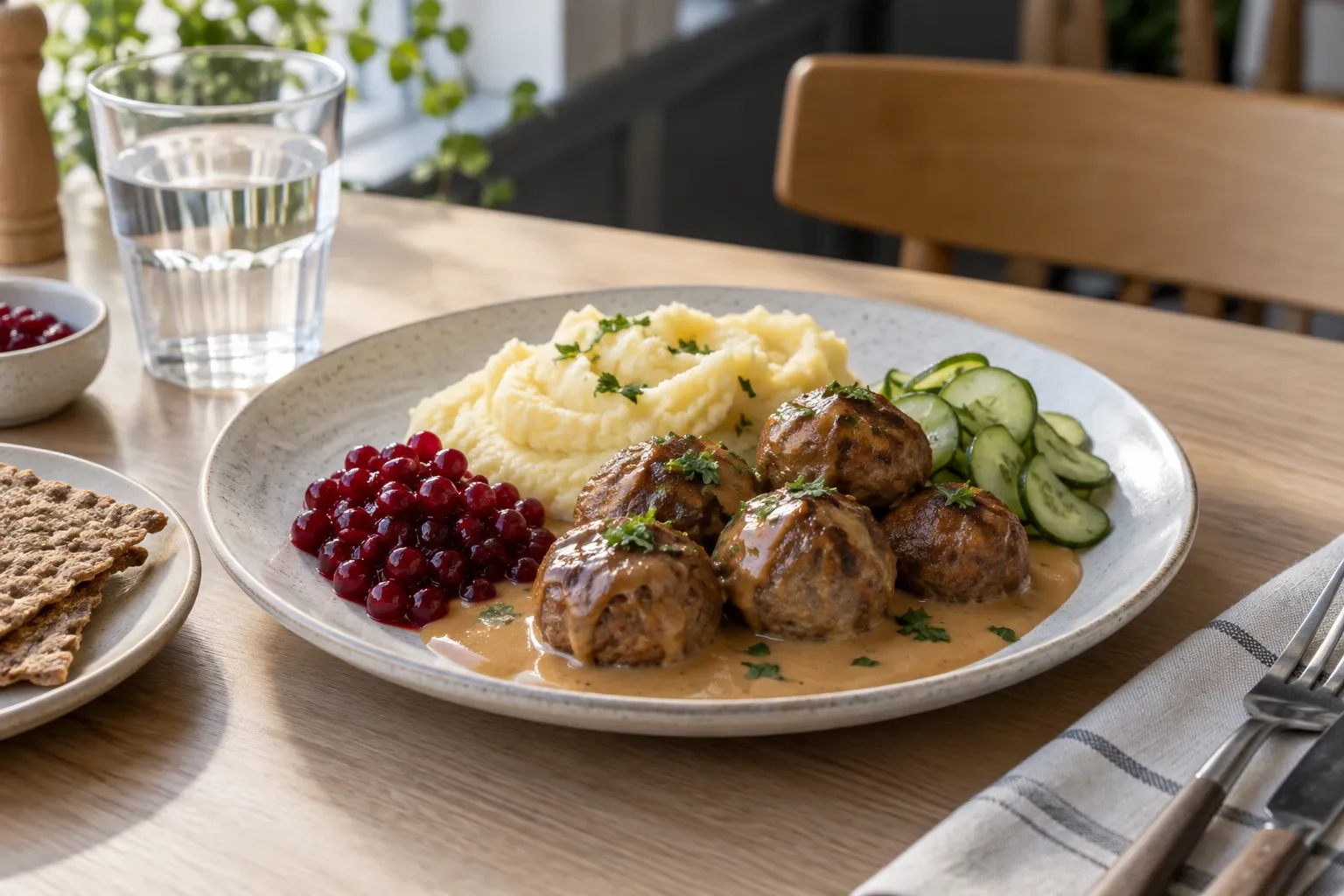
This is the food Swedes actually eat on a Tuesday. Here is what the word means, how to decode the dishes on a lunch board, where to find them, and the two health notes that apply to specific plates.
When you need this
You are standing outside a lunch restaurant reading a chalkboard of Swedish words. You want “real Swedish food” without paying dinner prices. You are in a rental kitchen looking at the supermarket freezer, or you have been invited to an ordinary dinner at a Swedish home. Or you are pregnant, or travelling with children, and see strömming or liver on a menu.
What makes a dish husmanskost
Husmanskost (roughly “smallholder’s fare”) means plain, filling, inexpensive everyday food. SLU’s meal historian defines it as dishes Swedes cook without a recipe, heavy on carbohydrates and sauce, and known across the whole country rather than invented by one family. He also offers a handy test: if a dish is sold as a microwave ready meal in the supermarket freezer, it is probably husmanskost.
The word is old. The Swedish Academy’s historical dictionary records it from 1638, borrowed from Low German. German readers already know it: it is the same word as Hausmannskost. A husman was a rural smallholder, and the term first described the simple food a farmer gave his maids and farmhands as part of their terms of employment.
The dishes you will meet are younger than the word:
| Layer | Examples | Where it came from |
|---|---|---|
| Oldest survivors | Pea soup, meat soup | Pot cooking over an open fire |
| 1700s middle-class kitchens | Kalops, dillkött (meat in dill sauce) | French and British models |
| Late 1800s steam kitchens and cafés | Lapskojs, pannbiff med lök | Eating out in growing cities |
| Cheap salted pork | Fried pork with onion sauce, brown beans or raggmunk | Imported pork for workers |
| Cans, freezers, school meals | Köttbullar, kalops, sjömansbiff, frozen kåldolmar | Ready food for over a century; school meals from the 1950s |
Since the 1990s the offal dishes, liver dishes and pölsa have been fading. Almost none of this is regulated. The one legal exception is a name: falukorv, the sausage behind several weekday dinners, is an EU-protected traditional speciality, so it may only be sold under that name if it follows the registered recipe.
The lunch-board decoder
These are the dishes you are most likely to see, with what usually comes on the plate.
| On the board | What it is | Usually served with |
|---|---|---|
| Köttbullar | Meatballs | Cream gravy, mashed or boiled potatoes, lingonberries, sometimes pressed cucumber |
| Ärtsoppa med fläsk | Yellow pea soup with pork | Pancakes afterwards, on Thursdays |
| Stekt strömming / stekt sill | Fried Baltic herring fillets in rye flour and breadcrumbs | Mashed potato, melted butter, lingonberries |
| Kåldolmar | Cabbage leaves rolled round a mince filling, oven-cooked | Skysås (meat-juice gravy), lingonberry jam, potatoes |
| Kålpudding | Mince and onion baked under caramelised cabbage | Cream sauce, boiled potatoes, lingonberries |
| Raggmunk | Crisp grated-potato pancake | Fried salted pork and lingonberries, always |
| Stekt fläsk med löksås | Thick slices of salted pork, fried crisp | Creamy onion sauce, boiled potatoes, lingonberries |
| Kalops | Slow-cooked beef stew with bay, onion and allspice | Boiled potatoes and pickled beetroot |
| Pyttipanna | Diced potato, onion and leftover meat or sausage, fried | A fried egg |
| Wallenbergare | Patty of ground veal, cream and egg yolks | Potatoes, lingonberry jam, peas, gravy |
| Biff Rydberg | A late-1800s prime-beef dish | A “finer” husmanskost: never servants’ food |
The sides are a vocabulary of their own. Potatismos is mashed potato and kokt potatis boiled. Gräddsås is cream gravy, inlagd gurka pickled cucumber and rödbetor beetroot. Rårörda lingon are lingonberries stirred raw with sugar. Don’t skip them as “jam with meat”: they are the sharp counterweight to the cream sauce.
Two myths worth dropping. Janssons frestelse, the potato and cream gratin, is made with pickled sprats, which Swedes call ansjovis, not anchovies. And kåldolmar did not demonstrably come home with Karl XII. The earliest Swedish dolma recipe is in Cajsa Warg’s cookbook of 1765, which suggests cabbage leaves instead of costly vine leaves. The king story is an unconfirmed theory, like the Karl XII meatball claim that Sweden’s official account retracted in 2018.
Regional dishes
Husmanskost is mostly national. The exceptions are the dumplings and the grain sausages.
- Norrland: palt (called kams in southern Norrland) are boiled barley-and-wheat dumplings, sometimes with blood or liver, served with butter and lingonberry jam.
- Småland, Blekinge, Öland and Gotland: kroppkakor are tennis-ball-sized potato dumplings filled with pork and onion, served with melted butter and lingonberries. The Småland and Öland versions use their potatoes differently.
- Grain sausages: grynkorv and isterband are regional too.
- Skåne: add carrots to the pot and kalops becomes skånsk kalops.
- North and south: Baltic herring is sill south of Kalmar and strömming north of it, so the same plate is stekt sill or stekt strömming.
Where to eat it
Weekday lunch is where husmanskost lives. SLU’s historian calls the lunch restaurants the keepers of the older repertoire, and dinner menus rarely carry it. A dagens lunch board offers two or three daily dishes, usually one meat and one fish. Bread, salad, a drink and coffee are normally included in the fixed price. Lunch is eaten roughly between 11:00 and 13:00, and many places serve until 14:00 or 15:00. Our guide to dagens lunch explains how to order.
Thursday is pea-soup day. Many lunch restaurants serve ärtsoppa with pork followed by pancakes, a custom on Sweden’s intangible-heritage list. See pea soup and pancakes on Thursdays.
Supermarkets sell most classics as frozen ready meals, the same test SLU uses for what counts as husmanskost. If you are cooking yourself, using a Swedish kitchen in your rental and Swedish supermarkets explained cover the practical side.
Expect a plate of meat or fish, potatoes, sauce and lingonberries. The vegetables come from the lunch salad buffet, not the plate.
Health notes
Two dishes carry official advice from Livsmedelsverket, the Swedish Food Agency.
- Stekt strömming is Baltic herring. Because of dioxins and PCBs, children, young people and anyone pregnant, breastfeeding or planning pregnancy should eat it at most 2–3 times a year. Other adults can eat it once a week.
- Liver in pregnancy. Do not eat liver or liver dishes, whether beef, pork, chicken or goose, because of the vitamin A. Spreadable or sliced liver pâté is fine, but pre-sliced pâté packed more than a week ago can carry listeria.
Allergies need a question, not a guess. Cream, butter and wheat flour are the default in sauces, mash and breadcrumbs. Swedish rules let a restaurant give allergen information orally, and staff must be able to tell you what a dish contains. Our guide to food allergies in Sweden has the phrases.
Two days on the calendar
| Date | Day | Note |
|---|---|---|
| 26 February | Husmanskostens dag | First held in 2025, so a new custom, not an old one |
| 30 November | Kåldolmens dag (cabbage roll day) | Kept since 2010 on the date of Karl XII’s death |
In winter, heavy cabbage dishes such as kålpudding come into their own. In December, meatballs, Janssons frestelse and herring move onto the Christmas buffet, where they follow festive rules rather than everyday ones.
Practical information
| Item | Detail |
|---|---|
| Best time to eat husmanskost out | Weekday lunch, roughly 11:00–14:00 |
| Thursday special | Pea soup with pork, then pancakes |
| VAT on a meal eaten in | 12% |
| VAT on the same meal taken away | 6%, from 1 April 2026 to 31 December 2027 |
| Lunch price | Fixed per restaurant, extras usually included; see our dagens lunch guide |
| Baltic herring (strömming) limit | 2–3 times a year for children, young people and anyone pregnant, breastfeeding or planning pregnancy |
| Liver in pregnancy | Avoid liver and liver dishes; liver pâté is fine |
FAQ
What is husmanskost?
Husmanskost is Swedish everyday home cooking: filling, inexpensive dishes that Swedes make without a recipe, such as meatballs, pea soup, fried herring with mash and cabbage rolls. The word dates from the 1600s and shares its root with German Hausmannskost. It first meant the plain food a farmer gave his maids and farmhands.
Where can I eat husmanskost in Sweden?
At a weekday lunch restaurant, which is where the older repertoire survives. Look for the dagens lunch board, roughly 11:00 to 14:00; bread, salad, a drink and coffee are usually included. Dinner menus rarely carry it. On Thursdays many places serve pea soup and pancakes. Supermarket freezers sell most classics as ready meals.
What are the most typical husmanskost dishes?
Meatballs with cream gravy and lingonberries, yellow pea soup with pork, fried Baltic herring with mashed potato, cabbage rolls, potato pancakes with fried pork, kalops beef stew, fried pork with onion sauce and pyttipanna hash with a fried egg. Most come with potatoes and lingonberries or pickled beetroot.
Is husmanskost safe to eat when pregnant or for children?
Mostly yes, with two exceptions from Livsmedelsverket. Fried strömming is Baltic herring, which children, young people and anyone pregnant, breastfeeding or planning pregnancy should eat at most 2–3 times a year. Pregnant women should not eat liver or liver dishes; liver pâté is fine. Ask about cream and wheat flour if allergies apply.
Is Janssons frestelse made with anchovies?
No. It is a gratin of potatoes, onion, breadcrumbs, lots of cream and pickled sprats. The mix-up comes from the Swedish word for those sprats, ansjovis, which looks like anchovies on an English shopping list. The dish is a classic of the Christmas buffet and often features at Easter too, so it is rarer on everyday lunch boards.
Did Karl XII bring cabbage rolls to Sweden?
That is an unconfirmed theory. The first Swedish dolma recipe appears in Cajsa Warg’s cookbook of 1765, which suggests replacing costly vine leaves with cabbage leaves. Kåldolmens dag on 30 November, the date of Karl XII’s death, nods to the story. A similar Karl XII origin claim for meatballs was publicly retracted in 2018.
Related guides
- Dagens lunch — how the weekday lunch deal works, and where husmanskost is served.
- Swedish meatballs — the best-known dish in depth, including the Karl XII myth.
- Pea soup and pancakes on Thursdays — the weekly tradition and what goes with it.
- Pickled herring explained — the cold, festive sibling of fried strömming.
- Swedish food: the complete visitor’s guide — the festive calendar and protected food names.
Facts verified 2026-10-15. Sources: SLU Future Food, Svenska Akademien (SAOB), Livsmedelsverket, Skatteverket, Jordbruksverket (Smaka Sverige), Levande kulturarv, Helsingborgs stad, Visit Sweden — full register in this topic’s source file. Found something outdated? Tell us and we’ll fix it.