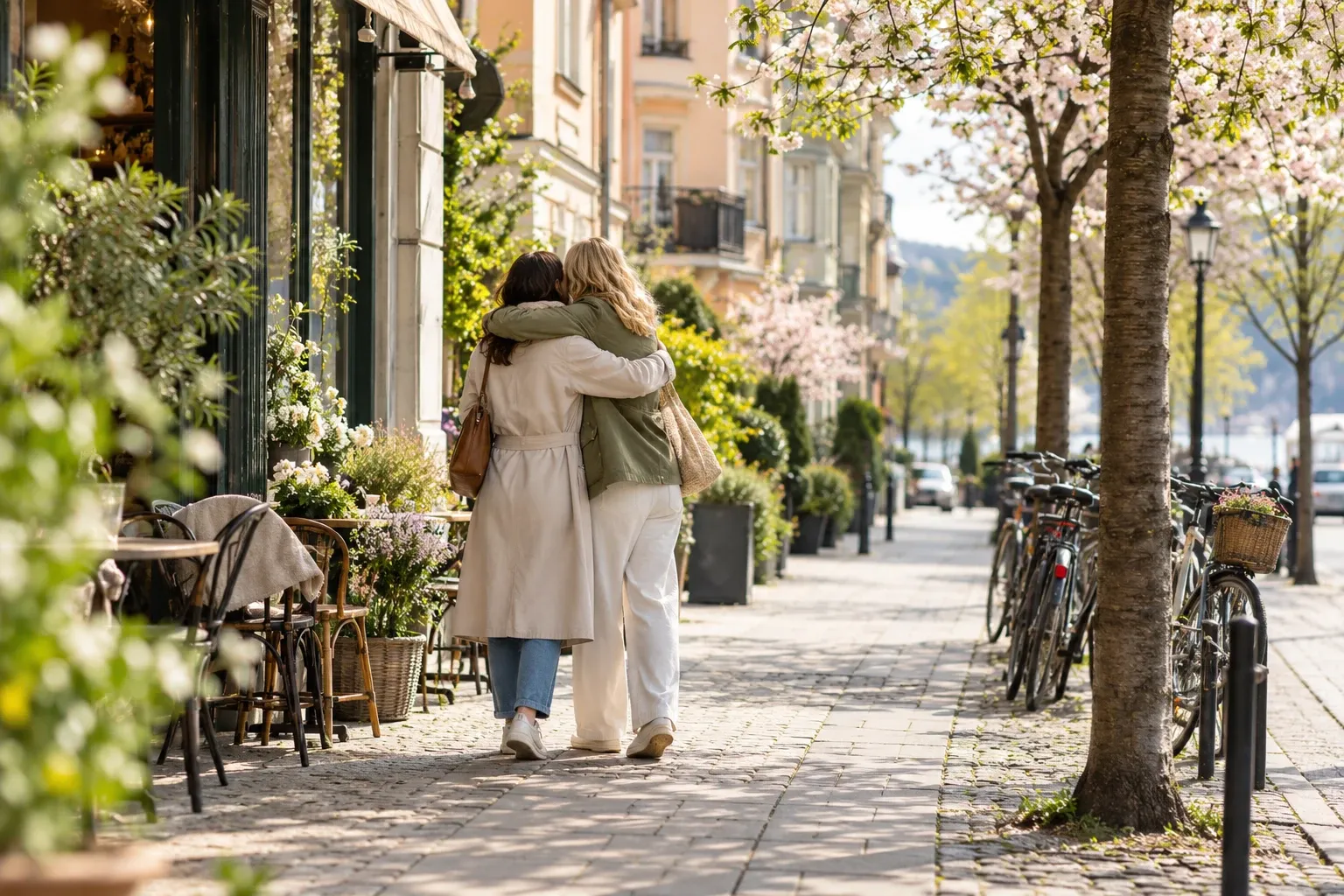
Sweden has two greeting modes. Strangers and colleagues get a handshake. Friends usually get a hug, or simply a hej with no touching at all. Here is how to tell which moment you’re in, what the words mean, and where the law comes in.
When you need this
You’re meeting a Swedish colleague, landlord or host family for the first time and want to get the opening right. A friend of a friend opens their arms while you’re holding out a hand. You walk into a party and wonder whether to greet the whole room. A text ends with kram. Or someone you met last week says tack för senast, and you have no idea what you’re being thanked for.
The short version
| Situation | Usual greeting | Words |
|---|---|---|
| First meeting, any setting | Handshake, eye contact, first name | Hej, I’m Anna |
| Work, business meeting | Handshake | Hej + first name |
| Party or dinner, people you don’t know | Handshake with each new person | First name |
| Friends and family | Hug, or a spoken hej | Hej, hejsan, tjena |
| Second meeting with someone friendly | Often a hug, if they start it | Hej |
| Unsure | Pause and let them lead | Hej |
The rule of thumb from the Swedish Institute’s student site is short. Hug friends and relatives. Shake hands with someone you’re meeting for the first time or aren’t close to. If you’re unsure whether it’s a hug, a handshake or a kiss, “wait for the cue” and let the other person go first. An international student’s guide on Uppsala University’s blog adds that a hug is usually fine from the second meeting, or once you know each other.
The handshake myth
Many culture guides say the most common greeting in Sweden is a firm handshake. For a first meeting that’s right. Swedish sociologists describe the handshake as “a rather formal form of greeting, to be used particularly in new introductions”. Among friends, though, the data says otherwise.
In 2017, three sociologists published the only peer-reviewed study of how Swedes greet. Statistics Sweden had interviewed 2,244 23-year-olds in the winter of 2013. Each was asked how they greet their closest friends “in town or on the street”. The answers, ranked:
- A hug
- A spoken hej without touching
- A handshake
- A kiss on the cheek, the least common
The study was written after a political row in 2016. A politician had declined to shake a female reporter’s hand, and was widely accused of breaking a “Swedish norm”. The authors’ dry conclusion: in Sweden we do not shake hands, “at least not in the friendship circles of young adults”. Young adults with two Swedish-born parents were in fact strongly under-represented among handshakers.
Keep the limits in mind. The sample was 23-year-olds, the question was about friends, and the fieldwork is now more than a decade old. Older Swedes, and greetings between strangers, were not measured. No newer Swedish survey has been published.
Men, women and who hugs whom
The sharpest differences in the study ran along gender lines:
- Handshakes between friends happened almost only between two men.
- Men greeting women preferred a hug to a handshake.
- Women preferred hugs, whether greeting men or women.
- Cheek kisses were uncommon and occurred almost only when a woman was involved.
Family background mattered too. Young adults with a parent born in Iran were the most likely to hug and kiss cheeks. Those with a parent from the former Yugoslavia were over-represented among handshakers. Those with two Swedish-born parents leaned towards a plain hej. In a Swedish city you’ll meet all of these habits, often in one room.
Swedes who have lived abroad may surprise you as well. The Swedish Institute’s student site tells of a newcomer who held out a hand to a Swedish colleague and got kisses on the cheeks instead.
North and south
Geography shows up in the data. In Norrland, the northern half of Sweden, and in rural areas, the favourite greeting between friends was hej with no touching. Hugs dominated in the cities of the south. The urban south also had the most handshakes and cheek kisses.
So if a friendly Norrlander greets you with just a hej instead of a hug, it’s the local default, not coolness.
The words
Svensk ordbok, the Swedish Academy’s dictionary, defines hej as an informal word for both hello and goodbye. You can’t get it wrong.
| Swedish | Register | Use |
|---|---|---|
| hej | Informal, all-purpose | Hello and goodbye, anywhere |
| hej då | Informal | Goodbye |
| hejsan | Informal | A friendly hello |
| tjena, tja | Colloquial | Between friends |
| god dag | Relatively formal, daytime | Formal settings, older speakers |
| morsning | Somewhat old-fashioned | Heard now and then |
| hallå | Attention-getting | “Hey, you!”, or answering the phone |
Use first names with everyone. Swedes say du, the informal “you”, to doctors, professors and advisers, and titles are dropped. The exceptions are a courtroom, a government minister and the royal family. Our guide to the du reform and first names explains how that happened.
Two more phrases trip visitors up:
- Tack för senast means “thanks for last time”. It’s said the next time you meet someone whose hospitality you enjoyed. Answer tack själv (“thank you, too”) or just smile.
- Kram means “hug”. Friends and family end texts, emails and cards with kram, kram på dig or puss och kram (“kiss and hug”). The dictionary lists it as part of a farewell in letters.
Not a hugger? Or your faith rules out touch?
A warm hej and a smile is never wrong. In the north it’s the most common greeting between friends anyway. If someone opens their arms and you’d rather not, offering a hand works too. The Swedish Institute’s student site notes that Swedes generally respect cultures and religions where hugging or handshaking is not permitted.
There’s one legal edge, and it concerns work. In August 2018 the Labour Court (Arbetsdomstolen) ruled on a job interview at an interpreting company. The interview ended because the applicant, citing her religion, would not shake a male manager’s hand. She greeted men with a hand on her heart instead. The court found this was indirect discrimination under the Discrimination Act and awarded her 40,000 kr in compensation.
| Point in the judgment | What it means for you |
|---|---|
| Ending the recruitment over the handshake was indirect discrimination | An employer can’t simply reject you for a religious refusal to shake hands |
| It would have been reasonable to require greeting everyone the same way | Greeting men and women differently is the part an employer may question |
| A hand-on-heart greeting was not, with its background known, demeaning | An alternative greeting is acceptable |
| Two of five members dissented | The ruling settles that case, not every future one |
The practical takeaway: if you don’t shake hands, greet everyone the same way, for example with a hand on the heart or a hej.
Church services: the peace greeting
If you attend a Church of Sweden service, the priest will at one point say Herrens frid vare med er (“the Lord’s peace be with you”). The congregation then turns to its neighbours and says Herrens frid. This fridshälsning (peace greeting) grew up spontaneously from the late 1960s. Before the pandemic it was usually a handshake; during the pandemic, eye contact took its place.
A short history
The hug is newer than it looks. Ethnologist Jonas Frykman has described Swedish greeting from the 1800s to the Second World War as a stiff ritual: girls learned to curtsy and boys to bow. In his account, the 1970s and 1980s were the great decades of informalisation, bringing the du reform, dropped titles and “the arrival of the hug”.
The pandemic briefly reversed it. In 2020 SVT reported that hugs and handshakes had dropped in Sweden. Catrin Norrby, a professor of Nordic languages, compared habits like these with the slow du reform: lifelong habits are hard to break. No survey since has measured whether the hug fully came back.
Practical information
| Item | Detail |
|---|---|
| Greeting in any form | Free; no rule, no fee |
| First meeting or work | Handshake, eye contact, first name |
| Friends and family | Hug or hej; cheek kisses rare |
| Most common greeting among friends (2013 data, 23-year-olds) | Hug, then hej, then handshake, then cheek kiss |
| Legal protection | Discrimination Act 2008:567; Labour Court judgment AD 2018 nr 51 |
| Compensation in the 2018 handshake case | 40,000 kr plus interest (case-specific) |
FAQ
Do Swedes hug or shake hands?
Both, depending on the relationship. A handshake with eye contact is the standard for first meetings, work and formal settings. Among friends and family, hugs are more common: in a study of 2,244 young adults, the hug was the most common way to greet a friend, followed by a simple spoken hej, with the handshake third. When unsure, let the other person lead.
Is it rude not to hug in Sweden?
No. Plenty of Swedes greet friends with just a hej, especially in the north and the countryside, and nobody expects a visitor to hug. If someone opens their arms and you would rather not, a warm hej, a smile or an offered hand is fine. Swedes generally respect people whose culture or religion rules out hugging or handshakes.
Do Swedes kiss on the cheek?
Rarely. In the only Swedish study of greeting habits, the cheek kiss came last of four greetings among friends and occurred almost only when a woman was involved. Some Swedes who have lived abroad use it, and it was more common among young adults with an Iranian family background. Do not start with one; follow the other person’s lead.
How do you greet someone at a business meeting in Sweden?
With a handshake, eye contact and your first name. Swedes treat the handshake as the formal greeting for new introductions, and use first names and the informal du with almost everyone, doctors and professors included. Titles are dropped. Hugs at work come later, if at all, and usually from the Swede’s side.
Can I refuse to shake hands in Sweden for religious reasons?
Yes. In 2018 the Swedish Labour Court found that ending a job interview because a woman, citing her religion, would not shake a male manager’s hand was indirect discrimination, and awarded her 40,000 kr. The court added that an employer could reasonably require greeting everyone the same way, for example with a hand on the heart, regardless of gender.
What does hej mean, and how do you say goodbye?
Hej is the all-purpose informal greeting, and the dictionary defines it as a word for both hello and goodbye. Hej då is the dedicated goodbye; hejsan is another informal hello, and tjena or tja are colloquial. God dag is relatively formal and heard less often. If you learn one word, learn hej.
What does kram mean at the end of a message?
Kram means “hug”. Swedish friends and family end texts, emails and cards with kram, kram på dig or puss och kram (“kiss and hug”), and the dictionary lists it as part of a farewell in letters. It is an everyday sign of warmth between people who know each other well, so you will rarely see it from someone you have only just met.
Related guides
- Swedish etiquette: 20 unwritten rules — the wider map: punctuality, shoes off, queue tickets.
- The du reform and first names — why your doctor expects you to use her first name.
- Basic Swedish phrases — hej, tack and ursäkta, with pronunciation.
- Dinner at a Swedish home — arrival, the welcome toast and tack för senast.
- Personal space and small talk — why strangers don’t chat, and why it isn’t coldness.
Facts verified 2026-10-15. Sources: Sociologisk Forskning (Andersson, Edling & Rydgren 2017), Arbetsdomstolen, Sveriges Riksdag (Diskrimineringslag 2008:567), Svenska institutet, Svenska Akademien (Svensk ordbok), Svenska kyrkan, SVT — full register in this topic’s source file. Found something outdated? Tell us and we’ll fix it.