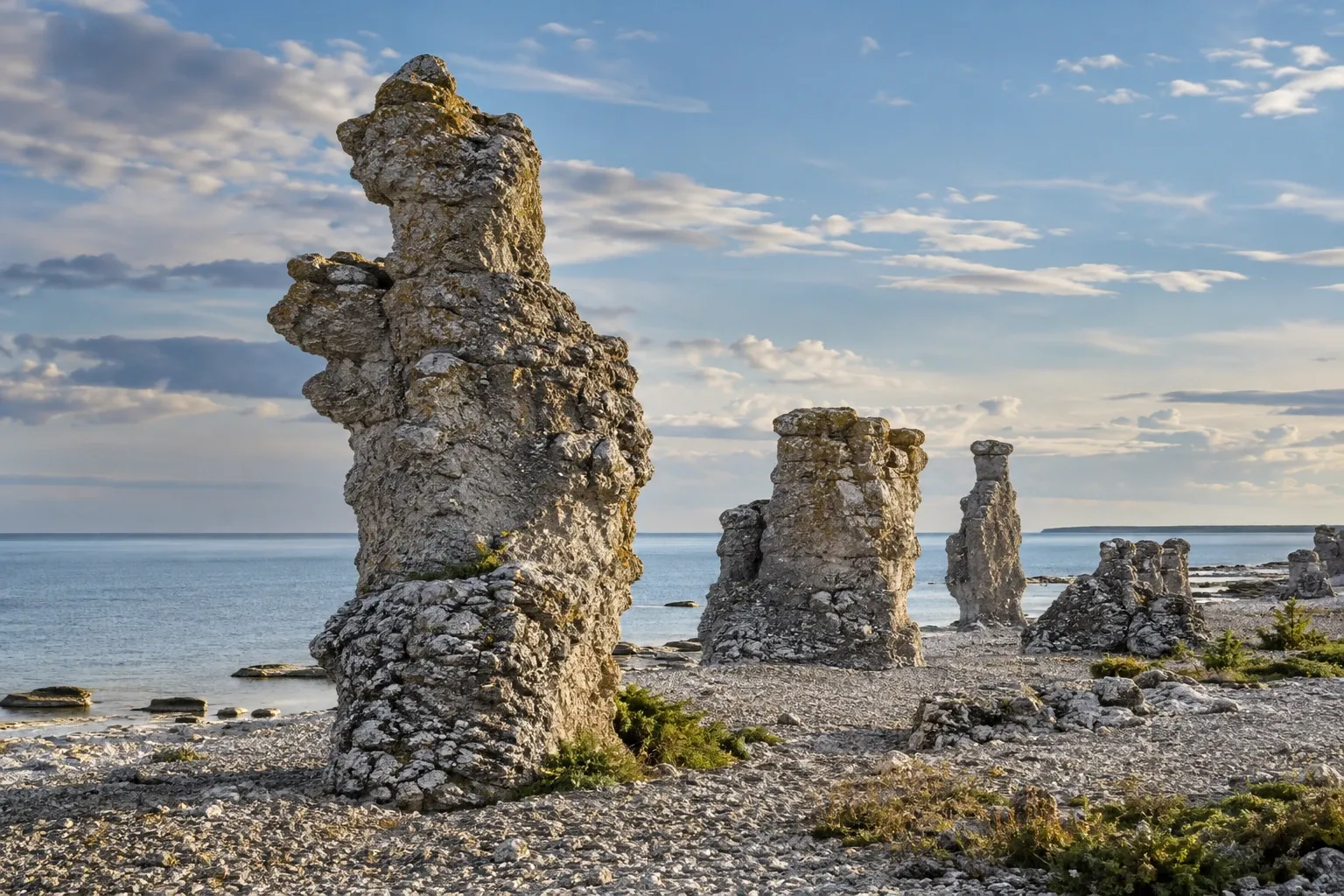
Fårö is Gotland’s wild north: stone pillars on shingle beaches, sheep-grazed heath at Langhammars, and the island Ingmar Bergman made his home. Getting there is free and easy. The planning is about wheels, ferry queues and the rules in the reserves.
When you need this
You’ve booked Gotland and want to give Fårö more than a quick look, or you’re coming for Bergman. Maybe you need to know whether the bus goes there (it doesn’t). Or you’re wondering which rauk field to pick, or whether a motorhome can stay the night by the stacks (it can’t, in the reserves). This guide covers Fårö itself. For the island as a whole, start with our Gotland and Visby travel guide.
Getting there: the ferry, the bus and why you need wheels
Fårö sits across a narrow strait from Fårösund, at Gotland’s northern tip. There’s no bridge. Trafikverket, the Swedish Transport Administration, runs a road ferry from Fårösund to Broa on Fårö. It crosses 1,300 m in about six minutes and costs nothing, for cars, bikes and foot passengers alike. Region Gotland and Trafikverket are still talking about better ferry service, and the region is looking at how a fixed link might be paid for. Nothing has been decided.
The catch is getting around once you’re over. Region Gotland’s bus line 20 runs from Visby to Fårösund, and no line in its network continues onto Fårö. So a car-free visit means bringing a bike on the bus or on the Gotland ferry, then cycling from Broa.
| How you travel | What works | Watch out for |
|---|---|---|
| Car | Drive to Fårösund, take the free ferry | Long summer queues, and residents’ priority lanes 1 June–15 August |
| Ordinary bike | Bus line 20 to Fårösund, or ride; bike on the ferry | Bus bike places can’t be booked |
| E-bike | Ride the whole way | E-bikes are never allowed on Gotland’s buses |
| On foot | Ferry over as a foot passenger | No bus on Fårö; the sights are spread out |
The queue. Trafikverket warns that car queues can get long in summer. From 1 June to 15 August, a priority lane lets two groups board first: permanent Fårö residents, and Gotland residents who cross for work on Fårö most of the year. That comes on top of the emergency vehicles, buses and taxis that always go first on road ferries. This rule rests on the national traffic ordinance and a Transportstyrelsen regulation, so it’s not just a local habit. Build in slack both ways.
Trafikverket’s ferry app, Trafikinfo Färjerederiet, shows the timetable and any disruptions. You can also use it to call the ferry. For how Sweden’s free ferries work in general, see Sweden’s free yellow road ferries.
The raukar: which field to choose
Raukar (singular rauk) are limestone sea stacks. Gotland’s bedrock is largely made of coral reefs that grew in a tropical sea about 430 million years ago. After the last ice age the land rose from the sea, and the waves wore away the softer layered limestone faster than the hard reef rock. What stayed standing are the raukar. All four places below are free to visit.
| Place | Where | What you get | Facilities |
|---|---|---|---|
| Digerhuvud | North-west coast, Lauterhorn to Helgumannen fishing village | Long field of stacks from about 1 m to 8 m; a paved road runs through | Parking, fire place, rest area, dry toilet |
| Langhammars | Northern tip, a 2.5 km peninsula | More than 50 raukar, some over 8 m, at Klajvika beach | Parking, rest area, dry toilet |
| Gamla hamn | Signed site with its own car park | Medieval harbour turned lagoon, a lone rauk, chapel ruin, Viking Age graves | Info board at the car park; a few hundred metres’ walk |
| Ullahau | East, just north of Sudersand | A horseshoe sand dune rising just over 15 m, with antlion pits | Parking, rest area, path |
Digerhuvud is the one for climbing and sitting. The county board, Länsstyrelsen Gotland, says you can always find a rauk of your own to climb, explore or lean against. Langhammars is the postcard. The county board calls its Klajvika stacks the most photographed raukar on Gotland. They’re also on the back of Sweden’s 200-krona note, whose front shows Ingmar Bergman. You can reach Langhammars from Digerhuvud or by the turning 2 km north-east of Fårö church.
Gamla hamn (“the old harbour”) adds history. Storm-thrown ridges of stone and gravel sealed off the medieval harbour, and it now looks more like a lake. Nearby stand the ruins of a small chapel to St Olaf and about fifteen low cairns, probably Viking Age graves. A lone rauk stands in the water. It goes by several names, among them Kaffepannan, “the coffee pot”.
The rules in the reserves
All four places are nature reserves, and each has binding regulations (föreskrifter) that apply on top of allemansrätten, Sweden’s right of public access. They differ in the details, so read the board at the car park. The ones visitors break most often:
- Fossils and stones. You may not chip fossils from raukar or bedrock at Digerhuvud or Gamla hamn. Langhammars also bans moving or taking away stones, blocks or fossils. Anywhere on Gotland, knocking fossils out of bedrock is prohibited and is not covered by allemansrätten.
- Fires. Digerhuvud allows fires only at the marked place, and Langhammars only at prepared fire places. At Gamla hamn no fire may be lit near the raukar, because the heat can damage or blacken them. Ullahau bans fire altogether.
- Driving and parking. Stay on marked roads and park only in marked places.
- Dogs. At Digerhuvud dogs must be on a lead all year except 1 November to 31 January. Everywhere in Swedish nature, loose dogs are banned from 1 March to 20 August. See dogs in Swedish nature.
- Insects. Ullahau bans collecting them.
Gamla hamn’s harbour and graves are also protected ancient monuments (fornlämningar). Disturbing them needs a county board permit. For why reserve rules override the general right of access, see nature reserves in Sweden.
Bergman’s Fårö: what you can visit and what you can’t
Ingmar Bergman first came to Fårö in 1960. He was looking for a location for Through a Glass Darkly and later made the island his home. The Ingmar Bergman Foundation counts six films and one TV series shot on Fårö, with Persona, Shame and A Passion making most use of the landscape. Bergmancenter’s own count is four feature films, one TV series and two documentaries. He died at home on Fårö on 30 July 2007, aged 89.
| Bergman site | Can you visit? | Notes |
|---|---|---|
| Hammars, his house | No | His Fårö properties have been an artists’ residency, Bergmangårdarna, since 2009; not open to the public |
| Bergmancenter | Yes, in season | Visitor centre in the middle of Fårö: exhibition, cinema, VR tour of the Hammars house |
| His grave | Yes | Fårö churchyard, in a corner under trees, a spot he chose himself |
| Bergman Week | Yes | Annual festival in late June, run by Bergmancenter |
Hammars is closed. Plenty of fan pages still treat Bergman’s house as a sight, but it’s a working residency. Bergmancenter’s VR tour starts on the beach and takes you through the house, which still looks as it did when he lived there. That’s the way to see it.
Bergmancenter runs an exhibition about Bergman and the island, Lek, lust och ljus, plus a 64-seat cinema. Groups of at least five can book a 45-minute guided tour all year, in Swedish, English or German. In season there’s also a scheduled tour, Wednesday to Friday at 15:00. Opening is seasonal, so see Practical information before you go.
The grave is in the churchyard of Fårö church. SVT reported at the 2007 funeral that Bergman chose the spot himself. It’s a working churchyard, so visit quietly.
Bergman Week (Bergmanveckan) runs in late June. The 2026 edition held its closing ceremony on 26 June. The 2027 dates weren’t published when we checked in October 2026.
Camping and motorhomes
The reserves are the wrong place to spend a night. Digerhuvud, Gamla hamn and Ullahau ban camping and caravans. Langhammars bans caravans and sleeping in a motorhome. Across Gotland, Region Gotland’s local rules also ban camping in a tent, caravan, motorhome or car on public places such as roads, streets and parks, unless the land is set aside for it. In practice, a motorhome sleeps at a campsite.
A tent is different. Away from homes and outside the reserves, Region Gotland says a single night is fine as long as you don’t disturb the landowner or damage nature. See wild camping with a motorhome for the vehicle rules.
Seasons
- 1 June – 15 August: residents’ priority lanes at the ferry, and long car queues.
- Late June: Bergman Week.
- 15 May – 15 September: the diocese says Gotland’s churches are generally open to visitors in the daytime.
- October – April: Bergmancenter closed except for pre-booked visits. The reserves stay open, and Digerhuvud allows dogs off the lead only from 1 November to 31 January.
Practical information
| Item | Detail |
|---|---|
| Fårö road ferry | Free; Fårösund–Broa, 1,300 m, about 6 minutes; timetable in Trafikverket’s app |
| Bus | Line 20 Visby–Fårösund; none on Fårö |
| Bike on a Gotland bus | 20 kr, ordinary bikes only, no booking (checked 2026-09-25) |
| Rauk reserves | Free |
| Bergmancenter entry | 120 kr adults; 100 kr students and groups of 15+; free up to 15 (checked 2026-10-15) |
| Bergmancenter scheduled guided tour | 150 kr, Wednesday–Friday 15:00 in season (checked 2026-10-15) |
| Bergmancenter hours, 2026 | 1 June–30 August daily 11:00–17:00; 3–27 September Thursday–Sunday 11:00–16:00; October–April pre-booked only |
FAQ
How do you get to Fårö?
Drive or take Region Gotland’s bus line 20 from Visby to Fårösund, then cross on Trafikverket’s free road ferry to Broa on Fårö. The crossing is 1,300 m and takes about six minutes. No bus runs on Fårö itself, so bring a car or an ordinary bike; e-bikes are never allowed on Gotland’s buses.
Is the Fårö ferry free?
Yes. Trafikverket’s Fårösund ferry is a state road ferry and the crossing is free of charge, for cars, bikes and foot passengers. From 1 June to 15 August, priority lanes let permanent Fårö residents and some workers board first, so other cars can queue for a long time. Check timetables and disruptions in Trafikverket’s ferry app.
Where are the best raukar on Fårö?
Digerhuvud on the north-west coast has a long field of stacks up to 8 m, a paved road through it and room to climb and sit. Langhammars at the northern tip has more than 50 raukar, the Klajvika stacks from the 200-krona note. Gamla hamn adds a medieval harbour and a lone rauk in the water. All three are nature reserves.
Can you visit Ingmar Bergman’s house on Fårö?
No. Bergman’s properties at Hammars became an artists’ residency, Bergmangårdarna, in 2009 and are not open to the public. Bergmancenter, a visitor centre in the middle of Fårö, has an exhibition about Bergman and the island and a VR tour that walks you from the beach through the house, which still looks as it did when he lived there.
Where is Ingmar Bergman buried?
In the churchyard of Fårö church. Bergman died at his home on Fårö on 30 July 2007, aged 89, and was buried there after a simple funeral in August 2007. He chose the spot himself, in a corner of the churchyard under trees. Visit it as you would any working churchyard.
Can I camp or park a motorhome at the raukar?
Not in the reserves. Digerhuvud, Gamla hamn and Ullahau ban camping and caravans, and Langhammars bans caravans and sleeping in a motorhome. Across Gotland, a local ordinance bans camping in tents, motorhomes or cars on public places such as roads and parks. A single night in a tent elsewhere, away from homes, is possible under allemansrätten.
When is Bergmancenter open?
In the 2026 season it opened daily 11:00–17:00 from 1 June to 30 August, then Thursday to Sunday 11:00–16:00 from 3 to 27 September. From October to April it is closed except for pre-booked visits. Groups of at least five can book a 45-minute guided tour all year, in Swedish, English or German.
Related guides
- Gotland and Visby travel guide — the island hub: Visby, the buses and the island-wide rules.
- A long weekend on Gotland — how Fårö fits into a three-day plan.
- Taking the ferry to Gotland — getting yourself, a car or a bike to the island.
- Gotland by bike — the Gotlandsleden route, Fårö loop included.
- Nature reserves in Sweden — why local rules override allemansrätten.
Facts verified 2026-10-15. Sources: Trafikverket, Länsstyrelsen Gotland, Region Gotland, Sveriges Riksbank, Naturvårdsverket, Bergmancenter, Stiftelsen Ingmar Bergman, SVT — full register in this topic’s source file. Found something outdated? Tell us and we’ll fix it.