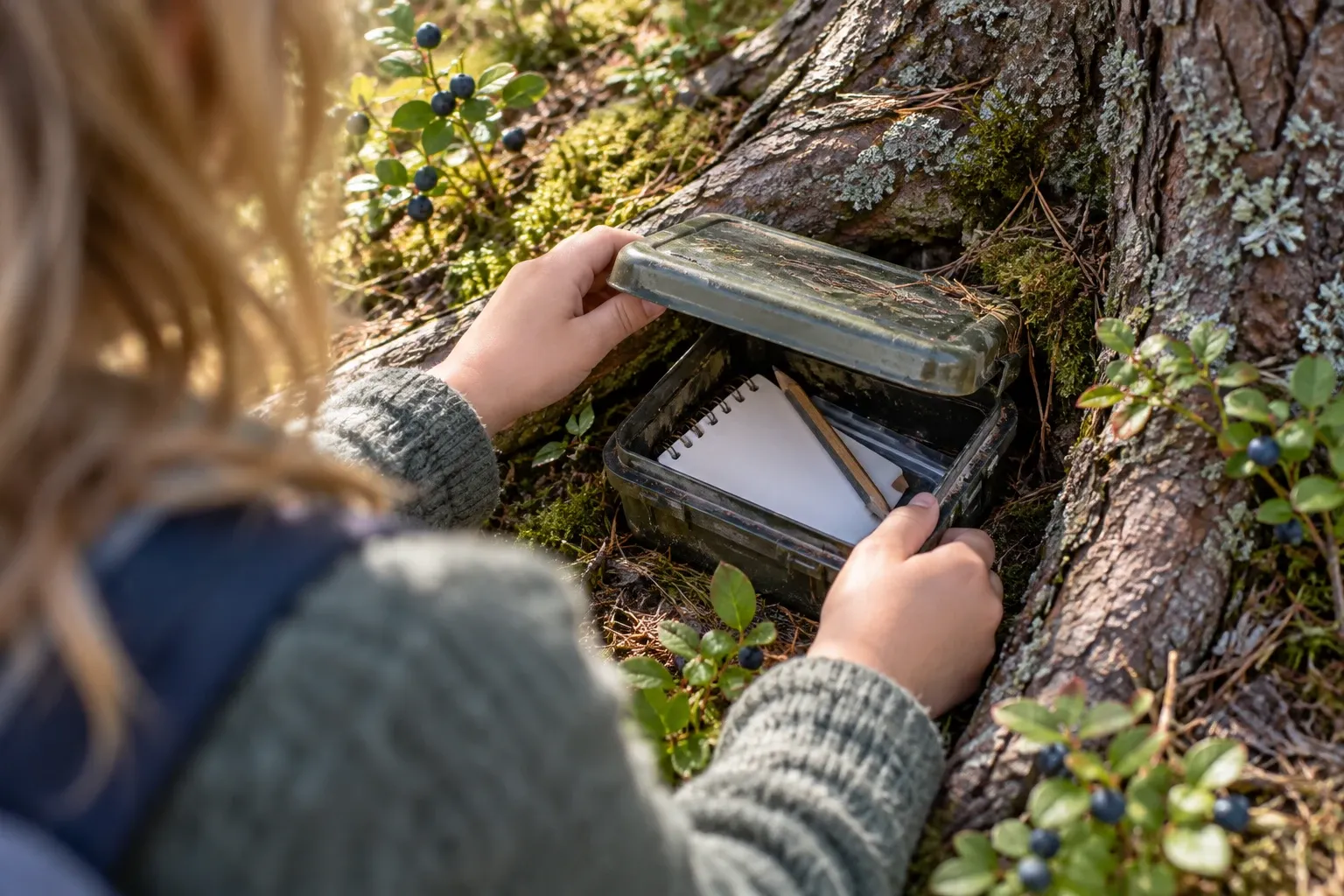
Sweden’s right of public access makes it one of the easiest countries in the world to geocache with children. The finding part is free and open almost everywhere. The hiding part has rules most visitors never hear about, and one of them is a criminal statute.
When you need this
- You want a free outdoor activity for children anywhere in Sweden, town or forest
- Your kids already geocache at home and want to log Swedish finds
- You found a small box or tube under a stone and wonder what it is
- You plan to hide a cache while on holiday or living in Sweden
- You are choosing between geocaching and Hittaut in a Swedish town
How geocaching works
Geocaching is a treasure hunt with a phone or a GPS. Someone hides a container, publishes its coordinates online, and others find it, sign the logbook and put it back. Swedish county board pages describe it the same way: searching for cacher, or skatter (treasures), whose coordinates are on the internet.
The main listing site is geocaching.com, run by Geocaching HQ. A basic account is free, and its app shows caches near you on a map. An optional paid premium subscription adds features and opens premium-only caches. You do not need it to start.
Finding caches with children
For a family, a first cache takes about as much planning as a walk to the playground. The steps:
- Create a free account. For a child under 16 it has to be the parent’s account (more on that below).
- Pick a cache that suits the children. The listing gives the container size and difficulty and terrain ratings. Large, easy caches in town parks are the gentlest start.
- Check the place. If the cache is in a nature reserve or national park, read the area’s rules on its information board or the county board’s page.
- Pack a pen and a litter bag. Geocaching HQ calls the pen perhaps the most essential tool, and the bag lets you leave the spot better than you found it.
- Walk in on paths where you can. Go around gardens, crop fields and fresh plantings, which the access right does not cover.
- Find it, sign and date the logbook, then put the container back exactly where and how you found it.
- Trade fairly. If a child takes an item, they leave one of equal or greater value.
- Log the find online afterwards, and tell the owner if the container is damaged.
What goes in and out of the box
Children care most about the swap. Geocaching HQ’s own suggestions for trade items are key rings, marbles and small toys. Food and scented items are banned in caches, and so are knives, lighters, ammunition, drugs and alcohol.
A trackable is different: it is a tagged item meant to travel from cache to cache. Either move it to another cache and log the move, or leave it where it is. The most common family mistake is a child pocketing one as a souvenir.
Accounts for under-16s
Geocaching HQ’s terms, effective 4 March 2026, say the service is not directed at anyone under 16. Under-16s may still play, but a parent or guardian must own and manage the account. Players aged 16 and 17 need a parent’s consent. In practice the family shares the parent’s account, and the children sign the logbook with the family’s username.
Is it allowed? Finding vs hiding
Finding a cache and hiding one are two different things in Swedish terms, and most English-language pages blur them.
| Finding a cache | Hiding a cache | |
|---|---|---|
| What covers it | Allemansrätten, the right of public access | Landowner’s consent |
| Permission needed | No, on land open under the access right | Yes: fixed markers need the landowner’s approval |
| Protected areas | Follow the area’s binding regulations | Check the regulations; ask the county board |
| Ancient monuments | Do not move stones or dig | Never hide in or by one |
| Platform rules | Sign, re-hide, trade fairly | Permission, no burying, 161 m spacing, maintenance |
Allemansrätten lets anyone be on most land temporarily and considerately without asking, under the principle “do not disturb, do not destroy”. It is not a statute in itself. Naturvårdsverket, the Swedish Environmental Protection Agency, describes it as shaped by other laws, such as the Penal Code’s bans on damage and trespass and the Environmental Code’s protection of nature. That is all a family on a cache hunt needs.
The listing coordinates are not permission, though. A cache’s position tells you where it is, not that you may cross a garden or a field of crops to get there.
Hiding a cache in Sweden
Here is where many cachers go wrong. Your visit is covered by the access right; an object you leave for months is not. Naturvårdsverket’s guidance on organised activities says plainly that you need the landowner’s approval to put up fixed markers or change the terrain. The page does not name geocaching, but a cache sitting in place for a season is that kind of marker. The listing site makes the same demand: the hider promises they have the landowner’s or land manager’s permission.
Naturvårdsverket’s 2022 guidance on events in nature draws the line by time. Orienteering controls put out for a single training or race need no consent, if they are collected afterwards. Markers left longer call for agreement. Any marker should carry the organiser’s name, a phone number and a removal date. An organiser who leaves markers behind can be convicted of littering.
The listing site adds its own rules. They bind the listing, not Swedish law, but a cache that breaks them is not published:
- No burying, and no digging a hole to hide or find a cache
- At least 161 m (0.1 mile) between physical caches
- No caches on railway property; schools, government buildings, bridges and dams are named as unsuitable
- The owner visits regularly, fixes problems, and removes the container within 60 days of archiving the listing
A forgotten cache is litter. When you stop maintaining one, remove the container and archive the listing. Västra Götaland’s county board adds a step: delete its position from the databases too.
Nature reserves and national parks
The access right still applies in protected areas, but each reserve and national park has its own binding regulations (föreskrifter). Visitors must follow them, and they vary from area to area. Read the board at the entrance or the county board’s page before you search.
One county board, Västra Götaland, has published geocaching guidelines for its protected areas. It does not treat geocaching as competition, so in reserves where competitions are banned, caching may go on without a special permit. Caches must not be placed in areas with an access ban, or inside buildings in nature and culture reserves. They should be kept away from sensitive wildlife such as raptor nests, and the path to them should not wear out fragile ground.
We found no other county board with a published position. Reserve rules differ, so if you want to hide a cache in a reserve anywhere else, ask the county board first. For how reserves work, see nature reserves in Sweden.
Ancient monuments: the rule with a criminal penalty
A pile of stones is a tempting hiding spot, but in Sweden it may be a burial cairn or another protected remain. Under the Historic Environment Act (Kulturmiljölagen), it is a crime to move, remove, dig out, cover or otherwise alter or damage an ancient monument (fornlämning) without a permit. Damaging one deliberately or through carelessness is fornminnesbrott, punished by fines or up to six months in prison.
Before you hide anything near old stones, check Fornsök, the Swedish National Heritage Board’s free map of registered ancient remains. It is not complete, so treat anything old-looking as protected and choose another spot. Children searching for a cache should also leave stone piles and walls alone.
Seasons and safety
| Season | What changes |
|---|---|
| Spring and summer | Tick season; nesting birds are most easily disturbed |
| From 1 Sept (north) and 8 Oct (south) | Moose hunting; dress so hunters can see you |
| May to October | Hittaut checkpoints are out in its towns |
| Winter | Snow can bury ground-level caches; pick ones above ground or in town |
Ticks live exactly where caches hide. The common tick is reported from every Swedish municipality, so check children after any forest or meadow search. Our tick guide covers removal and TBE.
Hunting season does not close the forest. The access right still applies, but if you see a “Jakt pågår” (hunting in progress) sign, the simplest course is to search somewhere else. Bright clothing helps; see hiking during hunting season.
Coverage fades in the forest. Download what you need before you leave town, and if someone gets lost, call 112: your phone sends its position automatically when you call. Lost in the forest has the full routine.
Hittaut, the Swedish alternative
Hittaut is the home-grown Swedish version of the idea. Run by the Swedish Orienteering Federation and local clubs, it puts permanent orienteering checkpoints around dozens of towns, usually May to October. It is free. You find posts with the app or a paper map and register each post’s code.
Its big advantage for children is grading: green (very easy), blue (easy), red (intermediate) and black (advanced). Geocaching is everywhere and all year; Hittaut is seasonal, local and easier to pitch at a five-year-old. Orienteering in Sweden explains Hittaut and the rest of the sport.
Practical information
| Item | Detail |
|---|---|
| Basic geocaching account | Free |
| Premium membership | Optional paid subscription; price varies by currency, check the site |
| Account age | Under 16: parent owns and manages the account; 16–17: parent’s consent |
| Access to land | Free under allemansrätten |
| Hiding a cache | Landowner’s consent; reserve rules; never at an ancient monument |
| Spacing between caches | At least 161 m (listing rule) |
| Removing an archived cache | Within 60 days (listing rule) |
| Damaging an ancient monument | Fines or up to 6 months in prison |
| Hittaut | Free; usually May–October |
FAQ
Is geocaching legal in Sweden?
Yes. Looking for caches relies on allemansrätten, which lets anyone walk on most land temporarily without asking, as long as they do not disturb or destroy. Stay out of gardens, crop fields and areas with an access ban, follow nature reserve rules, and put each cache back as you found it. Hiding a cache needs more: the landowner’s consent.
Do I need permission to hide a geocache in Sweden?
Yes, in practice. Naturvårdsverket says fixed markers in the terrain need the landowner’s approval, and a cache left for months is that kind of marker. The listing site also requires the hider to have permission. Label the container, keep it clear of ancient monuments and sensitive wildlife, and remove it when the listing ends.
Can you geocache in Swedish nature reserves and national parks?
Usually you can search, but each area has its own binding regulations, so read them first. Västra Götaland’s county board allows caching in its reserves where competitions are banned, but not in areas with an access ban or inside reserve buildings. Elsewhere, rules differ from reserve to reserve, so ask the county board before hiding a cache in one.
Is geocaching free?
Yes. A basic account on geocaching.com is free, and finding caches on land open under allemansrätten costs nothing. An optional premium subscription unlocks extra features and premium-only caches; its price varies by currency, so check the site. Hittaut, the Swedish orienteering-checkpoint hunt, is also free in every town where it runs.
Can children have their own geocaching account?
Not before 16. The listing site’s terms, effective 4 March 2026, say under-16s may use the service only through an account a parent or guardian owns and manages, and 16- and 17-year-olds need a parent’s consent. In practice the family shares the parent’s account, and the children sign the logbook with the family’s username.
What should kids take from or leave in a geocache?
Sign the logbook first. If a child wants to take a small item, they should leave something of equal or greater value, such as a marble or a key ring. Never leave food, scented items, knives or lighters. A trackable is meant to travel: move it to another cache and log it, or leave it where it is.
Is geocaching the same as Hittaut?
No. Geocaching uses containers hidden by players worldwide and listed online. Hittaut is a Swedish summer activity run by the Swedish Orienteering Federation: local clubs put out checkpoint posts in dozens of towns, usually May to October, and you register each post’s code in an app or online. Both are free; Hittaut has clearer difficulty grades for children.
Related guides
- Allemansrätten, the right of public access — the right behind every cache hunt, in full.
- Orienteering in Sweden — Hittaut and the sport’s other easy ways in.
- Nature reserves in Sweden — why their rules override the access right.
- Ticks in Sweden — what to check on children after a forest search.
- Sweden with kids — the wider family picture.
Facts verified 2026-10-15. Sources: Naturvårdsverket, Länsstyrelsen Västra Götaland, Sveriges Riksdag (Kulturmiljölag 1988:950), Riksantikvarieämbetet, Geocaching HQ guidelines and terms, Svenska Orienteringsförbundet — full register in this topic’s source file. Found something outdated? Tell us and we’ll fix it.