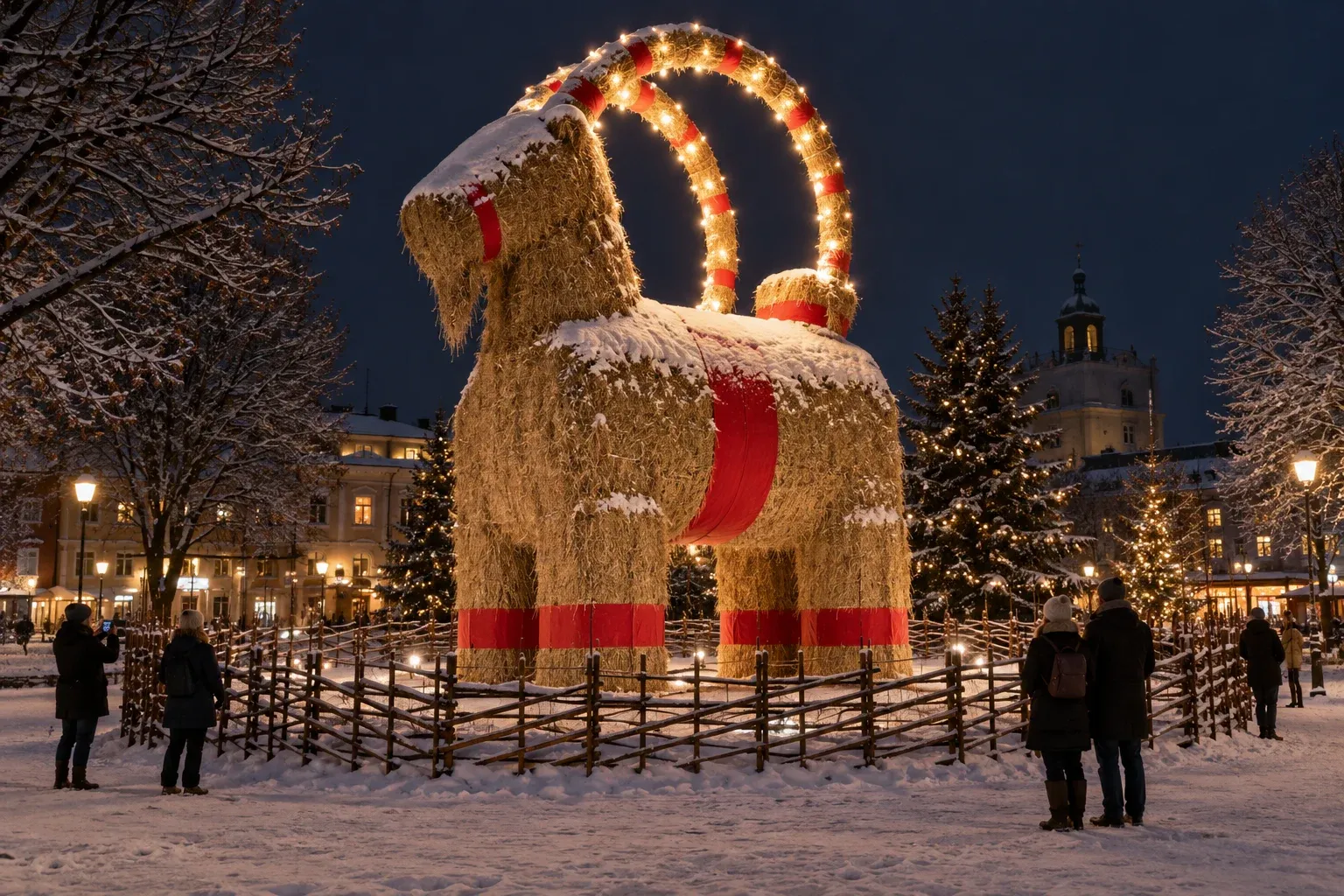
Every Advent, a city north of Stockholm builds a giant straw goat, and the world waits to see whether it survives. Here is the real record, who builds it, where and when to see it in 2026, and what happens to anyone who sets it alight.
When you need this
- You are in Sweden around Advent and want to see the goat in person
- You saw a news story that “the goat burned again” and want the real record
- You want to follow the goat online from abroad by webcam
- You are planning a day trip to Gävle for the first Advent inauguration
- You wonder whether burning it is a prank or a crime
What the Gävle goat is
Gävlebocken (the Gävle Goat) is a giant version of the julbock, the straw Yule goat that brought Christmas gifts before Santa did and is now mostly a home decoration across Sweden. Gävle’s goat stands in the city centre from the first Sunday of Advent until early January. Gävle kommun, the municipality that owns it, gives its size as 10 metres high, 7 metres long and 3 tonnes. Many English sources say 13 metres; the municipality says 10.
It began as a shop promotion. In 1966 the merchants of Söder, Gävle’s southern shopping district, put the first goat up on Slottstorget on 1 December to bring customers to their shops. It burned at midnight on New Year’s Eve, and the man responsible was prosecuted for gross criminal damage. Sixty years of drama followed.
The burn record, 1966–2025
The popular line is that the goat “burns every year”. It does not. Visit Gävle, the city’s tourism organisation, publishes the goat’s fate year by year. Counting season by season from that chronicle, we get:
| Outcome, 1966–2025 | Seasons |
|---|---|
| Burned (sometimes more than once in a season) | 30 |
| Destroyed another way: smashed, sabotaged, hit by a car, storm | 6 |
| Fate unclear in the record | 3 |
| Survived | 21 |
| Total | 60 |
Press tallies of “around 39” or “over 40” count multiple fires in one season, other destruction or damage. Thirty is the number of seasons in which the goat burned.
A few years stand out. In 2001 a visiting American set it alight the day before Christmas Eve. In 2016 it burned just hours after its 50th birthday party on 27 November. From 2017 the goat survived four seasons in a row. Then came the last fire, on the night of 17 December 2021: the arsonist was caught with soot on him, everything was on film, and he was sentenced to six months in prison and ordered to pay more than 100,000 kr in damages.
Since then the goat has had other enemies. In 2023 jackdaws pecked at it all December for the seeds in the straw. And in 2025 it was not fire that ended the season: on 27 December storm Johannes, with winds above 40 m/s, blew the goat over inside its fence. If you read “the goat burned last year”, that is out of date: the last fire was in 2021.
Not every loss was arson. The goat has also been smashed, run into by cars (in 1976, and the small school goat in 2016) and sabotaged so it sagged (1972). Most fires in the record fell between Lucia on 13 December and New Year’s Eve.
Who builds it today
The merchants built the first goats, gave up in 1971, and came back in 1986. Today the goat is built by a team of about ten goat builders (bockbyggare) from Gävle kommun.
| Build fact | Figure |
|---|---|
| Straw mats | About 60, each 5 m long and 80 cm wide |
| Time to tie the mats | About six weeks, all by hand |
| Knots | About 12,000 |
| Nails | About 2,500 |
| Frame | Wooden, reused every year |
| Straw | From a farm near Enköping; burned for heat and energy after takedown |
In the days before first Advent the goat is lifted into place by truck and crane. Gävlebocken is a registered trademark, and the municipality’s permission is needed to use it. Since 1986 a second, smaller goat built by the natural science club at Vasaskolan, a Gävle school, has often stood nearby; it set Guinness records at 12.5 metres in 1985 and, according to the chronicle, 16 metres in 1993.
Seeing the goat in 2026
The 60th-anniversary inauguration is on Sunday 29 November 2026, the first Sunday of Advent. Gävle kommun has confirmed the date; the programme comes later. For reference, here is how 2025 worked:
| 2025 arrangement | Detail |
|---|---|
| Inauguration | 16:00 on first Advent, on Stortorget, with a stage show |
| Christmas market | In the city on first Advent |
| Traffic | Streets around Rådhusesplanaden closed 12:00–18:00 |
| Accessibility | Ramp at the inauguration, next to the mixing desk |
| Online | Inauguration not streamed; webcam ran as usual |
| Takedown | 7 January 2026 |
Where: since 2022 the goat has stood on Rådhusesplanaden (the town hall esplanade), because Agnes, a new cultural centre, was being built on its original site at Slottstorget (Castle Square). Agnes has opened, but whether the goat moves back for 2026 had not been announced on 6 October 2026. Check Visit Gävle in November.
Seeing the goat is free. Go on first Advent for the crowd, the stage show and the Christmas market, or come on a weekday evening for a quiet look at the lit horns and red ribbons. Leave the car: streets close on inauguration day. See train travel in Sweden for getting to Gävle. And stay outside the fence.
The webcam
You do not have to travel to watch. Visit Gävle streams the goat live on its website from assembly until takedown; in 2025 the stream started on the morning of 28 November. The goat has been watched by webcam since 1996, and Visit Gävle says about 100,000 people in 120 countries follow it.
Burning it is a crime
Some visitors treat the burnings as a harmless prank. Swedish law does not. Burning the goat is damaging someone else’s property, here the municipality’s, and the Swedish Penal Code (Brottsbalken) sets prison scales:
| Offence | Prison scale | Statute |
|---|---|---|
| Criminal damage (skadegörelse) | Up to 2 years | Brottsbalken 12:1 |
| Gross criminal damage (grov skadegörelse) | 1 to 6 years | Brottsbalken 12:3 |
| Arson (mordbrand): a fire that endangers people or risks extensive destruction | 2 to 8 years | Brottsbalken 13:1 |
The gross-damage wording, including the one-year minimum, comes from a law change in force since 1 August 2026. Courts weigh danger to life or health and damage to property of great cultural or economic importance. The real-world benchmark: six months in prison and more than 100,000 kr in damages for the 2021 fire. The goat is fenced and filmed around the clock, as that case showed.
Practical information
| Item | Detail |
|---|---|
| 2026 inauguration | Sunday 29 November 2026, first Advent; 60th anniversary; time to be announced (16:00 in 2025) |
| Location | Rådhusesplanaden 2022–2025; 2026 site to be confirmed by Visit Gävle |
| Standing period | First Advent until early January (7 January in 2025–26) |
| Cost | Free, on site and by webcam |
| Webcam | Visit Gävle website, from assembly (28 November in 2025) |
| Size | 10 m high, 7 m long, 3 tonnes |
| Record 1966–2025 | Burned in 30 of 60 seasons; last fire 17 December 2021; storm in 2025 |
FAQ
How many times has the Gävle goat burned?
By our count of Visit Gävle’s official year-by-year chronicle, the goat burned in 30 of its 60 seasons from 1966 to 2025, sometimes more than once in a season. It was also smashed, run into by cars and sabotaged. The last fire was on 17 December 2021. In 2025 storm Johannes blew it over instead.
When is the Gävle goat inaugurated in 2026?
On the first Sunday of Advent, Sunday 29 November 2026, which is also the goat’s 60th anniversary. Gävle kommun has confirmed the date; the full programme comes later. In 2025 the ceremony was held at 16:00 on Stortorget with a stage show and a Christmas market. The goat stays up until early January.
Where can I see the Gävle goat?
In central Gävle. Since 2022 it has stood on Rådhusesplanaden, because Agnes, the new cultural centre, was being built on its old site at Slottstorget. Whether it returns to Slottstorget for 2026 had not been announced on 6 October 2026, so check Visit Gävle closer to Advent. Viewing is free.
Is there a Gävle goat webcam?
Yes. Visit Gävle streams the goat live on its website from assembly until takedown; in 2025 the stream started on the morning of 28 November. The goat was first watched by webcam in 1996, and Visit Gävle says about 100,000 people in 120 countries follow it. The inauguration itself was not streamed in 2025.
Is it illegal to burn the Gävle goat?
Yes. Burning it is criminal damage under the Swedish Penal Code: up to two years in prison, or one to six years if gross. A fire that endangers people can be charged as arson, two to eight years. The 2021 arsonist was sentenced to six months in prison and ordered to pay over 100,000 kr in damages.
Who builds the Gävle goat?
Today a team of about ten goat builders from Gävle kommun. They tie around 60 straw mats by hand, which takes about six weeks, and fix them to a wooden frame reused each year. The merchants of Söder started the tradition in 1966. A smaller goat by a school club has often stood nearby.
How big is the Gävle goat?
Gävle kommun gives its size as 10 metres high, 7 metres long and 3 tonnes. English-language sources often say 13 metres, but the municipality’s figure is 10. The build uses about a truckload of straw, 2,500 nails and 12,000 hand-tied knots, according to Visit Gävle.
Related guides
- Advent in Sweden — the first Sunday of Advent, when the goat and every window light go up
- Swedish Christmas traditions — the whole season, including the small straw julbock
- Christmas markets in Sweden — where to find markets on the Advent weekends
- Sweden in December — daylight, dates and closures for a December trip
- Tjugondag Knut — when Christmas officially ends, a few days after the goat comes down
Facts verified 2026-10-06. Sources: Gävle kommun, Visit Gävle, Sveriges riksdag (Brottsbalken) and TV4 — full register in this topic’s source file. Found something outdated? Tell us and we’ll fix it.