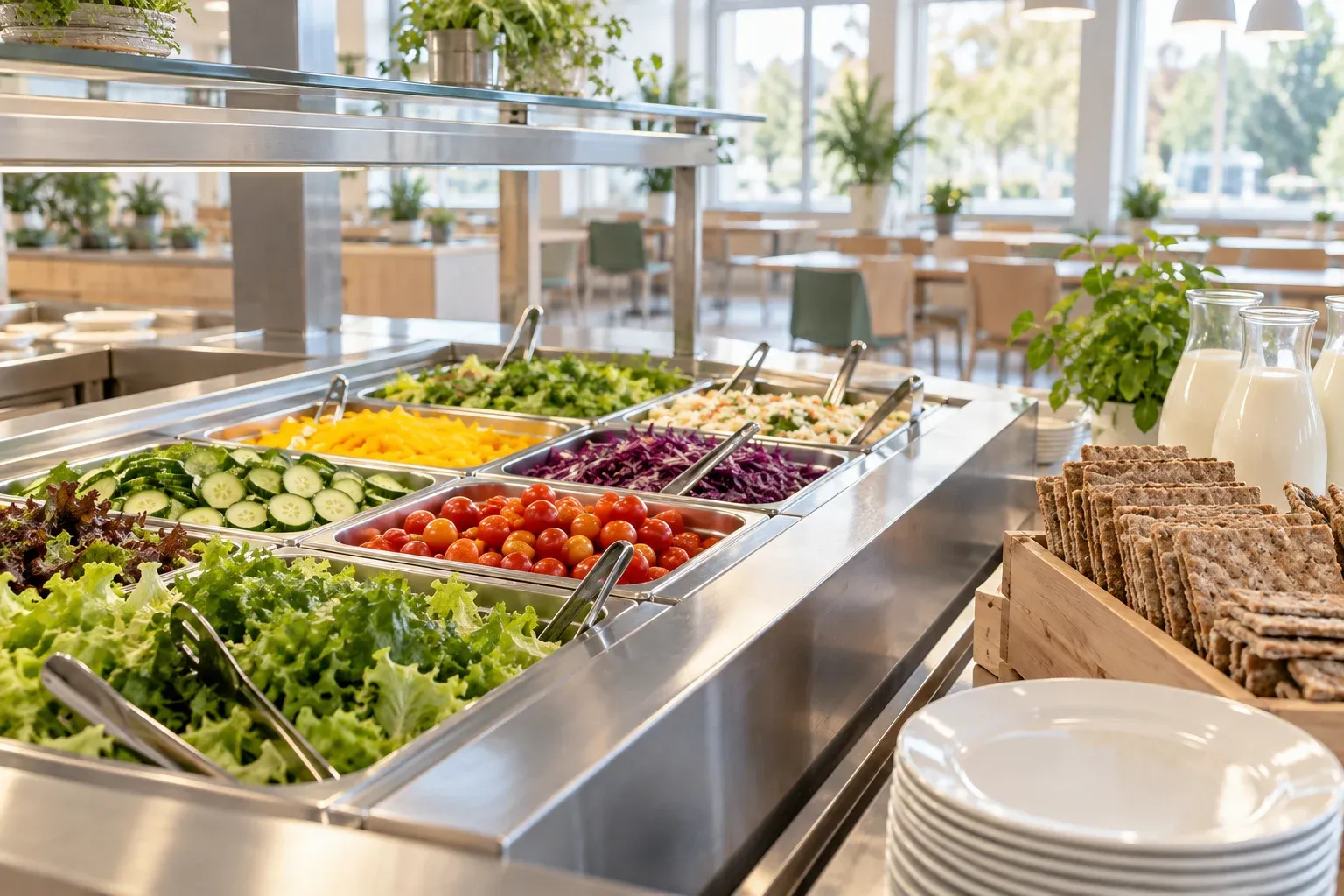
If your child goes to school in Sweden, lunch is part of the school day and you never see a bill. Here is what the law actually requires, where the story really starts, what goes on the plate, and how special diets work.
When you need this
You’re moving to Sweden with school-age children and want to know what lunch costs. Your child has an allergy, celiac disease or another medical diet. Your family eats halal, vegetarian or vegan and you wonder what the school must provide. Your teenager is starting gymnasium (upper secondary school) and you’ve seen a lunch charge, or none. Or you’ve read that Sweden has had free school lunch “since 1946” and want the real story.
What the law says
The rule is one sentence in the Education Act, Skollagen (2010:800). In the fee provisions for compulsory school, adapted compulsory school, special school and Sámi school, the Act says pupils “shall be offered nutritious school meals free of charge”. The same chapters bind every school provider, so independent schools (friskolor) can’t charge for lunch any more than municipal ones can.
Three details matter for parents:
| Question | Answer | Type |
|---|---|---|
| Which meal? | Lunch. The requirement has been interpreted as lunch only. | Agency guidance |
| Which school years? | Preschool class and compulsory school (years 1–9) | Law and guidance |
| Upper secondary? | Not covered. If meals are offered, the home municipality decides whether they’re free. | Law and guidance |
Breakfast and afternoon snacks are outside the legal duty. Whether a school offers them is up to the provider and the principal. After-school centers (fritidshem) usually serve an afternoon snack, and in 2024 about 16 percent of municipalities served breakfast at all their schools three to five days a week (see fritids and after-school care).
Skolinspektionen, the Swedish Schools Inspectorate, supervises that schools follow the Education Act. Food safety in the school kitchen is checked by the municipality’s food control.
Who gets it
Free lunch comes with a school place, not with citizenship. Children who live in Sweden and go to compulsory school eat for free. The Education Act counts as resident everyone registered in the population register, and also asylum seekers, some holders of temporary permits, people with EU free-movement rights, diplomats’ families and children staying without a permit, with some limits.
Tourists’ children aren’t enrolled, so they’re outside the system. School holidays and weekends have no school lunch either, because the duty belongs to the school day. If you’re visiting, plan your own meals; Sweden with kids covers eating out as a family.
A structural change is coming. From 1 July 2028, preschool class (förskoleklass) is abolished and compulsory school gets ten year groups instead of nine. The free-lunch rule simply carries on in the new year 1. Swedish schools for newcomer families explains the reform and the rest of the system.
The real history: 1840s, 1946, 1998
Most articles say Sweden has had free school lunch “since 1946”. That’s half right.
| Year | What happened |
|---|---|
| 1840s | Charities and local associations begin feeding poor schoolchildren |
| 1945 | A population inquiry proposes school meals open to all and, in principle, free |
| 1946 | The Riksdag’s decision, with state grants, starts the nationwide expansion |
| 1966 | The special school-meal grant is folded into the general grant system |
| 1990s | Every municipality serves lunch in compulsory school, but some start charging in upper secondary |
| 1 January 1998 | Free school meals in compulsory school become a legal duty |
| 2011 | The new Education Act requires meals to be nutritious |
| 2026 | Livsmedelsverket publishes new national school-meal guidelines |
Good to know: Free school lunch has been a legal right only since 1 January 1998. The 1946 decision funded the expansion; it didn’t make lunch a right. The government wrote it into law after some municipalities began charging in upper secondary and a few discussed fees lower down. Older guides may still say otherwise.
Sweden also wasn’t first. Finland’s law on free meals for all pupils came into force in 1943 and reached the whole country five years later. What Sweden can claim is scale and consistency: around two million meals are served in Swedish preschools and schools every day, and Livsmedelsverket, the Swedish Food Agency, calls the system unique in the world.
What’s on the plate
“Nutritious” has a concrete meaning. Livsmedelsverket’s 2026 guidelines say a school lunch should cover about 30 percent of a child’s daily energy and nutrient needs, averaged over four weeks, following the Nordic nutrition recommendations. A complete lunch looks like this:
- One or more cooked dishes
- A salad bar with at least five components
- Wholegrain crispbread (knäckebröd) with spread
- Water and low-fat milk (lättmjölk, 0.5 %) or a fortified plant drink
Fish or shellfish should appear at least once a week, and red meat is limited to about 125 grams (cooked weight) a week. Most schools serve lunch as a buffet, so children take what they want from the dishes on offer.
Timing is part of the rules too. The guidelines say each pupil should have fixed lunch times between 11:00 and 13:00 and at least 25 minutes at the table. Lunch can be as early as 11:00, and it covers barely a third of a child’s needs, which is why the afternoon snack matters. Swedish meal times explains why the whole country eats this early.
Special diets: what the school must do
This is where the rules split into three levels, and it’s worth knowing which one your family falls under.
| Need | Must the school provide it? | Basis |
|---|---|---|
| Allergy, celiac disease, other hypersensitivity, other medical diagnoses | Yes, a safe special diet | Agency guidance on the school’s duty |
| Religious needs (for example no pork, halal) | Expected to adapt; religion is protected by the Discrimination Act | Agency guidance |
| Ethical, philosophical or lifestyle diets (for example veganism) | No legal duty; the municipality or provider decides | Agency guidance |
For medical diets, the school’s steering documents don’t say what kind of certificate is needed, but a doctor’s certificate (läkarintyg) is the common evidence. Report the diet in writing before the first day: mix-ups at serving are a common cause of reactions, such as the standard meal going to a child with milk allergy. Keep the certificate current, because many children outgrow milk and egg allergy before school age, and an old diet restricts their food for no reason. While an assessment is pending, the guidelines say schools should meet the need as far as they can.
For religious needs, raise it with the school early. The guidelines expect meals to be adapted for pupils who don’t eat all foods for religious reasons. Halal food in Sweden covers what’s available outside school.
For vegetarian and vegan families, vegetarian is easy: 71 percent of municipalities offered a vegetarian alternative in all compulsory schools in 2024, and Livsmedelsverket considers a well-composed vegetarian meal nutritionally complete. Vegan food can be served with careful planning, but it isn’t a legal duty. If no hot vegan dish is offered, your child may have to build a meal from the buffet.
Warning: Don’t assume an ethical diet will be cooked separately, and don’t assume gymnasium lunch is free. Both depend on local decisions.
For allergy labeling and eating out with a food allergy, see food allergies in Sweden.
Lunch culture: what newcomers notice
Swedish school lunch is a shared meal, not a lunch box. Pupils eat in the school dining room (skolrestaurang or matsal), and the guidelines expect teachers and other staff to eat with them as role models. Schools call this the pedagogisk måltid, the “pedagogical meal”, though the Education Act itself doesn’t define it.
Older pupils don’t always use the right they have. As many as one in three högstadium pupils (years 7–9) doesn’t eat school lunch every day, and some leave school grounds to buy snacks or fast food instead. If your teenager comes home starving, that’s a likely reason.
Who pays? There has been no earmarked state grant for school meals since 1966, when it was folded into the general grant system that funds municipalities; Swedish taxes and welfare explains that wider system.
Practical information
| Item | What to know | Checked |
|---|---|---|
| Lunch in compulsory school and preschool class | Free by law, municipal and independent schools alike | 2026-10-14 |
| Lunch in upper secondary school | Set by the home municipality; may be free or charged | 2026-10-14 |
| Medical special diet | Free; part of the school lunch | 2026-10-14 |
| Breakfast and snacks | Not covered by the law; local decision | 2026-10-14 |
| Lunch time | Fixed, between 11:00 and 13:00, at least 25 minutes at the table | 2026-10-14 |
| Who supervises | Skolinspektionen (Education Act); municipal food control (food safety) | 2026-10-14 |
FAQ
Is school lunch really free in Sweden?
Yes, in compulsory school. The Education Act says pupils shall be offered nutritious school meals free of charge, and that applies to municipal and independent schools alike. It covers lunch on school days, not breakfast or snacks. Parents never pay, sign up or apply: enrolling the child is enough. Upper secondary school is the exception.
Since when has school lunch been free in Sweden?
The Riksdag decision of 1946 started the nationwide expansion of school meals with state grants, and free lunch spread to every municipality over the following decades. It became a legal duty only on 1 January 1998, after some municipalities had started charging. The current Education Act added the requirement that meals be nutritious, in force since 2011.
Is lunch free in Swedish upper secondary school?
Not automatically. The law makes gymnasium tuition and books free but says nothing about meals. If the school offers lunch, the student’s home municipality decides whether it is free or charged, so the answer differs from place to place. Check with your home municipality before term starts rather than assume. Compulsory-school lunch, by contrast, is free everywhere in Sweden.
Do Swedish schools have to provide special diets?
Yes, for medical needs. Livsmedelsverket says schools must provide safe special diets for pupils with allergy, celiac disease, other hypersensitivity and other medical diagnoses. Religious needs are protected by the Discrimination Act, and schools are expected to adapt. Ethical or lifestyle diets, including veganism, are not a legal duty; the municipality decides what it can offer.
What does a Swedish school lunch look like?
Usually a buffet with one or more cooked dishes, a salad bar with at least five components, wholegrain crispbread with spread, and water or low-fat milk. Fish should appear at least weekly and red meat is limited. Lunch is eaten between 11:00 and 13:00, often with teachers at the table, and should cover about 30 percent of daily needs.
Can my child get free school lunch if we are only visiting Sweden?
No. The free lunch comes with a school place, and tourists’ children are not enrolled. Children who live in Sweden, including registered residents, asylum seekers, EU citizens with a right of residence and some others the Education Act treats as resident, attend school and eat for free. For a holiday, plan your own meals.
Related guides
- Swedish schools for newcomer families — enrollment, fees and the 2028 reform in full
- Swedish meal times — why Swedes eat lunch so early
- Food allergies in Sweden — labels, restaurants and the words to know
- Halal food in Sweden — where to find it outside school
- Fritids and after-school care — the afternoon snack and the rest of the day
Facts verified 2026-10-14. Sources: Sveriges riksdag (Skollag 2010:800, Prop. 1997/98:6), Livsmedelsverket, Skolverket and Education Finland — full register in this topic’s source file. This is general information, not legal advice. Found something outdated? Tell us and we’ll fix it.