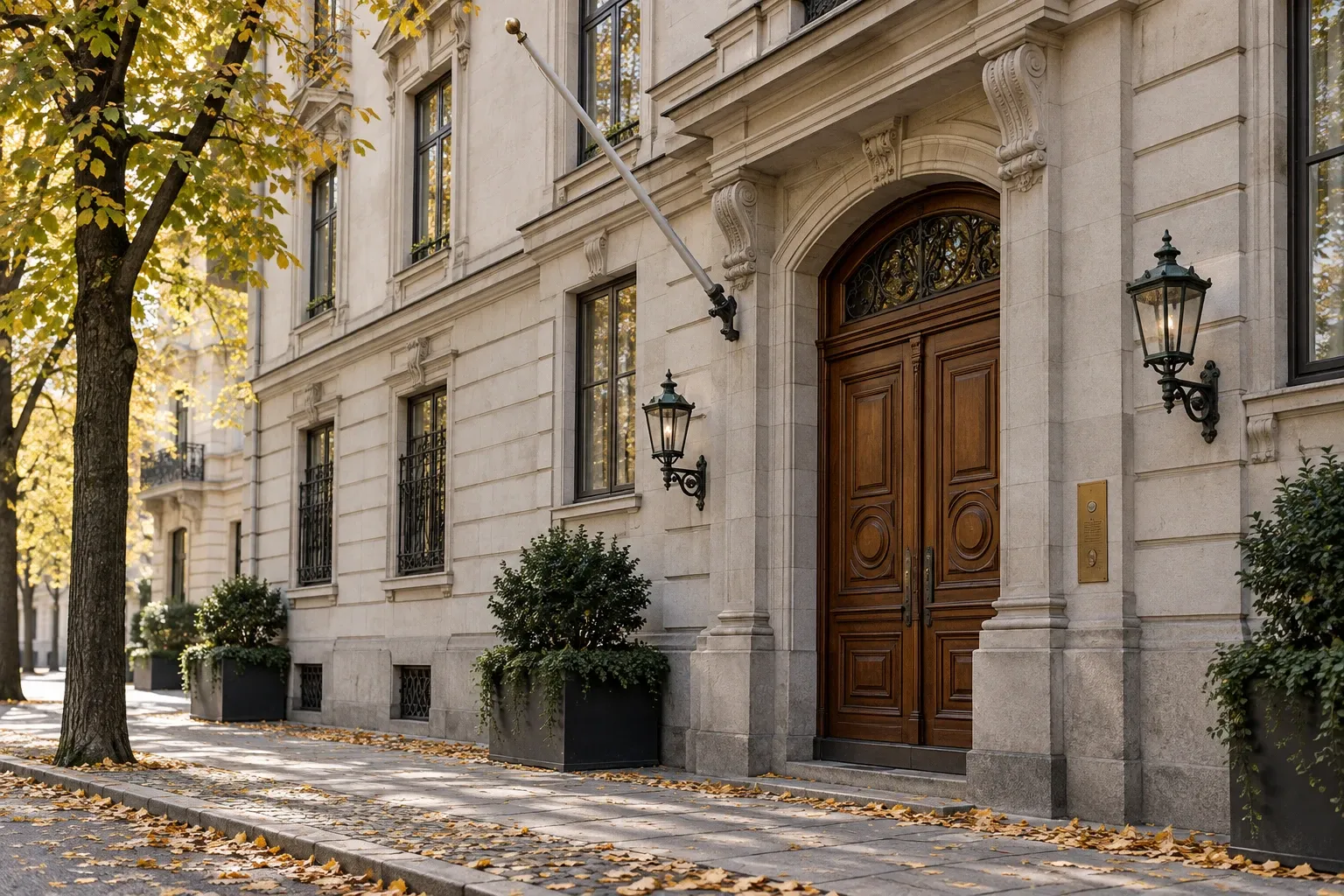
Your embassy is the right call for a lost passport, an arrest, a death or a serious illness. It is the wrong call for an ambulance, a hospital bill or a court case. Here is how to find yours and what to ask it for.
When you need this
Your passport has gone and you need a document to fly home. Someone in your group has been arrested, badly hurt or has died. You have run out of money and can’t reach anyone at home. Or you just want to know, before you travel, whether your country even has an embassy in Sweden.
Emergency first: 112, the police, then the embassy
An embassy is your own government’s office, not a Swedish authority. It can’t send an ambulance or the police. So the order is:
- Danger to life, fire or a crime in progress: call 112.
- Everything else for the police: 114 14, or +46 77 114 14 00 from a foreign mobile.
- Then your embassy, for what only your own state can do.
For a lost passport, that means a police report first, with the case number kept safe, and then the embassy for an emergency travel document. Our guide on what to do about a lost or stolen passport covers the full route.
Finding the embassy that covers Sweden
The authoritative source is the Stockholm Diplomatic List. Sweden’s Ministry for Foreign Affairs (Utrikesdepartementet, UD) publishes it and updates it every month. It lists every foreign mission accredited to Sweden, with its address, phone numbers and often its consular section’s office hours. Your own foreign ministry’s website is the other place to look.
Three things surprise people when they read it:
- Not every embassy is in Sweden. In the 25 September 2026 edition, by our count, about 150 states list an embassy, and roughly a third of them are run from another capital, most often London, Brussels, Berlin or Copenhagen.
- The resident ones are in and around the capital. Nearly all are in Stockholm or nearby municipalities such as Lidingö, Solna and Nacka.
- Few consulates exist outside the capital. The same edition lists just two career consulates-general, both in Gothenburg.
Some embassies come to you now and then. India’s embassy, for example, held a consular camp in Helsingborg on 20 June 2026 for passport renewals, announced on its own website.
Phone before you go. Consular sections commonly work by appointment. Canada’s embassy in Stockholm, for instance, offers consular services by appointment on weekdays and closes on Swedish holidays such as 1 May and Midsummer’s Eve. Many foreign ministries, including the UK’s and Canada’s, run 24-hour emergency lines for their nationals.
What your embassy can do
What any embassy does is set by its own government, not by Sweden. The framework is the 1963 Vienna Convention on Consular Relations. Its list of consular functions includes issuing passports and travel documents, “helping and assisting nationals”, acting as notary and civil registrar, and protecting the interests of minors. Foreign ministries then publish their own rules. The UK, Canada, New Zealand and Germany describe very similar help:
| Situation | What the embassy typically does |
|---|---|
| Lost or stolen passport | Issues an emergency travel document to get you home, usually for a fee |
| Arrested or detained | Visits or contacts you, tells your family with your consent, gives you a list of local lawyers, raises concerns about mistreatment |
| Victim of crime | Gives contact details for police and medical services; UK staff sometimes accompany people to the police station |
| Death of a traveller | Asks the police to inform the family if none are present, gives details of international funeral directors and explains how to register the death |
| Money lost | Puts you in touch with relatives and shows fast ways to transfer money |
| Paperwork | Notarial services, such as a certificate of no impediment for marrying abroad, for a fee |
The UK says consular help itself is free, while specific services such as emergency travel documents and notarial acts cost money. Ask your embassy for its current fee; we don’t publish them because each state sets and changes its own.
What your embassy cannot do
This is where travellers lose time. The four foreign ministries we checked rule out the same things:
- Pay your bills. Hospital, hotel, legal fees, bail and fines stay yours.
- Give legal advice or act as your lawyer. You get a list; you choose and pay the lawyer.
- Get you out of custody or interfere in Swedish criminal or civil proceedings.
- Investigate a crime. That is the Swedish police’s job.
- Get you better treatment than a Swede in the same situation.
- Translate formal documents or provide formal interpreting.
There is a legal reason behind the court rule. Both Vienna Conventions oblige embassy and consular staff to respect Swedish law and not to interfere in Sweden’s internal affairs. The UK is blunt about the rest: “You do not have a legal right to consular assistance.” For most states, help is discretionary. Travel insurance is what pays when the embassy won’t; see travel insurance for Sweden.
Arrested or detained: your right to consular contact
This is the one point where Swedish law gives you a firm right, and many travellers get it wrong. The police do not automatically tell your embassy. The Act on notification when foreign nationals are deprived of their liberty (Lag 1989:152) works like this:
| Your right | What the law says |
|---|---|
| To be told | The authority holding you must tell you without delay that you can have your consulate informed |
| In writing | If you are held on suspicion of a crime, you must get that information in writing, in a language you understand, and may keep it while detained |
| To have the consulate informed | On your request, without delay; messages from you are passed on |
| To be visited | Unless you object, your consul may visit, talk and write to you and help you protect your rights |
So say it clearly: “I want my consulate informed.” Ask for a lawyer as a separate request, because the embassy can give you a list but won’t act as one. The Swedish Act exists to meet Sweden’s obligations under the 1963 Vienna Convention, which also requires Swedish authorities to tell the consulate without delay when a foreign national dies in Sweden. Our guides on your rights if arrested or questioned and the Swedish police and what officers may ask go further.
Out of money
Don’t count on a loan. The UK says it cannot pay your bills or give you money. Canada and Germany describe the realistic route: the embassy helps relatives or friends at home send money to you quickly.
Germany is the instructive exception. Its Consular Act (Konsulargesetz, § 5) allows help only when the emergency can’t be solved any other way, for example by enabling the journey home. The recipient must repay the costs, and relatives and spouses can be liable within their duty of maintenance. If you are German, treat it as a last resort with a bill attached.
Dual nationals, EU citizens and honorary consuls
Dual nationals. The UK limits help to a dual national in the country of their other nationality. Canada warns that local authorities may refuse consular access to a dual citizen. Germany’s statute excludes some dual nationals who live in the other country. The Swedish Act speaks of a foreign national (utlänning), so if you also hold Swedish citizenship, don’t count on consular contact.
EU citizens. Go to your own state’s mission for Sweden, even if it sits in another capital. The rule that lets an “unrepresented” EU citizen use any other EU country’s embassy applies outside the EU, not in Sweden.
Honorary consuls. Many states have part-time honorary consuls in Swedish towns, and they are not embassies. Latvia, for example, says its honorary consuls in Sweden “do not provide consular services”; only its Stockholm embassy does. Other states give theirs limited powers, so ask your foreign ministry before travelling to one for a passport.
Is an embassy foreign territory?
No, despite the popular belief. Under the 1961 Vienna Convention on Diplomatic Relations, embassy premises are inviolable: Swedish officials may not enter without the head of mission’s consent. Nothing in the convention makes the building the other country’s territory, and the same treaty binds staff to respect Swedish law. An embassy can’t shelter you from a Swedish court case or a Swedish bill.
Practical information
| Item | What to know |
|---|---|
| Where to find your embassy | Stockholm Diplomatic List (updated monthly) or your foreign ministry’s site |
| Embassies covering Sweden from abroad | About a third of accredited states (25 September 2026 edition) |
| Consulates-general outside Stockholm | Two, both in Gothenburg (same edition) |
| Emergency numbers first | 112 for danger; police 114 14, or +46 77 114 14 00 from a foreign mobile |
| Consular help itself (UK example) | Free; emergency travel documents and notarial acts carry fees |
| Emergency travel document fee | Set by your state; ask your embassy |
| Legal fees, bail, fines, hospital bills | Yours to pay |
| Consular cash advance (Germany) | Exceptional only, and must be repaid |
| If detained | Ask for your consulate to be informed; it is not automatic |
FAQ
Where is my country’s embassy in Sweden?
Check the Stockholm Diplomatic List, published and updated monthly by Sweden’s Ministry for Foreign Affairs, or your own foreign ministry’s website. Most embassies are in Stockholm or its suburbs, but about a third of the states accredited to Sweden cover it from another capital, such as London, Brussels, Berlin or Copenhagen. A few have consulates-general in Gothenburg.
Will Swedish police tell my embassy if I am arrested?
Only if you ask. Swedish law says the authority holding a foreign national must inform the home consulate without delay on request, and must tell you of that right without delay, in writing in a language you understand if you are suspected of a crime. Unless you object, your consul may then visit, talk and correspond with you.
Can my embassy get me a lawyer or get me out of jail?
No to both, in the usual sense. Embassies give you a list of local lawyers and can tell your family, visit you and raise concerns about mistreatment. They do not hire or pay a lawyer, give legal advice, interfere in Swedish court proceedings or obtain your release. Choose a lawyer yourself, using the embassy’s list as a starting point.
Can my embassy lend me money?
Rarely. The UK says it cannot pay your bills or give you money, and Canada and Germany describe helping relatives send funds quickly. Germany may advance money in strictly defined cases, such as the journey home, and the law makes the recipient repay it. Travel insurance and a transfer from home are the realistic routes.
My country has no embassy in Sweden. Who helps me?
The mission accredited to Sweden from another capital, listed in the Stockholm Diplomatic List with its address abroad. Call it; emergency help is often by phone. EU citizens cannot use another member state’s embassy as “unrepresented” citizens here: that scheme applies outside the EU. Your foreign ministry’s 24-hour line is the fallback.
Is an embassy foreign territory?
No. Under the 1961 Vienna Convention on Diplomatic Relations the premises are inviolable, so Swedish officials may not enter without the head of mission’s consent. That does not make the building foreign soil, and the convention obliges embassy staff to respect Swedish law and not interfere in Sweden’s internal affairs.
Can an honorary consul issue me a passport?
Usually not. Honorary consuls represent a state locally, often promoting trade and culture. Latvia, for example, states that its honorary consuls in Sweden do not provide consular services, which only its Stockholm embassy offers. Some states give honorary consuls limited powers, so ask your foreign ministry before travelling to one.
Related guides
- Lost or stolen passport in Sweden — the police report and the emergency document, step by step.
- 112 and Sweden’s emergency numbers — which number to call before the embassy.
- Your rights if arrested or questioned — lawyers, interpreters and custody beyond consular contact.
- When someone dies while travelling in Sweden — the practical steps the embassy can only help with.
- Travel insurance for Sweden — what pays when the embassy won’t.
Facts verified 2026-10-14. Sources: Government Offices of Sweden (Stockholm Diplomatic List), Sveriges Riksdag (Lag 1989:152), United Nations (Vienna Conventions 1961 and 1963), Polismyndigheten, European Commission, UK FCDO, Global Affairs Canada, NZ MFAT, German Federal Foreign Office (Konsulargesetz) — full register in this topic’s source file. Found something outdated? Tell us and we’ll fix it.