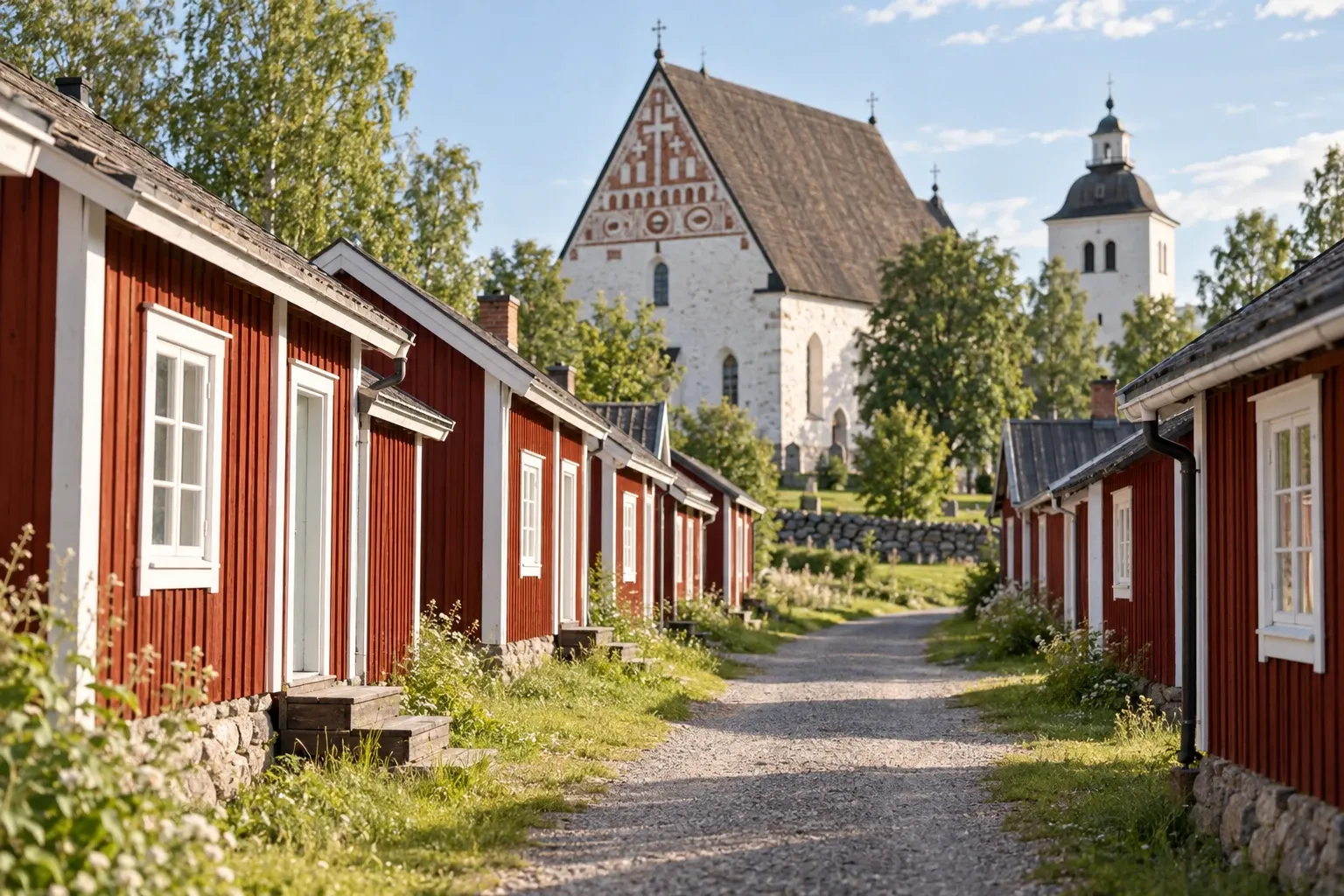
Northern Sweden has a type of village found almost nowhere else: hundreds of small red cottages packed around a church, empty most weekends. This guide explains what they are, how to visit Gammelstad well, and which other church towns are worth a stop.
When you need this
You’re in Luleå and wondering whether Gammelstad deserves half a day. Or you saw kyrkstad on a road sign on the Bothnian coast and want to know what it is. Maybe you want to see inside a church cottage, or even sleep in one. Or you’re planning a trip around Midsummer or a church weekend, when these places come alive.
What a church town is
A church town is a group of small cottages, sheds and stables built next to a parish church as somewhere to sleep. In the north, parishes were huge and the roads were slow. Farmers who lived far from the church stayed overnight for Sunday services and church festivals. They also came for parish meetings, markets and court sessions. Between those weekends the town stood empty with its shutters closed.
The trips were not optional. A church-attendance duty from 1681 expected people living within a mil (10 km) of the church to attend every Sunday. Those further away came at longer intervals, and everyone came for the great festivals. The duty lasted until 1849. Over time the church weekends also became where people met: news was swapped, and youth weekends often ended in weddings.
Church towns once stood across Norrland, and in Norway and Finland too. In Sweden they survive only in the far north. A 2003 government inquiry counted church-town buildings at 71 places and found them surviving at 16:
| County | Surviving church towns |
|---|---|
| Norrbotten (8) | Gammelstad, Öjebyn, Lappstaden in Arvidsjaur, Boden, Hortlax, Norrfjärden, Råneå, Älvsbyn |
| Västerbotten (7) | Bonnstan in Skellefteå, Lövånger, Burträsk, Byske, Ammarnäs, Fatmomakke, Vilhelmina |
| Jämtland (1) | Ankarede in Strömsund municipality |
Some are large and whole; Råneå has about ten cottages left. Inland, in the old Sámi lands, church towns look different. Lappstaden, Fatmomakke and Ammarnäs are wholly or partly made of Sámi kåtor (timber huts) and storehouses rather than farmers’ cottages.
Gammelstad: what you are looking at
Gammelstad, about 10 km northwest of central Luleå, is the largest and best-preserved church town in Sweden. UNESCO added it to the World Heritage List on 7 December 1996. Tourism has quadrupled since then, SVT reported in 2026, the site’s 30th anniversary year.
The numbers vary slightly between official sources. The World Heritage property counts 520 protected buildings. About 405 of them are church cottages, divided into some 552 chambers. The rest are the merchants’ and officials’ houses of a short-lived town.
That town is the twist in the story. In the 1600s the place received town rights. But the land was slowly rising out of the sea (land uplift), and the harbour grew too shallow. So the town moved to where Luleå stands today, and the old site became Gammelstad, the “old town”. Because trade left, the church town survived untouched by later industry.
Three things to look at:
- Nederluleå church. Norrland’s largest medieval church was, by tradition, inaugurated on 29 June 1492. Inside are an altarpiece made in Antwerp around 1520 and choir paintings from the early 1500s, attributed to Albertus Pictor’s workshop or school. Its 39-metre bell tower was finished in 1852.
- The street plan. Medieval lanes radiate from the church on its hill, and a 1600s grid runs toward the old harbour. UNESCO cites the plan, preserved whole, as a main reason for the listing.
- The cottages. Most have one or two chambers, and no two are quite alike. Shutters closed means no church weekend is on.
Visiting a living church town
Gammelstad is not an open-air museum. About 800 people live within the World Heritage boundary, and the cottages belong to families who still use them. The parish holds a kyrkhelg (church weekend) three or four times a year, when owners stay over. Each summer’s confirmation group still sleeps in the cottages, as their grandparents did.
The area is also a protected ancient-monument area. The county board asks visitors to be careful with buildings and ground alike; beneath the lanes lies a layer of almost 900 years of remains. The rules on the ground are simple:
- Walk the lanes, but keep out of yards and doorways and leave doors and shutters alone.
- Keep dogs on a leash outdoors; they are not allowed in the buildings.
- Take off ice grips and spiked shoes before going indoors; the floors are sensitive.
- Don’t smoke indoors or close to buildings.
- At church ceremonies, only relatives and guests may take photos.
The area suits wheelchairs and prams, though bad weather limits access. The church has one adapted entrance, and the visitor-centre exhibition has a lift.
Start at the visitor centre. Its interactive exhibition on the church town’s history is free, and you can download brochures in English, German and French. Guided tours run all year and are booked on Gammelstad’s website. You don’t need to book anything just to walk around. For bus 9, parking and the rest of the city, see our Luleå travel guide.
Seeing inside a cottage
Most cottages are private and shuttered, so plan if you want to see an interior:
| Where | What | When |
|---|---|---|
| Gammelstad | Exhibition cottage 253–254, run by the local history association | Weekends, May–September |
| Gammelstad | Guided tour from the visitor centre | All year, booked online |
| Öjebyn, Piteå | Show cottage no. 28, from 1804 | Summer |
Sleeping in one is possible, just not at Gammelstad. In Lövånger, south of Skellefteå, church cottages are let to visitors. Piteå museum’s survey also reports commercial letting in Vilhelmina and Boden. In those three places, the museum notes, renting has replaced the old tradition of family-owned cottages.
The other church towns
If Gammelstad hooks you, several more are within easy reach of the coast road or the inland routes:
- Öjebyn (Piteå). One of the largest church towns, with a living tradition. It began as a medieval trading place, and its stone church was first completed in the late 1400s. In summer there are guides on site, a summer museum and the show cottage.
- Lappstaden (Arvidsjaur). Norrbotten’s only Sámi church town has 32 kåtor and 54 storehouses on posts. All are privately owned, and it has been a listed building since 1948. At the end of August the local Sámi association’s Storstämningen weekend fills it with lasso-throwing contests. Read our Sámi culture guide before you go.
- Bonnstan (Skellefteå). 116 privately owned houses with almost 400 chambers. It was rebuilt after a fire in 1835 and has been legally protected since 1982. Historical walks run in spring, summer and autumn; see our Skellefteå guide.
- Lövånger (Skellefteå). 117 cottages around a grey-stone church from the early 1500s, and the place to sleep in a church cottage.
When to go
| Period | What you get |
|---|---|
| 11 June – 16 August | Gammelstad’s visitor centre open 10:00–18:00; Hägnan’s farmhouses and most animals there from late June |
| Late June | Midsummer and confirmation, when cottages are most used; Öjebyn’s weekday guides start |
| End of August | Storstämningen in Arvidsjaur |
| Church weekends | Three or four a year at Gammelstad; check the parish calendar |
| Rest of the year | Lanes open at all hours; visitor centre 12:00–16:00, closed over Christmas and New Year |
Winter is quiet but beautiful, with red cottages under snow. Just bring grips for the icy lanes and take them off at the door. The 2026 anniversary year ended with its last weekend on 9–11 October.
Practical information
| Item | Detail (checked 2026-10-15) |
|---|---|
| Gammelstad church town | Free, open at all hours |
| Visitor-centre exhibition | Free |
| Visitor-centre hours | 12:00–16:00 daily; 10:00–18:00 from 11 June to 16 August; 10:00–16:00 from 17 to 31 August; closed 24–26 Dec and 31 Dec – 1 Jan (2026) |
| Hägnan open-air museum | Free; occasional fee at larger events |
| Parking | Free, except during some larger Hägnan events |
| Nederluleå church | Usually Monday–Wednesday 11:00–15:00; Sunday mass 11:00; ceremonies take priority |
| Exhibition cottage 253–254 | Weekends, May–September |
| Guided tours | Booked and priced on Gammelstad’s website |
| Öjebyn guides | Weekdays 10:00–17:00, 26 June – 31 July (2026) |
| Distance from Luleå | About 10 km |
FAQ
What is a church town in Sweden?
A kyrkstad is a cluster of small cottages next to a parish church, built so families from distant villages could stay overnight for Sunday services, festivals, parish meetings and markets. A church-attendance duty from 1681 made the journeys regular. Church-town buildings once stood at 71 places; 16 survive, all in Norrbotten, Västerbotten and Jämtland.
Is Gammelstad free to visit?
Yes. The church town is an open area you can walk at any hour, and the visitor centre’s exhibition and the Hägnan open-air museum are free. Hägnan occasionally charges, and parking is charged then too, at some larger events. Guided tours are paid and booked on Gammelstad’s website. The church keeps limited opening hours.
Can you go inside the church cottages?
Usually not, because they are private family property and most are shuttered outside church weekends. To see an interior at Gammelstad, use the exhibition cottage, open at weekends from May to September, or join a guided tour. In Öjebyn near Piteå, show cottage no. 28 from 1804 is open in summer.
Can you stay overnight in a church cottage?
Not at Gammelstad, where owners use their own cottages at church weekends and confirmations. In Lövånger, south of Skellefteå, church cottages are let to visitors, and Piteå museum’s survey reports commercial letting in Vilhelmina and Boden too. In those places the old owner tradition has given way to rental.
Which other church towns can I visit?
Öjebyn in Piteå has summer guides and a show cottage. Lappstaden in Arvidsjaur is a Sámi church town of huts and storehouses. Bonnstan in Skellefteå has 116 houses rebuilt after an 1835 fire. Lövånger has 117 cottages around an early-1500s church. Smaller survivors include Råneå, Burträsk, Byske and Fatmomakke.
When is the best time to visit Gammelstad?
From mid-June to mid-August, when the visitor centre opens 10:00–18:00, Hägnan’s farmhouses and animals are there, and Midsummer brings confirmation and church-weekend life. Outside summer the lanes are open at all hours but the visitor centre opens only 12:00–16:00. In winter the red cottages under snow are quiet and beautiful.
Related guides
- Luleå travel guide — bus 9, parking and what else to do in the city.
- UNESCO World Heritage sites in Sweden — Sweden’s other World Heritage sites, and which pair with Gammelstad.
- Visiting Swedish churches — opening hours, concerts and etiquette in a working church.
- Skellefteå guide — Bonnstan, Lövånger and the coast around them.
- Northern Sweden summer road trip — a loop that starts at Gammelstad.
Facts verified 2026-10-15. Sources: UNESCO World Heritage Centre, Länsstyrelsen Norrbotten, Riksantikvarieämbetet, the Gammelstad visitor centre, Nederluleå and Piteå parishes, Piteå museum (citing SOU 2003:81), Skellefteå museum, SVT, Sveriges Radio — full register in this topic’s source file. Found something outdated? Tell us and we’ll fix it.