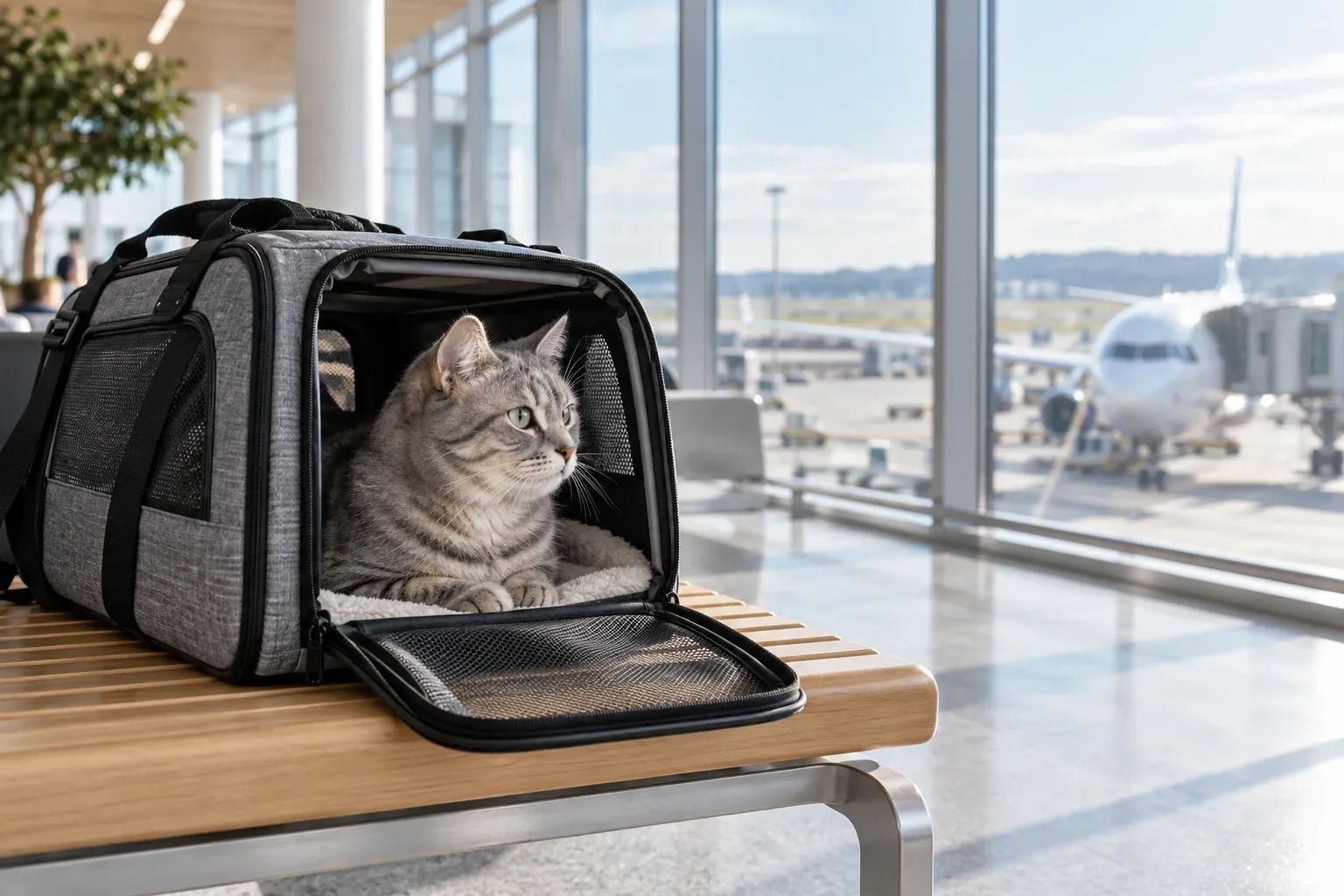
Most pet-travel guides are written for dogs and add “cats too” at the end. Here is what actually differs for cats, ferrets, rabbits, rodents and pet birds coming to Sweden, under the EU rules in force since April 2026.
When you need this
You’re bringing a cat or ferret by car, ferry or plane, crossing from Norway, moving here with a cat, or travelling with a rabbit, guinea pig or budgie. If you’re bringing a dog, our dog entry guide covers the extras that only apply to dogs.
Cats and ferrets: the shared core
Since 22 April 2026, Sweden’s pet-travel rules come from the EU Animal Health Law and Delegated Regulation (EU) 2026/131, not the older Regulation 576/2013. Cats and ferrets follow exactly the same rules as dogs, in three origin groups set by Jordbruksverket (the Swedish Board of Agriculture):
| Travelling from | What your cat or ferret needs |
|---|---|
| EU, Norway, Switzerland, Iceland, a few microstates | Microchip → rabies vaccination → 21 days → EU pet passport |
| Listed non-EU countries (UK, USA, Canada, Australia, Japan …) | Chip, rabies, 21 days, animal health certificate + owner declaration |
| All other countries (e.g. Brazil, China, Russia, Thailand, Turkey) | All of the above, plus a titre blood test and a 90-day wait |
Three details trip people up:
- The chip goes in first. It must be fitted before, or at the latest on the same day as, the rabies vaccination. A vaccination given before the chip is invalid, and the 21-day wait starts over after revaccination.
- Kittens can’t travel young. The rabies shot can be given from 12 weeks, so a kitten can travel at about 15 weeks at the earliest.
- New chips must be approved. A cat chipped in Sweden on or after 22 April 2026 needs a chip approved by Jordbruksverket to get a passport. Older chips, and chips fitted outside the EU, don’t need replacing. A readable tattoo documented as applied before 3 July 2011 also still counts.
New Swedish EU pet passports are only issued to people permanently resident in Sweden. Passports already issued stay valid.
Where cats differ from dogs
There is no quarantine for cats in Sweden. Jordbruksverket says so directly: a cat arriving with wrong or incomplete papers can be refused entry and sent back, or in the worst case put down. If your cat’s chip isn’t an ISO chip, carry your own reader; an unreadable chip has the same consequences.
No tapeworm treatment — not for Sweden, not for Norway. Sweden requires no deworming for any pet, because the fox tapeworm already occurs here (Jordbruksverket recommends it but doesn’t require it). Norway’s tapeworm rule covers dogs only. Mattilsynet, the Norwegian food safety authority, states that cats and ferrets entering Norway don’t need to be medicated.
Norway is the easy neighbour. A cat travelling with its owner directly from Norway needs a chip and a passport but no rabies vaccination. That exemption ends if the cat changes owner, travels without you, or is one of more than five animals. Buying a kitten in Norway, you have to travel with it, or within five days of it, for the exemption to apply.
From the UK, the US and further afield
From a listed country such as the UK or the USA, your cat needs the chip, the rabies vaccination and the 21-day wait, plus an animal health certificate (form E9.207) completed by an official vet and a signed owner declaration. You then have 10 days from the stamp to reach an EU travellers’ point of entry. Flying directly into Sweden from outside the EU, that means Stockholm Arlanda or Göteborg Landvetter; no other Swedish airport accepts direct pet arrivals. Once stamped, the certificate is valid for onward travel in the EU for six months, or until the rabies vaccination expires.
No titre test is required from listed countries, but Jordbruksverket recommends one: some vaccinated cats imported to Sweden turned out to have too little antibody protection.
British readers: since 22 April 2026, Great Britain residents can no longer travel into the EU on an EU-issued pet passport. You need an animal health certificate before each trip.
From a high-risk rabies country, add the titre test: a blood sample at least 30 days after vaccination, analysed by an EU-approved lab, showing at least 0.5 IU/ml. The certificate can’t be issued until 90 days after the sample. Jordbruksverket grants no exemptions, so plan for three months or more. Malaysia and Australia are listed countries but carry extra requirements because of Nipah and Hendra disease.
Leaving Sweden for a high-risk country and coming back? Do the titre test before you go and have it recorded in the EU passport. Then no 90-day wait applies on your return.
Customs: report your cat — except from Norway
Dogs and cats must be reported to Tullverket (Swedish Customs) on entry. Not doing so can count as an offence under the Swedish smuggling act, and the animal can be refused entry.
| Arriving from | How to report |
|---|---|
| Another EU country, you live in the EU, EU pet passport | Online before crossing, then the green lane |
| Another EU country, other cases | Red lane (röd fil) at the border |
| Norway, cat chipped with EU or Norwegian pet passport | No report needed |
| Iceland or Switzerland | Red lane at any border crossing |
| Outside the EU | Red lane at Arlanda or Landvetter |
The Norway exemption comes from Tullverket’s own page; Jordbruksverket’s general wording still says to report at the border, so if in doubt, use the red lane. Bought the cat outside the EU? Customs duty and VAT may be due on its value. From Norway, a bought cat only needs reporting above a value threshold, given in the table below.
For everything else in your luggage, see our customs allowances guide.
Moving here: the cat register
Since 1 January 2023, every cat that lives in Sweden must be ID-marked and registered with Jordbruksverket. That covers indoor and outdoor cats alike. A cat brought in after three months of age must be registered within four weeks of entry, and chipped or tattooed within the same period if it isn’t already.
The duty applies to cats kept permanently in Sweden, so a cat on holiday is exempt. Cats born before 1 January 2008 are exempt too. A voluntary registration with SVERAK or SKK (the cat-club and kennel-club registers) doesn’t count. The registration fee is in the table below. If you’re relocating, our guide to moving to Sweden for work covers the rest of the paperwork.
Rabbits, rodents and pet birds
Smaller pets have their own, mostly lighter, rules. Whatever the species, the animals must be bred in captivity. Wild-caught animals can’t be kept as pets, and you can bring five at most, travelling with you (or within five days of you) and not for sale.
| Pet | From the EU, Norway or Switzerland | From outside the EU |
|---|---|---|
| Rabbits | No certificate; any border crossing | Arlanda or Landvetter, shown to Tullverket |
| Guinea pigs, hamsters, rats and other rodents | No certificate; any border crossing | Arlanda or Landvetter, shown to Tullverket |
| Pet birds | No certificate or owner declaration; birds must be healthy | Health certificate, owner declaration, avian-influenza conditions, Arlanda or Landvetter, 30 days’ isolation at home |
Bringing a bird from outside the EU is the hard case. The bird needs individual marking and a vet check within 48 hours of departure. It also needs one of three avian-influenza safeguards: 30 days’ isolation in a listed country, H5/H7 vaccination, or 14 days’ isolation plus a test. Sweden has no approved quarantine facility for birds, so a bird that can’t meet these conditions has to enter the EU via a quarantine in another member state.
Animals that break the rules can be seized, quarantined or put down at the border. If customs can’t tell what species an animal is, you pay for the expert check. For reptiles, exotic mammals and anything endangered, check with Jordbruksverket before you travel. Species protected under CITES need a permit to cross the border, and breaches can lead to fines or prison.
Animals you can’t keep in Sweden
No domestic cat breed is banned. But Sweden bans keeping a few kinds of animal as pets, whatever their papers say:
- Monkeys, birds of prey and carnivores other than dogs, cats, badgers and domestic ferrets
- Wild-caught animals of any species
- Cat–wild-cat hybrids up to the fourth generation. A cross between a domestic cat and a wild cat such as a serval may not be kept or sold for four generations; from the fifth generation it counts as a domestic cat. Owners of Savannah-type cats should check the generation before travelling.
On the road
Keep the cat in a secured carrier and offer water at least every six hours. On trips over six hours, use a carrier with a litter tray. Never leave it in a car where the temperature could rise above +25 °C or fall below −5 °C. Even in mild weather, a cat may stay in a parked car for three hours at most. If your cat flies, the airline’s own rules apply on top of the entry rules.
Cats aren’t covered by Sweden’s 1 March–20 August dog-supervision period, but owners must still keep them from causing damage or a real nuisance. For a vet once you’re here, see vets in Sweden.
Practical information
| Item | Detail |
|---|---|
| Legal basis (cats, ferrets) | Reg. (EU) 2016/429 + Delegated Reg. (EU) 2026/131, since 22 April 2026 |
| EU / Norway group | Chip → rabies (from 12 weeks) → 21 days → EU pet passport |
| Norway → Sweden with owner | No rabies vaccination; chip and passport still needed |
| Listed non-EU (UK, USA …) | Chip, rabies, 21 days, health certificate E9.207 + owner declaration |
| Unlisted non-EU | Plus titre ≥ 0.5 IU/ml, sample ≥ 30 days after vaccination, certificate ≥ 90 days after sample |
| Direct non-EU entry | Arlanda or Landvetter only |
| Customs | Online (EU residents) or red lane; not needed from Norway with chip + passport |
| Quarantine for cats | None in Sweden |
| Tapeworm treatment for cats | Not required, into Sweden or Norway |
| Maximum animals | Five dogs, cats or ferrets per private vehicle; five rabbits, rodents or birds |
| Swedish entry fee | None listed |
| Cat register (residents) | Within four weeks of entry; 40 kr online, 100 kr by form (checked 2026-10-15) |
| Cat bought outside the EU | Duty and VAT on value; from Norway only above 3,500 kr |
| Pet birds from outside the EU | Health certificate + 30 days’ isolation at home |
| Banned | Monkeys, birds of prey, most carnivores, wild-caught animals, hybrids to 4th generation |
FAQ
What does my cat need to enter Sweden from another EU country?
A microchip fitted before or on the day of the rabies vaccination, a rabies vaccination given from 12 weeks of age and at least 21 days before travel, and an EU pet passport. No tapeworm treatment is needed. Report the cat to Tullverket online before you cross if you live in the EU, otherwise at the red channel.
Does my cat need tapeworm treatment for Sweden or Norway?
No. Sweden requires no deworming for cats from any country, because the fox tapeworm already occurs here; Jordbruksverket recommends it but does not require it. Norway’s tapeworm rule covers dogs only: Mattilsynet states that cats and ferrets entering Norway do not need to be medicated. Dogs heading for Norway still need a treatment 24 to 120 hours before.
Can I bring my cat to Sweden from the UK or the USA?
Yes. Both are listed countries: microchip first, rabies vaccination, a 21-day wait, an animal health certificate from an official vet plus an owner declaration, and direct arrival at Arlanda or Landvetter. No titre test is required, though Jordbruksverket recommends one. Since 22 April 2026, Great Britain residents can no longer use EU-issued pet passports.
Do I have to declare my cat at Swedish customs?
Yes, in most cases. EU residents arriving from another EU country with an EU pet passport can report online and use the green channel; travellers from outside the EU, Iceland or Switzerland use the red channel. Arriving from Norway, you need not report a chipped cat with a pet passport. An unreported cat can be refused entry.
Is there quarantine for cats in Sweden?
No. Jordbruksverket states that Sweden has no quarantine for cats. A cat arriving with incorrect or incomplete documents can be refused entry and sent back, or in the worst case put down. That makes the paperwork, especially chip-before-vaccine and the 21-day wait, the thing to get right before you leave.
Do I need to register my cat in Sweden?
Only if the cat lives here. Since 1 January 2023 every cat kept in Sweden must be ID-marked and registered with Jordbruksverket; a cat brought in after three months of age must be registered within four weeks of entry. It costs 40 kr online. Cats on holiday and cats born before 2008 are exempt.
Can I bring a rabbit, guinea pig or pet bird to Sweden?
Yes. Up to five rabbits, rodents or pet birds travelling with you from another EU country, Norway or Switzerland need no health certificate, provided they were bred in captivity and are not for sale. From outside the EU they must arrive at Arlanda or Landvetter; birds also need a health certificate and 30 days’ isolation at home.
Are any cats or pets banned in Sweden?
No domestic cat breed is banned, but cats crossed with wild cats such as servals may not be kept up to the fourth generation. Monkeys, birds of prey and carnivores other than dogs, cats, badgers and domestic ferrets are banned as pets, as are wild-caught animals. Endangered species need a CITES permit.
Related guides
- Bringing your dog to Sweden — the dog rules, Norway tapeworm and the leash law
- Customs allowances — red and green lanes for everything else you carry
- Vets in Sweden — finding a vet once you’re here
- Crossing the Sweden–Norway border — the road crossings where the pet exemptions apply
- Arlanda airport guide — one of the two airports that accept pets from outside the EU
Facts verified 2026-10-15. Sources: Jordbruksverket (Swedish Board of Agriculture), Tullverket (Swedish Customs), Sveriges riksdag, EUR-Lex, Mattilsynet, British Veterinary Association — full register in this topic’s source file. Found something outdated? Tell us and we’ll fix it.