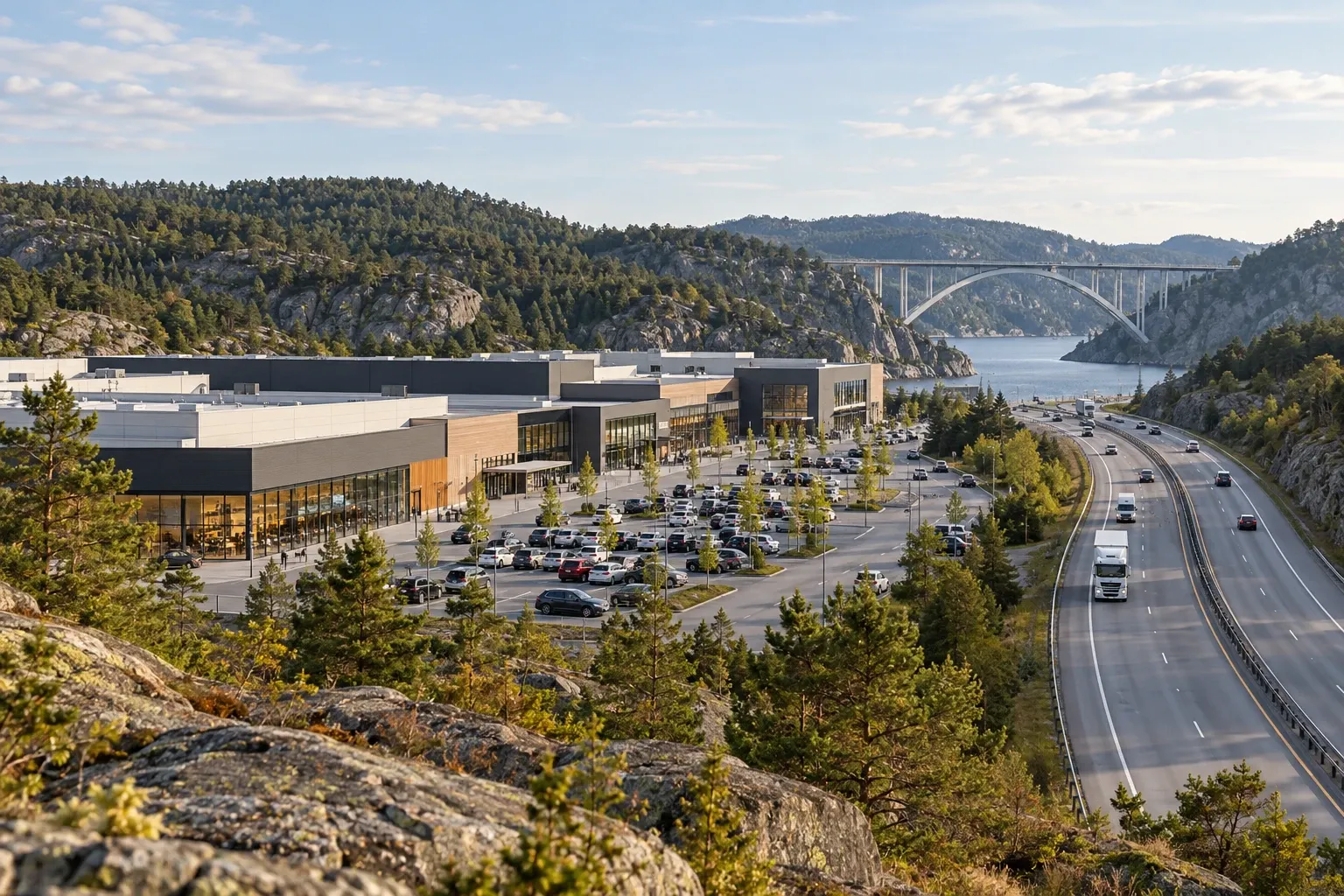
Drive into Sweden from Norway and the first thing you meet is often a car park the size of a small airport. That’s grensehandel, Norwegian border shopping, and it runs on taxes. Here’s why it exists, where it happens and what it means if you shop there yourself.
When you need this
You’re driving the E6 from Oslo toward Gothenburg, or heading east from Oslo into Värmland, and wonder why towns of modest size have such big shops right at the border. Or you’re staying in Norway and want to know if a grocery run to Sweden is worth it. Or you’re planning a Strömstad or Charlottenberg stop and want to miss the crowds. And if you’re carrying anything back into Norway, you need to know the limits first.
Why Sweden is cheaper: four reasons
The price gap isn’t about shops being generous. It’s built into tax and trade policy, mostly on the Norwegian side.
| Driver | Norway | Sweden |
|---|---|---|
| VAT on food | 15% | 6% since 1 April 2026, until 31 December 2027 (was 12%) |
| VAT on alcohol and tobacco | 25% | 25% |
| Farm import duties | Set to protect domestic production | EU customs union, no duties within the EU |
| Alcohol excise | About 1.8 times Sweden’s on spirits, about 2.5 times on wine and strong beer | Lower, though high for Europe |
Norway sits outside the EU and its customs union. It charges import duty on farm goods “to protect our own production”, in Norwegian Customs’ own words, and the rate can change with the season: apples, for example, carry more duty in autumn. Then add the alcohol tax gap. For the full Nordic picture, see alcohol prices in Sweden versus its neighbours.
The result shows up in Eurostat’s price level index (EU average = 100). In 2024, food stood at 130.6 in Norway against 106.7 in Sweden, about 22% higher. Soft drinks were about 33% higher, and alcohol about 55%. Those figures predate Sweden’s April 2026 food VAT cut, which widened the tax gap on groceries.
The fourth driver is the exchange rate. When the Swedish krona is strong, the saving shrinks. On 14 October 2026, 1 Norwegian krone bought 1.05 Swedish kronor.
Norway has tried to pull shoppers home. It abolished its tax on chocolate and sugar goods on 1 January 2021, and taxes on soft drinks and sweets were removed in 2021 to curb border trade. The Norwegian Institute of Public Health found no clear effect: in autumn 2022, 74% of day-trippers still bought sweets or soft drinks, averaging 1.6 kg of sweets and 10.5 litres of soft drinks per trip.
Where Norwegians shop
Statistics Norway (SSB) tracks spending by people living in Norway on day trips abroad, meaning any trip without an overnight stay. In 2025 they spent NOK 11.3 billion on 5.0 million such trips, and 88% of the money was spent in Sweden. Three places dominate.
| Destination | Spending 2025 | Share | Day trips 2025 |
|---|---|---|---|
| Strömstad, Svinesund and Nordby (E6, Bohuslän) | NOK 5.7 billion | 50% | 2.5 million |
| Charlottenberg (Eda, Värmland) | NOK 1.6 billion | 14% | 0.7 million |
| Töcksfors (Årjäng, Värmland) | NOK 0.8 billion | 7% | 0.4 million |
| Rest of Sweden | NOK 1.9 billion | 17% | 0.9 million |
| Other countries | NOK 1.3 billion | 12% | 0.5 million |
Töcksfors is the riser: its spending roughly doubled between 2023 and 2025. The Swedish side shows the same scale. Strömstad’s grocery stores sold SEK 8.0 billion of goods in 2023, against SEK 1.9 billion in Eda and SEK 1.0 billion in Årjäng. The dependence works both ways. When the border closed in 2020, grocery sales in Sweden’s border municipalities fell 35%. When it reopened, Strömstad’s April–June grocery sales went from SEK 305 million in 2021 to SEK 1.9 billion in 2022.
What goes in the basket
Food and groceries are the largest single item, about 40% of 2025 spending. The rest of the basket, in NOK:
| Category | Spending 2025 |
|---|---|
| Food and groceries | 4.5 billion |
| Cafes and restaurants | 974 million |
| Soft drinks and mineral water | 887 million |
| Wine and spirits | 739 million |
| Snus | 670 million |
| Beer and cider | 622 million |
| Cigarettes and tobacco | 553 million |
| Chocolate and sweets | 537 million |
| Fuel | 495 million |
Alcohol is a smaller share than the stereotype suggests. The Swedish research body CAN puts Norwegian border trade in alcohol at about 0.43 litres of pure alcohol per Norwegian adult a year in 2022–2025, down about 23% on 2016–2019. A typical day trip averaged about NOK 2,250 of spending in 2025.
The trade in 2026: weaker krone, paused statistics
Two things changed this year, and most write-ups have missed both.
First, the trade dipped. In the first quarter of 2026, people in Norway made 18% fewer day trips abroad than a year earlier, and food spending fell 18.7%. Total spending held at NOK 2.5 billion, because each trip got bigger. SSB put the dip down to a strong Swedish krona, which makes Sweden “less profitable” for Norwegian shoppers.
Second, SSB has postponed its border-trade statistics. Its statistics page now says publication is delayed because of problems with the data, with no new date set. So nobody can yet say with official numbers whether Sweden’s food VAT cut on 1 April 2026 pulled more Norwegians across. If you see a confident figure for mid-2026, it isn’t from SSB.
What it means for visitors
Expect crowds around Norwegian holidays. SSB says border shopping rises around holidays and holiday periods, with Easter traditionally the peak. Norwegian dates matter more than Swedish ones, because the shoppers come from Norway. If you just want to see Strömstad or use the E6 without queues, plan around them.
Pay in kronor, by card. Sweden’s currency is the krona. No rule obliges a Swedish shop to take Norwegian cash; some border shops may, at their own choice and rate. See exchanging currency in Sweden.
There’s more to Strömstad than shopping. It’s the gateway to the Koster islands and the northern Bohuslän coast. See Strömstad and the northernmost west coast and the west coast road trip to the Norwegian border.
Tax-free isn’t the answer for Norway residents. Sweden’s ordinary tourist refund scheme (200 kr minimum) doesn’t cover people living in Norway. They need a purchase of at least 1,000 kr excluding VAT, imported into Norway with Norwegian VAT paid. Details are in VAT refunds in Sweden.
Doing the run yourself: the limits that bite
Staying in Oslo and tempted by a Swedish grocery run? Norway’s customs rules apply to anyone entering Norway, tourists included. On a trip shorter than 24 hours, these are the ones that matter:
- Value limit: NOK 3,000 of goods once in 24 hours, not counting alcohol and tobacco. After more than 24 hours abroad it’s NOK 6,000.
- Alcohol: 1 litre of spirits, 1.5 litres of wine and 2 litres of beer per person, with swap rules. On a day trip this counts only for goods with tax paid in the EEA. Norwegian Customs’ own example: Systembolaget in Strömstad counts, the ferry’s tax-free shop doesn’t. Keep the receipts.
- Tobacco: 200 cigarettes or 250 g for visitors living outside Norway, half that for Norwegian residents.
- Meat and cheese: 10 kg in total per person over 12.
- Banned: nicotine pouches without tobacco, the Swedish “white snus”. They’re confiscated.
- One item, one value: you can’t split an item across trips or people, and an item over the limit carries duty on its full value.
Over the limit? Declare before you cross: alcohol and tobacco in Norwegian Customs’ Kvoteappen, or any goods at a staffed office’s red channel. It’s far cheaper than being caught. Fifteen litres of wine over the quota costs NOK 1,065 to declare, or a NOK 9,900 fine plus confiscation. The full tables, both directions, are in crossing the border between Sweden and Norway, and snus rules in snus: the rules for taking it home.
Practical information
| Item | Amount or rule |
|---|---|
| VAT on food, Sweden | 6% from 1 April 2026 to 31 December 2027 (previously 12%) |
| VAT on food, Norway | 15%; alcohol and tobacco 25% |
| Price level, food, 2024 (EU = 100) | Norway 130.6, Sweden 106.7 |
| Price level, alcoholic drinks, 2024 (EU = 100) | Norway 225.8, Sweden 145.8 |
| Norway value limit, day trip | NOK 3,000, once in 24 hours |
| Norway value limit, over 24 hours | NOK 6,000 |
| Fine for 15 L wine over the quota | NOK 9,900 plus confiscation (NOK 1,065 if declared) |
| Average spend per Norwegian day trip, 2025 | About NOK 2,250 |
| Exchange rate, 14 October 2026 | 1 NOK = 1.05 SEK |
| Individual shop prices | Not published here: they change weekly and by chain |
FAQ
Why do Norwegians shop in Sweden?
Because most everyday goods cost less there. Norway charges 15% VAT on food against Sweden’s 6% since April 2026, protects its farmers with import duties, and taxes alcohol at about twice Sweden’s rate. Eurostat put Norwegian food prices about 22% above Swedish ones in 2024 and alcohol about 55% above. The gap shrinks when the Swedish krona is strong.
Where do Norwegians go border shopping in Sweden?
Mostly to three places. The Strömstad area, including Svinesund and Nordby on the E6, took half of all Norwegian day-trip spending in 2025. Charlottenberg in Värmland took 14% and Töcksfors 7%. The rest is spread along the border further north, and 12% goes to other countries.
How much can I bring back to Norway after a day in Sweden?
Per person: 1 litre of spirits, 1.5 litres of wine and 2 litres of beer, with swap rules, plus goods worth up to NOK 3,000 once in 24 hours. Meat and cheese are capped at 10 kg. On a same-day trip the alcohol quota counts only for goods with Swedish tax paid, so not tax-free. Declare anything more in Kvoteappen before crossing.
Is alcohol cheaper in Sweden than in Norway?
Yes, clearly, even though Sweden is expensive by European standards. Norway’s alcohol excise is about 1.8 times Sweden’s on spirits and about 2.5 times on wine and strong beer at the October 2026 exchange rate. Eurostat’s 2024 price level for alcoholic drinks was 225.8 in Norway against 145.8 in Sweden. Norwegian residents still bring home far more food than alcohol.
Can I pay with Norwegian kroner in Strömstad or Charlottenberg?
Plan to pay in Swedish kronor, by card. Sweden’s currency is the krona, and no rule obliges a Swedish shop to accept Norwegian cash. Some border shops may take it, but that is each shop’s own choice, at its own rate. A card payment charged in kronor is the reliable option wherever you shop in Sweden.
When are the Swedish border shops busiest?
Around holidays and holiday periods, according to Statistics Norway, with Easter traditionally the peak. Norwegian holidays matter more than Swedish ones, because the shoppers come from Norway. If you only want to see Strömstad or Charlottenberg, or need a quick stop on the E6, plan around Norwegian holiday dates.
Related guides
- Crossing the border between Sweden and Norway — every allowance in both directions, plus Kvoteappen, dogs and tolls.
- Alcohol prices in Sweden versus its neighbours — why Sweden is cheap next to Norway and dear next to Germany.
- Systembolaget: how Sweden’s alcohol monopoly works — the shop your day-trip receipts will come from.
- Snus: the rules for taking it home — what Norway accepts and what it confiscates.
- Grocery prices in Sweden — what a Swedish shop actually costs.
Facts verified 2026-10-15. Sources: SSB (Statistics Norway), SCB (Statistics Sweden), Eurostat, Tolletaten, Skatteetaten, Skatteverket, FHI, Sveriges riksbank, CAN — full register in this topic’s source file. Found something outdated? Tell us and we’ll fix it.