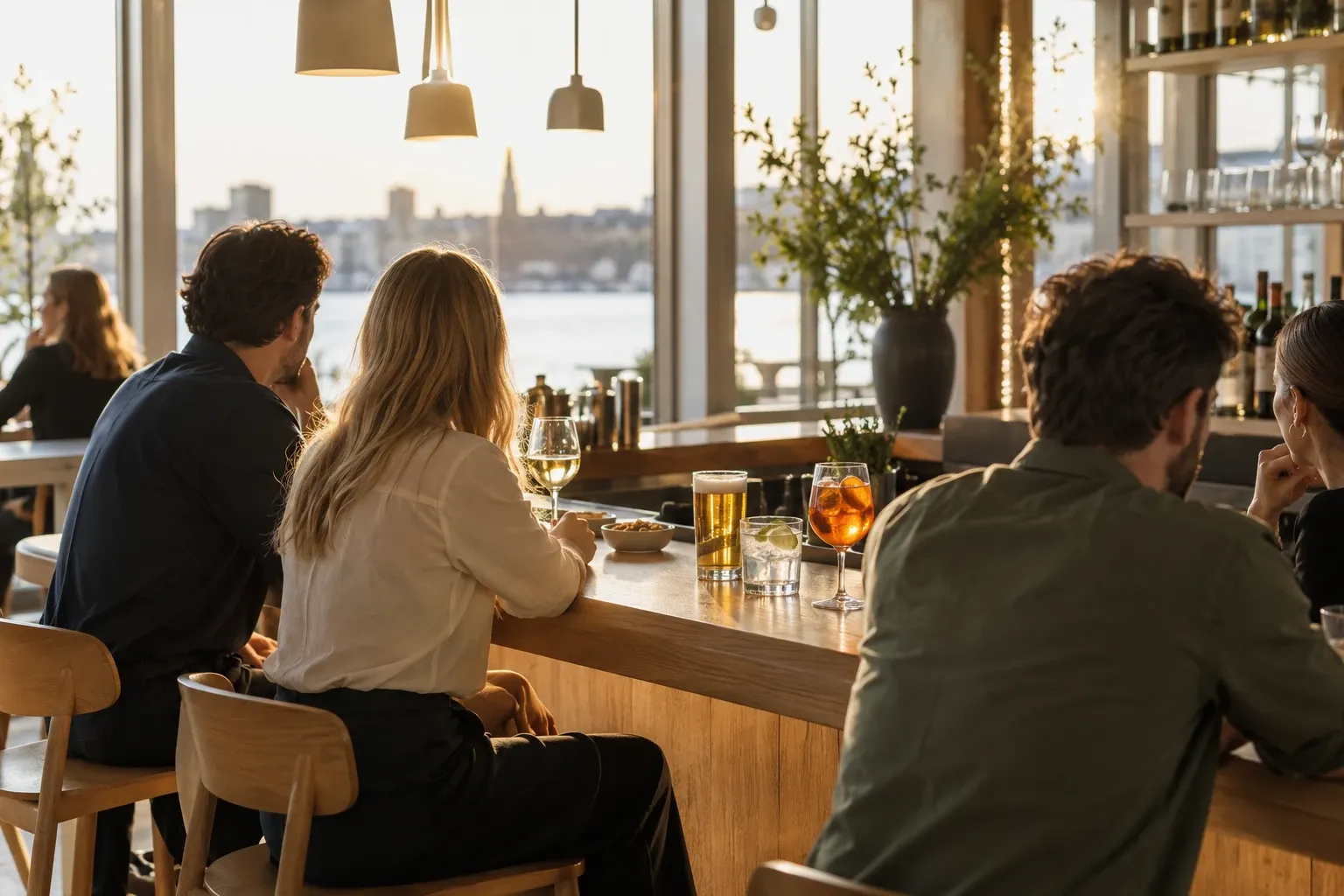
“AW på fredag?” in a Swedish team chat is an invitation, not a calendar booking. Here is what the custom involves, how to join and pay, and the Swedish alcohol rules that decide what an AW deal can look like.
When you need this
- A Swedish colleague has written “AW på fredag?” in the team chat.
- You’re on a business trip and your hosts suggest an AW after the meeting.
- You don’t drink and wonder whether joining will be awkward.
- You’re new on a Swedish payroll and the employer is paying.
- You’ve seen “AW-pris” chalked on a bar board.
- You want to step outside the bar with your drink to take a call.
What an AW is
Afterwork looks English, but it’s a Swedish word. The Institute for Language and Folklore (Isof) calls it a pseudo-anglicism: a word that looks English but isn’t used that way in English. It means going out with colleagues or friends after work for a drink or a meal, and Isof recommends writing it AW. In speech the letters come out as “ah-veh”.
The state’s guide for people moving to Sweden, on sweden.se, puts it plainly: an invitation to an AW “doesn’t mean more work”. It’s a casual get-together with colleagues after work, often over a drink or a meal. Swedes also use the word for friends meeting after work.
The format is low-key. Someone suggests it in the office chat or the corridor. A few people walk to a nearby bar or restaurant when the working day ends, and everyone leaves when they want to. A restaurant dinner counts as an AW too.
Joining in
An AW is social and voluntary, and nobody keeps score. It is, though, the main informal place where Swedish colleagues get to know each other, alongside the daily fika (coffee break). Move to Gothenburg, the West Sweden Chamber of Commerce’s welcome service for newcomers, tells people to join even if they don’t drink.
A few habits help:
- Stay as long as you like. One drink, or one alcohol-free drink, and home is completely normal.
- Use it to suggest a plan. Swedish social life runs on concrete invitations, and an AW is a natural place to propose the next one. Our guide to making friends in Sweden has more.
- Don’t joke about who was drunk the morning after. The Local’s guide to Swedish colleagues specifically warns against it.
- Mind the bar’s own rules. You must be 18 to be served, and staff may ask for ID. Clubs you move on to may set a higher door age; see nightlife, club ages and ID.
Paying
The default is your own tab: each person orders and pays for their own drinks, unless someone clearly offers to treat.
| Situation | What works |
|---|---|
| Paying for your own drinks | A bank card or phone wallet; many city bars are card-only, which is lawful |
| Splitting a shared bill | Ask to pay separately at the till; Swish needs a Swedish bank account and BankID |
| Tipping | Not expected at the bar; rounding up is optional |
| The employer is paying | The invitation normally says so |
If you can’t Swish, our guide to splitting bills without Swish covers the alternatives. For card-terminal tip prompts, see tipping in Sweden.
AW prices and the law
Many bars advertise AW-priser (AW prices) for the early-evening slot, and some now apply them to the regular menu, not only at the bar. Jönköping’s official visitor guide calls the city’s AW tradition strong. What visitors don’t see is the law behind the chalkboard.
The Alcohol Act (8 kap. 21 §) sets three limits on how a licensed venue prices alcohol:
- A price floor. A drink may not be priced below the venue’s purchase price plus a reasonable markup. The law doesn’t define “reasonable”, and the municipality supervises.
- No steering to stronger drinks. Pricing may not promote stronger drinks.
- No pushing. Staff may not urge or induce guests to buy alcohol.
So happy hour is legal, but free drinks and two-for-one spirits are not. One more change matters: since 1 June 2026 a bar no longer needs a kitchen or food to hold a serving license. An AW venue may now serve drinks only. Anything written before June 2026 that says Swedish bars must serve food is out of date.
Alcohol-free at an AW
Ordering alcohol-free is ordinary. Every licensed venue must by law offer non-alcoholic drinks in a satisfactory range. Swedes are drinking less, too: total consumption fell to about 8.2 liters of pure alcohol per person aged 15 or over in 2025 (preliminary figures), and only about 1 liter of that was drunk in bars and restaurants. Swedish business media described the AW in March 2026 as more controlled than it used to be: an alcohol-free beer or one glass of wine, and home early.
If you avoid alcohol completely, read the label. Systembolaget, the state alcohol retailer, caps its own alcohol-free range at 0.5%, and even 0.0% drinks can contain about 0.05%. Our guide to alcohol-free drinks in Sweden goes further.
Your glass stays inside
You may not carry a served drink out of a licensed venue. That includes walking off the outdoor terrace (uteservering) onto the pavement, because the terrace is part of the licensed area and the pavement isn’t. Hotel minibars are the only exception.
The detail worth knowing: The Alcohol Act forbids it but sets no penalty for the guest. The duty falls on the venue, which answers for it under its license, so staff will take the glass off you at the door. A fine comes in only outside: drinking on the street inside a municipal no-drinking zone is fined under the Public Order Act. See drinking in public in Sweden.
Two more rules end evenings:
- Visible drunkenness. Staff may not serve anyone noticeably intoxicated. In Stockholm the city’s rules say such guests must be turned away.
- Driving. The limit is 0.2 per mille in the blood, during or after driving. One or two AW drinks can matter; see the drink-driving limit.
When your employer pays
For people on a Swedish payroll, an employer-paid AW has a tax side. Skatteverket, the Swedish Tax Agency, treats food and drink at a staff party (personalfest) as tax-free internal representation. The gathering must be temporary, though: meetings held regularly every week or every other week don’t qualify.
| Format | Tax treatment for the employee |
|---|---|
| Occasional staff party or AW counted as internal representation | Tax-free |
| Weekly or fortnightly employer-paid gathering | Not temporary, so not internal representation |
| Employer-paid meal outside internal representation | Taxable meal benefit (kostförmån) |
Separately, the company can deduct at most two staff parties a year. That cap limits its own deduction, not whether you’re taxed.
Through the year
| When | What changes |
|---|---|
| Every week | Friday is one of the two big drinking days: in CAN’s 2018 survey, 36% had drunk on a Friday and 11% on a Monday |
| Payday weekend | Bars are busier on the first weekend after the 25th; see payday in Sweden |
| Summer | AWs move to outdoor terraces |
| July | Most offices empty for the summer holiday, and workplace AWs pause with them |
| Late November to Christmas | The workplace julbord (Christmas buffet) or staff party often replaces the AW; see the julbord guide |
The custom is the same across Sweden. Serving hours and no-drinking zones are set by each municipality.
Practical information
| Item | Amount or rule |
|---|---|
| Joining an AW | 0 kr; you pay for what you order |
| Drinks at AW prices | Set by the venue; never below purchase price plus a reasonable markup |
| Serving age in a bar | 18 |
| Serving hours | 11:00–01:00 by default; the municipality may set others |
| Tip at the bar | Nothing customary |
| Alcohol-free | Must be on offer; Systembolaget’s own limit 0.5% |
| Drink-driving limit | 0.2 per mille |
| Employer-paid staff party | Tax-free if internal representation (Skatteverket, checked 2026-10-15) |
FAQ
What does AW mean in Sweden?
AW stands for afterwork, pronounced “ah-veh”: a casual drink or meal with colleagues or friends straight after the working day. The word looks English but is Swedish; the Institute for Language and Folklore calls it a pseudo-anglicism. An AW invitation does not mean more work. It usually means a nearby bar or restaurant, and people leave when they like.
Do I have to go to an afterwork with my colleagues?
No. An AW is social and voluntary, and nobody keeps score. It is, though, the main informal place where Swedish colleagues get to know each other, so joining now and then helps, especially if you are new. Staying for one drink, or one coffee, and leaving early is completely normal.
Who pays at a Swedish afterwork?
Usually everyone pays for what they order, often at the bar as they go, unless someone clearly offers to treat. Many city bars take cards only, and splitting by Swish needs a Swedish bank account, so bring a card or phone wallet. If the employer is paying, the invitation normally says so.
Is happy hour legal in Sweden?
Yes, within limits. Bars may offer “AW prices”, but the Alcohol Act forbids pricing a drink below the venue’s purchase price plus a reasonable markup, pricing that pushes stronger drinks, and urging guests to buy alcohol. That rules out free drinks and two-for-one spirits. The municipality supervises the venue’s license, including its pricing.
Is it OK not to drink alcohol at an AW?
Yes. Alcohol-free beer, soft drinks and coffee are ordinary AW orders, and every licensed venue must by law offer non-alcoholic drinks. Swedes drink less every year, and AWs have become more moderate. If you avoid alcohol completely, check the label: drinks sold as alcohol-free can contain traces, and Systembolaget sets its own limit at 0.5%.
Can I take my drink outside the bar?
No. You may not carry a served drink out of a licensed venue, and that includes walking off the outdoor terrace onto the pavement. The Alcohol Act puts the duty on the venue rather than fining the guest, so staff will stop you. Drinking on the street in a municipal no-drinking zone can be fined.
Is an employer-paid afterwork a taxable benefit?
It depends on the format. Skatteverket treats food and drink at a staff party as tax-free internal representation, but gatherings repeated every week or every other week are not temporary and fall outside it. A meal paid by the employer outside internal representation is a taxable meal benefit. The company can deduct at most two staff parties a year.
Related guides
- Swedish drinking culture — how to say skål, snaps songs and why Fridays are loud.
- Swedish work culture — the office the AW grows out of: fika, flat hierarchy, leaving at five.
- Drinking in Sweden — bar hours, ages and the 2026 rule changes in full.
- Alcohol-free drinks in Sweden — what to order when you’re not drinking.
- Making friends in Sweden — turning AW colleagues into friends.
Facts verified 2026-10-15. Sources: Sveriges Riksdag (Alkohollag 2010:1622, Ordningslag 1993:1617, Lag 1951:649), Svenska institutet (sweden.se), Isof, Skatteverket, Folkhälsomyndigheten, Systembolaget, CAN, Stockholms stad — full register in this topic’s source file. Found something outdated? Tell us and we’ll fix it.