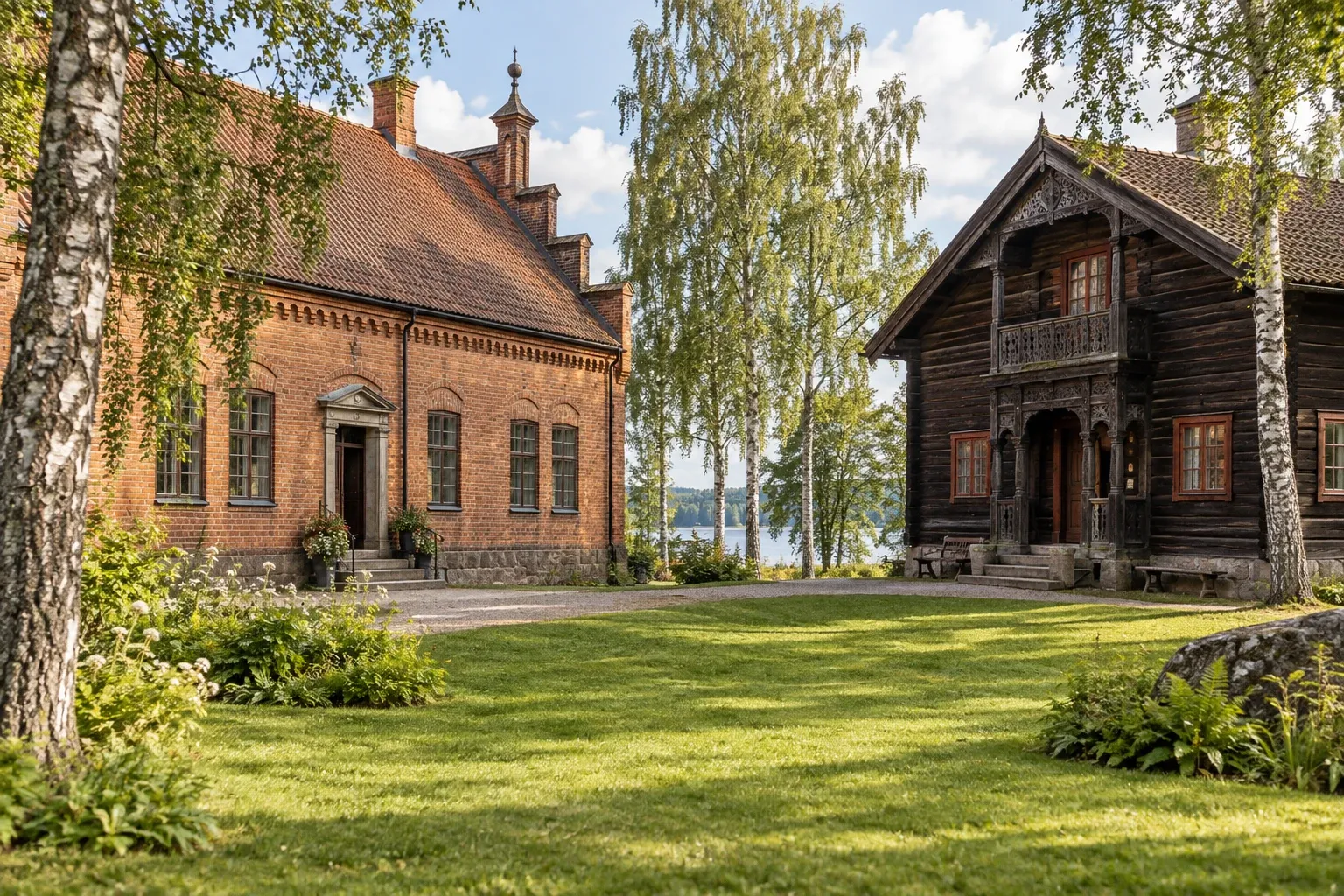
Anders and Emma Zorn left their art, their home and some 60 buildings to the Swedish state. Here is what each of the four Zorn sites is, when it opens in 2026/27, and the house rules that catch visitors out.
When you need this
You’re in Mora or somewhere on Lake Siljan and want to see the Zorn museum and the Zorns’ home. Maybe you need to know whether Zorngården has an English tour, whether you must book, or what is open on a Monday or between Christmas and New Year. Perhaps you’re travelling with a wheelchair, a pushchair or young children — or you saw Zorn’s Midsummer Dance in Stockholm and want to see where he painted. For Mora town itself, the Vasaloppet finish and the lake round, see our Mora and Lake Siljan guide.
The four Zorn sites at a glance
Zornsamlingarna (the Zorn collections) is the official name of both the couple’s donation and the institution that runs it. Two of its four sites are open all year; two only in high summer.
| Site | What it is | Where | Open 2026/27 |
|---|---|---|---|
| Zornmuseet | Museum with the world’s largest collection of Zorn’s work | Vasagatan 36, Mora | All year; Mondays closed outside summer |
| Zorngården | The Zorns’ home, as they left it | About 100 m from the museum | All year, guided tours only |
| Zorns gammelgård and Textilkammaren | Open-air museum of about 40 timber buildings, plus a textile museum | Yvradsvägen 3, about 1–1.5 km from the museum | Summer only (23 June – 9 August in 2026) |
| Gopsmor | Zorn’s wilderness studio and fishing cabin | About 20 km north of Mora | About a week in summer (27 June – 5 July in 2026) |
The museum and Zorngården are about 100 m apart, so a tour slot plus the museum fits comfortably in half a day.
Who Anders and Emma Zorn were
Anders Zorn (1860–1920) was born and died in Mora. He entered the Royal Academy of Fine Arts in Stockholm in 1875, made his name with watercolours, and switched to oil painting in St Ives, England, in the winter of 1887–88. His fame rested above all on portraits: on seven trips to the United States he painted, among others, Presidents Grover Cleveland and William Taft. He also made 290 etchings, with Rembrandt as his model.
Emma Zorn (born Lamm, 1860–1942) came from a Stockholm merchant family. She handled her husband’s dealings with exhibitors, museums and publishers, and after his death it was she who pushed the museum through. The couple left almost everything they owned to the state: some 60 buildings and nearly 20,000 objects, from Zorn’s own works and Dalarna folk art to antique sculpture, silver, old-master paintings and 180 Rembrandt etchings Zorn collected.
Zornmuseet
The museum was completed in 1939 to designs by Ragnar Östberg, the architect of Stockholm City Hall — it was his last work. It always shows a selection of Zorn’s watercolours, oils, sculptures and etchings, often alongside pieces from his own collections, across three floors. A slideshow about Zorn runs daily in the film room.
Look for the genre scenes from the Siljan area that belong to the museum: Midnatt (Midnight), Vallkulla (Herding Girl) and Dans i Gopsmorstugan (Dance in the Gopsmor Cottage), plus Vattna hästen (Watering the Horse), painted at Gopsmor. Zorn’s own favourite, Midsommardans (Midsummer Dance), is not here — it hangs in Nationalmuseum in Stockholm.
Two things to know for autumn 2026. Parts of the museum are closed for rehanging from 1 September to 28 November, with reduced admission meanwhile. Then on 29 November, Zorns julmarknad (Zorn’s Christmas market) runs from 11 to 17, with Christmas-themed tours of Zorngården and the museum’s new permanent exhibition on Zorn. See our Christmas markets guide for others around the country.
You don’t need to book museum admission in advance. You do need a card: no Zorn site takes cash.
Zorngården and the guided tour
Zorngården began in 1886, when the 26-year-old Zorn bought land next to Mora church and moved a small timber cottage there from his grandfather’s farm in the village of Yvraden. He rebuilt it in stages to his own drawings, especially after the couple moved home from Paris in 1896, and it stood finished around 1910. Local building tradition meets English Arts & Crafts; the Great Room (Stora rummet) upstairs is nine metres high. Guests included Prince Eugen, Carl and Karin Larsson, Albert Engström and Erik Axel Karlfeldt. When Emma Zorn died in 1942 the house passed to the state and opened to the public that year.
The house rules are strict:
- Guided tours only (guidad visning), about 45 minutes, at fixed times. Places are limited, so book on the museum’s site to be sure of one.
- At least one English tour every day, winter and summer. Book that slot rather than hoping one fits.
- No photography inside; the garden is fine.
- Late arrivals are not waited for. The museum warns of road-work queues in the area and says it cannot wait for or move bookings.
If you liked this, the other great Dalarna artist’s home, Carl Larsson-gården, is also shown on guided tours.
The open-air museum and Textilkammaren
Zorns gammelgård (Zorn’s heritage farm) is an open-air museum by Lake Siljan that Zorn started in 1914 by buying old cottages, storehouses and other traditional buildings. Emma Zorn and the art historian Gerda Boëthius carried on after his death. Today about 40 buildings stand there.
The star is small: a fire house (eldhus) whose logs were felled in 1237, originally from the summer farm Fäsås outside Mora. Both the museum and Mora kommun date it to 1237, and the museum calls it Sweden’s oldest timber building.
Next door, Textilkammaren (the textile chamber, built 1993) shows the Zorns’ collection of folk textiles and costumes from the Siljan area. In summer 2026 it also showed 600 Dala horses donated by a French collector — background on the horse in our Swedish souvenirs guide.
The catch: both are open only in high summer (daily 11–16, 23 June – 9 August in 2026). On 23 June there is a free children’s Midsummer at 14:00. The 2027 dates were not yet published at our check.
Gopsmor
Gopsmor is Zorn’s wilderness studio and fishing cabin, built 1904–1906 by the Österdalälven river. He painted Dance in the Gopsmor Cottage and Watering the Horse there. When the river was regulated for a hydropower plant in 1970, the cabins were moved to a similar spot and rebuilt exactly; 2026 was its 120th year.
It is about 20 km north of Mora, signposted from road 70 towards Älvdalen. You can’t drive to the door: from the car park it is about 300 m on foot over grass and forest ground, and there is no water or toilet. The houses open for about a week in summer, entry free; the museum says the grounds can be visited in summer and autumn, though you cannot go inside the houses then.
Opening hours by season
| Period | Zornmuseet | Zorngården tours | Gammelgård, Gopsmor |
|---|---|---|---|
| 31 Aug 2026 – 4 Jun 2027 | Tue–Sun 11–17, Mondays closed | Tue–Fri 13, 14, 15; Sat–Sun 12, 13, 14, 15 | Closed |
| 1 Sep – 28 Nov 2026 | Parts closed for rehanging | As above | Closed |
| 29 Nov 2026 | Christmas market 11–17; new permanent exhibition | Christmas-themed tours | Closed |
| 22 Dec 2026 – 10 Jan 2027 | Daily 11–17, Mondays included; closed 24 and 25 Dec | Winter schedule | Closed |
| 5 Jun – 5 Sep 2027 | Daily 9–17 | Daily from 9:30 | High summer only |
One warning about the calendar. On 15 October 2026 the Christmas and New Year window appeared only on the museum’s Swedish öppettider (opening hours) page, not the English one. Check the Swedish page before a holiday visit.
Access, bags, photos and children
Step-free visitors. Zorngården, the open-air museum and Gopsmor have steep stairs, narrow doorways and high thresholds that rule out wheelchairs, rollators and pushchairs; Zorngården has no lift. Zornmuseet has an automatic door, a lift to every floor and an accessible toilet at the entrance, and Textilkammaren is on one level with an accessible toilet. There are no toilets at Zorngården or Gopsmor, so go before you walk over.
| Rule | Zornmuseet | Zorngården | Open-air museum |
|---|---|---|---|
| Photography (private) | Yes, no flash or tripod | No (garden yes) | Yes |
| Large bags, backpacks, umbrellas, ice cleats | Not allowed; lockers | Not allowed; lockers | — |
| Dogs | Guide dogs only | Guide dogs only | Pets on the grounds; guide dogs only in Textilkammaren |
| Children under 15 | With an adult | — | With an adult |
Museum texts are in Swedish and English; at Textilkammaren they are in Swedish only. The film room has a hearing loop. Groups of 25 or more must pre-book.
Parking and getting there. Zornmuseet has no car park of its own; use the public spaces across Vasagatan, or a few to the west, and drop-off is possible at the back entrance. By rail, Mora C is the end of the regional Siljan line — more in our train travel guide.
Practical information
| Item | Details (checked 2026-10-15) |
|---|---|
| Zornmuseet, adult | 125 SEK; reduced to 65 SEK until 28 November 2026 |
| Zornmuseet, under 18 | Free (under 15 with an adult) |
| Zornmuseet annual card | 400 SEK |
| Zorngården guided tour | Adult 150 SEK; under 18 75 SEK |
| Groups (25+, pre-booked) | Zornmuseet 100 SEK, Zorngården 120 SEK per person |
| Zorns gammelgård and Textilkammaren | Adult 125 SEK; under 18 free |
| Gopsmor | Free |
| Payment | Card only at every site |
| Addresses | Zornmuseet: Vasagatan 36, Mora. Gammelgård: Yvradsvägen 3, Mora |
FAQ
Do you need to book Zorngården in advance?
It is strongly advised. Zorngården, Anders and Emma Zorn’s home in Mora, can only be seen on a guided tour of about 45 minutes, and places are limited, so the museum recommends booking to be sure of one. Admission to Zornmuseet next door does not need booking. A late arrival for a booked tour will not be waited for.
Are there tours of Zorngården in English?
Yes. The museum runs at least one English-language tour of Zorngården every day, in both the winter schedule to 4 June 2027 and the summer schedule from 5 June. Tours start at fixed times, so book the English slot rather than assuming one will fit. Photography is not allowed inside the house, though it is in the garden.
Is the Zorn Museum open on Mondays?
Not between 31 August 2026 and 4 June 2027, when Zornmuseet opens Tuesday to Sunday, 11 to 17. The exception is Christmas and New Year: from 22 December to 10 January it opens every day, except Christmas Eve and Christmas Day. From 5 June to 5 September 2027 it is open daily, 9 to 17.
Can you take photos in the Zorn Museum?
Yes, for private use, without flash or a tripod; a few works may carry a photo ban for copyright reasons. Inside Zorngården, the Zorns’ home, photography is not allowed at all, though you may photograph its garden and the open-air museum. Commercial photography at any Zorn site needs the museum’s permission. Leave large bags and umbrellas in the lockers.
Can you visit Zorngården in a wheelchair?
No. The museum says Zorngården’s steep stairs, narrow doorways and high thresholds rule out wheelchairs, rollators and pushchairs, and the house has no lift or toilet. Zornmuseet, about 100 metres away, has an automatic door, a lift to every floor and an accessible toilet, so a step-free visit focuses on the museum and its collections.
What is Gopsmor?
Gopsmor is Anders Zorn’s wilderness studio and fishing cabin, built 1904–1906 by the Österdalälven river about 20 km north of Mora; he painted Dance in the Gopsmor Cottage there. It was moved and rebuilt when the river was regulated in 1970. The houses open for about a week in summer, entry free; the grounds can be visited in summer and autumn.
Related guides
- Mora and Lake Siljan — the town around the museum, the Vasaloppet finish and Zorn’s Gustav Vasa statue.
- Dalarna — the county hub, with Falun’s copper mine and the mountains.
- Carl Larsson-gården — the other Dalarna artist’s home, also guided-only.
- Nationalmuseum — where Zorn’s Midsummer Dance hangs.
- Christmas markets in Sweden — if the 29 November market is your reason to come.
Facts verified 2026-10-15. Sources: Zornsamlingarna (opening hours, prices, accessibility, site and history pages), Mora kommun, Tåg i Bergslagen — full register in this topic’s source file. Found something outdated? Tell us and we’ll fix it.