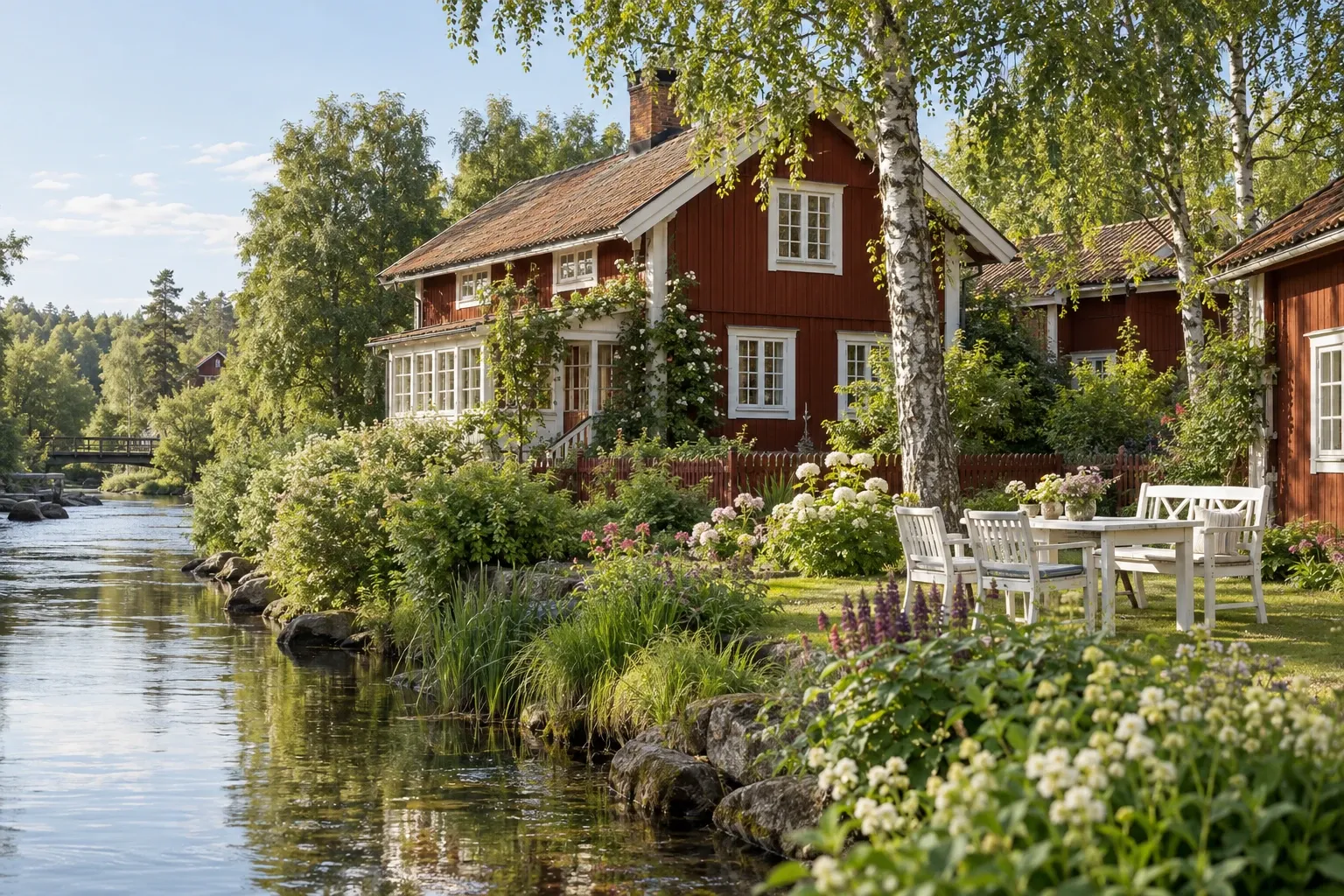
The house in Carl Larsson’s watercolours is real, still lived in, and open to visitors all year. Here’s what the tour shows, why Karin matters as much as Carl, and how to make the tour times, buses and parking fit together.
When you need this
You’re in Falun or touring Dalarna and wondering whether the Larsson house is worth the detour, and whether you can just walk in. Maybe you need an English tour, you’re travelling with a pushchair, a dog or a backpack, or you’re coming by bus at the weekend. Or you love Swedish design and want to know what’s original, who Karin was, and where else to see the art.
Carl Larsson-gården at a glance
Carl Larsson-gården — properly Lilla Hyttnäs — was the home of the painter Carl Larsson (1853–1919) and the artist and designer Karin Larsson, born Bergöö (1859–1928). It sits on the Sundborn river in the village of Sundborn, 13 km outside Falun.
| Part of the visit | What it is | Ticket? |
|---|---|---|
| The house (Lilla Hyttnäs) | Guided tour, about 45–50 minutes | Yes |
| The garden | Recreated in 2014 as it was in the Larssons’ time | Free during opening hours |
| Garden tour / textile tour | Summer garden tour; special tour on Karin’s textiles | Separate tickets |
| Konsthallen Kvarnen | Summer art hall in the village’s 17th-century mill, about 250 m away | Yes, summer only |
| Sundborn church | The parish church Carl decorated in 1905 | Free |
A family home, not a museum
This is the single most useful thing to know before you go. The house belongs to the Carl and Karin Larsson Family Association (släktförening, family association), formed in 1946 and today about 360 descendants. Carl’s will asked that the house stay open to the public and be run by the family, and it still is.
The association describes itself as neither a foundation nor a museum, and says it receives no fixed state operating grant. The family uses the house: dinner is still eaten in the dining room, and relatives gather there at Christmas and in summer. About 100 of them meet each year for the association’s meeting and a crayfish party — a tradition Carl painted in Crayfish Catch (1897).
That is why you can’t wander through on your own. A guide takes you room by room, there are no gallery labels, and the rules on bags and photos are strict. The house has been a protected building (byggnadsminne) since 1966: the building, most of the interior and the garden south and east of it may not be altered without the National Heritage Board’s consent. In September 2025 “Lilla Hyttnäs, Sundborn” by Karin and Carl Larsson was named in Sweden’s new cultural canon (kulturkanon) of 100 works.
Who were Carl and Karin Larsson?
Carl was born in Stockholm’s Old Town in 1853 and grew up poor. Karin Bergöö was born in Örebro in 1859 and trained at the School of Industrial Arts and the Royal Academy of Fine Arts. They met in 1882 in the Scandinavian artists’ colony at Grez-sur-Loing, south of Paris, and married in Stockholm in 1883.
They had eight children, six of whom reached adulthood. Karin’s father, Adolf Bergöö, gave them Lilla Hyttnäs in 1888, when it was a log cottage of two rooms and a kitchen.
| Year | What happened |
|---|---|
| 1888 | Lilla Hyttnäs given to Karin and Carl |
| 1889 | The family moves in for the summer |
| 1890 and 1899–1900 | Main extensions; the first studio, then the large studio |
| 1899 | Ett hem (A Home) published — the house becomes famous |
| 1901 | The family settles in Sundborn for good |
| 1912 | A painted miner’s cottage from Aspeboda is joined to the studio |
| 1919 / 1928 | Carl dies in Falun; Karin dies nine years later |
| 1946 | The family association takes over the house |
Carl’s watercolours of the house, published in books such as A Home (1899), The Larssons (1902) and On the Sunny Side (1910), made its rooms an image of the Swedish home far beyond Sweden. After the copyright expired in 1969 the pictures were reproduced in mass editions.
What you see on the tour
The house grew from two rooms to fourteen rooms and two studios, each with its own character. The tour takes about 45–50 minutes.
| Room | What to look for |
|---|---|
| Dining room | Red, green and yellow — the attraction calls it one of Sweden’s most painted rooms. Karin’s tablecloths and her tapestry The Four Elements on the built-in sofa, and the painted motto: love one another, children, for love is all |
| Parlour (förmak) | Light blue-and-white Gustavian tones, geraniums in the windows |
| Workshop (verkstaden) | Carl’s first studio, later Karin’s weaving and sewing room on a raised platform |
| Large studio | Built for Carl’s monumental paintings, among Scandinavia’s largest; a banquet hall at family feasts |
| Old room (Gammelrummet) | The guest room; visitors such as Prince Eugen, Selma Lagerlöf and Anders Zorn wrote their names on the bed doors. Find the seven animals Karin hid in the chair cushions |
| Bedrooms | Carl’s bed in the middle of his room; the drapery The Rose of Love in the opening to Karin’s room; Suzanne’s own painted flower border from 1901 |
| Reading room | Japanese woodcuts on the ceiling — Carl called Japan his “foster land” without ever going there |
Karin Larsson, the designer behind the pictures
Much of what makes the house famous is Karin’s work. She designed furniture such as her rocking chair and stepped flower stand, wove and embroidered the textiles, chose the bold colours, and made loose, corset-free clothes for herself and the children. The guides still wear her blue-and-white striped dress.
For a long time she stood in Carl’s shadow. The attraction dates her international breakthrough to the large Larsson exhibition at the Victoria and Albert Museum in London in 1997. If design is your interest, book the textile tour, which focuses on her work.
The garden, the mill and Sundborn church
These are the self-guided parts of a visit, and they turn a 45-minute tour into a half day.
- The garden was recreated in 2014, with the Larssons’ colourful garden furniture back in place and their stone furniture dug out from under the soil. It is free. In summer a garden tour explains how Karin grew flowers, vegetables and herbs.
- Konsthallen Kvarnen (konsthall, art hall; kvarn, mill), about 250 m away, shows a summer exhibition on the Larssons’ world. “Carl and Karin Larsson – For Love Is All” ran from 23 May to 23 August 2026, and the page lists a 2027 season of 28 May to 22 August.
- Sundborn church, built in 1755, was coloured and decorated throughout by Carl in 1905: altar angels, John the Baptist, pine-shoot wall decoration and flower garlands. Visit Dalarna lists it as the Larsson family’s burial place. It is a short walk away; the bathing spot below it is about 600 m from the house.
- On the water: from 1 May you can rent a bike or a rowing boat at the attraction’s shop. There’s a jetty for a dip in the river about 200 m from the house, and a sandy beach at Vitsand, about 1.5 km away.
Getting there
| How | What to know |
|---|---|
| Car | About 15 minutes from central Falun via road 862. 1 May – 30 September: park at the village entrance opposite the petrol station, about a 10-minute walk. 1 October – 30 April: park just above the house |
| Bus | Dalatrafik lines 234 and 235 from Falun Resecentrum or Knutpunkten — weekdays only. Pay by Visa or Mastercard or in the app; cash is not listed |
| Train | To Falun, then bus or taxi. Stockholm Arlanda is about 230 km away |
| On foot or by bike | The Carl Larsson trail (Carl Larsson-leden) runs 8.5 km between Falun and Sundborn |
Watch the clash: in winter the only English tour is at the weekend, when no buses run. Without a car, a taxi, a bike or the trail is the answer. For the rest of a Falun day, see our guide to Falun and the copper mine.
Accessibility and house rules
- The house is not step-free. High thresholds and a staircase rule out wheelchairs, walkers and pushchairs.
- The garden mostly is. Gravel paths are passable; there’s an accessible parking space by the entrance and an accessible toilet by the shop.
- The app is the alternative. The paid Carl Larsson app shows twelve rooms in 360°, with audio and sign-language films.
- Kvarnen is not accessible either: high, narrow stairs to the upper floors.
- Bags: no large handbags, backpacks, umbrellas or ice cleats in the house, and nowhere to store them.
- Photos: none inside; outdoors and in the garden you’re welcome.
- Dogs: on a lead in the garden, not in the house.
More on step-free planning in accessible Sweden.
Season by season
| Period | Guided tours |
|---|---|
| 1 May – 30 September | Swedish tours daily 10:00–17:00; other languages, children’s tours and garden tours as listed in the booking system |
| Late May – late August | Konsthallen Kvarnen open daily 11:00–17:00 |
| 1 October – 30 April | Monday–Friday: Swedish at 11:00. Saturday–Sunday: Swedish at 13:00, English at 14:15 |
At any time of year you can ask in advance for a tour in English, German, French, Hungarian, Finnish or Dutch, subject to availability, or book a private tour for up to 16 people.
Where else to see Carl Larsson’s art
Carl valued his big public paintings above the watercolours that made him loved. You can see them in museums across Sweden; displays rotate, so check what’s hung before a special trip.
| Museum | What it holds |
|---|---|
| Nationalmuseum, Stockholm | Six frescoes in the lower stair hall (1896–1903); upstairs, Gustav Vasa’s Entry into Stockholm 1523 and Midvinterblot, refused in his lifetime and bought back in 1997 |
| Gothenburg Museum of Art | His 1888–89 triptych and the watercolours October and November in the Fürstenberg Gallery — see Gothenburg museums |
| Dalarnas museum, Falun | Part of his study for Gustav Vasa’s Entry and works by Karin |
| Thielska Galleriet and Prince Eugen’s Waldemarsudde, Stockholm | Works collected by his friends |
Practical information
| Item | Detail (checked 2026-10-15) |
|---|---|
| Address | Lilla Hyttnäs, Sundborn, 13 km from Falun |
| Guided house tour | Adult 265 SEK; senior or student 215 SEK; ages 6–16 75 SEK; under 6 free; family (2 adults + 2 children) 605 SEK |
| Garden | Free during opening hours |
| Garden tour (summer) | 150 SEK |
| Textile tour | 265 SEK |
| Private tour (1–16 people) | 4,240 SEK, pre-booked only |
| Konsthallen Kvarnen (summer) | Adult 100 SEK; under 6 free with an adult |
| Carl Larsson app | Paid; price in the app stores |
| Sundborn church | Free |
| Buses 234 and 235 | Weekdays only; zone-based fares |
FAQ
Can you go inside Carl Larsson’s house in Sundborn?
Yes, but only on a guided tour. Lilla Hyttnäs is still the Larsson family’s home, so a guide takes you through the rooms in about 45 to 50 minutes and you cannot wander on your own. Pre-booking is recommended. Photography is not allowed inside, and large bags, backpacks and umbrellas must stay outside. The garden is free and open whenever the house is.
Are there tours in English at Carl Larsson-gården?
From October to April there is one scheduled English tour, at 14:15 on Saturdays and Sundays. From May to September tours run daily in Swedish, with other languages shown in the booking system. You can also ask in advance for a tour in English, German, French, Hungarian, Finnish or Dutch, subject to availability. A private tour for up to 16 people can be pre-booked.
Can you get to Carl Larsson-gården by bus?
On weekdays, yes: Dalatrafik buses 234 and 235 run from Falun’s Resecentrum or Knutpunkten to Sundborn, 13 km away. No buses run at weekends, so on Saturdays and Sundays you need a taxi, bike or car. Pay on board by Visa or Mastercard or in the app. You can also walk or cycle the 8.5 km Carl Larsson trail from Falun.
Is Carl Larsson-gården accessible for wheelchairs and pushchairs?
The house is not. It has high thresholds and a staircase, so wheelchairs, walkers and pushchairs cannot go in. The garden is mostly passable on gravel paths, and there is an accessible parking space by the entrance and an accessible toilet by the shop. The paid Carl Larsson app shows twelve rooms in 360 degrees, with audio and sign-language films.
Why is Carl Larsson-gården famous?
Carl Larsson’s watercolours of the house, published in books such as A Home in 1899, made its bright rooms an image of the Swedish home around the world. Karin Larsson designed much of what they show: furniture, textiles, colours and clothes. The house is a protected building, still owned by their descendants, and was named in Sweden’s cultural canon in 2025.
Where else can you see Carl Larsson’s paintings?
In Stockholm, Nationalmuseum has his stair-hall frescoes and the huge Midvinterblot, which was refused in his lifetime and bought back in 1997. Thielska Galleriet and Prince Eugen’s Waldemarsudde also hold his work. Gothenburg Museum of Art has his Fürstenberg triptych, and Dalarnas museum in Falun has a study for Gustav Vasa’s Entry and works by Karin.
Related guides
- Falun and the Falu Copper Mine — the World Heritage mine 13 km away, the other half of the day.
- Dalarna — the county hub: Lake Siljan, Midsummer and where to base yourself.
- Mora and Lake Siljan — the Zorn collections, home of the Larssons’ friends.
- Swedish design — the tradition the Larssons’ bright rooms helped start.
- The crayfish party — the feast Carl painted in Crayfish Catch.
Facts verified 2026-10-15. Sources: Carl Larsson-gården (Carl och Karin Larssons släktförening), Länsstyrelsen Dalarna, Svenska kyrkan Sundborn, Visit Dalarna, Nationalmuseum, Dalatrafik, SVT and Sveriges Radio — full register in this topic’s source file. Found something outdated? Tell us and we’ll fix it.