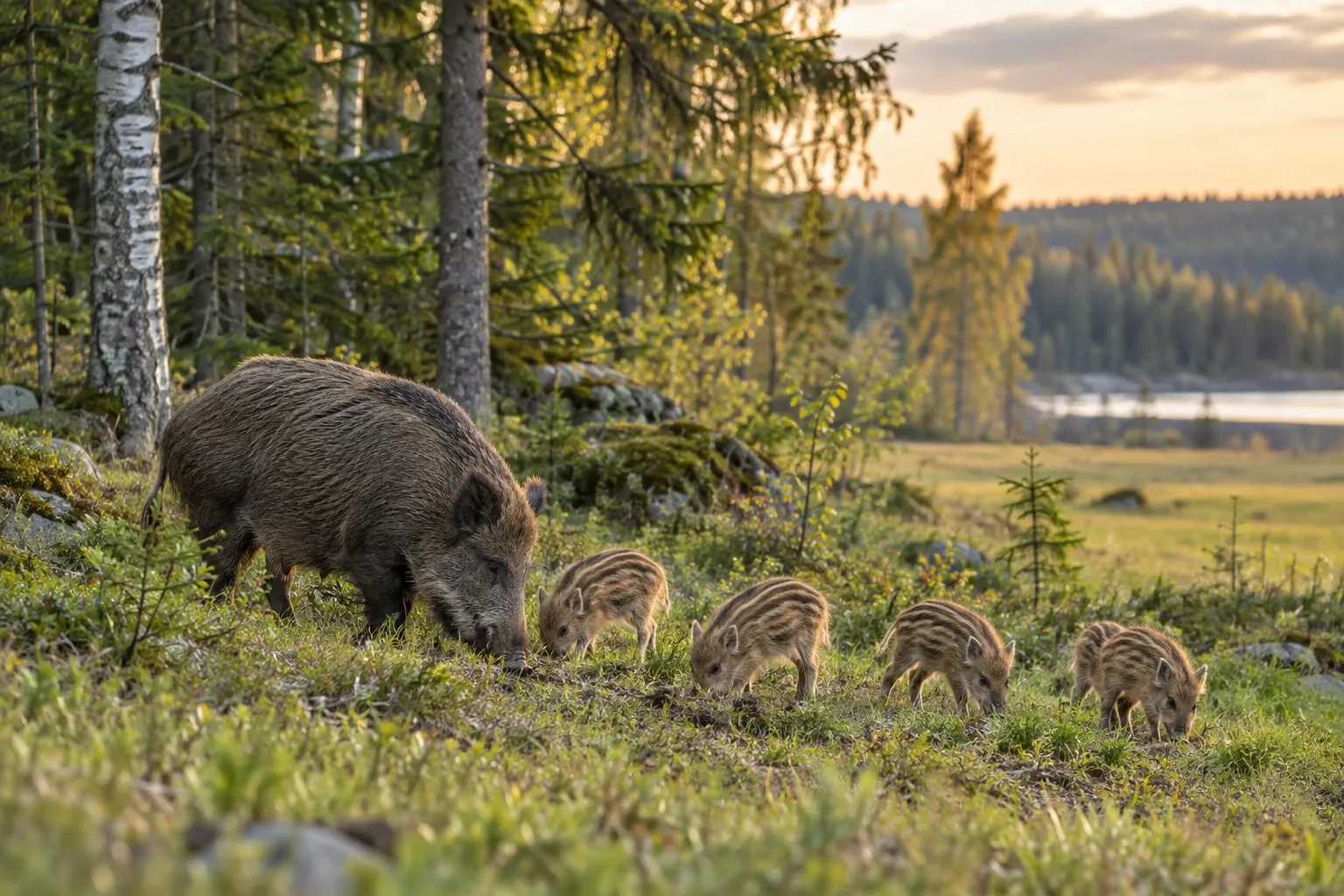
Most visitors to southern Sweden never see a wild boar. They see the dug-up turf along forest paths instead. Here is what to do on the rare evening you meet one, how to keep your dog safe, and how to keep boar off a cabin lawn.
When you need this
You’re walking, running or picking mushrooms in a southern or central Swedish forest, and it’s getting dark. You hear grunting in the undergrowth, or a piglet squealing. Or you’re walking a dog and want to know what a boar does when it meets one. Or you’ve woken up in a rented cabin to find the lawn turned over and the bin on its side.
This page covers boar on foot and around buildings. If you hit a boar with a car, the legal steps are in our guide to wildlife collisions in Sweden. For boar on the menu, see game meat on Swedish menus.
How many boar, and where
Wild boar (vildsvin) died out in Sweden centuries ago. They came back after animals escaped from enclosures in the 1970s, and in 1987 the Riksdag decided they belong to the Swedish fauna. They have spread ever since.
You’ll often read “300,000 wild boar”. That was the national management plan’s minimum estimate from 2020. Naturvårdsverket, the Swedish Environmental Protection Agency, published a new population model in August 2026. It gives about 318,000 boar left after the 2024/25 hunting year’s losses, and about 570,000 before them. The uncertainty is wide, and the model says numbers are rising again. The farmers’ federation LRF quotes “over 600,000 before the hunt”. That doesn’t contradict the agency: it counts the before-hunt population, and LRF is an interest group.
| Area | What to expect |
|---|---|
| Skåne, Södermanland, Östergötland | Highest densities measured in the 2026 camera study |
| Rest of southern and central Sweden | Present across large areas; density varies sharply between counties |
| Gävleborg | Growing, mainly in Gästrikland |
| Norrbotten, Västerbotten, Jämtland, Gotland | No harvest recorded in any year, so essentially no boar |
| Town edges | Not exempt: density rose with building and road density in the study |
Boar are shy and mostly active at night, and they’re rarely seen in daylight. They have an excellent nose and good hearing but poor eyesight. They usually know you’re there long before you see them. Family groups of sows and young are led by an old lead sow (ledarsugga); older males (galtar) mostly roam alone.
Meeting a boar on foot
Serious incidents with people are rare. A Svenska Jägareförbundet game warden says boar don’t seek people out. A municipal hunt coordinator calls attacks on people very rare, but notes that dogs can provoke charges. Swedish hunting organizations give the same advice:
- Recognize boar country. Fresh rooting (bök), muddy wallows and rubbed tree trunks mean boar use the area. Make normal noise as you walk. Talking or the odd clap lets them move off first.
- If you see or hear boar, stop. Look for small striped or reddish young. A squealing piglet means the sow is close. Don’t walk closer for a photo.
- Let the animal notice you, then back away calmly. Don’t run. Turn and walk away the way you came, or take a wide detour.
- Read the warning. A boar that stands facing you, staring and grunting or snorting, is telling you to leave. It may follow a short way to see you go. Keep retreating.
- Never put yourself between a sow and her piglets. If you find you are between them, move sideways and away from both, slowly.
- Get your dog away at once, and never step into a fight (more below).
- Call for help if needed. If you feel seriously threatened, call the police on 114 14. If it’s acute or anyone is hurt, call 112.
Running is the most common mistake, because a running person can be followed. Dusk and night are boar time. A midday walk rarely meets one, while an evening mushroom trip through dense spruce or reed edges is where surprises happen. A Jägareförbundet game warden suggests sticking to forest roads rather than the thickest cover.
Sows and piglets
A sow with young is the encounter to avoid. Piglets are born yellow-striped and turn reddish at three to four months, staying that color until about a year old. Births are most common in late winter, so sows with striped young are most common in spring and early summer. Piglets can be born in any month, though.
Swedish law protects that sow from hunting. The Hunting Ordinance (jaktförordningen) allows adult boar to be hunted from 1 April to 31 January, except a sow followed by small striped or brown piglets. She’s also the boar most likely to warn you off. In one reported case, a mother and her daughter on an evening forest road found themselves between a squealing piglet and grunting in the trees. They didn’t run. They walked slowly to a large boulder, climbed it and phoned a neighbor who hunts, and he came and fetched them.
Boar and dogs
This is where encounters really go wrong. A boar sees a dog as a much bigger threat than a person, especially near its young. An adult boar wins a fight with a dog. Dogs have been badly hurt and killed, including a dachshund killed in a garden in Onsala, Kungsbacka.
| Situation | What to do |
|---|---|
| 1 March–20 August | The law requires your dog to be kept from running loose where there is game; in practice, a leash |
| Rest of the year | Your dog must still be stopped from chasing game; a leash is the safe choice in boar country |
| Boar spotted ahead | Leash or call the dog in and leave the way you came |
| Dog and boar fighting | Call the dog, but never step in: boar bite and slash, and sows have tusks too |
“My dog doesn’t hunt” doesn’t help, because the boar can’t tell. The full rules are in our guides to dogs in Swedish nature and Sweden’s leash law.
Boar at your cabin
Around cabins and villa gardens, boar are a nuisance rather than a danger. They dig up lawns overnight, tip bins and raid compost and fallen fruit. The fix is to take the food away. County boards and Naturvårdsverket give the same list:
- Keep waste in a closed bin that stands firmly and can’t be pushed over.
- Compost only in a closed container.
- Pick up fallen fruit, and don’t leave bird seed or barbecue leftovers outside.
- Never put food out in nature. A municipal guide notes that it falls under the littering ban in the Environmental Code (Miljöbalken chapter 15 section 26).
Fencing is the owner’s job, and a normal fence or a low electric fence with two or three wires is the county boards’ recommended garden protection. If the lawn has been rooted up, tell your host. Don’t try to deal with the boar yourself: boar that come into a garden may be hunted all year, but firing a gun in a zoned built-up area needs police permission. The county board pays no compensation for boar damage. More on what a rental includes and expects of you is in Swedish cabin expectations.
Dead boar and swine fever
Don’t touch a dead boar; report it. African swine fever (afrikansk svinpest) reached Swedish wild boar near Fagersta in 2023. Sweden was declared free of the disease on 25 September 2024. In July 2026 the virus was found in wild boar in southern Finland. SVA, the National Veterinary Institute, rates the risk to Swedish boar as low, and to farm pigs as very low.
People can’t catch the disease, but they can carry it on boots and gear. Pork leftovers are the main route into wild boar. So:
- Report a dead boar, especially one with no visible injury, through SVA’s online wildlife form (Rapportera vilda djur). It asks for the location and photos, and it’s free.
- Bin your food waste and leave nothing at picnic spots or roadside rest areas.
- Bringing pork from a country with swine fever is covered in bringing food to Sweden.
The hunting season
Boar may be hunted with pursuing dogs from 1 August to 31 January. In autumn you can meet hunting dogs working on boar, alongside the moose hunt. Boar are mostly hunted at night, often from a stand at a bait site (åtel) or a field edge. A headlamp on a night walk near fields makes you visible. Our guide to hiking during hunting season covers the rest.
On the road, boar are about one in eight of Sweden’s hoofed-game accidents. After a collision you must mark the spot and call 112. For boar, the marker goes about 100 meters from the site, for your own safety. Never approach an injured boar.
Practical information
| Item | Detail |
|---|---|
| Population | About 318,000 after the 2024/25 hunting year; about 570,000 before it (Naturvårdsverket, August 2026) |
| Where | Southern and central Sweden; essentially none in Norrbotten, Västerbotten, Jämtland or Gotland |
| When active | Dusk to dawn; rests in dense cover by day |
| Threatening boar | Police 114 14 |
| Emergency or injury | 112 (works without a SIM card) |
| Dead boar | Report to SVA online (Rapportera vilda djur); free |
| Dog rule | Kept from running loose where there is game, 1 March–20 August (law) |
| Hunting with dogs | 1 August–31 January |
| Garden damage | Not compensated by the county board |
FAQ
Are wild boar dangerous to people in Sweden?
Rarely. Boar are shy, mostly active at night and avoid people, and a municipal hunt coordinator calls attacks on people very rare. The risk comes when a sow feels her piglets are threatened, when a boar is injured or cornered, or when a dog provokes it. Back away calmly and keep dogs leashed, and an encounter almost always ends with the boar leaving.
What should I do if I meet a wild boar in the forest?
Stop, let it notice you, and back away calmly without running. If it stands facing you and grunts, it is warning you off; keep retreating and detour. Never walk between a sow and her striped piglets. Get your dog away at once. If you feel seriously threatened, call the police on 114 14, or 112 if anyone is hurt.
Where in Sweden are there wild boar?
Across large parts of southern and central Sweden, with the highest measured densities in Skåne, Södermanland and Östergötland. Gävleborg’s population is growing, mainly in Gästrikland. Naturvårdsverket’s 2026 model found no harvest at all in Norrbotten, Västerbotten, Jämtland or Gotland, so the far north and Gotland have essentially no boar. Town edges are not exempt.
How many wild boar are there in Sweden?
Naturvårdsverket’s August 2026 report estimates about 318,000 wild boar after the 2024/25 hunting year’s losses, and about 570,000 before them, with a wide uncertainty interval. The often-quoted “300,000” was the 2020 plan’s minimum estimate. Farmers’ federation LRF uses “over 600,000 before the hunt”. The model says the population is growing again.
Is it safe to walk a dog where there are wild boar?
Yes, on a leash. Boar see dogs as a bigger threat than people, and an adult boar wins a fight with a dog. From 1 March to 20 August Swedish law requires dogs to be kept from running loose where there is game. If a boar and a dog clash, call the dog and leave, but never step in between them.
What do I do about wild boar at my rental cabin?
Remove what attracts them: keep waste in a closed, stable bin, compost only in a closed container, pick up fallen fruit and do not leave bird seed or leftovers out. Tell the host if the lawn has been rooted up; fencing or hunting is the owner’s decision. Boar damage is not compensated by the county board.
What should I do if I find a dead wild boar?
Do not touch it. Report it to SVA, the National Veterinary Institute, through its online wildlife-reporting form, with the location. This is how African swine fever was detected in 2023. People cannot catch the disease but can carry it on boots and gear. If you hit the boar with a car, mark the spot and call 112.
Related guides
- Dogs in Swedish nature — leash rules and the hunting-season risks for your dog.
- Wildlife collisions in Sweden — what the law requires after hitting a boar with a car.
- Hiking during hunting season — when boar and moose hunts fill the autumn forest.
- Wildlife in Sweden — the other animals you might meet, and where.
- 112 and Sweden’s emergency numbers — when to call 112 and when 114 14.
Facts verified 2026-10-15. Sources: Naturvårdsverket, Länsstyrelsen Jönköping, Västra Götaland and Gävleborg, SVA, Sveriges Riksdag (Jaktförordningen 1987:905, Lag 2007:1150), Svenska Jägareförbundet, Nationella viltolycksrådet, SOS Alarm — full register in this topic’s source file. Found something outdated? Tell us and we’ll fix it.