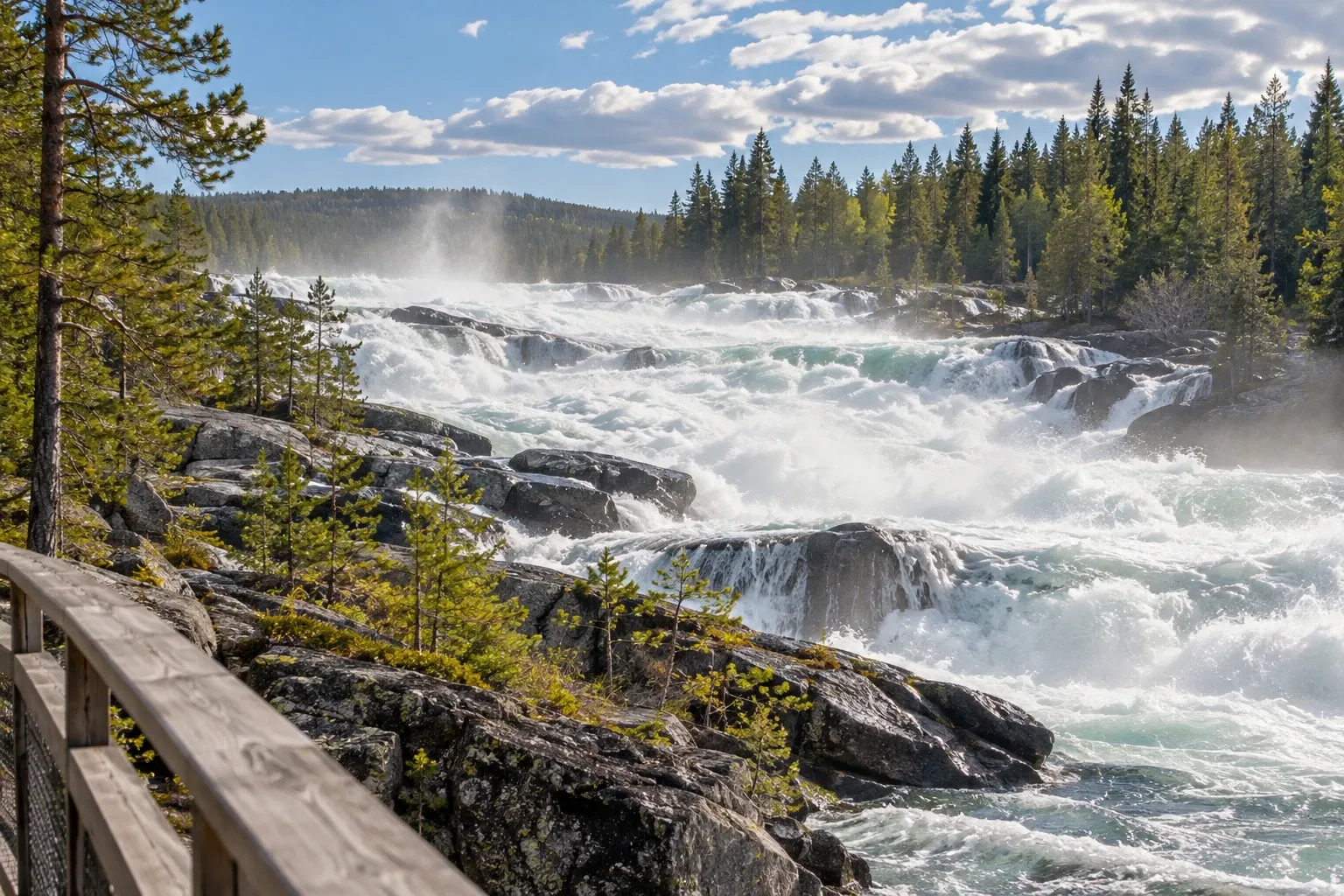
Four of Sweden’s waterfalls are worth a long detour. Three famous ones will disappoint you if you arrive in the wrong month, or at all. Here is which is which, what each record actually measures, and what the reserve rules let you do there.
When you need this
You’re planning a northern road trip and want to know which falls justify the kilometres. You’ve read “Sweden’s highest waterfall” or “Europe’s largest rapids” and want to know what that means on the ground. Or you want water in your photos and need to know which falls run in which month, which have step-free paths, and whether you can pitch a tent, light a fire, fish or fly a drone there.
The falls at a glance
Sweden has fewer roaring rivers than it once did. Most of the great falls of the north were harnessed for hydropower in the 20th century. The county board describes places like Hällingsåfallet as rare precisely because dams have silenced so many rapids. What survives is mostly protected, mostly free, and very different from fall to fall.
| Waterfall | County | What it is | The number that matters |
|---|---|---|---|
| Storforsen | Norrbotten | A rapid (fors) on the free-flowing Piteälven | 82 m total drop over about 5 km |
| Tännforsen | Jämtland | Wide single waterfall west of Åre | 38 m drop, 60 m wide |
| Njupeskär | Dalarna | Mountain fall in Fulufjället National Park | 93 m high, 70 m free fall |
| Hällingsåfallet | Jämtland | Fall into a canyon | Just over 40 m |
| Ristafallet | Jämtland | Wide fall split by a wooded island | 14 m drop, 50 m wide |
| Hallamölla | Skåne | Cascades by an old mill | 23 m total drop |
| Trollhättefallen | Västra Götaland | Urban falls, normally dry | Runs on schedule only in July |
| Döda fallet | Jämtland | A waterfall without water | Dry since 1796 |
| Stora Sjöfallet | Norrbotten | Once one of Europe’s largest falls | Most water now diverted |
Six of the nine sit in a county-board nature reserve or national park, each with its own binding regulations (föreskrifter). Trollhättefallen runs through the municipal Älvrummet reserve, Stora Sjöfallet lies in a Laponia national park, and Ristafallet has no reserve page at all.
Storforsen: Europe’s largest unregulated rapid
If you see one, see this. The Piteälven is one of Sweden’s four unregulated “national rivers”, and Länsstyrelsen Norrbotten, the county board that manages Storforsen, calls it the largest rapid in the Nordic countries and the largest unregulated one in Europe. Its total drop is 82 m, but that is spread over about five kilometres. Expect volume and noise, not a single curtain of water.
The reserve lies just under 40 km north of Älvsbyn and about 6 km from Vidsel, off road 374, with a large car park. A boardwalk (däckspång) leads out to the rapids, and a smooth green “health loop” works for wheelchairs, rollators and pushchairs. Disabled parking closer to the water sits behind a barrier that opens when staff are present, usually daytime in summer. The county board names midsummer as the time of greatest flow.
Two things surprise visitors. Fishing is not allowed inside the reserve, because the landowner, Sveaskog, has not opened the water to it. And Storforsen has its own small “Döda fallet”, a stretch dried out by timber-floating works. That is not the famous Döda fallet in Jämtland.
In autumn 2025, stone arms were dug in the river below the rapids without a permit. A preliminary investigation followed, and in 2026 the county board required the municipality to restore the site. The visitor area was not reported closed, but you may see machinery downstream.
Tännforsen and the Jämtland four
Jämtland gives you four very different falls within a day’s driving.
- Tännforsen is, in the county board’s words, one of Sweden’s largest waterfalls: a 38 m drop over a 60 m wide edge. It is about 20 km west of Åre. Take the E14 to Staa, turn right onto Skalstugevägen, and follow the signs. Wide gravel paths with handrails and adapted outhouses make it easy for rollators and wheelchairs. Climbing in the waterfall’s mist zone (forsdimma) is banned.
- Ristafallet is at Hålland between Järpen and Undersåker, signposted from the E14. It drops 14 m over a 50 m width, split by a wooded island. The campsite that maintains the road and forest charges for parking. In winter, when the fall freezes, a cave on the island can be visited.
- Hällingsåfallet drops just over 40 m into what the county board calls Sweden’s longest canyon. It is signposted from the Gäddede road on the south side of Hetögeln. A 150 m path leads from the car park to a viewing ramp directly above the fall. For more effort, a steep path along the canyon starts at the Hällarna rest area, about a kilometre before the car park.
- Döda fallet, between Bispgården and Hammarstrand off road 87, is the dry bed of a 35 m waterfall. More on it below.
Njupeskär: the highest free fall
Njupeskär, in Fulufjället National Park in northern Dalarna, is 93 m high, and 70 m of that is free fall. Sweden’s national-parks site calls it the waterfall with the highest free fall in Sweden. For total height it says only “one of the highest”, so “Sweden’s highest waterfall” overstates it.
The trail’s southern part is fully accessible, but the waterfall view needs more climbing. The last stretch into the gorge closes in winter and spring, and snow can lie on the trail into early June. Our Fulufjället and Njupeskär guide covers the trail, park zones and the bookable bus.
The south: Hallamölla and Trollhättan
Hallamölla is Skåne’s largest waterfall, a 23 m series of cascades beside a mill dating back to the 1400s. It sits on the Verkeån in eastern Skåne, where Skåneleden (north bank, orange markers) and Backaleden (south bank, yellow) meet. About 20 km of trail runs from Andrarum to the sea at Haväng. It is small by northern standards, but the south’s only real waterfall walk.
Trollhättefallen, a 32 m series of falls on Göta älv, is controlled by Vattenfall, the state power company.
Famous but dammed or dry
This is where most waterfall lists go wrong.
| Fall | What lists say | What you actually find |
|---|---|---|
| Trollhättefallen | Daily summer releases | Since 2024, scheduled releases only during Fallens Dagar in July (2026: 17–19 July). Otherwise usually dry |
| Stora Sjöfallet | One of Europe’s great waterfalls | True until the 1920s. The Suorva dam now diverts most of the water for hydropower |
| Döda fallet | “Dead waterfall” | Literally dry: a 1796 flood channel emptied the lake above it in four hours |
At Trollhättan, the falls may still open without notice when Lake Vänern’s level must be regulated, and about 300 m³ of water a second then comes through. Never go down into the dry riverbed. See our Trollhättan guide for viewpoints and the festival.
Stora Sjöfallet was once five great falls with about 50 m of drop. Go for the national park and naturum Laponia, downstream from the falls, not for the waterfall of old photographs. Our Stora Sjöfallet National Park guide has the details.
Döda fallet was the Storforsen of the Indalsälven until a flood channel failed in 1796. Today 870 m of wooden ramp crosses the dry riverbed, with 300 m usable by wheelchair users, though parts reach 13–14%. Theatre is staged there in summer.
Rules at the falls
Reserve regulations are law, not etiquette. The county-board pages summarise them; the full reserve decision (reservatsbeslut) is the binding text.
| Fall | Tents | Fires | Also note |
|---|---|---|---|
| Storforsen | Only at prepared sites | Only at prepared sites | No fishing; no off-road cycling except the marked route; no snowmobiles |
| Tännforsen | Not restricted in the summary | Only at prepared places, with your own or supplied wood | No climbing in the mist zone; berries and edible mushrooms only |
| Hällingsåfallet | Banned | Only in prepared fire places | No damage to trees, mosses, lichens or fungi |
| Döda fallet | Banned | Banned | Dogs on a lead; no picking plants or stones |
| Njupeskär | Banned in the entrance zone except 1 Dec–31 Mar | Banned in the entrance zone except at built fire places | No flying below 2,000 ft (610 m), drones included |
The simplest approach is to camp outside the reserve boundary under ordinary allemansrätten, the right of public access, after checking the reserve’s own rules. For drones, the summaries for Storforsen, Tännforsen, Hällingsåfallet and Döda fallet list no rule, but the full decision binds and general drone rules in Sweden apply. Our guide to nature reserves explains why local rules override the right of access.
Safety and winter
The county board’s Storforsen listing carries a standing warning: leaving the marked trail is life-threatening because of the risk of drowning. Its reserve page also warns of steep drops and rock slabs that are slippery when wet. Stay on boardwalks and behind railings, and wear shoes that grip.
Winter changes the falls rather than closing them all:
- Tännforsen turns into ice sculptures.
- Ristafallet freezes into an ice curtain.
- Hällingsåfallet forms strange ice blocks, but can be hard to reach.
- Storforsen’s car park is ploughed, but the boardwalk is snowy, icy and uneven.
- Njupeskär allows ice climbing 1 December–31 March, while the gorge trail stays closed because of avalanches and falling ice, snow and rocks.
For spring flood, late May to early July is the window, with the north’s highest flows.
Practical information
| Item | Detail (checked 2026-10-15) |
|---|---|
| Entry to the county-board reserves | No fee stated for Storforsen, Tännforsen, Hällingsåfallet, Döda fallet or Verkeån |
| Ristafallet parking | Fee charged by the campsite that maintains the road; amount not published |
| Storforsen firewood | Long logs to split yourself; pre-split wood sold when the café and tourist office are open |
| Trollhättan releases 2026 | Fallens Dagar, 17–19 July, six releases a day at 12:00, 14:00, 16:00, 18:00, 20:00 and 23:00 |
| Njupeskär gorge trail | Last stretch closed in winter and spring; snow can lie into early June |
| Storforsen peak flow | Around midsummer, per the county board |
| Where to check | County-board reserve pages, Naturkartan listings, Sveriges nationalparker, Visit Trollhättan Vänersborg |
FAQ
What is the biggest waterfall in Sweden?
It depends on the measure. Storforsen in Norrbotten is the biggest by water and force: the county board calls it the largest rapid in the Nordic countries, with an 82 m drop over about five kilometres. Njupeskär has the highest free fall, 70 m. Tännforsen, 38 m high and 60 m wide, is the classic single waterfall.
Is Storforsen really Europe’s largest unregulated rapid?
That is how Länsstyrelsen Norrbotten, the county board that manages it, describes Storforsen: the largest rapid in the Nordic countries and the largest unregulated one in Europe. The Piteälven is one of Sweden’s four unregulated national rivers, so no dam controls its flow. Remember it is a rapid: the 82 m drop is spread over roughly five kilometres.
When is the best time to see Swedish waterfalls?
Late May to early July, during the snowmelt flood. The county board names midsummer as Storforsen’s peak flow, and Tännforsen roars all summer. Njupeskär’s gorge trail opens once the snow has gone, sometimes not until early June. Trollhättan runs on schedule only during Fallens Dagar in July. Winter brings ice formations instead.
Can you see Trollhättan falls with water any day?
No. Since 2024 Vattenfall has opened the falls on schedule only during Fallens Dagar in July; in 2026 that meant six releases a day on 17–19 July. The rest of the year the riverbed is usually dry, apart from unannounced openings when Lake Vänern’s level must be regulated. Check the current year’s schedule before travelling.
Can I camp next to a waterfall in Sweden?
Usually not right beside the famous ones. At Storforsen tents and fires are allowed only at prepared places, and Hällingsåfallet and Döda fallet ban tents outright. Tännforsen allows fires only at prepared places. The binding text is each reserve’s regulations. Camping outside the boundary, under ordinary allemansrätten, is the simple answer.
Which Swedish waterfalls are wheelchair accessible?
Several have adapted paths. Storforsen has a boardwalk to the rapids and a smooth health loop for wheelchairs and rollators. Tännforsen has wide gravel paths with handrails and adapted outhouses. Döda fallet has 300 m of wheelchair ramp, though parts are steep. At Njupeskär the southern part of the trail is fully accessible, but the waterfall view needs more climbing.
Is Stora Sjöfallet still a waterfall?
Only a small one. Until the 1920s it was among Europe’s largest waterfalls, a series of five falls; today the lakes are regulated by the Suorva dam and most of the water runs through the hydropower system instead. The national park and naturum Laponia are still worth the drive, but do not come for the falls of old photographs.
Related guides
- Fulufjället and the Njupeskär waterfall — trail seasons, park zones and the bus that must be booked.
- Trollhättan: waterfall days and canal locks — the festival schedule and the best viewpoints.
- Jämtland in summer — fit Tännforsen into a trip around the Åre valley.
- Nature reserves in Sweden — why reserve rules override the right of public access.
- Water safety in Sweden — currents, cold water and life jackets before you go near a rapid.
Facts verified 2026-10-15. Sources: Länsstyrelsen Norrbotten, Länsstyrelsen Jämtland, Länsstyrelsen Skåne, Länsstyrelsen Dalarna, Naturvårdsverket / Sveriges nationalparker, SMHI, Jokkmokk municipality, Vattenfall, Visit Trollhättan Vänersborg, SVT — full register in this topic’s source file. Found something outdated? Tell us and we’ll fix it.