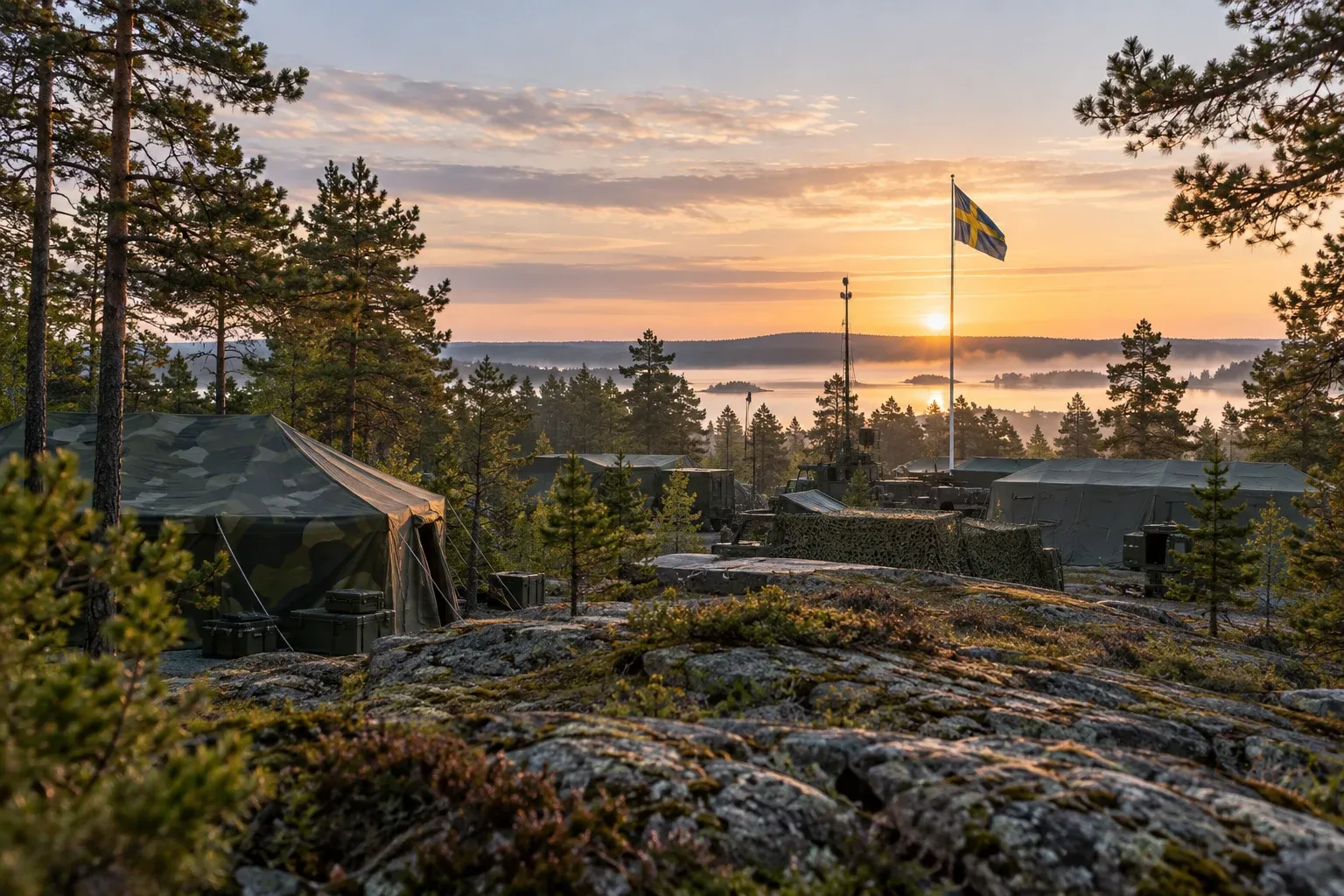
Sweden switched conscription back on in 2017, for women and men alike. Here is how the system works, who it actually reaches, and what it means for you as a visitor, a foreign resident, a new citizen or a dual national.
When you need this
A news story about Swedish conscription made you wonder whether it touches you on holiday. You are moving here for work or study and your paperwork mentions “total defense duty”. You are about to become a Swedish citizen. You hold Swedish and another citizenship. Or a Swedish colleague, flatmate or teenager is heading off to lumpen, the everyday slang for military service, and you want to understand what that means.
The system in one picture
Värnplikt (military service) is one of three forms of a wider duty, totalförsvarsplikt, the total defense duty. That duty covers every Swedish citizen and every non-citizen living in Sweden, from the start of the year they turn 16 to the end of the year they turn 70.
| Form | What it is | Who can be required to do it |
|---|---|---|
| Värnplikt | Military service with the armed forces | Swedish citizens only, from the year they turn 19 to the year they turn 47 |
| Civilplikt | Civil defense service, for example in rescue services or electricity supply | Citizens and residents; non-citizens only with training of at most 60 days |
| Allmän tjänsteplikt | General service duty: staying in your job or doing assigned essential work | Everyone covered, but only during höjd beredskap (heightened alert) |
The key design choice is a switch. Assessment and long service are mandatory only when the government decides they are needed for Sweden’s defense readiness. The law can sit on the books with the duties turned off, which is exactly what happened for seven years. For how this fits into Sweden’s wider crisis planning, see total defense and civil preparedness.
From pause to reactivation
In 2010 the act was rewritten so that assessment and service apply only after a government decision, and no such decision was in force. The same rewrite made the wording gender-neutral.
On 2 March 2017 the government flipped the switch back on:
- 1 July 2017: assessment (mönstring) became mandatory again.
- 1 January 2018: basic training with military service became mandatory again.
Because the act had been gender-neutral since 2010, the reactivated system applied to women and men on the same terms from day one. Sweden’s conscription agency states plainly that the duties apply equally to both. In practice fewer women are enrolled: in 2025 they made up 16 percent of those starting basic military training. The broader picture of gender equality in Swedish life is in gender equality in everyday Sweden.
How selection works
Conscription in Sweden is selective, not universal. Plikt- och prövningsverket (the Swedish Defence Conscription and Assessment Agency, usually called Pliktverket) runs a funnel, and only as many people go through as the armed forces and civil defense need.
- The questionnaire. In January or February of the year they turn 18, Swedish citizens registered in Sweden get a letter asking them to fill in the mönstringsunderlag, about 40 questions online, within two weeks. People registered abroad and some people receiving disability or care support are exempt.
- The call to assessment. Pliktverket uses the answers to decide who to call. Saying you don’t want to serve does not decide it.
- Assessment. Mönstring takes one to two days in person: medical and psychological tests, physical tests and interviews with a nurse, a doctor, a psychologist and a recruiter.
- The decision. You get a preliminary answer at the end of the day and the final decision within four months: whether you will train, in which role, where and when.
The numbers show how selective it is:
| Year group | Step | Figure |
|---|---|---|
| Born 2008 | Questionnaires sent (January 2026) | About 111,500 |
| Born 2008 | Called to assessment (May 2026 to April 2027) | 30,008 |
| Born 2008 | Expected to start basic training (2027–2028) | About 10,000 |
| Mostly born 2006 | Enrolled for basic military training starting in 2025 | 8,251 |
Basic military training is capped at 615 days by law and in practice usually lasts 9–15 months, depending on the role. Refresher training afterwards is limited to 240 days in total and normally no more than 34 days a year.
Does it apply to you?
This is the question most English-language coverage skips. The act draws clear lines:
| You are… | What applies |
|---|---|
| A tourist or short-term visitor | Nothing. The duty covers only Swedish citizens and people living in Sweden. |
| A foreign resident, EU or non-EU | Total defense duty from 16 to 70, but no military service and no assessment duty. You can be placed in civil service with at most 60 days’ training, or directed to essential work during heightened alert. |
| A new Swedish citizen | The assessment duty starts on the day you become a citizen, and normally ends after the year you turn 24. |
| A Swedish citizen with a second citizenship | The full Swedish duty, with one exemption from long training (below), plus whatever your other country requires. |
The act does not define “living in Sweden” (bosatt), and it does not treat EU citizens any differently from other foreign residents. An exchange student here for a term is very unlikely to be reached by anything in practice, since military service and assessment are for citizens only. Population registration, which comes with a personnummer, is the usual sign that the state regards you as living here. If you are moving here for a job, the rest of the paperwork is in moving to Sweden for work.
Becoming a citizen? If you naturalize before the end of the year you turn 24, expect the questionnaire and possibly a call to assessment. The citizenship process itself is covered in Swedish citizenship.
Dual citizens. A Swedish citizen who also holds another citizenship need not do basic training longer than 60 days if they have already done equivalent service in the other country, or choose to do it there before turning 19 and it is at least as long and effective as the Swedish training. That does not switch off your other country’s rules. Sweden’s foreign ministry warns that you may be called up when visiting your other country of citizenship, that some countries imprison people who have not served, and that being past the age limit or not knowing the rule may not help.
Warning: If you are a dual citizen, check your other country’s military-service rules before you travel there, not after you arrive.
Civilplikt: the civil side
Civilplikt is the civil counterpart to military service: trained people for functions society needs in a crisis. It may not include combat tasks beyond guarding or keeping order. The government reactivated it for municipal rescue services and electricity supply from January 2024.
The bigger change is recent. Since 1 January 2026, civilplikt again includes a duty to attend assessment and do long basic training, starting with rescue services. The government also opened it to more fields, including security guarding, electronic communications, network and information systems, and cybersecurity. The 2008 year group’s call-ups already include possible enrolment for civil service in municipal rescue services.
Good to know: some pages, including one of Pliktverket’s own explainers, still say no basic training is carried out for civilplikt. However, the government decision of December 2025 applies from 1 January 2026.
Your rights and the penalties
The duty comes with protections:
- Unarmed service. If you have a serious conviction against using weapons on another person, you can apply to serve unarmed. An application made before enrolment, or within six months of it, is normally granted without further inquiry.
- Deferral. You can get a deferral for up to a year at a time if service would seriously harm your studies, work or family.
- Rebooking. You can move your assessment date for a valid reason; the first rebooking needs no certificate, a second one does.
- Benefits. Travel, food, lodging, healthcare and equipment are free, and conscripts get a daily allowance and, after some training, a bonus.
- Your job. An employee may not be dismissed for doing their duty.
And it has teeth:
| What you do | Consequence |
|---|---|
| Ignore the questionnaire | Pliktverket calls it a breach of the law and can order you to answer under a conditional fine |
| Skip assessment you were called to | A fine; you can also be fetched by the police at your own cost |
| Desert or refuse service | Fines or up to one year in prison; six months to four years in serious cases during heightened alert |
What changes next
Two government bills propose amendments to the act from 1 January 2027. One would keep people placed in the armed forces’ conscript reserve until the year they turn 47 and extend total readiness service to 360 days. The other covers security vetting and wartime placement in civil defense. As of October 2026 no Riksdag decision had been found, so treat both as proposals. Who decides, and how a bill becomes law, is explained in how Sweden is governed.
Practical information
| Item | What to know | Checked |
|---|---|---|
| Answering the questionnaire | Free; online, within two weeks of the letter | 2026-10-14 |
| Assessment | Free; travel, food and lodging covered by law | 2026-10-14 |
| Basic training | Free; daily allowance paid, amount set by ordinance (check Pliktverket) | 2026-10-14 |
| Police escort after a no-show | At your own cost | 2026-10-14 |
| Year group born 2008 | 30,008 called to assessment, May 2026 to April 2027 | 2026-10-14 |
| Proposed amendments | From 1 January 2027, not yet decided | 2026-10-14 |
FAQ
Does Sweden still have conscription?
Yes. After a pause from 2010, the government reactivated it in 2017: assessment became mandatory from 1 July 2017 and basic military training from 1 January 2018. It is selective. Every Swedish citizen answers a questionnaire at 18, but only part of each year group is called to assessment, and in 2025 about 8,250 people were enrolled for basic training.
Do women have to do military service in Sweden?
Yes, on the same terms as men. The total defense act has been gender-neutral since 2010, so women answer the same questionnaire and can be called to assessment and enrolled. In practice fewer women are enrolled: in 2025 they made up 16 percent of those enrolled for basic training with military service.
Can tourists or foreigners be conscripted in Sweden?
Tourists, no: the duty covers only Swedish citizens and people living in Sweden. Foreign residents are covered by total defense duty from 16 to 70, but military service applies only to Swedish citizens. A foreign resident can be placed in civil service of at most 60 days’ training, or directed to essential work during heightened alert.
What happens at mönstring?
Mönstring is the in-person assessment, lasting one to two days. You do medical and psychological tests, physical tests and interviews with a nurse, doctor, psychologist and recruiter. At the end you get a preliminary decision on whether, where and when you will train, and the final decision comes within four months.
I have dual citizenship. Do I have to serve in Sweden?
If one citizenship is Swedish, the Swedish duty applies. You need not do long basic training if you have done equivalent service in your other country, or choose to before turning 19. Your other country can still have its own rules, and Sweden’s foreign ministry warns you may be called up when visiting it.
What is civilplikt?
Civilplikt is the civil counterpart to military service: trained people for essential functions such as rescue services and electricity supply in a crisis. Since 1 January 2026 it again includes a duty to attend assessment and do long basic training, starting with rescue services. Civil service may not include real combat tasks beyond guarding.
Related guides
- Total defense and civil preparedness — the wider system conscription is part of, and what it means for visitors
- Swedish citizenship — naturalizing before 24 brings the assessment duty with it
- How Sweden is governed — who flips the conscription switch and passes the 2027 amendments
- The personnummer explained — registration, the usual sign that you live in Sweden
- Moving to Sweden for work — the rest of a new resident’s obligations
Facts verified 2026-10-14. Sources: Sveriges riksdag (Lag 1994:1809 om totalförsvarsplikt), Plikt- och prövningsverket, Regeringen and Myndigheten för civilt försvar — full register in this topic’s source file. This is general information, not legal advice. Found something outdated? Tell us and we’ll fix it.