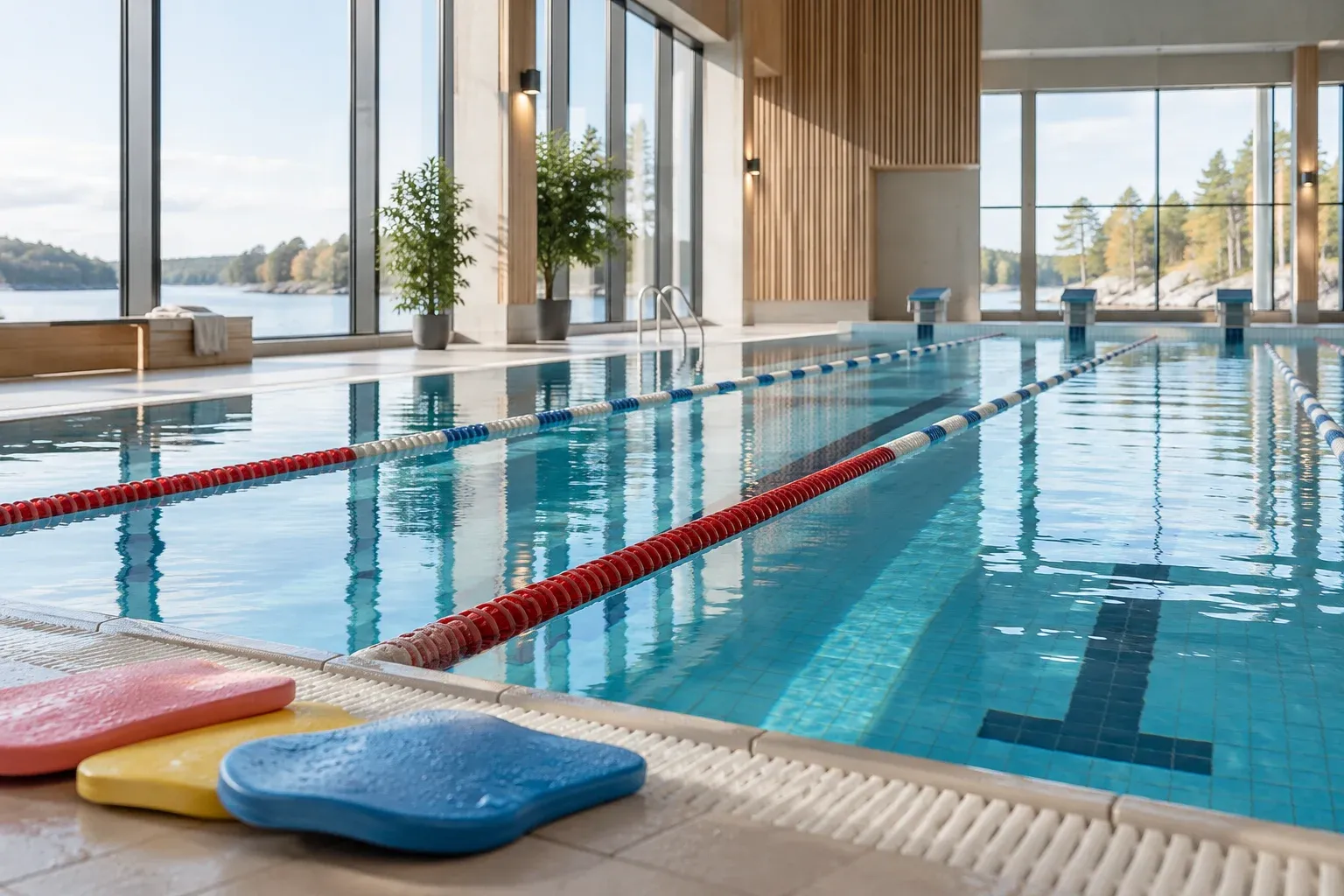
In Sweden, learning to swim is written into the grading rules, not left to parents. Here is what the school requirement says word for word, how it differs from the pool definition and the badges, and what newcomer families should do.
When you need this
Your child’s new Swedish school has put simundervisning (swimming lessons) on the schedule, or sent home a note about a swim test. Maybe your child arrived in year 4 or 5 and has never had a lesson. Perhaps a letter suggests a sommarsimskola (summer swim school), or you keep seeing Swedish children with sew-on swim badges. Or you’re simply heading for a summer of Swedish lakes and want to know what “can swim” means here.
Why Sweden puts swimming in the curriculum
Sweden is a country of lakes, coastline and jetties, and most swimming happens at spots nobody is watching. The official advice is to keep yourself safe: never swim alone, and swim along the shore rather than straight out. The school system’s answer is to make every child a swimmer and teach water rescue at the same time.
Drowning is the background. Svenska Livräddningssällskapet (SLS, the Swedish Life Saving Society) counted 103 drowning deaths in 2025, with July the worst month. Ten of them were children and young people under 19; most victims were 60 or older. In 2026, 44 people had drowned by the end of August, fewer than in the same months of 2025.
What the curriculum requires
Swimming sits in the compulsory subject idrott och hälsa (physical education and health). Its syllabus is a binding ordinance, part of the 2022 curriculum known as Lgr22. Swimming appears in the content for every stage and in the grade criteria.
| School years | What the syllabus requires (core content) | Status |
|---|---|---|
| 1–3 | Water confidence; balancing, floating and swimming on front and back | Binding |
| 4–6 | Swimming on front and back; bathing etiquette and water safety in all seasons; emergencies by water with rescue aids | Binding |
| 7–9 | Different strokes on front and back; emergencies in and by water with rescue aids | Binding |
| End of year 6, grade E | Handles emergencies on land and by water and “simmar 200 meter i en följd varav 50 meter i ryggläge” | Binding |
| End of year 9, grade E | The same sentence, word for word | Binding |
E is the lowest passing grade, so a pupil who cannot swim 200 meters continuously, with 50 on the back, does not meet the pass criteria as written. The goal used to sit in year 5 and moved to year 6 with the 2011 curriculum, so pages that still say “by year 5” are out of date.
The rule binds the school, not the family. Children living in Sweden have school duty and get the whole curriculum, swimming included. Asylum-seeking children and others counted as resident by another route have the right to school but no duty. Pupils in anpassad grundskola (school for pupils with intellectual disabilities) follow a separate syllabus with different swimming criteria. Independent schools (friskolor) follow the same criteria, while international schools that teach a foreign curriculum are not bound by the Swedish PE syllabus.
School goal, pool definition and badges
Three different “200 meters” float around Sweden, and expat forums mix them up.
| Standard | Who sets it | What it asks | Deep water? |
|---|---|---|---|
| School criterion (year 6 and 9) | Skolverket, in the PE syllabus | 200 m continuously, 50 on the back, plus emergencies by water | Not stated |
| Simkunnig (able to swim) | The common definition used by pools and SLS; Stockholm’s pools quote it | Fall into deep water, then swim 200 m, 50 on the back | Yes |
| Simborgarmärket badge | Svensk Simidrott (Swedish Swimming Federation) | 200 m in any stroke, untimed | Yes |
The pool definition is the one that decides independence at a public pool. Stockholm, for example, requires children under 12 and non-swimmers to have a swimming adult aged at least 18 with them the whole time; see our guide to Swedish swimming pools.
The badge ladder
Simmärken (swimming badges) are voluntary, run by Svensk Simidrott, the national swimming federation, not by SLS as some pages say. Swedish children collect them at swim schools from about age four and sew them onto towels or swimwear.
| Badge | What the child does |
|---|---|
| Sjöhästen | No performance test, mainly ages about 4–8 |
| Baddaren (green, blue, yellow) | Head under, bubbling, gliding; yellow adds jumping into deep water |
| Sköldpaddan | Float 5 seconds on the back, roll onto the front |
| Pingvinen (silver, gold) | 10 meters, floating, jumping in; gold in deep water with 10 meters on the back |
| Silverfisken / Guldfisken | 25 meters, shallow / deep water |
| Hajen (bronze, silver, gold) | 100 meters up to 200 meters with 50 on the back in deep water, clothed float and rescue (gold) |
| Simborgarmärket | 200 meters any stroke in deep water; a new design every year, available from January |
Hajen Guld and Vattenprovet (jump in, then 200 meters with 50 on the back in deep water) are the closest badge matches to the school goal. The badges are a motivation tool; the school checks its own criterion.
How schools teach it
There is no national rule on how many lessons a school gives or when they start. Skolverket’s most recent national follow-up, a 2022 survey of PE teachers, found:
- 93% of year-6 pupils were judged to meet the swimming criterion, down from 95% in 2014; 95% met the water-emergency part.
- Just over seven in ten schools start swimming before year 3, more often at municipal schools than independent ones.
- Starting early pays off: where swimming starts in preschool class or year 1, all pupils met the criterion at almost four in ten schools, against about two in ten where it starts in year 2 or later.
- About seven in ten teachers reported problems with pupil absence, getting pool time or offering extra lessons.
- Schools with many newly arrived pupils, or fewer parents with higher education, had lower shares meeting the goal.
Municipalities fill gaps differently. Malmö, for example, makes swimming compulsory for all municipal-school pupils in year 2 and runs free swim school at two pools during the autumn break.
If your child arrived late
A child who comes to Sweden at 9, 10 or 11 may have only a year or two of school swimming before the year-6 checkpoint. Act early:
- Ask the school when swimming lessons happen, how many sessions are left before year 6, and whether extra teaching is offered.
- Book a municipal holiday swim school or a club’s term course alongside; many are free or low-cost, but rules and booking are local.
- Practice the 50 meters on the back. It is the part children who learned to swim abroad most often lack.
- Treat swim days like any other lesson. Skolverket names absence as a common problem.
- Consider your own lessons. Many municipalities and clubs run adult beginner classes, and some offer women-only sessions.
Visiting families are outside the system: children on holiday are not tested, and joining a local swim school depends on the pool or club.
What is changing in 2026–2028
Freshness note (October 2026): two changes most English pages miss. In February 2026 the government launched a swimming package of 90 million kronor a year for 2026–2028, 45 million of it to the sports federation RF, aimed at areas with high social exclusion. It cited around 53,000 children aged 10–16 who are not considered able to swim. And from autumn 2028 compulsory school becomes ten years long, so today’s year 6 becomes year 7. Skolverket must deliver new curricula by 31 March 2027; where swimming will sit in them has not been published.
Mistakes to avoid
- Confusing the badge with the school goal. Simborgarmärket allows any stroke; the school wants 50 meters on the back.
- Waiting for year 6. The survey data says early starters do far better.
- Treating swimming as optional. It is part of a graded, compulsory subject.
- Treating a pool test as lake safety. The test is usually swum in a heated indoor pool; cold open water and waves are harder. For small children, 1177, the national health advice service, says to keep under-threes within arm’s reach and put children in a life jacket or rescue vest near water and on jetties, because drowning is often quick and silent. See our water safety guide.
Practical information
| Item | Details |
|---|---|
| Swimming in compulsory school | Free, part of free schooling |
| National requirement | End of year 6 and year 9: 200 m continuously, 50 on the back, plus emergencies by water |
| Latest national figure | 93% of year-6 pupils met the goal (Skolverket survey, school year 2021/22) |
| Municipal holiday swim school | Often free; varies by municipality (checked 2026-10-14) |
| Club and term swim schools, badges | Paid; set locally — check the pool or club (checked 2026-10-14) |
| Government swimming package | 90 million kronor a year 2026–2028 (as of February 2026) |
| Curriculum change | Ten-year school from autumn 2028; new curricula proposed by 31 March 2027 |
FAQ
Do Swedish children have to learn to swim at school?
Yes. Swimming is part of the compulsory subject physical education and health. To reach the lowest passing grade at the end of year 6, a pupil must swim 200 meters in one go, 50 of them on the back, and handle emergencies on land and by water. The same requirement appears again at the end of year 9.
What does “simkunnig” mean in Sweden?
It means able to swim. The common Swedish definition, used by pools and the Life Saving Society, is to fall into deep water, get your head under, come up and swim 200 meters, 50 of them on your back. The school criterion is close but simpler: 200 meters continuously, 50 on the back, without the fall-in.
What happens if my child can’t swim by year 6?
The child does not meet the swimming part of the E criteria in physical education, so the school should give extra teaching. Many schools and municipalities offer extra sessions or holiday swim schools. Skolverket found 93 percent of year-6 pupils met the goal in 2022; for the rest, lack of lessons and absence were the common problems.
What are Swedish swimming badges?
Simmärken are voluntary badges from Svensk Simidrott, the Swedish Swimming Federation. Children start with Sjöhästen or Baddaren, then Sköldpaddan, Pingvinen and the fish badges, up to Hajen Guld: 200 meters with 50 on the back in deep water. Simborgarmärket, 200 meters in any stroke in deep water, gets a new design every year.
My child arrived in Sweden at 10. Is there enough time?
Usually, if you start at once. Ask the school how many swimming sessions remain before year 6 and whether extra teaching is offered, and book a holiday or term swim school alongside. Skolverket found that schools starting swimming early reach the goal far more often, so a late arrival needs more lessons, not fewer.
Does this apply to tourists’ children?
No. The curriculum applies to pupils in Swedish schools, which mainly means children living in Sweden. Visiting children are not tested. Many municipal pools and clubs run swim schools during the holidays, and some accept visitors, but places and booking rules are local. Check the pool’s own page before you travel.
Will the swimming rule change with the 2028 school reform?
Probably in its year number at least. From autumn 2028 the compulsory school has ten years, so today’s year 6 becomes year 7. Skolverket is drafting new curricula, due to the government by 31 March 2027. Where swimming will sit in them has not been published, so check again in 2027.
Related guides
- Water safety in Sweden — unguarded beaches, life jackets and what to do if someone is drowning.
- Lake swimming in Sweden — where the school skill gets used every summer.
- Swedish swimming pools — shower rules and the age-12, 200-meter rule for swimming alone.
- Swedish schools for newcomer families — school duty, placement and the 2028 reform.
- Ice safety in Sweden — the winter half of the water-safety curriculum.
Facts verified 14 October 2026. Sources: Skolverket (PE syllabus, Simkunnighet i årskurs 6), Regeringskansliet, Sveriges riksdag, Svensk Simidrott, Svenska Livräddningssällskapet, 1177, Krisinformation.se, Malmö stad — full register in this topic’s source file. Found something outdated? Tell us and we’ll fix it.